RNA Search and 61 gggcgcagcg gcggccgcag accgagcccc gggcgcggca - - PowerPoint PPT Presentation

rna search and
SMART_READER_LITE
LIVE PREVIEW

RNA Search and 61 gggcgcagcg gcggccgcag accgagcccc gggcgcggca - - PowerPoint PPT Presentation

The Human Parts List, circa 2001 1 gagcccggcc cgggggacgg gcggcgggat agcgggaccc cggcgcggcg gtgcgcttca RNA Search and 61 gggcgcagcg gcggccgcag accgagcccc gggcgcggca agaggcggcg ggagccggtg 3 billion nucleotides, containing: 121 gcggctcggc


slide-1
SLIDE 1

1

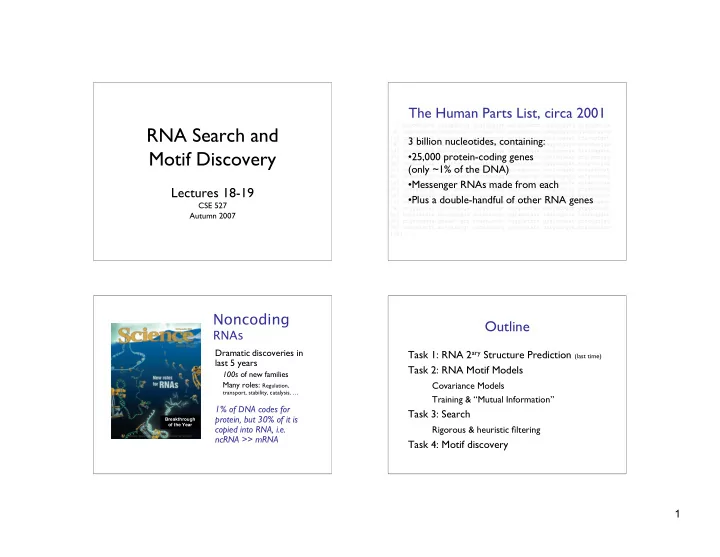
RNA Search and Motif Discovery

Lectures 18-19

CSE 527 Autumn 2007

1 gagcccggcc cgggggacgg gcggcgggat agcgggaccc cggcgcggcg gtgcgcttca 61 gggcgcagcg gcggccgcag accgagcccc gggcgcggca agaggcggcg ggagccggtg 121 gcggctcggc atcatgcgtc gagggcgtct gctggagatc gccctgggat ttaccgtgct 181 tttagcgtcc tacacgagcc atggggcgga cgccaatttg gaggctggga acgtgaagga 241 aaccagagcc agtcgggcca agagaagagg cggtggagga cacgacgcgc ttaaaggacc 301 caatgtctgt ggatcacgtt ataatgctta ctgttgccct ggatggaaaa ccttacctgg 361 cggaaatcag tgtattgtcc ccatttgccg gcattcctgt ggggatggat tttgttcgag 421 gccaaatatg tgcacttgcc catctggtca gatagctcct tcctgtggct ccagatccat 481 acaacactgc aatattcgct gtatgaatgg aggtagctgc agtgacgatc actgtctatg 541 ccagaaagga tacataggga ctcactgtgg acaacctgtt tgtgaaagtg gctgtctcaa 601 tggaggaagg tgtgtggccc caaatcgatg tgcatgcact tacggattta ctggacccca 661 gtgtgaaaga gattacagga caggcccatg ttttactgtg atcagcaacc agatgtgcca 721 gggacaactc agcgggattg tctgcacaaa acagctctgc tgtgccacag tcggccgagc 781 ctggggccac ccctgtgaga tgtgtcctgc ccagcctcac ccctgccgcc gtggcttcat 841 tccaaatatc cgcacgggag cttgtcaaga tgtggatgaa tgccaggcca tccccgggct 901 ctgtcaggga ggaaattgca ttaatactgt tgggtctttt gagtgcaaat gccctgctgg 961 acacaaactt aatgaagtgt cacaaaaatg tgaagatatt gatgaatgca gcaccattcc 1021 ...

The Human Parts List, circa 2001

3 billion nucleotides, containing:

  • 25,000 protein-coding genes

(only ~1% of the DNA)

  • Messenger RNAs made from each
  • Plus a double-handful of other RNA genes

Breakthrough

  • f the Year

Noncoding

RNAs

Dramatic discoveries in last 5 years

100s of new families Many roles: Regulation,

transport, stability, catalysis, …

1% of DNA codes for protein, but 30% of it is copied into RNA, i.e. ncRNA >> mRNA

Outline

Task 1: RNA 2ary Structure Prediction (last time) Task 2: RNA Motif Models

Covariance Models Training & “Mutual Information”

Task 3: Search

Rigorous & heuristic filtering

Task 4: Motif discovery

slide-2
SLIDE 2

2

Task 2: Motif Description How to model an RNA “Motif”?

Conceptually, start with a profile HMM:

from a multiple alignment, estimate nucleotide/ insert/delete preferences for each position given a new seq, estimate likelihood that it could be generated by the model, & align it to the model all G mostly G del ins

How to model an RNA “Motif”?

Add “column pairs” and pair emission probabilities for base-paired regions

paired columns

<<<<<<< >>>>>>> … …

RNA Motif Models

“Covariance Models” (Eddy & Durbin 1994)

aka profile stochastic context-free grammars aka hidden Markov models on steroids

Model position-specific nucleotide preferences and base-pair preferences Pro: accurate Con: model building hard, search sloooow

slide-3
SLIDE 3

3

“RNA sequence analysis using covariance models”

Eddy & Durbin Nucleic Acids Research, 1994 vol 22 #11, 2079-2088

(see also, Ch 10 of Durbin et al.)

What

A probabilistic model for RNA families

The “Covariance Model” ≈ A Stochastic Context-Free Grammar A generalization of a profile HMM

Algorithms for Training

From aligned or unaligned sequences Automates “comparative analysis” Complements Nusinov/Zucker RNA folding

Algorithms for searching

Main Results

Very accurate search for tRNA

(Precursor to tRNAscanSE - current favorite)

Given sufficient data, model construction comparable to, but not quite as good as, human experts Some quantitative info on importance of pseudoknots and other tertiary features

Probabilistic Model Search

As with HMMs, given a sequence, you calculate likelihood ratio that the model could generate the sequence, vs a background model You set a score threshold Anything above threshold → a “hit” Scoring:

“Forward” / “Inside” algorithm - sum over all paths Viterbi approximation - find single best path (Bonus: alignment & structure prediction)

slide-4
SLIDE 4

4

Example: searching for tRNAs

Alignment Quality Comparison to TRNASCAN

Fichant & Burks - best heuristic then

97.5% true positive 0.37 false positives per MB

CM A1415 (trained on trusted alignment)

> 99.98% true positives <0.2 false positives per MB

Current method-of-choice is “tRNAscanSE”, a CM- based scan with heuristic pre-filtering (including TRNASCAN?) for performance reasons.

Slightly different evaluation criteria

Mj: Match states (20 emission probabilities) Ij: Insert states (Background emission probabilities) Dj: Delete states (silent - no emission)

Profile Hmm Structure

slide-5
SLIDE 5

5

CM Structure

A: Sequence + structure B: the CM “guide tree” C: probabilities of letters/ pairs & of indels Think of each branch being an HMM emitting both sides of a helix (but 3’ side emitted in reverse order)

Overall CM Architecture

One box (“node”) per node

  • f guide tree

BEG/MATL/INS/DEL just like an HMM MATP & BIF are the key additions: MATP emits pairs

  • f symbols, modeling base-

pairs; BIF allows multiple helices

CM Viterbi Alignment

(the “inside” algorithm)

xi = ith letter of input xij = substring i,..., j of input Tyz = P(transition y z) Exi ,x j

y

= P(emission of xi,x j from state y) Sij

y

= max logP(xij gen'd starting in state y via path ) Sij

y = max logP(xij generated starting in state y via path )

Sij

y =

maxz[Si+1, j1

z

+ logTyz + log Exi ,x j

y

] match pair maxz[Si+1, j

z

+ logTyz + log Exi

y ]

match/insert left maxz[Si, j1

z

+ logTyz + log Ex j

y ]

match/insert right maxz[Si, j

z

+ logTyz] delete maxi<k j[Si,k

yleft + Sk+1, j yright ]

bifurcation

  • Time O(qn3), q states, seq len n

compare: O(qn) for profile HMM

CM Viterbi Alignment

(the “inside” algorithm)

slide-6
SLIDE 6

6

Model Training Mutual Information

Max when no seq conservation but perfect pairing MI = expected score gain from using a pair state Finding optimal MI, (i.e. opt pairing of cols) is hard(?) Finding optimal MI without pseudoknots can be done by dynamic programming Mij = fxi,xj

xi,xj

  • log2

fxi,xj fxi fxj ; 0 Mij 2

* 1 2 3 4 5 6 7 8 9 * MI: 1 2 3 4 5 6 7 8 9 A G A U A A U C U 9 A G A U C A U C U 8 A G A C G U U C U 7 2 0.30 1 A G A U U U U C U 6 1 0.55 1 A G C C A G G C U 5 0.42 A G C G C G G C U 4 0.30 A G C U G C G C U 3 A G C A U C G C U 2 A G G U A G C C U 1 A G G G C G C C U A G G U G U C C U A G G C U U C C U A G U A A A A C U A G U C C A A C U A G U U G C A C U A G U U U C A C U A 16 4 2 4 4 4 C 4 4 4 4 4 16 G 0 16 4 2 4 4 4 U 4 8 4 4 4 0 16

M.I. Example (Artificial)

Cols 1 & 9, 2 & 8: perfect conservation & might be base-paired, but unclear whether they are. M.I. = 0 Cols 3 & 7: No conservation, but always W-C pairs, so seems likely they do base-pair. M.I. = 2 bits. Cols 7->6: unconserved, but each letter in 7 has

  • nly 2 possible mates in 6. M.I. = 1 bit.

5’ 3’

slide-7
SLIDE 7

7

Find best (max total MI) subset of column pairs among i…j, subject to absence of pseudo-knots “Just like Nussinov/Zucker folding” BUT, need enough data---enough sequences at right phylogenetic distance

MI-Based Structure-Learning

Si, j = max Si, j1 maxik< j4 Si,k1 + Mk, j + Sk+1, j1

  • Pseudoknots

disallowed allowed

max j Mi, j

i=1 n

  • /2
slide-8
SLIDE 8

8

tRNAScanSE

uses 3 older heuristic tRNA finders as prefilter uses CM built as described for final scoring Actually 3(?) different CMs

eukaryotic nuclear prokaryotic

  • rganellar

used in all genome annotation projects

Rfam – an RNA family DB

Griffiths-Jones, et al., NAR ‘03, ’05

Biggest scientific computing user in Europe - 1000 cpu cluster for a month per release Rapidly growing:

Rel 1.0, 1/03: 25 families, 55k instances Rel 7.0, 3/05: 503 families, >300k instances

IRE (partial seed alignment):

Hom.sap. GUUCCUGCUUCAACAGUGUUUGGAUGGAAC Hom.sap. UUUCUUC.UUCAACAGUGUUUGGAUGGAAC Hom.sap. UUUCCUGUUUCAACAGUGCUUGGA.GGAAC Hom.sap. UUUAUC..AGUGACAGAGUUCACU.AUAAA Hom.sap. UCUCUUGCUUCAACAGUGUUUGGAUGGAAC Hom.sap. AUUAUC..GGGAACAGUGUUUCCC.AUAAU Hom.sap. UCUUGC..UUCAACAGUGUUUGGACGGAAG Hom.sap. UGUAUC..GGAGACAGUGAUCUCC.AUAUG Hom.sap. AUUAUC..GGAAGCAGUGCCUUCC.AUAAU Cav.por. UCUCCUGCUUCAACAGUGCUUGGACGGAGC Mus.mus. UAUAUC..GGAGACAGUGAUCUCC.AUAUG Mus.mus. UUUCCUGCUUCAACAGUGCUUGAACGGAAC Mus.mus. GUACUUGCUUCAACAGUGUUUGAACGGAAC Rat.nor. UAUAUC..GGAGACAGUGACCUCC.AUAUG Rat.nor. UAUCUUGCUUCAACAGUGUUUGGACGGAAC SS_cons <<<<<...<<<<<......>>>>>.>>>>>

Rfam

Input (hand-curated):

MSA “seed alignment” SS_cons Score Thresh T Window Len W

Output:

CM scan results & “full alignment”

slide-9
SLIDE 9

9

Rfam – key issues

Overly narrow families Variant structures/unstructured RNAs Spliced RNAs RNA pseudogenes

Human ALU is SRP-related, with 1.1×10⁶ copies Mouse B2 repeat (350k copies) tRNA related

Speed & sensitivity Motif discovery

Task 3: Faster Search Faster Genome Annotation

  • f Non-coding RNAs

Without Loss of Accuracy

Zasha Weinberg

& W.L. Ruzzo

Recomb ‘04, ISMB ‘04, Bioinfo ‘06

Ravenna: Genome Scale RNA Search

Typically 100x speedup over raw CM, w/ no loss in accuracy: drop structure from CM to create a (faster) HMM use that to pre-filter sequence; discard parts where, provably, CM will score < threshold; actually run CM on the rest (the promising parts) assignment of HMM transition/emission scores is key (large convex optimization problem)

Weinberg & Ruzzo, Bioinformatics, 2004, 2006

slide-10
SLIDE 10

10

Covariance Model

Key difference of CM vs HMM: Pair states emit paired symbols, corresponding to base-paired nucleotides; 16 emission probabilities here.

CM’s are good, but slow

EMBL CM hits junk Rfam Goal 10 years, 1000 computers 1 month, 1000 computers Our Work ~2 months, 1000 computers EMBL CM hits Ravenna Rfam Reality EMBL hits junk BLAST CM

Simplified CM

(for pedagogical purposes only)

A C G U – A C G U – A C G U – A C G U –

CM to HMM

25 emisions per state 5 emissions per state, 2x states

A C G U – A C G U – A C G U – A C G U – A C G U – A C G U – A C G U – A C G U –

CM HMM

slide-11
SLIDE 11

11 Need: log Viterbi scores CM ≤ HMM

Key Issue: 25 scores → 10

P

A C G U – A C G U –

L

A C G U – A C G U –

R CM HMM

Viterbi/Forward Scoring

Path π defines transitions/emissions Score(π) = product of “probabilities” on π NB: ok if “probs” aren’t, e.g. ∑≠1

(e.g. in CM, emissions are odds ratios vs 0th-order background)

For any nucleotide sequence x:

Viterbi-score(x) = max{ score(π) | π emits x } Forward-score(x) = ∑{ score(π) | π emits x }

Key Issue: 25 scores → 10

Need: log Viterbi scores CM ≤ HMM

PCA ≤ LC + RA PCC ≤ LC + RC PCG ≤ LC + RG PCU ≤ LC + RU PC– ≤ LC + R– … … … … … PAA ≤ LA + RA PAC ≤ LA + RC PAG ≤ LA + RG PAU ≤ LA + RU PA– ≤ LA + R–

NB: HMM not a prob. model

P

A C G U – A C G U –

L

A C G U – A C G U –

R CM HMM

Rigorous Filtering

Any scores satisfying the linear inequalities give rigorous filtering Proof: CM Viterbi path score ≤ “corresponding” HMM path score ≤ Viterbi HMM path score

(even if it does not correspond to any CM path) PAA ≤ LA + RA PAC ≤ LA + RC PAG ≤ LA + RG PAU ≤ LA + RU PA– ≤ LA + R– …

slide-12
SLIDE 12

12

Some scores filter better

PUA = 1 ≤ LU + RA PUG = 4 ≤ LU + RG Assuming ACGU ≈ 25% Option 1: Opt 1: LU = RA = RG = 2 LU + (RA + RG)/2 = 4 Option 2: Opt 2: LU = 0, RA = 1, RG = 4 LU + (RA + RG)/2 = 2.5

Optimizing filtering

For any nucleotide sequence x:

Viterbi-score(x) = max{ score(π) | π emits x } Forward-score(x) = ∑{ score(π) | π emits x }

Expected Forward Score

E(Li, Ri) = ∑all sequences x Forward-score(x)*Pr(x) NB: E is a function of Li, Ri only

Optimization: Minimize E(Li, Ri) subject to score Lin.Ineq.s

This is heuristic (“forward↓ ⇒ Viterbi↓ ⇒ filter↓”) But still rigorous because “subject to score Lin.Ineq.s”

Under 0th-order background model

Calculating E(Li, Ri)

E(Li, Ri) = ∑x Forward-score(x)*Pr(x)

Forward-like: for every state, calculate expected score for all paths ending there; easily calculated from expected scores of predecessors & transition/emission probabilities/scores

Minimizing E(Li, Ri)

Calculate E(Li, Ri) symbolically, in terms of emission scores, so we can do partial derivatives for numerical convex

  • ptimization algorithm

E(L1, L2,...) Li

Forward: Viterbi:

slide-13
SLIDE 13

13

Estimated Filtering Efficiency

(139 Rfam 4.0 families)

3 7 .99 - 1.0 4 6 .25 - .99 2 2 .10 - .25 3 11 .01 - .10 17 8 10-4 - 10-2 110 105 < 10-4 # families (expanded) # families (compact) Filtering fraction

~100x speedup

Results: New ncRNA’s?

7 290 283 U4 snRNA 1 200 199 U5 snRNA 3 131 128 S-box

54 123 69 Purine riboswitch

313 1464 264 193 59

1106 322 180

# found rigorous filter + CM

1 312 U7 snRNA 2 1462 U6 snRNA 13 251 Hammerhead III 26 167 Hammerhead I 48 11 Retron msr

102 1004 Histone 3’ element 121 201 Iron response element 123 57 Pyrococcus snoRNA

# new # found BLAST + CM Name

Results: With additional work

And more…

11 71 60 Lysine riboswitch 21 247 226 tmRNA 121 729 608 tRNAscan-SE

(human)

331 6039 5708 Group II intron 5158 63767 58609 Rfam tRNA # new # with rigorous filter series + CM # with BLAST+CM

“Additional work”

Profile HMM filters use no 2ary structure info

They work well because, tho structure can be critical to function, there is (usually) enough primary sequence conservation to exclude most of DB But not on all families (and may get worse?)

Can we exploit some structure (quickly)?

Idea 1: “sub-CM” Idea 2: extra HMM states remember mate Idea 3: try lots of combinations of “some hairpins” Idea 4: chain together several filters (select via Dijkstra) for some hairpins

}

slide-14
SLIDE 14

14

Filter Chains

  • Fig. 2. Filter creation and selection. Filters for Rfam tRNA (RF00005) generated

by the store-pair and sub-CM techniques and those selected for actual filtering are plotted by filtering fraction and run time. The CM runs at 3.5 secs/kbase. The four selected filters are run one after another, from highest to lowest fraction.

Heuristic Filters

Rigorous filters optimized for worst case Possible to trade improved speed for small loss in sensitivity? Yes – profile HMMs as before, but optimized for average case “ML heuristic”: train HMM from the infinite alignment generated by the CM Often 10x faster, modest loss in sensitivity

Heuristic Filters

cobalamine (B12) riboswitch tRNA SECIS * * *

* rigorous HMM, not rigorous threshold

Task 4: Motif Discovery

slide-15
SLIDE 15

15

RNA Motif Discovery

Typical problem: given a ~10-20 unaligned sequences of ~1kb, most of which contain instances of one RNA motif of, say, 150bp -- find it. Example: 5’ UTRs of orthologous glycine cleavage genes from γ-proteobacteria

Approaches

Align sequences, then look for common structure Predict structures, then try to align them Do both together

“Obvious” Approach I: Align First, Predict from Multiple Sequence Alignment

… GA … UC … … GA … UC … … GA … UC … … CA … UG … … CC … GG … … UA … UA … Compensatory mutations reveal structure, (core of “comparative sequence analysis”) but usual alignment algorithms penalize them (twice)

Pfold (KH03) Test Set D

Trusted alignment ClustalW Alignment Evolutionary Distance

Knudsen & Hein, Pfold: RNA secondary structure prediction using stochastic context-free grammars, Nucleic Acids Research, 2003, v 31,3423–3428

slide-16
SLIDE 16

16

Pitfall for sequence-alignment- first approach

Structural conservation ≠ Sequence conservation

Alignment without structure information is unreliable

CLUSTALW alignment of SECIS elements with flanking regions

same-colored boxes should be aligned

Approaches

Align sequences, then look for common structure Predict structures, then try to align them

single-seq struct prediction only ~ 60% accurate; exacerbated by flanking seq; no biologically- validated model for structural alignment

Do both together

Sankoff – good but slow Heuristic

“Obvious” Approach II: Fold First

Predict secondary RNA structure using MFOLD or Vienna Problems

false folding predictions comparing structures

Our Approach: CMfinder

Simultaneous alignment, folding and CM- based motif description using an EM-style learning procedure

Yao, Weinberg & Ruzzo, Bioinformatics, 2006

slide-17
SLIDE 17

17

Cmfinder--A Covariance Model Based RNA Motif Finding Algorithm

Bioinformatics, 2006, 22(4): 445-452 Zizhen Yao

Zasha Weinberg Walter L. Ruzzo

University of Washington, Seattle

Design Goals

Find RNA motifs in unaligned sequences Seq conservation exploited, but not required Robust to inclusion of unrelated sequences Robust to inclusion of flanking sequence Reasonably fast and scalable Produce a probabilistic model of the motif that can be directly used for homolog search

Alignment → CM → Alignment

Similar to HMM, but much slower Builds on Eddy & Durbin, ‘94 But new way to infer which columns to pair, via a principled combination of mutual information and predicted folding energy And, it’s local, not global, alignment (harder)

CMfinder Outline

Search Folding predictions Heuristics Candidate alignment CM Realign

M step E step

M-step uses M.I. + folding energy for structure prediction

slide-18
SLIDE 18

18

Initial Alignment Heuristics

fold sequences separately candidates: regions with low folding energy compare candidates via “tree edit” algorithm find best “central” candidates & align to them BLAST anchors

Li = column i; σ = (α, β) the 2ary struct, α = unpaired, β = paired cols With MLE params, Iij is the mutual information between cols i and j Can find it via a simple dynamic programming alg.

CMfinder Accuracy

(on Rfam families with flanking sequence)

/CW /CW

slide-19
SLIDE 19

19

Summary of Rfam test families and results Task 5: Application

Genome-wide search for cis-regulatory RNA elements (in prokaryotes, initially)

Searching for noncoding RNAs

CM’s are great, but where do they come from? An approach: comparative genomics

Search for motifs with common secondary structure in a set of functionally related sequences.

Challenges

Three related tasks

Locate the motif regions. Align the motif instances. Predict the consensus secondary structure.

Motif search space is huge!

Motif location space, alignment space, structure space.

Predicting New cis-Regulatory RNA Elements

Goal:

Given unaligned UTRs of coexpressed or orthologous genes, find common structural motifs

Difficulties:

Low sequence similarity: alignment difficult Varying flanking sequence Motif missing from some input genes

slide-20
SLIDE 20

20

Approach

Choose a bacterial genome For each gene, get 10-30 close orthologs (CDD) Find most promising genes, based on conserved sequence motifs (Footprinter) From those, find structural motifs (CMfinder) Genome-wide search for more instances (Ravenna) Expert analyses (Breaker Lab, Yale)

A pipeline for RNA motif genome scans

CMfinder

Search Genome database

CDD

Ortholgous genes Upstream sequences Footprinter

Rank datasets

Top datasets Motifs Homologs

Yao, Barrick, Weinberg, Neph, Breaker, Tompa and Ruzzo. A Computational Pipeline for High Throughput Discovery of cis-Regulatory Noncoding RNA in

  • Prokaryotes. PLoS Computational Biology. 3(7): e126, July 6, 2007.

Genome Scale Search: Why

Most riboswitches, e.g., are present in ~5 copies per genome Throughout (most of) clade More examples give better model, hence even more examples, fewer errors More examples give more clues to function - critical for wet lab verification

Genome Scale Search

CMfinder is directly usable for/with search

Folding predictions Smart heuristics Candidate alignment CM Realign Search

slide-21
SLIDE 21

21

Footprinter finds patterns of conservation

1B_SUBTILIS

Upstream of folC start codons

A blind test

tyrS T box structure

1ST genome scan: 234 sequences 2ND genome scan: 447 sequences The motif turned out to be T box Match to RFAM T box family: 299 OF 342 False Positives: 89/148 are probable (upstream of

annotated tRNA-synthetase genes)

Chloroflexus aurantiacus Geobacter metallireducens Geobacter sulphurreducens

Chloroflexi δ -Proteobacteria

Symbiobacterium thermophilum

CMfinder: 9 instances Found by Scan: 447 hits

Results

Have analyzed most sequenced bacteria (~2005)

bacillus/clostridia gamma proteobacteria cyanobacteria actinobacteria firmicutes

slide-22
SLIDE 22

22

Actino Results

8 of 10 Rfam families found

Rfam Family Type (metabolite) Rank THI riboswitch (thiamine) 4 ydaO-yuaA riboswitch (unknown) 19 Cobalamin riboswitch (cobalamin) 21 SRP_bact gene 28 RFN riboswitch (FMN) 39 yybP-ykoY riboswitch (unknown) 48 gcvT riboswitch (glycine) 53 S_box riboswitch (SAM) 401 tmRNA gene Not found RNaseP gene Not found

not cis- regulatory (got one anyway)

Results of genome scans

Top 115 datasets (some are redundant) 13 T box, 22 riboswitches, 30 ribosomal genes RNase P, tRNA, CIRCE elements and other DNA binding sites

0.260 0.971 33 127 74 yybP-ykoY 34 10 ykoY 0.833 1.000 305 366 237 THI 305 16 thiA 0.892 1.000 33 37 14 glmS 33 16 glmS 0.970 0.915 97 100 37 Purine 106 14 xpt 0.874 0.669 299 342 67 T_box 447 9 folC 0.851 0.915 97 114 48 RFN 106 9 ribB 0.960 0.967 145 151 71 S_box 150 13 metK

sensitivity specificity

#TP #full #seed RFAM hits #motif Gene

More Actino Results

Many others (not in Rfam) are likely real;

  • f top 50:

known (Rfam, 23S) 10 probable (Tbox, CIRCE, LexA, parP, pyrR) 7 probable (ribosomal genes) 9 potentially interesting 12 unknown or poor 12

mRNA leader mRNA leader switch?

slide-23
SLIDE 23

23

Weinberg, Barrick, Yao, Roth, Kim, Gore, Wang, Lee, Block, Sudarsan, Neph, Tompa, Ruzzo and Breaker. Identification of 22 candidate structured RNAs in bacteria using the CMfinder comparative genomics pipeline. Nucl. Acids Res., July 2007 35: 4809-4819.

Ongoing & Future Work

Improved ranking/motif significance stats Better ortholog clustering Performance & scale-up Eukaryotic mRNAs, e.g. UTRs

Summary

ncRNA - apparently widespread, much interest Covariance Models - powerful but expensive tool for ncRNA motif representation, search, discovery Rigorous/Heuristic filtering - typically 100x speedup in search with no/little loss in accuracy CMfinder - CM-based motif discovery in unaligned sequences