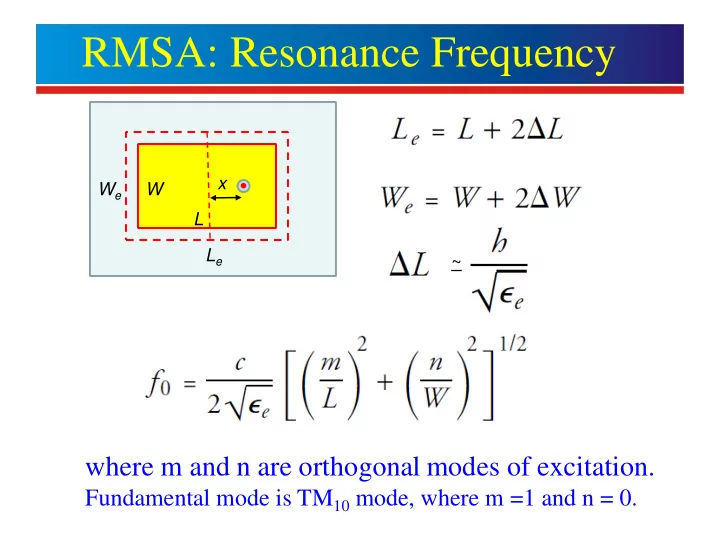
SLIDE 1 RMSA: Resonance Frequency
where m and n are orthogonal modes of excitation.
Fundamental mode is TM10 mode, where m =1 and n = 0.
L Le W We ~ x
SLIDE 2
RMSA – Characterization
SLIDE 3
RMSA: Design Equations
Smaller or larger W can be taken than the W obtained from this expression.
BW α W and Gain α W Choose feed-point x between L/6 to L/4.
SLIDE 4
RMSA: Design Example
Design a RMSA for Wi-Fi application (2.400 to 2.483 GHz)
Chose Substrate: εr = 2.32, h = 0.16 cm and tan δ = 0.001
= 3 x 10¹⁰ / ( 2 x 2.4415 x 109 x √1.66) = 4.77 cm. W = 4.7 cm is taken = 2.23 Le = 3 x 10¹⁰ / ( 2 x 2.4415 x 109 x √2.23) cm = 4.11 cm L = Le – 2 ∆L = 4.11 – 2 x 0.16 / √2.23 = 3.9 cm
SLIDE 5
RMSA: Design Example – Simulation using IE3D
L = 3.9 cm, W = 4.7 cm, x = 0.7 cm εr = 2.32, h = 0.16 cm and tan δ = 0.001 Zin = 54Ω at f = 2.414 GHz BW for |S11| < -10 dB is from 2.395 to 2.435 GHz = 40 MHz
Designed f = 2.4415 and Simulated f = 2.414 GHz % error = 1.1%. Also, BW is small.
SOLUTION: Increase h and reduce L
SLIDE 6 L = 3 cm and W = 4 cm
Substrate parameters: εr = 2.55, h = 0.159 cm, and tan δ = 0.001 Probe diameter = 0.12 cm for SMA connector. RMSA is analyzed using commercially available IE3D software.
Effect of Various Parameters on Performance of RMSA
L Le W We x
SLIDE 7
Effect of Feed Point Location (x)
For Infinite Ground Plane
With increase in x, input impedance plot shifts right towards higher impedance values.
SLIDE 8 Rectangular Microstrip Antenna (RMSA)
Co-axial feed Side View r Ground plane h Top View L W X Y x
SLIDE 9 Effect of Width (W)
With increase in W, aperture area, εe and fringing fields increase, hence frequency decreases and input impedance plot shifts towards lower impedance values.
BW α W and Gain α W
SLIDE 10
Effect of Thickness (h)
However, to reduce surface waves As h increases, fringing fields and probe inductance increase, frequency decreases and input impedance plot shifts upward.
BW α h/λ0
SLIDE 11
Effect of Probe Diameter
As probe diameter decreases, its inductance increases, so resonance frequency decreases and input impedance locus moves upward to the inductive region.
SLIDE 12 Effect of Loss Tangent (tanδ )
With increase in tan δ, dielectric losses increase, so input impedance locus moves left towards lower impedance
- value. BW increases but efficiency and gain decrease.
SLIDE 13
Effect of Dielectric Constant (εr)
With decrease in εr, both L and W increase, which increases fringing fields and aperture area, hence both BW and Gain increase.
SLIDE 14
RMSA – Pattern for Different εr (TM10 mode)
With increase in εr , size of the antenna decreases for same resonance frequency. Hence, gain decreases and HPBW increases.
SLIDE 15
RMSA – Pattern for Different εr (TM30 mode)
For TM30 mode, Le = 3 λ0 / (2 √ εe )
For εr = 2.32, Le ~ λ0 So, two radiating slots will be at a distance of λ0 yielding grating lobe in E-plane.
SLIDE 16
RMSA – Dual Polarization (TM10 and TM01 modes)
L = 10.1 cm and W = 7.9 cm Orthogonal Feeds at: x = 3.8 cm and y = 2.9 cm Substrate Parameters: εr = 4.3, h = 0.16 cm, tanδ = 0.02
( - - - ) theoretical, (——) measured
Measured resonance frequencies are 712 MHz and 913 MHz for two orthogonal modes
SLIDE 17
Effect of Finite Ground Plane
Finite Ground Plane Size is taken as Lg = L + 6h + 6h and Wg = W + 6h + 6h
SLIDE 18
MSA – BW Variation with h and f
SLIDE 19
Square MSA in Air – VSWR Plot
Square MSA on a finite ground plane. Low cost - Metallic plate suspended in air and fed by a co-axial feed. BW for VSWR < 2 is 95 MHz at 1.8 GHz (% BW ~ 5%)
SLIDE 20
Square MSA in Air – Radiation Pattern
Radiation Pattern at 1.8 GHz
F/B = 15 dB Cross Polar < 20 dB
SLIDE 21
MSA – Suspended Configurations
SLIDE 22 CMSA: Resonance Frequency
where Knm is the mth root
Bessel function of order n For Fundamental TM11 Mode: f0 ~ 8.791 / [(a + h/ √εr) √εe ] GHz where a and h are in cm and εe < εr Design Equation: a ~ 8.791 / (f0 √εe) - h /√εr
Choose feed-point x between 0.3a to 0.5a