RHP 4 Regional Learning Collaborative February 20, 2014 Dianne - - PDF document

rhp 4 regional learning collaborative february 20 2014
SMART_READER_LITE
LIVE PREVIEW

RHP 4 Regional Learning Collaborative February 20, 2014 Dianne - - PDF document

RHP 4 Regional Learning Collaborative February 20, 2014 Dianne Longley, HMA RHP Performing Providers 21 RHP 4 Performing Providers Bluebonnet Trails Community Mental Health Center Cuero Community Hospital Camino Real Community Services De Tar


slide-1
SLIDE 1

1

Dianne Longley, HMA

RHP 4 Regional Learning Collaborative February 20, 2014

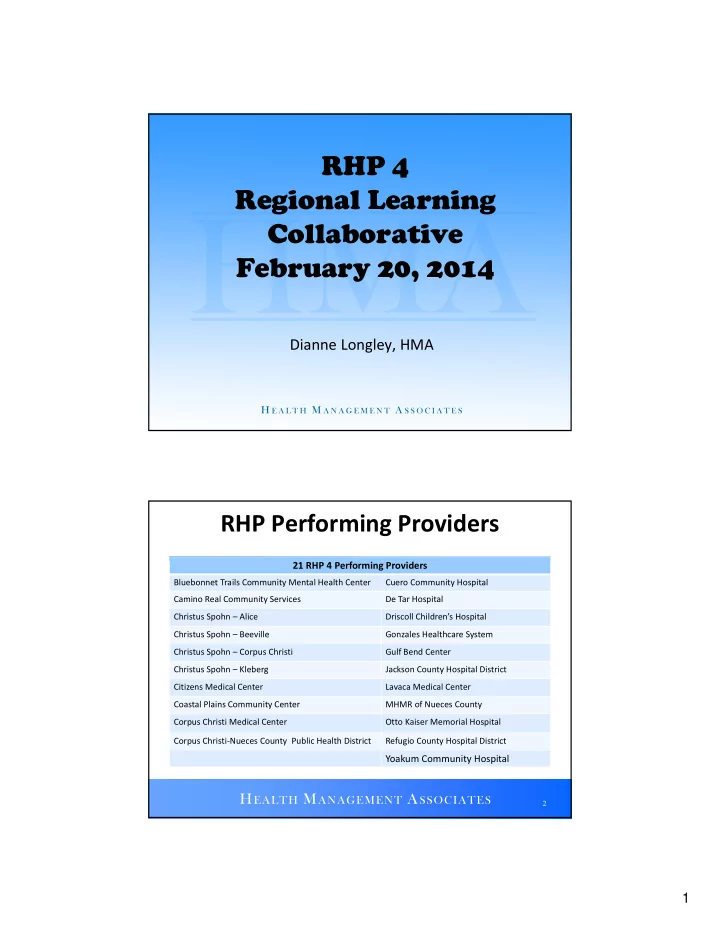
RHP Performing Providers

21 RHP 4 Performing Providers

Bluebonnet Trails Community Mental Health Center Cuero Community Hospital Camino Real Community Services De Tar Hospital Christus Spohn – Alice Driscoll Children’s Hospital Christus Spohn – Beeville Gonzales Healthcare System Christus Spohn – Corpus Christi Gulf Bend Center Christus Spohn – Kleberg Jackson County Hospital District Citizens Medical Center Lavaca Medical Center Coastal Plains Community Center MHMR of Nueces County Corpus Christi Medical Center Otto Kaiser Memorial Hospital Corpus Christi‐Nueces County Public Health District Refugio County Hospital District

Yoakum Community Hospital

2

slide-2
SLIDE 2

2

Key Elements of a Learning Collaborative

  • Focus on Learning from each other, not formal

teaching/instruction (which should be used occasionally)

  • Share best practices, lessons learned, challenges and

disappointments

  • Bring participants together on a regular basis
  • Establish quantifiable, project‐level goals and deadlines that all

participants pursue; define the problem and the goal

  • Require some minimum improvement (raise the floor)
  • Should support the principles of continuous quality

improvement

  • Celebrate successes

3

RHP Learning Collaborative Requirements

  • Each region/Anchor must conduct a minimum of 2 face‐to‐face

regional learning collaborative meetings and 2 meetings via conference call in each demonstration year (DY)

  • All performing providers are required to have at least one

representative at each meeting

  • Initial collaborative held in September 2013 counted toward LC

requirement for DY 2

  • This meeting counts toward LC requirements for DY 3; one additional

meeting and two conference calls will be scheduled between now and the end of September

  • Anchor submitted Learning Collaborative plan for

improvement in October as required by HHSC

4

slide-3
SLIDE 3

3

Provider Responsibilities

  • At each meeting, all providers are required to:
  • Provide updates on projects and progress towards

meeting the team improvement targets

  • Actively participate in the development of meeting

agendas to ensure collaborative is addressing issues of interest to the Provider

  • Provide recommendations on expert presenters for

discussion sessions, when appropriate

  • Discuss best practices, challenges and successes
  • Serve in leadership capacity as needed

5

Semi‐Annual and Bi‐Weekly Learning Collaborative Requirements

  • Several Providers have projects that include Quality Improvement

milestones requiring participation in semi‐annual learning collaboratives and/or bi‐weekly learning collaboratives

  • The Regional learning collaborative meetings WILL meet the

requirements for semi‐annual learning collobarative milestones

  • Regional meetings do NOT meet requirements for bi‐weekly learning

collaborative milestones; as discussed at September meeting, providers are responsible for organizing and participating in bi‐weekly meeting

  • Providers must maintain appropriate documentation (meeting

agendas, copies of sign‐in sheets, meeting presentations, etc.) of meeting participation in order to demonstrate they met the required metric/milestone

6

slide-4
SLIDE 4

4

Learning Collaborative Improvement Measures Requirements

  • Region must select an improvement methodology
  • As discussed at September meeting, Region 4 will use Plan‐Do‐

Study‐ACT (PDSA) methodology

  • Must select one or more key priorities for focus of group

LC improvements

  • In September, providers selected:
  • 1) Improve access to care and
  • 2) Improve patient engagement and responsibility through health

education and care coordination activities

  • Performing providers must participate in at least one of

the two Targeted Improvement Teams; may participate in both

7

Targeted Improvement Team Requirements

  • Each team must select one or more outcome measures for

demonstrating improvement within each provider’s

  • rganization that is related to the Team Improvement Goal
  • For example, outcome improvement measures for tracking Improved

Access to Care could include 1) an increase in the average number of patient visits per month; 2) a reduction in wait‐time for an appointment; 3) an increase in the number of primary care providers and/or specialty providers

  • Measures may vary by provider as long as they are

appropriate for demonstrating progress throughout the length

  • f demonstration period
  • Will discuss in detail during breakout sessions

8

slide-5
SLIDE 5

5

Requirements for Team Participants

  • Each Targeted Improvement Team will select Team Leaders in

breakout sessions today:

  • Project Leader: serves as coordinator of team activities
  • Technical Improvement and Reporting Manager: works closely with team

to identify quantifiable goals for measuring team’s improvement progress; helps develop reporting requirements; provides assistance and develops reports for team

  • Performing Provider Key Contacts: each Performing Provider will

designate a Key Contact who is responsible for ensuring the provider is represented at every collaborative meeting and coordinating communications with all other participants within his/her organization

9

Team Member Roles

  • All Team Members are expected to contribute to the learning

and sharing process as follows:

  • attend meetings or arrange for a substitute member from the
  • rganization
  • provide input on project activities
  • respond to requests for information or presentations
  • comply with any reporting requirements
  • work within your organization to identify appropriate staff and

engage them in the learning collaborative process where appropriate

  • celebrate successes and learn from each other

10

slide-6
SLIDE 6

6

Measuring and Reporting Progress and Accomplishments

  • Teams are required to measure progress and report on

accomplishments at semi‐annual meetings

  • Team will decide the measurement criteria for tracking

progress, including what information to track, frequency of reporting, content of reporting templates and timeline for reporting periods

  • The anchor will include in the annual report to HHSC an
  • verview of Team activities and progress toward meeting

the Region’s goals

11

Region‐Wide “Raise‐the‐Floor” Initiative

  • All providers must participate in at least one Region‐wide

“raise the floor initiative

  • These are simple improvements that everyone can do to

improve performance

  • Based on selection of initiative, tracking and reporting

instructions will be provided to all Providers

  • Future learning collaborative meetings will include a

session to discuss progress and challenges related to the Region‐wide initiative

12

slide-7
SLIDE 7

7

Questions and Contact Info

Health Management Associates:

Linda Wertz: Lwertz@healthmanagment.com Dianne Longley: Dlongley@healthmanagement.com Catie Hilbelink: Chilbelink@healthmanagement.com 512‐473‐2626

13

slide-8
SLIDE 8

1

HHSC Updates and Future Learning Collaborative Plans Linda Wertz, HMA

RHP 4 Regional Learning Collaborative February 20, 2014

3 Year Projects

  • Status of 3‐Year DSRIP Projects
  • HHSC is still reviewing submitted projects prior to CMS review
  • Prioritized review of projects from Regions 5, 8, 17 and 20, who

were not able to use a significant amount of their DSRIP allocation; HHSC anticipates review/approval will be completed in time to report DSRIP achievement in April 2014

  • Based on current schedule, expect all providers will be able to

report DSRIP achievement no later than October 2014

  • A waiver amendment has been submitted to allow the

state to use $345 million in unused DSRIP funds for 3‐year projects associated with statewide priority initiatives

2

slide-9
SLIDE 9

2

Phase 4: Plan Modification Requests

  • HHSC has approved many of the requested modifications
  • Requests that reduce scope of project activities or

quantifiable patient impact will be flagged for mid‐point assessment

  • HHSC returned some projects to request more

information; those projects have all been returned to HHSC for review last week

  • One additional round of plan modification requests for

DY 4 and 5 is expected in June or July 2014

3

Category 3 Update

  • Category 3 menu revisions have been finalized by CMS/HHSC

and are posted on the waiver website: http://www.hhsc.state.tx.us/1115‐Waiver‐Guideline.shtml

  • In a webinar on Tuesday, Feb 18th, HHSC announced the due

date for Provider selections/revisions is now scheduled for March 10th

  • Providers will be required to review all measures and

confirm you have no changes, edit existing measures to comply with changes in the Category 3 menu, or choose entirely new measures

4

slide-10
SLIDE 10

3

Category 3 Update, cont.

  • Many measures have been modified or deleted and replaced

with new measures; HHSC spreadsheet on website includes both existing and new measures

  • The Achievement methodology has also been revised; is

posted on the HHSC website

  • Measures include “Pay for Performance” (P4P) and “Pay for

Reporting” (P4R)

  • Pay for Reporting is limited to those projects where a P4P measure is

not available or applicable to your population

  • P4R will require what HHSC describes as prior approval, but the

approval is actually part of the review process; you do not submit an approval request prior to your Cat 3 submission

5

Category 3 Update, cont.

  • These revisions are significant and will require your

immediate time and attention

  • Review documents on HHSC website
  • Review Category 3 menu options that apply to your projects
  • Attend webinar on Monday, February 24, 1:30‐3:00pm
  • Be prepared to ask questions related to your projects
  • Allow yourself sufficient time to work through the new

project menus, templates and spreadsheets

6

slide-11
SLIDE 11

4

Key Waiver Dates

7

February 24, 2014 Category 3 webinar hosted by HHSC HHSC completes Phase 4 review March 7 or 10, 2014 Provider revisions to Category 3 due to HHSC April 1, 2014 HHSC target date for initial feedback on Category 3 measures requiring prior approval Late April 2014 Results due from CMS on 3‐Year projects April 30, 2014 April DY3 milestone/metric achievement reporting and Semi‐Annual Progress Reports due from providers Early June 2014 HHSC approves April reports or requests additional information from providers June 30, 2014 RHPs submit plan modifications for DY4‐5

Key Waiver Dates continued

8

July 9, 2014 Estimated IGT due date for April DY3 milestone/metric achievement Mid‐July 2014 Providers supply addition information if necessary following April DY3 reporting July 31, 2014 HHSC reviews and approves or disapproves additional information submitted by providers following April DY3 reporting July 31, 2014 Estimated payment date for April DY3 reporting

slide-12
SLIDE 12

5

All Dates Subject to Change

9

  • Dates and Deadlines will continue to fluctuate
  • It is imperative that providers stay informed on

changes – including due dates – announced by HHSC

  • Be sure you are looking at the most recent

version of notices/due dates

  • Be sure your organization has staff to cover these

dates during summer vacations!

Questions and Contact Info

Health Management Associates:

Linda Wertz Lwertz@healthmanagment.com Dianne Longley Dlongley@healthmanagement.com Catie Hilbelink chilbelink@healthmanagement.com 512‐473‐2626

10

slide-13
SLIDE 13

2/20/2014 1

RHP4 Provider Presentations

Learning Collaborative Meeting February 20, 2014

Behavioral Health Center of Nueces County

slide-14
SLIDE 14

2/20/2014 2

RHP 4 Learning Collaborative – Feb. 2014

Behavioral Health Center of Nueces County Summary Listing of RHP Projects

  • 1. Integrated Health Clinic‐ Incorporation of primary preventive care into the existing

behavioral healthcare service delivery system. The purpose is to reduce the number of potentially preventable hospitalization while increasing the effectiveness of holistic treatment by focusing on not only the recovery and rehabilitation of a person’s mind but their body as well.

  • 2. Peer Drop‐In Center‐ Aims to increase access to peer provided services for

individuals receiving outpatient mental health services through the utilization of trained peer specialist.

  • 3. Social and New Media Outreach and Education‐ Implementation of innovative

systems for community outreach and education which will include a website and mobile applications incorporating social and electronic media.

  • 4. Dual Diagnosis Stabilization Clinic‐ Provide outpatient crisis prevention and support

staff development using National Association of Dual Diagnosis direct support certification and clinical competency standards for individuals with a dual diagnosis of intellectual or developmental disabilities and mental health.

RHP 4 Learning Collaborative‐ Feb. 2014

Behavioral Health Center of Nueces County Project Successes and Accomplishments

  • 1. Integrated Health‐ Identified a primary care provider, completion of policy and

procedures, clinic manual, identified E/M codes for primary care and identified clinic

  • staff. FNP provider started seeing clients in clinic on 2/05/14. Working with Texas A&M‐

Corpus Christi, College of Nursing and Health Sciences with providing education and training purpose. LCDC from Charlie’s Place completing brief screenings assessing clients for possible substance additions or abuse.

  • 2. Peer Drop‐In Center‐ Hired two Certified Peer Specialists. Identification of land/lot to

purchase for the location of drop‐in center. Also have plans to purchase a building for the peer drop‐in center.

  • 3. Social and New Media Outreach Campaign‐ Currently developing a new center

website which will now include video descriptions of services provided. Plans to create a center YouTube channel for education and outreach. Purchase of an LED sign for Youth Services which will also be used to disseminate educational info to the community.

  • 4. Dual Diagnosis Crisis Stabilization Clinic‐ Identification of job descriptions, budget,

program manual, and initial client roster.

slide-15
SLIDE 15

2/20/2014 3

RHP 4 Learning Collaborative‐ Feb. 2014

Behavioral Health Center of Nueces County Project Implementation Challenges

  • 1. Integrated Health‐ Identifying a primary care provider and clinic space, “buy‐in”

from other staff members/caseworkers, identifying what E/M codes to use for documentation of services and billing. Transitioning from paper to electronic forms and data entry.

  • 2. Peer Drop‐In Center‐ Timeframe needed to secure location/facility for the center is

close proximity to other clinics and accessible via public transportation. 3.Social Media Education and Outreach‐Baseline data has been a challenge as new data collection methods have been implemented for psychiatric hospitalization. Implementation of best practices for social media in a healthcare organization as well as well as staff resource limitations.

  • 4. IDD Dual Diagnosis Stabilization Clinic‐ Identification of a clinic location and staff

experienced with persons diagnosed with intellectual disabilities.

RHP 4 Learning Collaborative‐ Feb. 2014

Behavioral Health Center of Nueces County Opportunities for Collaboration with Other Providers

Integrated Health‐ Feedback from other providers that have started the incorporation

  • f primary care services in existing behavioral healthcare setting on challenges faced

with clients. Which health conditions are treated in the clinic? Social and New Media Outreach Campaign‐ How are other providers using “new media” such as: Facebook, YouTube, Twitter, etc. Appointment reminders, education and follow ups. What has been the response from consumers? Peer Drop‐In Center‐ What educational groups, classes, and information is being shared/offered at the Peer Run Drop‐In Centers?

slide-16
SLIDE 16

2/20/2014 4

Bluebonnet Trails Community Services

RHP 4 Learning Collaborative – Feb. 2014

Bluebonnet Trails Community Services Summary Listing of RHP Projects

  • 1. Patient Navigator‐ Bluebonnet Trails Community Services, in collaboration with

Gonzales Memorial Hospital and the Community Health Centers of South Central Texas (FQHC), will implement a patient navigation project for frequent users of the ED due to chronic health conditions including behavioral health disorders. 2 RN’s will be located at the Hospital and provide assessment, triage, diversion and referral. Those without PCP’s will be referred to establish ongoing care and a medical home. The target population is patients who have visited the Gonzales Memorial Hospital ED more than 5 times in a year.

slide-17
SLIDE 17

2/20/2014 5

RHP 4 Learning Collaborative‐ Feb. 2014

Bluebonnet Trails Community Services Project Successes and Accomplishments

  • RN’s have been hired and trained
  • Offices are located within close proximity of the emergency department and

referrals have been initiated

  • We served our first patient 12/31/13
  • We have served 21 patients to date and have connected 10 to a medical home

RHP 4 Learning Collaborative‐ Feb. 2014

Bluebonnet Trails Community Services Project Implementation Challenges

  • Development of a shared electronic medical record
  • Internet connectivity and phone availability within the office setting of a rural

hospital

  • Compliance resistance and patient’s lack of knowledge regarding their disease
  • Locating resources to assist with co‐pays for medications
  • Lack of transportation options
  • Locating affordable medical equipment for client identified needs
slide-18
SLIDE 18

2/20/2014 6

RHP 4 Learning Collaborative‐ Feb. 2014

Bluebonnet Trails Community Services Opportunities for Collaboration with Other Providers

  • Has increased our knowledge of connecting patients to specialty services and

availability of these services within the surrounding community

  • Has created an opportunity to utilize the patient referral process to access hospital

charity and indigent programs and Medicaid enrollment

  • Has developed close working relationships with hospital staff for navigation of

patient needs

Camino Real Community Services

slide-19
SLIDE 19

2/20/2014 7

RHP 4 Learning Collaborative – Feb. 2014

Camino Real Community Services Summary Listing of RHP Projects

  • 1. Mobile Crisis Outreach Team (MCOT) ‐Karnes County
  • 2. Integrated Behavioral Health – Karnes County

RHP 4 Learning Collaborative‐ Feb. 2014

Camino Real Community Services Project Successes and Accomplishments

  • 1. Hired Senior MH specialist to Advise and Assist with 1115 Project Implementation
  • 2. Identified Magnitude of Unmet Need
  • 3. Designed and implemented relevant bilingual survey for our current consumers
  • 4. Assessed ease of Access to needed care
  • 5. Researched and designed two job classes to fit our program: Health Care

Coordinators(HCCs) and Behavioral Health Consultants (BHCs)

  • 6. Developed cooperative working relationship with relevant FQHC
  • 7. Identified and hired a Health Care Coordinator
  • 8. For MCOT project we had two focus groups which identified the need for mobile

crisis outreach services.

slide-20
SLIDE 20

2/20/2014 8

RHP 4 Learning Collaborative‐ Feb. 2014

Camino Real Community Services Project Implementation Challenges

  • 1. Recruiting in the medically and behaviorally underserved area.
  • 2. Constant mindfulness about the bilingual nature of our area.
  • 3. Recognizing the organizational culture change required to fulfill this delivery system

redesign goal.

  • 4. For MCOT project the biggest challenge is locating qualified professionals who want

to work as mobile crisis outreach workers.

RHP 4 Learning Collaborative‐ Feb. 2014

Camino Real Community Services Opportunities for Collaboration with Other Providers

  • 1. We are maturing our relationship with our Karnes County FQHC and see that

relationship as absolutely critical to Integrated Health roll out.

  • 2. We are working with the County Outreach office to identify individuals in need of

services

slide-21
SLIDE 21

2/20/2014 9

CHRISTUS Spohn Health System

RHP 4 Learning Collaborative – Feb. 2014

CHRISTUS Spohn Health System Summary Listing of RHP Projects

  • 1. Expand Primary Care‐ Provide additional clinic space and providers
  • Corpus Christi
  • Alice
  • Beeville
  • 2. Chronic Disease Registry‐ Implement registry for patients with CHF and Diabetes
  • Corpus Christi
  • Alice
  • Beeville
  • Kleberg
  • 3. Use of Telemedicine for Peripheral Arterial Disease Screenings and Diagnosis
  • Corpus Christi
  • Alice
  • Beeville
  • Kleberg
slide-22
SLIDE 22

2/20/2014 10

CHRISTUS Spohn Health System Summary Listing of RHP Projects

  • 4. Expand Specialty Care‐ Intensivist Program
  • Corpus Christi
  • 5. Crisis Stabilization Unit
  • Corpus Christi
  • 6. Psychiatric Mental Health Nurse Practitioner
  • Corpus Christi
  • 7. Diabetes Cellphone Application
  • Corpus Christi
  • 8. Care Transitions Program‐ Hospitalist Program
  • Corpus Christi
  • 9. Primary Care Redesign‐ Increase Graduate Medical Education (GME) training
  • Corpus Christi
  • 10. Physical and Behavioral Health Integration
  • Corpus Christi
  • Alice

RHP 4 Learning Collaborative – Feb. 2014

RHP 4 Learning Collaborative – Feb. 2014

CHRISTUS Spohn Health System Summary Listing of RHP Projects

  • 11. Enhance Medical Homes
  • Corpus Christi
  • 12. Implement Bedside Medication Verification
  • Corpus Christi
  • Alice
  • Beeville
  • Kleberg
  • 13. Computerized Physician Order Management
  • Corpus Christi
  • Alice
  • Beeville
  • Kleberg
  • 14. Sepsis
  • Corpus Christi
  • Alice
  • Beeville
  • Kleberg
slide-23
SLIDE 23

2/20/2014 11

RHP 4 Learning Collaborative – Feb. 2014

CHRISTUS Spohn Health System Summary Listing of RHP Projects

  • 15. Care Management to Integrate Primary and Behavioral Health Needs
  • Corpus Christi
  • Beeville
  • Alice
  • Kleberg
  • 16. Expand Care Transitions Program‐ Coverage Area and Diagnosis
  • Corpus Christi
  • Beeville
  • Alice
  • Kleberg
  • 17. Hospital “Culture of Safety” Transformation‐ Implement Program of Rapid Process

Improvement to Address Issues of Safety, Quality and Efficiency

  • Corpus Christi

RHP 4 Learning Collaborative‐ Feb. 2014

CHRISTUS Spohn Health System Project Successes and Accomplishments

  • 1. Care Transitions successfully implemented at one provider
  • 2. Chronic Disease Registry training underway with “go‐live” set for March 1st all sites
  • 3. Telemedicine/PAD screening implemented at 2 of 4 sites
  • 4. Expanded hours and number of providers in 2 primary care clinic sites
  • 5. Diabetes glucometer/cell phone application project enrollment underway
  • 6. Implementation of a Sepsis Screening Tool at all 4 sites
slide-24
SLIDE 24

2/20/2014 12

RHP 4 Learning Collaborative‐ Feb. 2014

CHRISTUS Spohn Health System Project Implementation Challenges

  • 1. Technology
  • Rapidly changing technology required frequent plan modifications
  • Data acquisition from current clinic system
  • Manual process prior to EHR implementation
  • Decision support data limited to “reason for visit” restricting

management of target population and sub‐sets

  • 2. Plan modification approval

RHP 4 Learning Collaborative‐ Feb. 2014

CHRISTUS Spohn Health System Opportunities for Collaboration with Other Providers

  • 1. Access to Care: Crisis Stabilization Unit
  • 2. Access to Care: Psychiatric Mental Health Nurse Practitioner Program – regional

needs

  • 3. Patient Engagement through Education and Care Coordination: Care Transitions
slide-25
SLIDE 25

2/20/2014 13

Citizens Medical Center

RHP 4 Learning Collaborative – Feb. 2014

Citizens Medical Center Summary Listing of RHP Projects

  • 1. Expand Primary Care Capacity
  • 2. Design, Develop & Implement a Program of Continuous, Rapid Process Improvement
  • 3. Expand (Existing) Primary Care Capacity
  • 4. Development of Behavioral Health Crisis Stabilization Services as alternative to

hospitalization.

slide-26
SLIDE 26

2/20/2014 14

RHP 4 Learning Collaborative‐ Feb. 2014

Citizens Medical Center Project Successes and Accomplishments

Primary Care Capacity Expansion

  • Coordinated effort with Community Health Centers of South Central Texas to improve

primary care access now includes CMC staff members with the capability to schedule appointments prior to discharge or during the screening process. Design, Develop & Implement a Program of Continuous, Rapid Process Improvement

  • LEAN Teams created (Inpatient Discharge, ED Patient Flow, Medication Reconciliation,

Sepsis Mortality, COPD Admissions & Readmissions) continue to impact organizational decisions and direction.

  • Improved cost savings and process efficiencies continue to be monitored.

Expand Existing Primary Care Capacity

  • Renovations to CMC building nearing completion with anticipated 03/01/14, opening.
  • Emphasis on improved access to prenatal and women’s services.

Development of Behavioral Health Crisis Stabilization Services as alternative to hospitalization.

  • In collaboration with Gulf Bend Center, an Extended Observation Unit was opened on

01/01/14.

  • Latest data (01/2914) indicated 81 crisis referrals received in Unit.

RHP 4 Learning Collaborative‐ Feb. 2014

Citizens Medical Center Project Implementation Challenges

Unexpected Barriers to Progress include:

  • Technological challenges and system limitations
  • Staffing, including illness and Holidays
  • Construction delays
  • Legal documents, including their review and execution
  • Hybrid EMR and continued progress to full implementation of EMR
slide-27
SLIDE 27

2/20/2014 15

RHP 4 Learning Collaborative‐ Feb. 2014

Citizens Medical Center Opportunities for Collaboration with Other Providers

Community Health Centers of South Central Texas ‐ ongoing Gulf Bend Center ‐ ongoing Long Term Care Facilities (SNFs, LTACs, and Nursing Homes) ‐ planning phase

  • to improve transitions in patient care

Coastal Plains Community Center

slide-28
SLIDE 28

2/20/2014 16

RHP 4 Learning Collaborative – Feb. 2014

Coastal Plains Community Center Summary Listing of RHP Projects

  • 1. Provide primary health care in 1 additional BH clinic (Beeville) for a total of 4

integrated clinics by DY3. FQHC will provide primary health care staffing and CPCC will hire 1 additional Navigator.

  • 2. Provide Substance Abuse services in 2 additional BH clinics for a total of 3

substance abuse integrated clinics by DY3. SA providers will staff clinics with .75 FTE LCDC.

  • 3. Purchase and implement ERS to share data between programs to achieve Level 4

interaction (close collaboration in a partially integrated system).

  • 4. Continuously improve integration of primary and behavioral health services by

demonstrating “plan, do, study, act” quality improvement cycles.

  • 5. 1,000 individuals will receive both physical and behavioral health care at the

established locations. 195 individuals will receive integrated substance abuse and Behavioral health services.

  • 6. 250 individuals will have integrated recovery plans developed due to high health,

mental health and /or substance abuse needs.

RHP 4 Learning Collaborative – Feb. 2014

Coastal Plains Community Center Summary Listing of RHP Projects

  • 7. Decrease the “no show” appointments by 2.5% for behavioral and physical health

services (doctor appointments).

  • 8. Will show a 10% increase in positive results of the 4 health metrics (blood

pressure, cholesterol, BMI, A1C ) over DY2 baseline.

  • 9. Decrease in preventable admission and readmission to psychiatric and other

inpatient facilities. 250 out of the 1,000 individuals served in integrated care will report using outpatient primary care/psychiatric services instead of Emergency Room (ER) to address non‐emergent health needs.

  • 10. Will identify and reach out to patients who need to be brought in for preventative

(e.g. dental) and ongoing care. 125 people in collaborative services will receive preventative health services.

  • 11. Through consumer satisfaction surveys, 75% of people will report satisfaction with

integrated care. The CSQ‐8 will be implemented.
slide-29
SLIDE 29

2/20/2014 17

RHP 4 Learning Collaborative‐ Feb. 2014

Coastal Plains Community Center Project Successes and Accomplishments

  • 1. Three clinic sites were staffed with FQHC staff (PA, LVN, clerk) and CPCC hired 3

Navigators to register clients into integrated care, monitor doctor visits, provide health education and referrals. Integrated services were offered in DY2 in all three clinics.

  • 2. The Center was able to provide integrated health services to a 138 individuals in a

period of one month.

  • 3. Navigators were extensively trained on our health metrics by Texas A&M‐

University Health and Science Education Center who are accredited by the American Diabetes Association.

  • 4. The Center was able to develop 250 integrated recovery plans with service

recipients.

  • 5. Through the integrated substance abuse program, 60 individuals participated in

I.O.P. and 40% successfully completed the program.

  • 6. Signed contract with HINSTX to track hospital emergency room visits of persons

served in Coastal Plains integrated care.

RHP 4 Learning Collaborative‐ Feb. 2014

Coastal Plains Community Center Project Implementation Challenges

  • 1. There was a delay in providing integrated care in the three clinics. The delay was

due to: FQHC pending approval for change of scope; obtaining finalized and signed agreements with FQHC and staffing issues with FQHC.

  • 2. Due to a late start of integrated care, we were not able to meet the DY2 target of

serving 500 persons. Have carried over this milestone to DY3.

  • 3. Currently the change of scope does not cover service provision to individuals with

a payer source. This is pending CMS approval to the FQHC.

  • 4. Two milestones were not accepted due to the need for additional support
  • documentation. One of the milestones was to establish a baseline for measuring

increase in positive results of standardized health metrics. The other milestone is the integrated services of BH and SA. Support Documentation submitted and we are waiting for acceptance of milestones.

  • 5. Pending approval related to SA services from HHSC.
slide-30
SLIDE 30

2/20/2014 18

RHP 4 Learning Collaborative‐ Feb. 2014

Coastal Plains Community Center Opportunities for Collaboration with Other Providers

Currently collaborating with Christus Spohn Health system through bi‐weekly collaborative meetings. Collaboration with FQHC, Navigators, and COADA monthly. Participating in RHP4 Learning Collaborative Meetings. Community Center Consortiums have standing items on agenda to address DSRIP projects. Texas Council of Community Centers provides conference calls, training opportunities, and other activities to assist centers in meeting outcomes. Collaboration with Texas A&M‐Health and Science Education Center. Collaboration with local pharmacies to provide greater access to 340B medications.

Corpus Christi Medical Center

slide-31
SLIDE 31

2/20/2014 19

RHP 4 Learning Collaborative – Feb. 2014

Corpus Christi Medical Center Summary Listing of RHP Projects

  • 1. Increase access to primary care ‐ Amistad FQHC
  • 2. Increase training of primary care physicians – Residency program expansion
  • 3. Increase training of specialty care physicians – Fellowship programs
  • 4. Increase access to behavioral health programs – PHP/IOP expansions
  • 5. Implement Chronic Disease Registry
  • 6. Improve Care Transitions
  • 7. Process Improvement ‐ Sepsis

RHP 4 Learning Collaborative‐ Feb. 2014

Corpus Christi Medical Center Project Successes and Accomplishments

Residency Programs

  • Increased approved positions for FP/IM by 6. Enrollment increased by 8 to 34 with

goal to get to 40

  • Received approval for 3 Pulmonary Fellowship positions and 4 Cardiology

Fellowship positions. Expect at least 2 enrolled with 7/1/14 class. PHP/IOP

  • Opened PHP 1/6/14. Average daily patient volumes between 3 – 7.
  • Opened 2nd IOP at BV 1/6/14. Average daily patient volumes between 3 – 4.
  • Opened 3rd IOP at NW 10/7/13. Average daily patient volumes between 2 – 3.

Care Transitions

  • Daily reporting of 30 day readmissions_all cause_all financial classes
  • Improved identification of PCP upon admission
  • Nursing education_teachback
  • Improved identification of “non patient” contact for discharge instructions

Sepsis

  • Benchmark data finalized. Dashboard developed. Monthly reporting of key

metrics.

  • Standard order sets drafted
slide-32
SLIDE 32

2/20/2014 20

RHP 4 Learning Collaborative‐ Feb. 2014

Corpus Christi Medical Center Project Implementation Challenges

Recruitment/Retention of Physicians

  • Amistad
  • Residency/Fellowship Programs
  • PHP/IOP

Make or Buy

  • Chronic Disease Registry

Post Discharge Follow Up

  • PCP identification
  • Appointments
  • Care Coordination
  • Support/Transportation

RHP 4 Learning Collaborative‐ Feb. 2014

Corpus Christi Medical Center Opportunities for Collaboration with Other Providers

Care Transitions

  • BDP
  • Coordination of Resources
  • Data Exchange

PHP/IOP

  • MHMR
  • Physician Offices

Sepsis

  • BDP
slide-33
SLIDE 33

2/20/2014 21

Corpus Christi‐Nueces County Public Health District

RHP 4 Learning Collaborative – Feb. 2014

CORPUS CHRISTI‐NUECES COUNTY PUBLIC HEALTH DISTRICT Summary Listing of RHP Projects

1.) 1.3.1 Implement a Chronic Disease Management Registry (Diabetes); Implement/enhance and use chronic disease management registry functionalities. 2.) 2.6.3 Implement an innovative and evidence‐based health promotion program; Engage community health workers in an evidenced‐based program (Diabetes Self‐ Management Education/Support) to increase health literacy of a targeted population. 3.) 2.7.5 Implement innovative evidence‐based strategies (MEND) to reduce and prevent obesity in children and adolescents. 4.) 2.9.1 Establish/Expand a Patient Care Navigation Program (Replacement Project – CMS approval pending)

slide-34
SLIDE 34

2/20/2014 22

RHP 4 Learning Collaborative‐ Feb. 2014

CORPUS CHRISTI‐NUECES COUNTY PUBLIC HEALTH DISTRICT Project Successes and Accomplishments

1.) 1.3.1

  • Close collaboration w/ Health Information Network of South Texas (HINSTX) and

community clinic partners to set‐up/implement HIE and registry (software/hardware, training, legal contracts, etc.)

  • In‐house Diabetes Registry set‐up

2.) 2.6.3

  • Diabetes Professional Consultant hired.
  • Request for Proposals (RFP) issued per governmental organization procurement

policies/laws. 3.) 2.7.5

  • Request for Qualifications (RFQ) issued and awarded to organizations within RHP to

implement MEND program.

  • CCNCPHD staff hired to manage/implement MEND program within health district

and in collaboration w/ MEND delivery partners.

  • MEND training of CCNCPHD and delivery partners in progress.

RHP 4 Learning Collaborative‐ Feb. 2014

CORPUS CHRISTI‐NUECES COUNTY PUBLIC HEALTH DISTRICT Project Implementation Challenges

1.) 1.3.1

  • Legal/Security (HIPPA) contracts
  • Pricing w/ HINSTX not secured yet

2.) 2.6.3

  • Lengthy procurement process (still in progress)
  • Service contracts not awarded

3.) 2.7.5

  • Lengthy procurement process (delivery partners awarded in December 2013)
  • Lengthy hiring process – new positions
slide-35
SLIDE 35

2/20/2014 23

RHP 4 Learning Collaborative‐ Feb. 2014

CORPUS CHRISTI‐NUECES COUNTY PUBLIC HEALTH DISTRICT Opportunities for Collaboration with Other Providers

1.) 1.3.1

  • Collaboration with other organizations linked to HIE for patient/client care

coordination. 2.) 2.6.3

  • Referrals/Collaboration with providers who may have patients/clients in need of

Diabetes Self‐Management Education/Support (DSME/S) services. 3.) 2.7.5

  • Referrals/ Collaboration with providers who may care for families that have
  • verweight/obese children and/or adolescents in need of intervention.

Cuero Community Hospital

slide-36
SLIDE 36

2/20/2014 24

RHP 4 Learning Collaborative – Feb. 2014

CUERO COMMUNITY HOSPITAL Summary Listing of RHP Projects

  • 1. Expand existing primary care capacity

RHP 4 Learning Collaborative‐ Feb. 2014

CUERO COMMUNITY HOSPITAL Project Successes and Accomplishments

The hospital has taken over ownership of 4 physician practices which were closed by the former owner. This has kept current access to primary care available. The hospital owning the clinics has given the community a sense of stabilization. With the knowledge that the clinics will remain open, there has been an increase of patient visits.

slide-37
SLIDE 37

2/20/2014 25

RHP 4 Learning Collaborative‐ Feb. 2014

CUERO COMMUNITY HOSPITAL Project Implementation Challenges

Contracting with providers Cash flow required until new Medicare and Medicaid numbers are assigned. Negotiating clinic insurance contracts Capital to furnish equipment 4 new clinics

RHP 4 Learning Collaborative‐ Feb. 2014

CUERO COMMUNITY HOSPITAL Opportunities for Collaboration with Other Providers

Knowledge in how to start new primary care clinics Physician contract/employment models

slide-38
SLIDE 38

2/20/2014 26

DeTar Healthcare System

RHP 4 Learning Collaborative – Feb. 2014

DeTar Healthcare System Summary Listing of RHP Projects

  • 1. Expand behavioral health services
  • 2. Implement program to reduce chronic disease admission rates
  • 3. Expand Primary Care through training (Family Medicine Residency)
  • 4. Expand pre‐natal services to rural areas
slide-39
SLIDE 39

2/20/2014 27

RHP 4 Learning Collaborative‐ Feb. 2014

DeTar Healthcare System Project Successes and Accomplishments

  • 1. Family Medicine Residency program approved by ACGME. Final approval will be in

June of 2014

  • 2. Program Director will start April 15th, 2014 and begin seeing patients shortly

thereafter.

  • 3. Pre‐natal services have been expanded into rural areas and have showed impact on

delivery outcomes

  • 4. A second LCSW has been recruited to help us meet the needs of patients within the

Intensive Outpatient Program (extended hours)

  • 5. Chronic disease education program has been well received and has been integrated

into several community organizations

  • 6. Chronic disease readmissions rates have decreased as well as ED visits for chronic

diseases

RHP 4 Learning Collaborative‐ Feb. 2014

DeTar Health System Project Implementation Challenges

  • 1. Referrals from Primary Care Physicians for chronic disease program
  • 2. Patients facing socioeconomic and geographical barriers to programs
  • 3. Lack of information exchange
  • 4. Transportation for patients
  • 5. Community understanding of 1115 waiver
slide-40
SLIDE 40

2/20/2014 28

RHP 4 Learning Collaborative‐ Feb. 2014

DeTar Healthcare System Opportunities for Collaboration with Other Providers

  • 1. Chronic Disease admission program – ED and inpatient
  • 2. Behavioral Health – Extended Observation Unit
  • 3. Residency – Adjunct clinical staff within the community

Driscoll Children’s Health System

slide-41
SLIDE 41

2/20/2014 29

RHP 4 Learning Collaborative – Feb. 2014

Driscoll Children’s Health System Summary Listing of RHP Projects

  • 1. Improve Access to Specialty Care Capacity ‐ Endocrinology
  • 2. Improve Access to Specialty Care Capacity – Maternal Fetal Medicine
  • 3. Expand Oral Health Services
  • 4. Introduce Telemedicine/Telehealth
  • 5. Implement Evidence‐based Health Promotion Programs
  • 6. Implement Care Transition Program
  • 7. Expand Primary Care Capacity

RHP 4 Learning Collaborative‐ Feb. 2014

Driscoll Children’s Health System Project Successes and Accomplishments

  • 1. Increased staffing and clinic locations for our Maternal Fetal Medicine program
  • 2. Increased marketing and outreach efforts by raising awareness of our Urgent Care

centers

  • 3. Telemed contracted providers to increase access to care
  • 4. The Cadena de Madre Program have increased staffing efforts, locations, and

marketing with our service communities

  • 5. The Endocrinology projects have increased staffing and clinic locations
  • 6. Established a High Risk Follow‐up Program specialized for patients discharged from

the NICU

  • 7. The Oral Health project have incentivized providers to increase services
slide-42
SLIDE 42

2/20/2014 30

RHP 4 Learning Collaborative‐ Feb. 2014

Driscoll Children’s Health System Project Implementation Challenges

  • 1. Patient adherence to provider instructions and maintaining compliance
  • 2. Patient No‐Show to scheduled appointments
  • 3. Changing the current culture
  • 4. Recruitment of skilled staff in remote locations
  • 5. Patient immigration status
  • 6. Lack of patient transportation for services
  • 7. Retrieving patient follow‐up information for tracking purposes
  • 8. Communication between primary care providers and specialists
  • 9. Physician specialty shortages in rural or remote areas

RHP 4 Learning Collaborative‐ Feb. 2014

Driscoll Children’s Health System Opportunities for Collaboration with Other Providers

  • 1. Continuity of care with primary care providers
  • 2. Tele‐med opportunities to collaborate (i.e. communicating with patient shared

facilities)

slide-43
SLIDE 43

2/20/2014 31

Gulf Bend Center

RHP 4 Learning Collaborative – Feb. 2014

GULF BEND CENTER Summary Listing of RHP Projects

  • 1. Development of behavioral health crisis stabilization services as alternatives to

hospitalization (Crisis Assessment Center with Medical Clearance)

  • 2. Use telehealth to deliver to specialty, psychosocial, and community‐based nursing

services

  • 3. Integrate Primary and Behavioral Health Care Services
slide-44
SLIDE 44

2/20/2014 32

RHP 4 Learning Collaborative‐ Feb. 2014

GULF BEND CENTER Project Successes and Accomplishments

Crisis Assessment Center with Medical Clearance We have developed a relationship and proactive recruitment plan with the University of Houston‐Victoria and Victoria College. We are currently providing crisis assessments from 8am to 7pm at the Center without the medical clearance component. Collaboration with local hospitals, FQHC, and other providers for guidance on the development and implementation of the needed physical health policies and procedures and the staffing of primary care providers. Telehealth Expansion Gulf Bend Center has increased its bandwidth and continues to monitor capacity. Gulf Bend Center has placed equipment in community locations and most recently, opened an Extended Observation Unit in Citizen’s Medical Center, providing another opportunity to expand the use of telemedicine. Integrate Primary and Behavioral Health Care Partnering with Detar and their primary care expertise, we began providing chronic disease management and education on February 2.

RHP 4 Learning Collaborative‐ Feb. 2014

GULF BEND CENTER Project Implementation Challenges

Crisis Assessment Center with Medical Clearance Communicating to stakeholders that the Crisis Assessment Center is an appropriate diversion from emergency departments, especially to law enforcement who routinely take patients to the ED out of habit. Recruitment of mid‐level primary care providers to rural communities. Telehealth Expansion Gaining support and cooperation of primary care providers in the consistent utilization

  • f telehealth equipment.

Identifying the most appropriate technology to utilize in our rural areas. Sharing of patient health information is particularly challenging with regard to substance abuse diagnoses and electronic health records (e.g. limiting access). Integrate Primary and Behavioral Health Care Recruiting and selecting primary care providers is a challenge for us due to our lack of experience in providing primary health care. Even more difficult is recruiting primary care providers with experience in behavioral health.

slide-45
SLIDE 45

2/20/2014 33

RHP 4 Learning Collaborative‐ Feb. 2014

GULF BEND CENTER Opportunities for Collaboration with Other Providers

Recruitment of primary care providers to rural areas. Enhancement of telehealth program and equipment. Behavioral health crisis stabilization services as alternatives to hospitalization and the development of protocols with regard to medical clearance.

Jackson County Hospital District

slide-46
SLIDE 46

2/20/2014 34

RHP 4 Learning Collaborative – Feb. 2014

JACKSON COUNTY HOSPITAL DISTRICT Summary Listing of RHP Projects

  • 1. Expand specialty care capacity with outpatient pulmonary rehabilitation clinic for

Medicaid and low income, uninsured patients with COPD and other respiratory conditions.

RHP 4 Learning Collaborative‐ Feb. 2014

JACKSON COUNTY HOSPITAL DISTRICT Project Successes and Accomplishments

  • 1. Determine need and develop plan to meet need.
  • 2. Obtain board and community buy‐in.
  • 3. Acquire building for clinic and renovate space.
  • 4. Negotiate management agreement with service provider.
  • 5. Educate hospital staff and referral base.
  • 6. Open clinic to patients DY2.
slide-47
SLIDE 47

2/20/2014 35

RHP 4 Learning Collaborative‐ Feb. 2014

JACKSON COUNTY HOSPITAL DISTRICT Project Implementation Challenges

  • 1. Educating clinic service provider.
  • 2. Re‐directing patients from ED to clinic.
  • 3. Estimating metrics correctly.
  • 4. Navigating the 1115 process.

RHP 4 Learning Collaborative‐ Feb. 2014

JACKSON COUNTY HOSPITAL DISTRICT Opportunities for Collaboration with Other Providers

  • 1. 1115 process strengthened relations ships with Citizens Medical Center and DeTar

Hospital .

  • 2. Creating a bigger safety net with more access to care.
slide-48
SLIDE 48

2/20/2014 36

Lavaca Medical Center

RHP 4 Learning Collaborative – Feb. 2014

Lavaca Medical Center Summary Listing of RHP Projects

  • 1. Expand existing primary care capacity through addition of primary care physician

providers.

slide-49
SLIDE 49

2/20/2014 37

RHP 4 Learning Collaborative‐ Feb. 2014

Lavaca Medical Center Project Successes and Accomplishments

LMC has completed a planning process that resulted in a written plan providing strategies and guidance on how Lavaca Medical Center will achieve our goals of both expanding our clinic’s staffing (additional primary care physicians) and the clinic’s patient service hours. LMC hired a physician who commenced practice in January of 2013. She quickly gained acceptance with both our community and our staff. With the early recruitment and hiring success, we have been able to get a head start

  • n the DY 3 milestone of increasing the # of patients seen.

RHP 4 Learning Collaborative‐ Feb. 2014

Lavaca Medical Center Project Implementation Challenges

Recruiting primary care physicians to a rural practice. Creating efficient reports with ‘small information system’ restraints.

  • a. Demonstrate increased walk‐in or appointment time frames.
  • b. Identifying clinic patients in support of the Cat 3 milestones for ED‐appropriate

utilization

slide-50
SLIDE 50

2/20/2014 38

RHP 4 Learning Collaborative‐ Feb. 2014

Lavaca Medical Center Opportunities for Collaboration with Other Providers

Successful strategies for recruitment of primary care physicians to LMC’s rural setting and rural practice.

Memorial Hospital (Gonzales)

slide-51
SLIDE 51

2/20/2014 39

RHP 4 Learning Collaborative – Feb. 2014

MEMORIAL HOSPITAL (Gonzales) Summary Listing of RHP Projects

  • 1. 121785303.1.1 – Expand existing primary care capacity (Waelder Medical Clinic)
  • 2. 121785303.1.3 – Implement remote patient monitoring program for diagnosis

and/or management of care (Home Health)

  • 3. 121785303.2.1 – Implement palliative care program to address patients with end‐
  • f‐life decisions and care needs (Home Health)
  • 4. 121785303.2.2 – Implement innovative evidence‐based strategies to reduce or

prevent obesity in children and adolescents (“Get Healthy Gonzales”)

  • 5. 121785303.1.100 – Implement remote patient monitoring program for diagnosis

and/or management of care (Sievers Medical Clinic)

RHP 4 Learning Collaborative‐ Feb. 2014

MEMORIAL HOSPITAL (Gonzales) Project Successes and Accomplishments

  • 1. 121785303.1.1 – Ahead of schedule on expanding clinic hours. Instead of having to

increase hours by 4 a week each year until open full time, have already achieved full time status. The process of hiring a new mid‐level practitioner took longer than initially anticipated. Plans for a new building which would facilitate a larger patient load had to be pushed back. However, initial data suggests ER visits have been reduced.

  • 2. 121785303.1.3 – Have secured vendor, trained staff and begun home monitoring
  • f patients. Initial data suggests ER visits have been reduced.
  • 3. 121785303.1.100 – (Three year project) Have secured vendor and ordered
  • equipment. Will be able to implement soon.
slide-52
SLIDE 52

2/20/2014 40

RHP 4 Learning Collaborative‐ Feb. 2014

MEMORIAL HOSPITAL (Gonzales) Project Implementation Challenges

  • 1. 121785303.2.1 – Resistance to acceptance of palliative care program due to

failure to understand purpose and ability to identify patients who may be eligible.

  • 2. 121785303.2.2 – Although initially on board with program, school officials have

been less than cooperative with assisting in identifying students. In addition, we have been unable to find someone to manage the program due to the part time nature of the program and limited facilities in which to hold the program.

RHP 4 Learning Collaborative‐ Feb. 2014

MEMORIAL HOSPITAL (Gonzales) Opportunities for Collaboration with Other Providers

We have been working with Bluebonnet Trails MHMR on one of their projects. They have placed two nurses in our facility to evaluate patients who utilized the ER for primary care or on a frequent basis in order to assist them with finding alternative sources of care.

slide-53
SLIDE 53

2/20/2014 41

Otto Kaiser Hospital

RHP 4 Learning Collaborative – Feb. 2014

Otto Kaiser Memorial Hospital Summary Listing of RHP Projects

  • 1. 136412710.1.1 Introduce Telemedicine to provide Neurology services in our

service area.

slide-54
SLIDE 54

2/20/2014 42

RHP 4 Learning Collaborative‐ Feb. 2014

Otto Kaiser Memorial Hospital Project Successes and Accomplishments

  • 1. Successful Implementation in July of 2013.
  • 2. Since Implementation, 9 consults have been done. Both ER and MedSurge have

utilized the system.

  • 3. Successful administration of TPA with positive outcome.
  • 4. This project has led to the introduction of tele‐cardiology as well.

RHP 4 Learning Collaborative‐ Feb. 2014

Otto Kaiser Memorial Hospital Project Implementation Challenges

  • 1. IT Challenges
  • 2. Getting Staff Trained
  • 3. Encouraging ER physicians, EMS personnel, and hospital staff to communicate

before patient arrival so that consults can take place as soon as possible after the patients gets to our facility.

  • 4. Expediting Transfers
slide-55
SLIDE 55

2/20/2014 43

RHP 4 Learning Collaborative‐ Feb. 2014

Otto Kaiser Memorial Hospital Opportunities for Collaboration with Other Providers

  • 1. Port Lavaca—This is a hospital of similar size to ours, and they have many of the

same systems in place that we do. Tele‐Neurology is one that they have, which will enable us to share experiences, and hopefully help both of us to improve our programs.

Refugio County Memorial Hospital

slide-56
SLIDE 56

2/20/2014 44

RHP 4 Learning Collaborative – Feb. 2014

Refugio County Memorial Hospital Summary Listing of RHP Projects

  • 1. (1.1.2) Expand Primary Care Capacity.

RHP 4 Learning Collaborative‐ Feb. 2014

Refugio County Memorial Hospital Project Successes and Accomplishments

  • 1. Hired Dr. Brent L. Pennington on August 1, 2013, which brought the total full‐time

clinic physician count to three. (There is also one full‐time Physician’s Assistant and one full‐time Nurse Practitioner)

  • 2. Partially renovated the Refugio Rural Health clinic to add an additional exam room,

and two offices.

  • 3. Expanded the Clinic Hours. The clinic is now open on Saturday from 8 a.m. until 4

p.m. Currently the RHC is averaging 9 patients on Saturdays.

  • 4. Clinic Volume for the last quarter of 2013 increased 20% over the last quarter of

2012.

slide-57
SLIDE 57

2/20/2014 45

RHP 4 Learning Collaborative‐ Feb. 2014

Refugio County Memorial Hospital Project Implementation Challenges

  • 1. Difficult to recruit physicians to rural areas.
  • 2. Dr. Pennington did not have a Texas Medical License when the recruitment process
  • began. The process of obtaining his Texas Medical License was lengthy and costly.

RHP 4 Learning Collaborative‐ Feb. 2014

Refugio County Memorial Hospital Opportunities for Collaboration with Other Providers

  • 1. Currently working with Detar Hospital and their pre‐natal program.
  • 2. Currently working with Detar Hospital to establish a Chronic Disease Care

management program.

slide-58
SLIDE 58

2/20/2014 46

Yoakum Community Hospital

RHP 4 Learning Collaborative – Feb. 2014

Yoakum Community Hospital Summary Listing of RHP Projects

  • 1. Primary Care – Yoakum is expanding its available primary care clinic capacity

through construction of new medical office space and recruiting additional primary care providers to the community. Yoakum expects one new family practice / OB physician to begin providing services in the next month and its new clinic space will be available for patients staring April 1, 2014.

  • 2. Specialty Care – Yoakum has evaluated the needs of the community and is working

to expand services in cardiology and nephrology. Yoakum has added one cardiologist and expects an additional cardiologist to begin providing services in the near future. Yoakum is also expecting a dialysis clinic to break ground soon and for services to commence within the next year.

slide-59
SLIDE 59

2/20/2014 47

RHP 4 Learning Collaborative‐ Feb. 2014

Yoakum Community Hospital Project Successes and Accomplishments

Yoakum Community Hospital has successfully expanded its capacity to provide primary and specialty care and expanded the number of providers and staff members providing services. Yoakum has also successfully recruited several new physicians to the community and provided opportunities for expanded availability for other physicians.

RHP 4 Learning Collaborative‐ Feb. 2014

Yoakum Community Hospital Project Implementation Challenges

The greatest challenge we face as a rural provider is recruiting and retaining

  • physicians. While we have seen some success through our DSRIP projects, this is a

constant struggle. Additionally, our expansion of primary care services has faced construction‐related delays, making project management a challenge recently. The work involved in these projects has also caused Yoakum to require additional staffing to keep up with our projects and the reporting required.

slide-60
SLIDE 60

2/20/2014 48

RHP 4 Learning Collaborative‐ Feb. 2014

Yoakum Community Hospital Opportunities for Collaboration with Other Providers

Yoakum believes that rural providers face similar challenges in maintaining a variety of services for patients. While our projects are specific to recruiting physicians to expand

  • ur primary and specialty care capacity at Yoakum, the learning collaborative provides

the opportunity for providers to share experiences with the challenges and solutions for recruiting physicians to rural facilities, as well as the difficulties faced by our patient population.