
SLIDE 1
Proceedings CIGMAT-2016 Conference & Exhibition
I-1 REVISIT OF THE HOUSTON FAULT PROBLEM Carl Norman, PhD and Kenneth E. Tand, P.E.
Kenneth E. Tand & Associates 2817 Aldine Bender Rd, Houston, Texas 77032
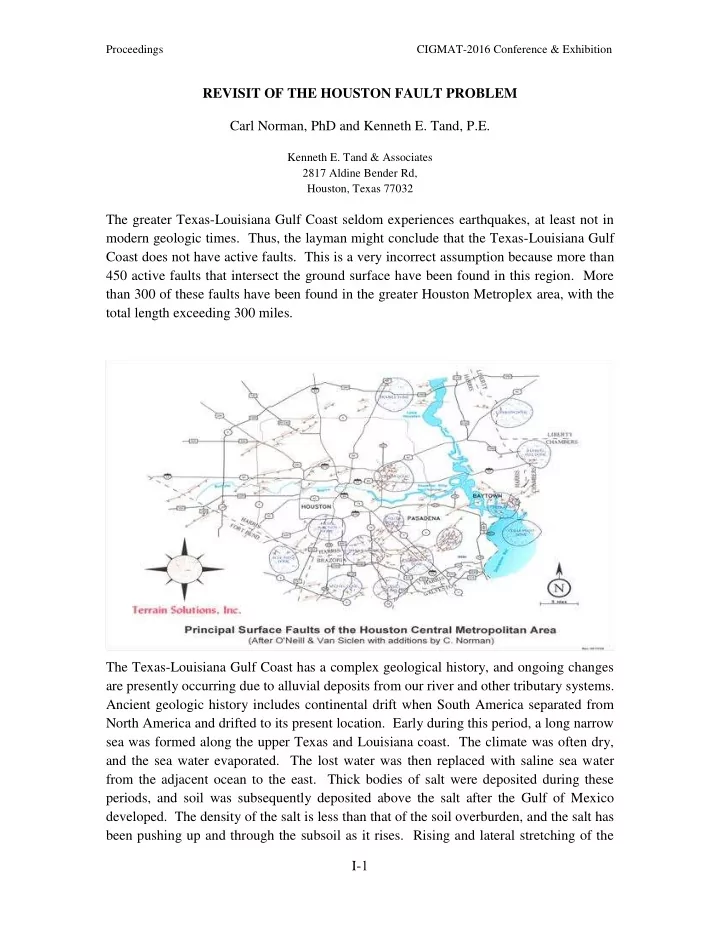
The greater Texas-Louisiana Gulf Coast seldom experiences earthquakes, at least not in modern geologic times. Thus, the layman might conclude that the Texas-Louisiana Gulf Coast does not have active faults. This is a very incorrect assumption because more than 450 active faults that intersect the ground surface have been found in this region. More than 300 of these faults have been found in the greater Houston Metroplex area, with the total length exceeding 300 miles. The Texas-Louisiana Gulf Coast has a complex geological history, and ongoing changes are presently occurring due to alluvial deposits from our river and other tributary systems. Ancient geologic history includes continental drift when South America separated from North America and drifted to its present location. Early during this period, a long narrow sea was formed along the upper Texas and Louisiana coast. The climate was often dry, and the sea water evaporated. The lost water was then replaced with saline sea water from the adjacent ocean to the east. Thick bodies of salt were deposited during these periods, and soil was subsequently deposited above the salt after the Gulf of Mexico
- developed. The density of the salt is less than that of the soil overburden, and the salt has