Residual Networks (ResNet) Residual Networks (ResNet) In [1]: - - PowerPoint PPT Presentation

residual networks resnet residual networks resnet
SMART_READER_LITE
LIVE PREVIEW

Residual Networks (ResNet) Residual Networks (ResNet) In [1]: - - PowerPoint PPT Presentation

3/8/2019 resnet slides Residual Networks (ResNet) Residual Networks (ResNet) In [1]: import d2l from mxnet import gluon, init, nd from mxnet.gluon import nn http://127.0.0.1:8000/resnet.slides.html?print-pdf/#/ 1/10 3/8/2019 resnet slides


slide-1
SLIDE 1

3/8/2019 resnet slides http://127.0.0.1:8000/resnet.slides.html?print-pdf/#/ 1/10
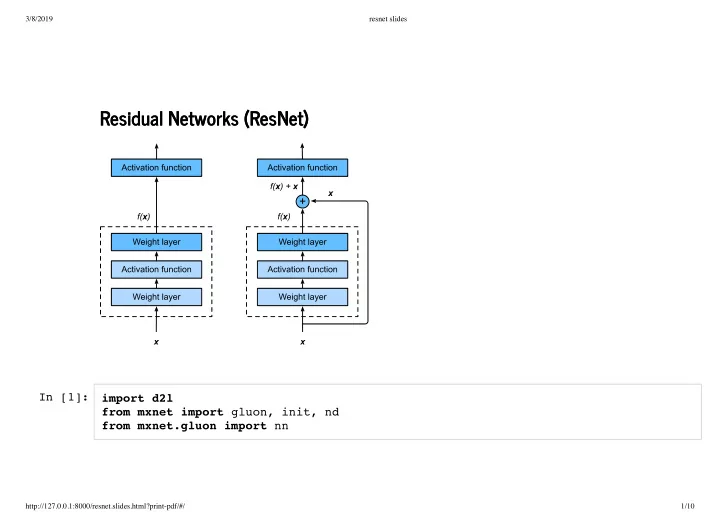
Residual Networks (ResNet) Residual Networks (ResNet)

In [1]: import d2l from mxnet import gluon, init, nd from mxnet.gluon import nn

slide-2
SLIDE 2

3/8/2019 resnet slides http://127.0.0.1:8000/resnet.slides.html?print-pdf/#/ 2/10

In [2]: class Residual(nn.Block): # This class is part of the d2l package def __init__(self, num_channels, use_1x1conv=False, strides=1, **kwargs): super(Residual, self).__init__(**kwargs) self.conv1 = nn.Conv2D(num_channels, kernel_size=3, padding=1, strides=str ides) self.conv2 = nn.Conv2D(num_channels, kernel_size=3, padding=1) if use_1x1conv: self.conv3 = nn.Conv2D(num_channels, kernel_size=1, strides=strides) else: self.conv3 = None self.bn1 = nn.BatchNorm() self.bn2 = nn.BatchNorm() def forward(self, X): Y = nd.relu(self.bn1(self.conv1(X))) Y = self.bn2(self.conv2(Y)) if self.conv3: X = self.conv3(X) return nd.relu(Y + X)

slide-3
SLIDE 3

3/8/2019 resnet slides http://127.0.0.1:8000/resnet.slides.html?print-pdf/#/ 3/10

Networks

slide-4
SLIDE 4

3/8/2019 resnet slides http://127.0.0.1:8000/resnet.slides.html?print-pdf/#/ 4/10

In [3]:

We also have the option to halve the output height and width while increasing the number

  • f output channels.

In [4]: blk = Residual(3) blk.initialize() X = nd.random.uniform(shape=(4, 3, 6, 6)) blk(X).shape blk = Residual(6, use_1x1conv=True, strides=2) blk.initialize() blk(X).shape Out[3]: (4, 3, 6, 6) Out[4]: (4, 6, 3, 3)

slide-5
SLIDE 5

3/8/2019 resnet slides http://127.0.0.1:8000/resnet.slides.html?print-pdf/#/ 5/10

ResNet Model Stage 1 ResNet Model Stage 1

ResNet and GoogLeNet are quite similar on the initial layers.

In [5]:

We also need a ResNet block.

In [6]: net = nn.Sequential() net.add(nn.Conv2D(64, kernel_size=7, strides=2, padding=3), nn.BatchNorm(), nn.Activation('relu'), nn.MaxPool2D(pool_size=3, strides=2, padding=1)) def resnet_block(num_channels, num_residuals, first_block=False): blk = nn.Sequential() for i in range(num_residuals): if i == 0 and not first_block: blk.add(Residual(num_channels, use_1x1conv=True, strides=2)) else: blk.add(Residual(num_channels)) return blk

slide-6
SLIDE 6

3/8/2019 resnet slides http://127.0.0.1:8000/resnet.slides.html?print-pdf/#/ 6/10

Then, we add all the residual blocks to ResNet. Here, two residual blocks are used for each module.

In [7]:

Finally, just like GoogLeNet, we add a global average pooling layer, followed by the fully connected layer output.

In [8]: net.add(resnet_block(64, 2, first_block=True), resnet_block(128, 2), resnet_block(256, 2), resnet_block(512, 2)) net.add(nn.GlobalAvgPool2D(), nn.Dense(10))

slide-7
SLIDE 7

3/8/2019 resnet slides http://127.0.0.1:8000/resnet.slides.html?print-pdf/#/ 7/10

Full ResNet-18 Full ResNet-18

slide-8
SLIDE 8

3/8/2019 resnet slides http://127.0.0.1:8000/resnet.slides.html?print-pdf/#/ 8/10

slide-9
SLIDE 9

3/8/2019 resnet slides http://127.0.0.1:8000/resnet.slides.html?print-pdf/#/ 9/10

In [9]: X = nd.random.uniform(shape=(1, 1, 224, 224)) net.initialize() for layer in net: X = layer(X) print(layer.name, 'output shape:\t', X.shape) conv5 output shape: (1, 64, 112, 112) batchnorm4 output shape: (1, 64, 112, 112) relu0 output shape: (1, 64, 112, 112) pool0 output shape: (1, 64, 56, 56) sequential1 output shape: (1, 64, 56, 56) sequential2 output shape: (1, 128, 28, 28) sequential3 output shape: (1, 256, 14, 14) sequential4 output shape: (1, 512, 7, 7) pool1 output shape: (1, 512, 1, 1) dense0 output shape: (1, 10)

slide-10
SLIDE 10

3/8/2019 resnet slides http://127.0.0.1:8000/resnet.slides.html?print-pdf/#/ 10/10

Data Acquisition and Training Data Acquisition and Training

We train ResNet on the Fashion-MNIST data set, just like before. The only thing that has changed is the learning rate that decreased again, due to the more complex architecture.

In [10]: lr, num_epochs, batch_size, ctx = 0.05, 5, 256, d2l.try_gpu() net.initialize(force_reinit=True, ctx=ctx, init=init.Xavier()) trainer = gluon.Trainer(net.collect_params(), 'sgd', {'learning_rate': lr}) train_iter, test_iter = d2l.load_data_fashion_mnist(batch_size, resize=96) d2l.train_ch5(net, train_iter, test_iter, batch_size, trainer, ctx, num_epochs) training on gpu(0) epoch 1, loss 0.4824, train acc 0.830, test acc 0.887, time 15.5 sec epoch 2, loss 0.2572, train acc 0.906, test acc 0.903, time 13.8 sec epoch 3, loss 0.1976, train acc 0.927, test acc 0.904, time 13.8 sec epoch 4, loss 0.1481, train acc 0.947, test acc 0.915, time 13.8 sec epoch 5, loss 0.1134, train acc 0.960, test acc 0.917, time 13.8 sec