RESEARCH AND INNOVATION : PANACEA TO AFRICA`S ECONOMIC - - PowerPoint PPT Presentation

research and innovation panacea to africa s economic
SMART_READER_LITE
LIVE PREVIEW

RESEARCH AND INNOVATION : PANACEA TO AFRICA`S ECONOMIC - - PowerPoint PPT Presentation

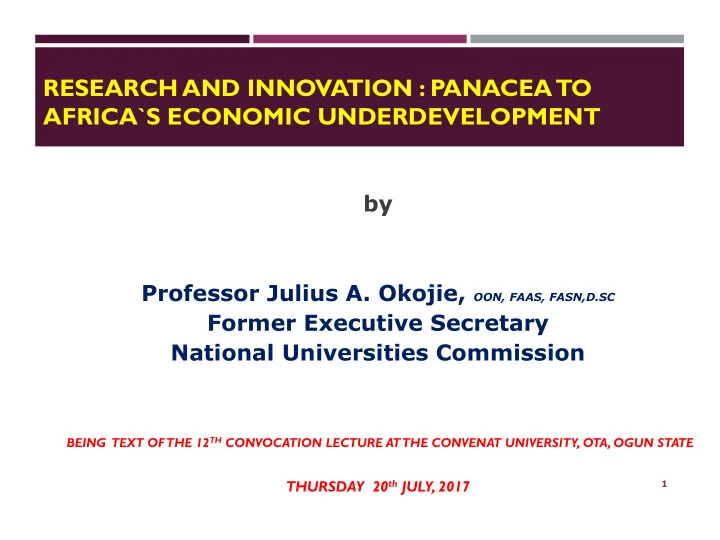
RESEARCH AND INNOVATION : PANACEA TO AFRICA`S ECONOMIC UNDERDEVELOPMENT by Professor Julius A. Okojie, OON, FAAS, FASN,D.SC Former Executive Secretary National Universities Commission BEING TEXT OF THE 12 TH CONVOCATION LECTURE AT THE CONVENAT


slide-1
SLIDE 1

RESEARCH AND INNOVATION : PANACEA TO AFRICA`S ECONOMIC UNDERDEVELOPMENT

by Professor Julius A. Okojie, OON, FAAS, FASN,D.SC Former Executive Secretary National Universities Commission

BEING TEXT OF THE 12TH CONVOCATION LECTURE AT THE CONVENAT UNIVERSITY, OTA, OGUN STATE

THURSDAY 20th JULY, 2017

1

slide-2
SLIDE 2

MAP OF AFRICA

2

slide-3
SLIDE 3

KWAME NKRUMAH

3

slide-4
SLIDE 4

KENNNETH KAUNDA

4

slide-5
SLIDE 5

JULIUS NYERERE

5

slide-6
SLIDE 6

PATRICE LUMUMBA

6

slide-7
SLIDE 7

AFRICA`S TEN LARGEST COUNTRIES BY POPULATION

S/N COUNTRY POPULATION(Million) LAND AREA (Km2) Migrants (Net) 1 Nigeria 191.84 910,902

  • 60,000

2 Ethiopia 104.34 1,000,430

  • 12,000

3 Egypt 95.22 999.933

  • 43,136

4 DR Congo 82.24 2,265,639

  • 19,184

5 Tanzania 56.88 885,943

  • 40,000

6 South Africa 55.44 1,213,049 120,000 7 Kenya 48.47 568,861

  • 10,000

8 Sudan 42.65 199,774

  • 30,000

9 Uganda 41.65 199,774

  • 30,000

10 Algeria 41.06 2,387,428

  • 28,000

7

slide-8
SLIDE 8

HUMAN DEVELOPMENT INDEX (HDI)

 Composite statistics of life expectancy ; Education: Mean years of

Schooling, and income per capita

8

slide-9
SLIDE 9

9

Trends in Human Development Index (HDI) in Selected Countries (2010 – 2014)

HD I Rank (188 countries) Country 2010 2011 2012 2013 2014 Very High Human Development 1 Norway 0.940 0.941 0.942 0.942 0.944 2 Australia 0.927 0.930 0.932 0.933 0.935 8 United States 0.909 0.911 0.912 0.913 0.915 14 United Kingdom 0.906 0.901 0.901 0.902 0.907 39 Saudi Arabia 0.805 0.816 0.826 0.836 0.837 High Human Development 50 Russian Federation 0.783 0.790 0.795 0.797 0.798 57 Barbados 0.780 0.786 0.793 0.785 0.785 62 Malaysia 0.769 0.772 0.774 0.777 0.779 83 Algeria 0.725 0.730 0.732 0.734 0.736 96 Tunisia 0.714 0.715 0.719 0.720 0.721 Medium Human Development 106 Botswana 0.681 0.688 0.691 0.696 0.698 108 Egypt 0.681 0.682 0.688 0.689 0.690 116 South Africa 0.643 0.651 0.659 0.663 0.666 130 India 0.586 0.597 0.600 0.604 0.609 140 Ghana 0.554 0.566 0.572 0.577 0.579 Low Human Development 145 Kenya 0.529 0.535 0.539 0.544 0.548 147 Pakistan 0.522 0.527 0.532 0.536 0.538 152 Nigeria 0.493 0.499 0.505 0.510 0.514 163 Haiti 0.471 0.475 0.479 0.481 0.483 186 Eritrea 0.381 0.386 0.390 0.390 0.391 188 Niger 0.326 0.333 0342 0.345 0.348

slide-10
SLIDE 10

GLOBAL COMPETITIVE INDEX

❖ Initiative of World Economic Forum ❖ The GCI is a set of institutions, policies and factors that

determine the level of productivity of a country, condition of public institutions and technical conditions

❖ 12 Pillars of Competitiveness

10

slide-11
SLIDE 11

12 PILLARS OF COMPETITIVENESS

11

11

Basic Requirements Efficiency Enhancers Innovation and Sophistication Factors 1. Institutions Higher Education and Training Business Sophistication 2. Infrastructure Goods Market Efficiency Research and Development Innovation 3. Macro-Economic Environment Labour Market Efficiency 4. Health and Primary Education Financial Market Development 5. Technological Readiness 6. Market size

slide-12
SLIDE 12

GCI 2015 Ranking

COUNTRY

SWITZERL AND SINGAPO RE NORWAY CHILE MAURITI US SOUTH AFRICA BRAZIL

NIGERIA

Population (Million)

8.0 5.4 5.1 17.6 1.3 53.0 202.8

169.3

GDP ($Billion)

650.8 295.7 511.3 277 11.9 350.8 235.30

286.5

GDP Per Capita ($)

81,323.96 56.775 100,318.32 15,775 9,159.68 6,620.72 11,604

1,692.26

Health and Primary Education (Of 7)

6.5 6.7 6.5 5.6 6.1 4.0 5.1

3.0s

Higher Education and Training (Of 7)

6.0 6.2 5.8 5.0 4.6 4.0 3.8

2.9

Labour Market Efficiency (Of 7)

5.8 5.7 5.1 4.3 4.3 3.8 3.7

4.5

GCI Overall Score

5.76 5.68 5.4 4.58 4.43 4.4 4.1

3.4

GCI Position

1st 2nd 11th 35th 46th 56th 75th

124th

12
slide-13
SLIDE 13

13

slide-14
SLIDE 14

14

slide-15
SLIDE 15

15

slide-16
SLIDE 16

16

Number of Public and Private schools

slide-17
SLIDE 17

WEBOMETRIC RANKING OF WORLD UNIVERSITIES 2012

AFRICA WORLD UNIVERSITY PRESENCE RANK IMPACT RANK OPENNESS RANK EXCELLENCE RANK 16 1335 University of Ibadan 3446 1302 1612 1715 24 1788 Convenant University, Ota 1662 1621 1943 2685 30 1986 Obafemi Awolowo University 1276 2542 2519 2534 54 2613 University of Lagos 2005 6118 2329 2521 56 2652 University of Nigeria 2986 5817 1424 2805 63 2840 University of Port Harcourt 611 5817 1529 3339 68 2914 University of Agriculture Abeokuta 2854 5429 2480 3125 70 2985 University of Ilorin 5467 6332 2110 2941 75 3049 Ahnadu Bello University 4180 8499 2557 2546 82 3214 Federal University of Technology Owerri 14969 2447 4016 3860 98 3507 Federal University of Technology Akure 4814 9897 3087 2894 99 3513 Federal University of Technology Minna 10700 7827 2915 3125

17

slide-18
SLIDE 18

18

slide-19
SLIDE 19

19

slide-20
SLIDE 20

20

slide-21
SLIDE 21

21

slide-22
SLIDE 22

RESEARCH INSTITUTES AND THEIR MANDATES

S/NO. Name Mandate 1. Nigerian Institute for Oil Palm Research (NIFOR) ➢ To conduct research into the production and products of oil palm and other palms of economic importance and transfer its research findings to farmers. 2. Forestry Research Institute

  • f Nigeria (FRIN)

➢ Mandate to conduct research into all aspects of forestry and forest products utilization. Mandate extended to include research in wildlife, watershed management and agroforestry. 3. Cocoa Research Institute of Nigeria (CRIN) ➢ Researches are focused on Cocoa, Kola, Cashew, Coffee and Tea. ➢ Improvement of the genetic potential, agronomic and husbandry practices, including processing and storage of the crops.

22

AGRICULTURAL RESEARCH INSTITUTE

slide-23
SLIDE 23

RESEARCH INSTITUTES AND THEIR MANDATES

S/NO. Name Mandate 4. National Agricultural Extension and Research Liaison Services (NAERLS) ➢ The Institute is responsible for development, collation, evaluation and dissemination of proven agricultural innovations and to research

  • n

extension methodologies and policy. in rural life and linkages. 5. Institute

  • f

Agricultural Research and Training (IAR&T), Ibadan ➢ Research into maize, kenaf, jute, soil & water management: and ➢ Total farming systems for the Ecological zones covered by Lagos, Ogun, Oyo, Osun, Ondo, Ekiti, Edo and Delta States 6. Rubber Research Institute

  • f

Nigeria (RRIN), Benin City ➢ Research into the genetic improvement, production and processing of rubber and other latex producing plants.

23

AGRICULTURAL RESEARCH INSTITUTE

slide-24
SLIDE 24

RESEARCH INSTITUTES AND THEIR MANDATES

S/NO. Name ss

1. National Institute for Chemical Technology (NARICT) ➢ Mandate to develop the technologies required by the Chemicals industry. ➢ Research into the conversion

  • f

agricultural, mineral and other raw materials into chemicals. 2. National Centre for Technology Management (NACETEM) ➢ Mandate as a training Centre for the development

  • f

middle to high level manpower in science, technology and innovation management to all tiers of government and the private sector. 3. Institute of Agricultural Research and Training (IART) ➢ The Institute conducts research on various cereals and legumes e.g. maize, jutes, Keraf and sisal hemp, soil and fertilizer use. 4. Institute of Agricultural Research and Extension Services (IAR) ➢ Has the mandate of researching into the genetic improvement

  • f

sorghum, cowpea, cotton, groundnut and sunflow.

24

SCIENCE AND TECHNOLOGY

slide-25
SLIDE 25

RESEARCH INSTITUTES AND THEIR MANDATES

S/NO. Name Mandate 5. National Agricultural Extension Research and Liaison Services ➢ Key mandate

  • f

the institution are: Planning and coordination of agricultural extension. ➢ Promotion of dissemination of agricultural research results and technologies. 6. National Animal Production Research Institute (NAPRI) ➢ Has a broad mandate of conducting applied research on food animal species as well as forage and to develop appropriate technologies in breeding and reproduction. 7. National Horticultural Research Institute (NIHORT) ➢ Conducts research into fruits, vegetables, their processing, preservation and development of indigenous ornamentals.

25

SCIENCE AND TECHNOLOGY

slide-26
SLIDE 26

RESEARCH INSTITUTES AND THEIR MANDATES

S/NO. Name Mandate

1. Nigerian Institute

  • f

Medical Research (NIMR) ➢ To conduct research into communicable diseases of public health importance in the country, non- communicable diseases prevalent in the country. 2. Institute of Child Health (ICH) ➢ Conducts research in collaboration with many local and international institutions on child health related enquiries. 3. The National Institute for Pharmaceutical Research and Development (NIPRD) ➢ Mandated to carry

  • ut

research and development

  • f

drugs and pharmaceutical substances from locally available natural resources;

26

MEDICAL RESEARCH INTITUTES

slide-27
SLIDE 27

Universities and research institutes have always had

collaborative research (symbiotic);

It has also encouraged the share of resources, staff

and materials;

There is always a free flow of staff from institutes to

universities and vice versa.

27

RESEARCH CONT’D

slide-28
SLIDE 28

INNOVATION

28

“...the process of making changes to something established by introducing something new.” “…radical or incremental changes to products, processes or services.”

slide-29
SLIDE 29

INNOVATION CONT’D

 Learning and innovation go hand in hand. The arrogance of success is to

think that what you did yesterday will be sufficient for tomorrow.

  • William

Pollard

 One of the only ways to get out of a tight box is to invent your way

  • ut.
  • Jeff Bezos

 But innovation comes from people meeting up in the hallways or

calling each other at 10:30 at night with a new idea, or because they realized something that shoots holes in how we've been thinking about a problem.

  • Steve

Jobs

29

slide-30
SLIDE 30

ENTREPRENEURSHIP

30

The capacity, willingness to develop, organise and manage a business venture along with any of its risks in order to make profits… The entrepreneurial spirit is characterised by Innovation and risk taking.

slide-31
SLIDE 31

ALIKO DANGOTE

31

slide-32
SLIDE 32

FOLORUNSHO ALAKIJA

32

slide-33
SLIDE 33

WHY ENTREPRENEURSHIP?

 Unemployment:A serious shortage of employment opportunities;  Choice: Enables the youth to choose his own clients and projects;  Novelty: Offers him the chance to be challenged in new ways;  Autonomy: Enables him to set his own schedule and make the rules;  Provides him an opportunity to work collaboratively with business partners;  Gives him a sense of pride and self accomplishment; and  Allows

him to reap the benefits

  • f

his

  • wn

creative ideas.

33

slide-34
SLIDE 34

ENTREPRENEURSHIP CONT’D

ENTRENCHMENT OF ENTREPRENEURSHIP IN NIGERIAN UNIVERSITIES The National Council on Education (NCE) during its 53rd meeting in calabar (2006):

  • Tertiary Education Supervisory Agencies to produce appropriate guide

and training manuals for the teaching of Entrepreneurship;

  • Presidential Directive to introduce Entrepreneurship Education. 34
slide-35
SLIDE 35

ENTREPRENEURSHIP CONT’D

ENTRENCHMENT PROCESS

 Implementation

Committee

  • n

Entrenchment

  • f

Entrepreneurship Education in all Nigerian Universities (ICEEENU);

  • EEd General Studies and B. Sc. (Entrepreneurial Studies).

 In 2012, all State-owned universities were given a grant to

establish functional Entrepreneurship Development Centres.

35

slide-36
SLIDE 36

ENTREPRENEURSHIP CONT’D

ANNUAL NATIONAL ENTREPRENEURSHIP WEEK (ANEW)

 A one week series of events to be run annually;  Stakeholders: Industry practitioners, Professional bodies, Academics

and Students to enhance the development of knowledge-based enterprises (social and for profit);

 Promotes vibrant and informed entrepreneurs to transform their

environment/community through creativity and/or innovative ideas.

36

slide-37
SLIDE 37

ENTREPRENEURSHIP CONT’D

NATIONAL ENTREPRENEURSHIP RESOURCE AND KNOWLEDGE CENTRE (NERKC)

 NERKC empowers students and graduates with entrepreneurial

knowledge and skills for self-employment, economic independence and social security;

 Memorandum of Understanding (MoU) was jointly signed between

the Knowledge Institute (KI), Exeter (USA), AIA Global and NUC on the 8th of December, 2015 with the commitment to work as partners for the development of NERKC project.

37

slide-38
SLIDE 38

ENTREPRENEURSHIP CONT’D

The NERKC Programs and content include:

✓ Virtual incubator/Accelerator/Resources Network; ✓ Virtual

Entrepreneurial Learning Center (VELC) for e-learning/self-learning programs and certifications;

✓ Resource portals to support faculty and students of participating HEIs; ✓ Resource

portals to support youths and

  • ther

stakeholders in entrepreneurship development; and

✓ Virtual forums/chat-rooms to facilitate inter-student and other stakeholder

information sharing

38

slide-39
SLIDE 39

AFRICA CENTRES OF EXCELLENCE (ACE)

39

Nigerian Beneficiary Institutions of the Africa Centres of Excellence (ACE)

S/N Africa Centre of Excellence Lead Institution and Country Discipline 1. ACE for Agricultural Development and Sustainable Environment Federal University of Agriculture, Abeokuta, Nigeria Agriculture 2. ACE for Dryland Agriculture Bayero University Kano, Nigeria Agriculture 3. ACE for Food Technology and Research Benue State University, Makurdi Nigeria Agriculture 4. ACE for Genomics of Infectious Diseases Redeemer’s University, Ede Nigeria Health 5. ACE for Neglected Tropical Diseases and Forensic Biotechnology Ahmadu Bello University, Zaria, Nigeria Health 6. ACE for Phytomedicine and Development University of Jos, Jos, Nigeria Health 7. ACE for Reproductive Health and Innovation University

  • f

Benin, Benin, Nigeria Health 8. ACE for Materials African University of Science and Technology, Abuja, Nigeria STEM 9. ACE for Oil Field Chemicals University

  • f

Port-Harcourt, Nigeria STEM 10. ACE for Science, Technology and Knowledge Obafemi Awolowo University, Ile- Ife, Nigeria STEM

slide-40
SLIDE 40

REFORM

 To make changes or alter in order to improve an institution or a

practice by removing or correcting faults, defects and /or problems;

 Tools for reform: Policies, Laws, Sanctions.

40

slide-41
SLIDE 41

REFORM EFFORTS

Policy on University Education

✓ University research shall be relevant to the nation’s

developmental goals;

✓ Inculcation of community spirit in the students through projects

and actionable researches; and

✓ Allocation of not less than 60% of the places to science in

conventional universities and not less than 80% in the Universities of Technology and Agriculture.

41

slide-42
SLIDE 42

WHERE DO WE GO FROM HERE

➢ Policy and research endeavors should address national needs; ➢ Universities should develop robust research policies to encourage

good research culture;

➢ Collaborative research (symbiotic); ➢ Leveraging ICT to bridge the gaps in research and learning; ➢ Support ongoing effort towards the establishment of a national

science plan and national science foundation;

42

slide-43
SLIDE 43

WHERE DO WE GO FROM HERE

43

➢ The need for efficient data capture and collation for planning and

prioritizing;

➢ Private sector involvement in the development and operation of

entrepreneurial centres & research clusters;

➢ Opportunities for internship position; ➢ Aadequate funding, monitoring to ensure sustainability of research efforts;

and

➢ Funding ! Funding!! Funding!!!

slide-44
SLIDE 44

AREAS THAT NEED RESEARCH, INNOVATION AND ENTREPRENEURSHIP

✓ Agriculture; ✓ Biotechnology Research; ✓ Health; ✓ Energy; ✓ Nanotechnology; ✓ Water Resources; ✓ Mines and Materials development; ✓ Information and Communication

T echnology (ICT);

✓ Raw Materials and Manufacturing; and ✓ Industrial Research, Development and Production

44

slide-45
SLIDE 45

We can not prepare the future for our children but we can prepare our children for the future.

45

slide-46
SLIDE 46

ON WINGS OF EAGLES

46

slide-47
SLIDE 47

ON WINGS OF EAGLES

On Wings of Eagles The break of dawn, the start of day, An eagle flies, pursues its prey, With wings outstretched and talons primed, It won’t be stopped, it won’t be stayed A ray of sunshine hits its beak, A steely glare, no sign of “meek”, Its feathers bright and fully preened, The force of all its strength is seen It soars above the hill and dale, With a confidence that says “I cannot fail”, This magnificent bird of prey says “I am the king of birds. I rule the skies” So ride on the winds of destiny And write your page of history Oluwatosin Thomas Okojie 2017

47

slide-48
SLIDE 48

REFERENCES

Africa Union (AU) Report 2014

Federal Ministry of Education Unpublished Report 2010

Natural History of Africa 2015

Okojie J.A and Okali D.U.U (1993) Lost Crops of Nigeria: Implications for food security. Conference Proceedings series No 3 University of Agriculture Abeokuta

Okojie J.A. (1994) Once upon a forest: A master piece of creation UNAAB INAUGURAL Lecture Series No 1

The National Council on Education (NCE) Report, Calabar 2006

United Nation Development Programme(UNDP) Report 2015

Webometric Ranking of World Universities 2012

World Economic Forum 2014 -2015

48

slide-49
SLIDE 49

Thank you and God Bless

49