Requirements for Ethical Institutional Review Boards Human Research - - PDF document

requirements for ethical
SMART_READER_LITE
LIVE PREVIEW

Requirements for Ethical Institutional Review Boards Human Research - - PDF document

Requirements for Ethical Institutional Review Boards Human Research A mechanism for oversight of research A valid and important question An attempt to implement the ethical Valid methodology principles important to research Balance


slide-1
SLIDE 1

1

Institutional Review Boards

A mechanism for oversight of research An attempt to implement the ethical principles important to research Dale Hammerschmidt, M.D. University of Minnesota

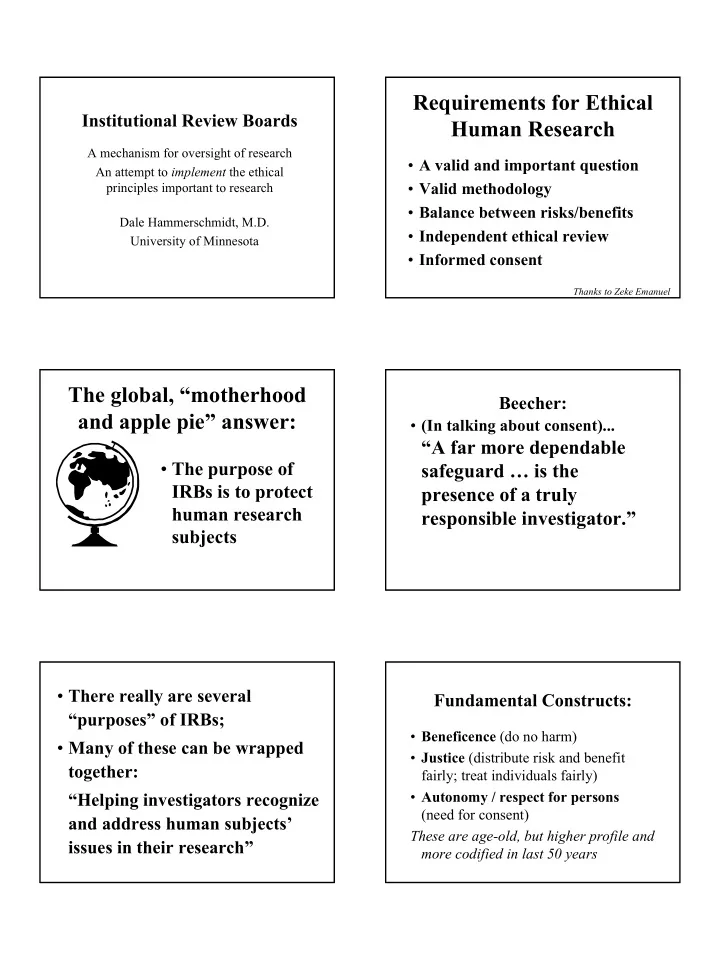
Requirements for Ethical Human Research

  • A valid and important question
  • Valid methodology
  • Balance between risks/benefits
  • Independent ethical review
  • Informed consent

Thanks to Zeke Emanuel

The global, “motherhood and apple pie” answer:

  • The purpose of

IRBs is to protect human research subjects

Beecher:

  • (In talking about consent)...

“A far more dependable safeguard … is the presence of a truly responsible investigator.”

  • There really are several

“purposes” of IRBs;

  • Many of these can be wrapped

together: “Helping investigators recognize and address human subjects’ issues in their research” Fundamental Constructs:

  • Beneficence (do no harm)
  • Justice (distribute risk and benefit

fairly; treat individuals fairly)

  • Autonomy / respect for persons

(need for consent) These are age-old, but higher profile and more codified in last 50 years

slide-2
SLIDE 2

2

Why a Greater Emphasis?

  • Education of patients/subjects
  • Public funding
  • News reporting
  • Desire for access
  • Scandal
  • Near misses (thalidomide)
  • Scandal

Why a Greater Emphasis?

  • High-profile scandals

War atrocities (⇒ Nürnberg Code) Beecher’s 1966 article: “Ethics and Clinical Research” N Engl J Med 274:1354ff [June

16th]

Tuskegee natural history study of syphilis

...latter two said problems are mainstream, not fringe

Why a Greater Emphasis?

  • Near misses

Thalidomide not licensed in US through a regulatory fluke rather than through having a good process to ensure safety; Birth defects in countries where it was licensed were a wake-up call

Results of Scandals and Near-Misses:

  • 1962 Amendment to the Pure Food,

Drug and Cosmetic Act

  • Helsinki Declaration and other codes
  • f ethics
  • National Research Act of 1974;

Belmont Commission & Report

  • Federal research regulations to

protect research subjects

Helsinki Declaration:

  • First edition 1964; several revisions
  • (WMA) Went beyond Nuremberg

Code, to address research with therapeutic intent

  • Also addressed diminished

competence

  • Called for oversight of research

IRBs called “Helsinki Committees” in some venues

Helsinki Declaration I(§2):

…in an experimental protocol which should be transmitted for consideration, comment and guidance to a specially appointed committee independent of the investigator and the sponsor…

slide-3
SLIDE 3

3

Tuskegee:

  • Natural history study of untreated

syphilis in 400 black men

  • Patients allowed to believe they were

being treated

  • New treatments ( e.g. PCN) neither

studied nor offered as they became available PHS funding; PHS researchers, etc.

1974: “Defense of 1974: “Defense of Tuskegee Tuskegee” ”

Elliot Richardson Elliot Richardson ⇒ ⇒ Charles McCarthy Charles McCarthy: :

∃ No No Effective Defense Effective Defense

∴Need Mechanism to Need Mechanism to Prevent Recurrence Prevent Recurrence

  • 45 CFR §46: Basic DHHS

45 CFR §46: Basic DHHS Policy re: Human Subjects Policy re: Human Subjects

Promulgated for NIH: May, 1974; Expanded & revised 1991

45 CFR 45 CFR §

§ 46:

46:

  • Subpart A:

Subpart A: “ “The Common Rule The Common Rule” ”

  • Subpart B:

Subpart B: Reproductive Issues Reproductive Issues

  • Subpart C: Prisoners

Subpart C: Prisoners

  • Subpart D: Children

Subpart D: Children

  • Subpart E:

Subpart E: Decisionally Decisionally Impaired Impaired (never formally adopted) (never formally adopted)

Also Important: Also Important:

  • Lots of other regs, codes and

Lots of other regs, codes and statutes might apply, depending statutes might apply, depending

  • n the type of research and
  • n the type of research and

where it where it’ ’s done s done

  • (FDA, JCAHO, VA, local

(FDA, JCAHO, VA, local statutes, statutes, etc etc.) .) Institutional Review Boards:

  • Prospective review of research

proposals

  • Continuing review of ongoing

research

  • Idea is to protect human subjects

from inappropriate risk

Ideally a coöperative venture with the investigator, rather than a police function

Composition of IRBs:

  • Investigators and Non-investigators
  • People linked to the institution and

people independent of it

  • People with useful expertise (in

science, ethics, law, community concerns)

Ideally a body with a broad background, capable of independent action

slide-4
SLIDE 4

4

IRBs ask about scientific merit:

  • Does the scientific merit warrant

putting subjects at risk?

  • Have the risks been minimized

insofar as is practicable?

  • General scientific merit review is

usually better done elsewhere

IRBs ask about conflict of interest:

  • Is there something that might adversely

impact clinical decision making?

  • Is there something that might distort the

consent process?

  • Are these bad enough that they need to

be disclosed?

  • Is disclosure a sufficient remedy?

Academic misconduct issues re: C-of-I usually belong elsewhere

The most important questions IRBs ask:

  • Are the risks and benefits (personal

and societal) in reasonable balance?

  • Is the information and consent

process adequate?

IRBs also must ask:

  • Does the research conform to federal

regulations?

  • How about local ordinances and

institutional policies?

  • How about relevant ethical norms?
  • Are there justice concerns re:

inclusiveness or vulnerable groups?

IRB Reporting Lines:

  • To the institution

– Administratively – Maintaining an effective IRB is something the institution guarantees to the feds

  • To the feds

– Substantively – OHRP and FDA

Obligations to feds and to subjects may require decisions in tension with institution’s interests

It’s crucial to remember:

  • We’re all in favor of good science
  • We’re all in favor of doing the right

thing by research subjects

  • We all have things to teach one another
  • We’ll do a far better job as colleagues

than we will as adversaries

slide-5
SLIDE 5

5

IRB: Institutional Review Board

Regulatory Authority--- Office of Human Subjects Protection (OHRP) Food and Drug Administration (FDA)

Review:

“…irrespective of funding source” Not just federal monies

Important Regulatory Authority

Federal-Wide Assurance of Compliance

  • Institutional agreement with the feds that

we will follow the rules

  • Includes the assurance that all research

done at an institution will be done in accordance with federal rules

  • Thus, IRB review is for all human

subjects’ research

Important Regulatory Authority

45 CFR §46

  • Basic federal regs covering human

subjects

  • AKA “OPRR Regs” (historically)

AKA “OHRP Regs” (currently)

  • Rules establishing and guiding the

Office for Human Research Protection

Important Regulatory Authority

45 CFR §46

  • Defines “human subject,” “research”
  • Sets standards for IRB composition

and function

  • Defines levels of review for different

types of research

  • Sets expectations (rules) re: consent,

protections, reporting, special classes

  • f research subjects, etc.

Exempt Expedited Full

Review Continuum

Lowest

Low High

Level of risk determines route of review

slide-6
SLIDE 6

6

Exemptions

Certain research may be exempt from IRB review because it doesn’t meet the regulatory definition of “research.” Certain research may be exempt because it doesn’t meet the regulatory definition for involving “human subjects.”

Exemptions

Certain research may be exempt because an individual investigator’s part of the study may be remote from human subjects.

Exemptions

Certain research may be exempt because an individual investigator’s part of the study may be remote from human subjects. Certain research may be exempt because it is of such low risk that IRB review would be overkill. TYPICAL INVESTIGATOR PROCESS:

File an abbreviated form with the IRB, in which the claim of exempt status is set forth and explained … the IRB then decides if it really qualifies as exempt

Exemption Categories:

Federal regulatory criteria for low- risk research Six specific categories of research Cannot involve vulnerable population Qualifying studies usually are of short duration Cannot create a durable confidentiality risk (no permanent record of individual)

Exemption Examples:

Anonymous re-use of data Anonymous questionnaires on non- sensitive topics Observation of public behavior without recording identities Field testing educational strategies or curricula

Important Regulatory Issue

  • Investigator has an inherent conflict in

deciding if research is exempt;

  • Investigator, Dept. Chair, etc. may well

not know the regs well enough to make the right call;

  • Regulatory expectation (FDA/OHRP)

is that there will be a process for making this decision knowledgeably;

  • At most centers it’s having the IRB
  • ffice screen for exempt status.
slide-7
SLIDE 7

7

Not Quite Exempt:

Expedited Review

Federal regulations also recognize that there is some research that is of very low risk, but needs a bit of IRB scrutiny; For specific designated categories of risk, IRB review may be carried out by the chair or by an experienced member (rather than by a duly- convened quorum).

Not Quite Exempt:

Expedited Review

If that experienced member agrees that the criteria are met, full approval may be granted without waiting for the next full IRB meeting; Usually is faster, simpler.

TYPICAL INVESTIGATOR PROCESS:

File usual IRB application form with IRB; include consent forms and other supporting info; specifically ask for expedited review (explaining why it would qualify)

Important Regulatory Issues

  • Investigator can request expedited

review, but the eligibility call must be made by someone who knows the regs (i.e. the expedited reviewer);

  • Expedited review is not “review light”;

requirements are exactly the same as in full-board review;

  • Difference is (only) that review doesn’t

require a convened quorum to grant approval.

Full Committee Review

Anything Else

Vulnerable populations Invasive procedures (physically or psychologically invasive) Sensitive topics Investigational products (FDA)

Continuing Review

Approval expires after a set time period or a set subject accrual Approval cannot be valid for more than one year Re-review has to occur before the approval expires, or there’s a lapse Re-review must be substantive

Why Continuing Review?

Details of studies change Available information changes As a result, risk/benefit balance may change Also as a result, consent burden may change

slide-8
SLIDE 8

8

Important Regulatory Issue

  • It’s the PI’s obligation to get the

continuing review info in on time (IRB sends two reminders at our shop);

  • It’s the PI’s obligation to provide all

the required information;

  • The regs make no provision for a grace

period, so the IRB has no authority to cut a procrastinator any slack.

In order to regulate something, you’ve got to define it…

So What’s Research?

A systematic activity designed to develop

  • r contribute to generalizable knowledge
  • Note that this is a regulatory definition
  • Some things we may think of as research don’t

meet this standard (e.g. intramural QA studies)

  • Irony: Even if activities carry risk, they may

not be required to be subject to oversight

45CFR§46.102(e)

So What’s a Human Subject?

A living individual about whom an investigator (whether professional or student) conducting research obtains

  • data through intervention or interaction

with the individual, or

  • identifiable private information.

45CFR§46.102(f) Dead folks don’t count, unless the information to be gained has impact for the living (e.g. relatives) (who are then the subjects) Unless totally anonymous, any time you have private information you have a human subject…

IRBs give special consideration to:

  • Vulnerable Subjects:

– children – prisoners – mentally disabled persons – economically disadvantaged persons – educationally disadvantaged persons

There are two concerns about vulnerable subjects:

  • Do they need special protections

because of their vulnerability?

  • Are they being inappropriately

excluded from research participation because of their vulnerability?

slide-9
SLIDE 9

9

Example: Research Involving Kids

  • No more than minimal risk
  • More than minimal risk, but benefit
  • ffsets the risk (e.g. clinical trials)
  • Benefit doesn’t fully offset risk, but risk

excess is small and information important for the subjects’ disease or condition

45CFR§46: Subpart D

Basic idea: take a more conservative view of Basic idea: take a more conservative view of risk/benefit balance when the subjects are vulnerable risk/benefit balance when the subjects are vulnerable

IRBs tend to spend a lot of effort

  • n the information and consent

process and consent forms:

Informed Consent:

  • What it is:

–ongoing process of communication and mutual understanding

  • What it isn’t:

–a piece of paper –a moment in time –a contract

Essential elements for Consent Process and Document:

Regs list nine features -- the biggies:

  • Must know it’s research;
  • Must know it’s voluntary;
  • Must know what they’re getting

into:

– What’s being asked of them – Risks and benefits – Alternatives (especially in clinical trials)

www.research.umn.edu/subjects/index.html

slide-10
SLIDE 10

10

Informed Consent:

  • The norm is a written consent form

executed prospectively

  • Oral consent may be OK in certain

low-risk studies

  • Oral consent may be OK if a written

form creates a confidentiality risk

  • Surrogate consent may be OK if

risk/benefit balance suitable