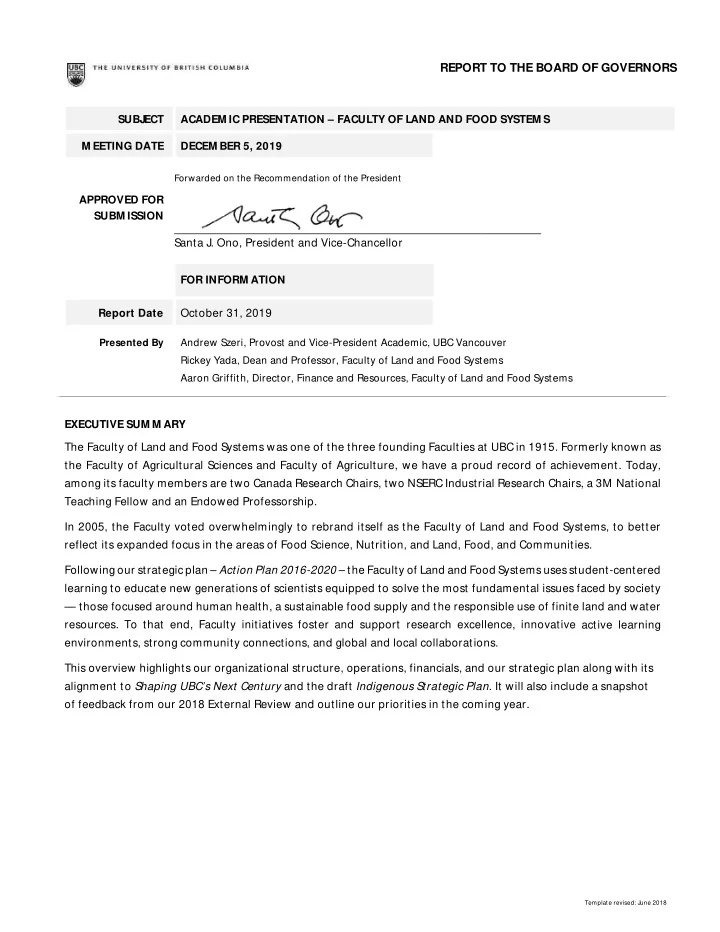
REPORT TO THE BOARD OF GOVERNORS SUBJ ECT ACADEM IC PRESENTATION - - PDF document

report to the board of governors
SMART_READER_LITE
LIVE PREVIEW

REPORT TO THE BOARD OF GOVERNORS SUBJ ECT ACADEM IC PRESENTATION - - PDF document

REPORT TO THE BOARD OF GOVERNORS SUBJ ECT ACADEM IC PRESENTATION FACULTY OF LAND AND FOOD SYSTEM S M EETING DATE DECEM BER 5, 2019 Forwarded on the Recommendation of the President APPROVED FOR SUBM ISSION Santa J. Ono, President and


slide-1
SLIDE 1

Template revised: June 2018

REPORT TO THE BOARD OF GOVERNORS

SUBJ ECT ACADEM IC PRESENTATION – FACULTY OF LAND AND FOOD SYSTEM S M EETING DATE DECEM BER 5, 2019 APPROVED FOR SUBM ISSION

Forwarded on the Recommendation of the President

Santa J. Ono, President and Vice-Chancellor FOR INFORM ATION Report Date October 31, 2019

Presented By Andrew Szeri, Provost and Vice-President Academic, UBC Vancouver Rickey Yada, Dean and Professor, Faculty of Land and Food Systems Aaron Griffith, Director, Finance and Resources, Faculty of Land and Food Systems

EXECUTIVE SUM M ARY The Faculty of Land and Food Systems was one of the three founding Faculties at UBC in 1915. Formerly known as the Faculty of Agricultural Sciences and Faculty of Agriculture, we have a proud record of achievement. Today, among its faculty members are two Canada Research Chairs, two NSERC Industrial Research Chairs, a 3M National Teaching Fellow and an Endowed Professorship. In 2005, the Faculty voted overwhelmingly to rebrand itself as the Faculty of Land and Food Systems, to better reflect its expanded focus in the areas of Food Science, Nutrition, and Land, Food, and Communities. Following our strategic plan – Action Plan 2016-2020 – the Faculty of Land and Food Systems uses student-centered learning to educate new generations of scientists equipped to solve the most fundamental issues faced by society — those focused around human health, a sustainable food supply and the responsible use of finite land and water

  • resources. To that end, Faculty initiatives foster and support research excellence, innovative active learning

environments, strong community connections, and global and local collaborations. This overview highlights our organizational structure, operations, financials, and our strategic plan along with its alignment to Shaping UBC’s Next Century and the draft Indigenous Strategic Plan. It will also include a snapshot

  • f feedback from our 2018 External Review and outline our priorities in the coming year.
slide-2
SLIDE 2

Faculty of Land and Food Systems: Overview for UBC Board of Governors

December 5, 2019

  • Dr. Rickey Yada, Professor and Dean
slide-3
SLIDE 3

OUR VISION The Faculty of Land and Food Systems is a world leader in integrated research, education and service to address critical global issues around human health and a sustainable food supply.

slide-4
SLIDE 4

3

Land and Food Systems Action Plan 2016-20

Action Plan to be renewed for 2020-2024

LFS Action Plan – Pillars supporting

  • ur Vision

Shaping UBC’s Next Century – Core areas T eaching, Student Learning and Engagement Transformative Learning Research, Innovation and Excellence Research Excellence Leadership and Community Engagement Local and Global Engagement Outstanding Work Environment People and Places Sustainability

slide-5
SLIDE 5

4

Land and Food Systems alignment with Indigenous Strategic Plan

  • Student Support and Retention: Dedicated advisor supports

Indigenous recruitment and retention of students

  • Curriculum: LandOne embeds Indigenous and Western

perspectives (1st-year cohort with Forestry and LFS students)

  • Faculty Recruitment and Research: Indigenous Health

Research & Education Garden at UBC Farm; Launching search for Indigenous new-hire (Assistant Professor)

  • Community: Initiatives housed at UBC Farm – Tal A’xin: Maya

in Exile Garden; Tu’wusht Garden Project; Culturally Relevant Urban Wellness Program

slide-6
SLIDE 6

5

Faculty of Land and Food Systems High Level Organizational Structure

Associate Dean Portfolios

  • Graduate Studies
  • Research
  • Academic

Assistant Deans

  • Learning Technologies
  • Development and Alumni

Engagement Faculty Advisory Board

  • Independent and external

perspective, supports external relations

slide-7
SLIDE 7

6

Faculty and Staff

Staff: Management/Prof. (59); Clerical/Secretarial (10); Tech/

Research Asst. (23); Farm Workers (4). Total Staff headcount = 96

slide-8
SLIDE 8

7

Academic Programs

Undergraduate Programs

  • Four programs leading to a Bachelor of Science

degree (BSc)

  • Field study courses in BC (wine grape production) and

abroad (Cuba, India, Thailand, Indonesia, etc.) Graduate Programs

  • Seven research-based programs (MSc/PhD)
  • Three professional masters programs
  • Launching a Graduate Certificate Program in

Aquaculture

slide-9
SLIDE 9

8

Land and Food Systems Undergraduate Student Body

*Agroecology program phased out + 2019W enrolment figures confirmed in Nov.

Program (BSc) 2014W 2015W 2016W 2017W 2018W 2019W+

Agroecology* 3 1 Applied Biology 393 414 458 426 470 514 Food, Nutrition, Health 958 978 1039 1123 1096 1081 Global Resource S ystems 109 121 115 125 120 124 Food & Res. Economics (Y

  • r. 1)

4 Total 1463 1514 1612 1674 1686 1723

slide-10
SLIDE 10

9

Domestic and International Undergraduate Students

+ 2019W enrolment figures confirmed in Nov.

slide-11
SLIDE 11

10

UBC Community Based Experiential Learning

2015-16 2016-17 2017-18

Overview of UBC Faculties # Local course-based placements 5294 5368 4592 LFS 669 (44%) 687 (43%) 797 (48%) Arts 671 (5%) 811 (6%) 1162 (8%) APSC 999 (21%) 1043 (2%) 692 (14%) Science 1797 (23%) 1731(20%) 1129(14%) HKIN 110 (0%)

  • Forestry

42 (5%)

  • Education

557 (24%) 637 (25%) 731 (28%) Pharmacy 241 (27%) 235 (27%) 31 (4%) Dentistry 208 (57%) 224 (62%) 50 (14%)

Opportunities by Faculty – Number of placements as % of FTE. Compiled by UBC Centre for Community Engaged Learning.

slide-12
SLIDE 12

11

Unique Learning Sites

  • Collaborative research,

teaching and learning

  • Partners with community,

Indigenous programs, industry, 8 UBC Faculties, and local/int’l academics

  • 24-hectare site, south end
  • f UBCV campus

UBC Farm’s Centre for Sustainable Food Systems

slide-13
SLIDE 13

12

Unique Learning Sites

  • World-leading research in

animal welfare and animal reproduction

  • 500 animal herd – 230 cows

milked/day

  • Milk and animal sales cover

cost of farm operations

  • Open-door policy, more than

2500 visitors/year Dairy Education and Research Centre in Agassiz, BC

slide-14
SLIDE 14

13

Unique Learning Sites

  • 300 Preceptors supervise

Dietetics students in hospitals, health & residential care centres, private practice, community/gov’t organizations.

  • 89 Clinical Instructors

appointed in Land and Food Systems for ongoing contributions to the UBC Dietetics education Dietetics students embedded in BC health organizations

slide-15
SLIDE 15

14

SWOT

Strengths

  • Addressing global issues in

Faculty Action Plan

  • Research excellence
  • Strong industry/gov’t

collaborations

  • Joint appointments with 4

UBC Faculties currently

  • Applied learning/research
  • Multidisciplinary approach

Weaknesses

  • Inadequate facilities are

detrimental to research and teaching (MacMillan)

  • Low percentage of mid-career

faculty members creates administrative pressure

  • Some graduate programs not

reflective of current faculty member strengths

slide-16
SLIDE 16

15

SWOT

Opportunities

  • Support BC agri-food and

aquaculture industries

  • High demand for Registered

Dietitians (RD)

  • Expand joint wine research

with UBCO

  • Strengthen Indigenous

community ties – programs at UBC Farm, student support, faculty new-hire

  • Academic Renewal Plan

Threats

  • Retention of younger faculty

challenging

  • Absence of mandatory

retirement at UBC makes succession planning difficult

  • Lack of critical faculty mass in

certain areas

  • Reliance on ISI enrolment
slide-17
SLIDE 17

16

Recent LFS External Review Findings

What’s working well

  • Commitment to innovative

teaching, scientific excellence and community engagement

  • Good budget and asset

management

  • Collaborative and focused on

partnerships

  • Strong alumni engagement
  • Work culture and community

building within LFS

Recommendations

  • Consider growing via joint hires

with other Faculties

  • Solicit new and creative

methods to fund facility upgrades

  • Improve communication of

faculty hirings and faculty expectations (teaching load, research, etc.)

slide-18
SLIDE 18

17

Land and Food Systems Rankings 2017-19

Rankings 2017 2018 2019 Canada Worldwide Canada Worldwide Canada Worldwide ARWU (Ag. Science) 1 16 1 16 1 20 QS (Ag. and Forestry) 1 16 1 12 1 15 Rankings 2017 2018 2019 Canada Worldwide Canada Worldwide Canada Worldwide ARWU (Food Science & T ech.) 8 101-150 3 51-75 4 76-100

ARWU: Academic Rankings of World Universities; QS: Quacquarelli Symonds

slide-19
SLIDE 19

18

Operating Fund in FY19/20 Total $23M

Domestic Undergraduate 10% International Undergraduate 27% Graduate Tuition 12% Operating Grant 29% Non-Credit Tuition 3% Grants, Contracts & Donations 1% Sales and Services 18%

slide-20
SLIDE 20

19

Year End Surpluses/(Deficits) Operating Fund

Carry Forward:

  • As of FY19, the Faculty’s

cumulative reserve was $11,265k.

  • The reserve is mainly

earmarked for 50% of UBC Farm Building Phase 1 Capital Project ($8,290k), Dairy Centre’s Robotic Milking System ($1,700k) and Faculty Renewals ($2,528k).

FY14 FY15 FY16 FY17 FY18 FY19 Operating (918) (345) (1,049) 2,860 2,738 3,202

(1,500) (1,000) (500) 500 1,000 1,500 2,000 2,500 3,000 3,500

In Thousands

slide-21
SLIDE 21

20

Faculty Priorities in 2020/2021

  • Complete UBC Farm Centre

Building with required funding and approvals

  • Upgrade Dairy Centre milking

facilities with a robotic system

  • Launch Aquaculture Certificate

Program

  • Expand/ restructure Dietetics

program

  • Faculty hires in plant science,

aquaculture, nutrition; and Indigenous faculty member

  • Complete FNH pilot plant

renovations

  • Complete formalized risk planning

process and registry

slide-22
SLIDE 22

21

Long-Term Priority

  • Upgrade of H.R. MacMillan and facilities to support

learning, research excellence, people & places.

slide-23
SLIDE 23

22

Appendix

slide-24
SLIDE 24

23

Undergraduate Programs

Degree Programs (BSc)

  • Applied Biology
  • Global Resource Systems
  • Food and Resource

Economics

  • Food, Nutrition and Health,

including BC’s only nationally accredited Registered Dietetics (RD) program Transformative Learning for Students

  • LFS Core Series (LFS

100, 250, 350, 450) – community-based learning and research projects

  • Field Studies courses in

BC (wine grape production) and abroad (Cuba, India, Thailand, Indonesia, etc.)

slide-25
SLIDE 25

24

Graduate Programs

Professional Masters

  • Master of Food and

Resource Economics

  • Master of Land and Water

Systems

  • Master of Food Science

Graduate Certificate Program (new)

  • Aquaculture

Research-based Programs (MSc and PhD)

  • Applied Animal Biology
  • Food Science
  • Human Nutrition
  • Integrated Studies in Land &

Food Systems

  • Plant Science
  • Soil Science
  • Agriculture Economics (MSc)