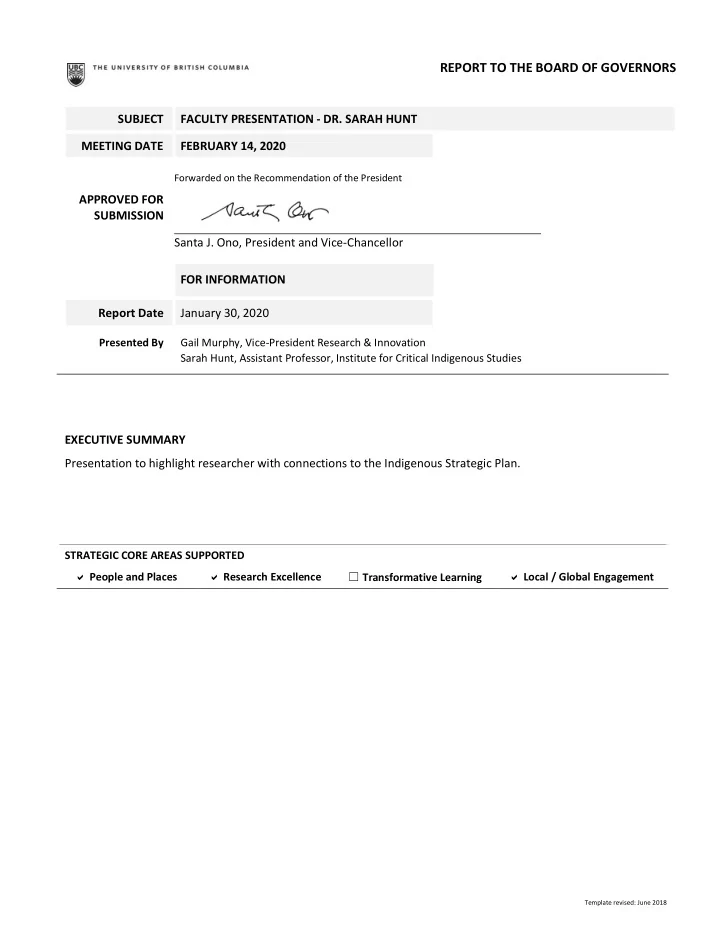
REPORT TO THE BOARD OF GOVERNORS SUBJECT FACULTY PRESENTATION - DR. - - PDF document

report to the board of governors
SMART_READER_LITE
LIVE PREVIEW

REPORT TO THE BOARD OF GOVERNORS SUBJECT FACULTY PRESENTATION - DR. - - PDF document

REPORT TO THE BOARD OF GOVERNORS SUBJECT FACULTY PRESENTATION - DR. SARAH HUNT MEETING DATE FEBRUARY 14, 2020 Forwarded on the Recommendation of the President APPROVED FOR SUBMISSION Santa J. Ono, President and Vice-Chancellor FOR


slide-1
SLIDE 1

Template revised: June 2018

REPORT TO THE BOARD OF GOVERNORS

SUBJECT FACULTY PRESENTATION - DR. SARAH HUNT MEETING DATE FEBRUARY 14, 2020 APPROVED FOR SUBMISSION

Forwarded on the Recommendation of the President

Santa J. Ono, President and Vice-Chancellor FOR INFORMATION Report Date January 30, 2020

Presented By Gail Murphy, Vice-President Research & Innovation Sarah Hunt, Assistant Professor, Institute for Critical Indigenous Studies

EXECUTIVE SUMMARY Presentation to highlight researcher with connections to the Indigenous Strategic Plan.

STRATEGIC CORE AREAS SUPPORTED  People and Places  Research Excellence ☐ Transformative Learning  Local / Global Engagement

slide-2
SLIDE 2

Gathering at the Shoreline: Redefining Justice Through Coastal Praxis

Tłaliłila’ogwa / Dr. Sarah Hunt Institute for Critical Indigenous Studies & Department of Geography, UBC sarah.hunt@ubc.ca

slide-3
SLIDE 3

Research question: What does justice feel like for coastal women?

2018-2020. Reawakening Networks of Justice in Everyday Expressions

  • f Indigenous Law: Decolonial approaches of coastal women, funded

by SSHRC Insight Development Grant.

slide-4
SLIDE 4

Tribal Journeys, 2017. Photo taken at Campbell River.

the methodology is itself an activation of coastal approaches to justice which are of concern in this project through the embodied knowledge of coastal people

slide-5
SLIDE 5

Method: shoreline gatherings

  • Research gatherings are organized into two

seasons: winter (the spirit) and summer (the body)

  • Follow seasonal patterns of life among coastal

peoples

  • Foster knowledge about ‘justice’ via collective

cultural and ocean-oriented practices

  • Research activities include gathering clams

(shoreline), spiritual bathing (river), harvesting plant medicines (forest), canoe journeys (ocean/shore), preparing salmon (house), preparing and weaving cedar (forest)

slide-6
SLIDE 6

Indigenous Political Ecologies

  • How do understandings of environment-human relations shift in

framing justice, self-determination and cultural survivance for coastal peoples’ across the nested scales of lands/waters, homes/families and bodies?

  • How are notions of the ‘environment’ challenged by coastal

knowledges embedded in Indigenous languages, place names, land- and ocean-based practices, food gathering, ceremony and everyday expressions of collective coastal identity?

  • What is required of scholars, policy makers, and others concerned

with justice for coastal peoples to fully account for coastal paradigms of justice in which the wellbeing of waters, lands, animals, ancestors, people and nations is intertwined?

slide-7
SLIDE 7

What does justice feel like for coastal people? Maintaining integrity of the emplaced interscalar relations by which we understand ourselves and continue our ways of being

  • ver time.