SLIDE 1
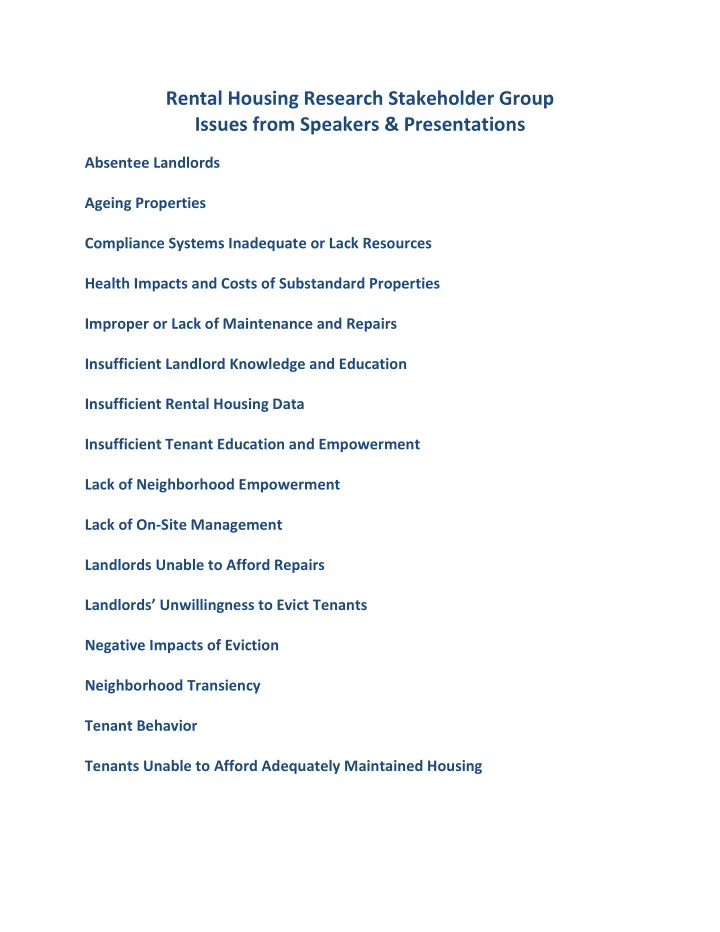
Rental Housing Research Stakeholder Group Issues from Speakers & Presentations
Absentee Landlords Ageing Properties Compliance Systems Inadequate or Lack Resources Health Impacts and Costs of Substandard Properties Improper or Lack of Maintenance and Repairs Insufficient Landlord Knowledge and Education Insufficient Rental Housing Data Insufficient Tenant Education and Empowerment Lack of Neighborhood Empowerment Lack of On‐Site Management Landlords Unable to Afford Repairs Landlords’ Unwillingness to Evict Tenants Negative Impacts of Eviction Neighborhood Transiency Tenant Behavior Tenants Unable to Afford Adequately Maintained Housing
SLIDE 2 Rental Housing Research Stakeholder Group Existing Programs
C.O.P.S. Block Watch and Neighborhood Observation Patrol Allows neighbors and volunteers to become the eyes and ears of law enforcement in their neighborhoods C.O.P.S. Code Enforcement Reporting Assists citizens with reporting code violations C.O.P.S. Crime Free Multi‐Housing Program Program for landlords of multiple units to help reduce crime in and around their rentals C.O.P.S. Safe Streets Provides support and guidance to neighbors of nuisance properties City of Spokane Building and Developer Services Enforces city building codes by inspecting and approving new building construction; and offers safety inspections in existing buildings to tenants or homeowners for a fee. City of Spokane Code Enforcement Enforces land use complaints; and city health and safety codes and ordinances; in buildings deemed unsafe or uninhabitable City of Spokane Nuisance Property Ordinance Section of Spokane Municipal Code outlining civil and criminal remedies available for properties with consistent criminal activity that may result in the building being ordered vacated for a year Gonzaga Center for Law and Justice, University Legal Assistance Free legal representation, advice, and counseling to low‐income persons 60 years of age and older Landlord Association of the Inland Northwest Landlord Education and Legal Resources Legal advice, witness program, forms and books, and landlord classes for association members Northwest Justice Project CLEAR Hotline Toll‐free hotline that provides legal assistance to low‐income individuals Rental Housing Association of Washington Member Resources Tenant screening, landlord education, and forms for association members SNAP Weatherization Program Provides assistance for improvements or repairs to increase energy efficiency in owner occupied homes
- r renter occupied homes with the owner’s permission. Also checks for home safety hazards including
carbon monoxide, lead, & asbestos
SLIDE 3
SNAP/Living Green DIY Minor Home Repairs Workshop teaching minor home repairs SNAP/Living Green Healthy Homes Workshop to reduce home allergens Solid Ground Tenant Services Informational website and phone line that provides tenant counseling and resource referral services Spokane County Bar Association Volunteer Lawyers Program Free legal assistance to low income residents Spokane Fire Department Permit System Conducts site inspections to ensure compliance with code and safety requirements as part of the issuance of sprinkler operating permits for commercial and residential buildings 5 units or larger Tenants Union Tenants Rights Hotline and Walk‐In Clinics Free phone and walk‐in counseling services from trained non‐attorney tenant counselors Washington DSHS Additional Requirements for Emergent Needs (AREN) Emergency assistance for individuals under TANF, State Family Assistance, or Refugee Cash Assistance. AREN provides emergency rental or relocation assistance, and covers repairs when there is a health risk and it is more expensive to move Washington Landlord Association Member Services & Advice Line for Landlord Members and Tenants Forms and screening services for association members. Advice line for association members and tenants Washington Law Help Guide to free civil legal services for low‐income persons and seniors Washington State 211 Referrals to rental assistance resource agencies Washington State Bar Association Moderate Means Program Housing‐related legal representation for moderate income families Washington State Landlord Tenant Act Revised Code of Washington covering legal requirements and responsibilities of landlords and tenants related to the leasing of residential property in the State of Washington Washington Web Lawyer Legal Advice Free online legal advice to low income residents via messaging system from volunteer attorneys
SLIDE 4 C.O.P.S. Block Watch and Neighborhood Observation Patrol C.O.P.S. Code Enforcement Reporting C.O.P.S. Crime Free Multi‐Housing Program C.O.P.S. Safe Streets City of Spokane Building and Developer Services City of Spokane Code Enforcement City of Spokane Nuisance Property Ordinance Absentee Landlords Ageing Properties Compliance Systems Inadequate
Health Impacts and Costs of Substandard Properties Improper or Lack of Maintenance and Repairs Insufficient Landlord Knowledge and Education Insufficient Rental Housing Data Insufficient Tenant Education and Empowerment Lack of Neighborhood Empowerment Lack of On‐site Management Landlords Unable to Afford Repairs Landlords’ Unwillingness to Evict Tenants Negative Impacts of Eviction Neighborhood Transiency Tenant Behavior Tenants Unable to Afford Adequately Maintained Housing
Issues From Speakers & Presentations Existing Programs
SLIDE 5 Absentee Landlords Ageing Properties Compliance Systems Inadequate
Health Impacts and Costs of Substandard Properties Improper or Lack of Maintenance and Repairs Insufficient Landlord Knowledge and Education Insufficient Rental Housing Data Insufficient Tenant Education and Empowerment Lack of Neighborhood Empowerment Lack of On‐site Management Landlords Unable to Afford Repairs Landlords’ Unwillingness to Evict Tenants Negative Impacts of Eviction Neighborhood Transiency Tenant Behavior Tenants Unable to Afford Adequately Maintained Housing
Issues From Speakers & Presentations
Gonzaga Center for Law and Justice, University Legal Assistance Landlord Assn of the Inland NW Landlord Education & Legal Resources Northwest Justice Project CLEAR Hotline Rental Housing Assn of Washington Member Resources SNAP Weatherization Program
Existing Programs
SLIDE 6 Absentee Landlords Ageing Properties Compliance Systems Inadequate
Health Impacts and Costs of Substandard Properties Improper or Lack of Maintenance and Repairs Insufficient Landlord Knowledge and Education Insufficient Rental Housing Data Insufficient Tenant Education and Empowerment Lack of Neighborhood Empowerment Lack of On‐site Management Landlords Unable to Afford Repairs Landlords’ Unwillingness to Evict Tenants Negative Impacts of Eviction Neighborhood Transiency Tenant Behavior Tenants Unable to Afford Adequately Maintained Housing
Issues From Speakers & Presentations
SNAP/Living Green DIY Minor Home Repairs SNAP/Living Green Healthy Homes Solid Ground Tenant Services Spokane Co. Bar Association Volunteer Lawyers Program Spokane Fire Department Permit System Tenants Union Tenants Rights Hotline and Walk‐ In Clinics
Existing Programs
SLIDE 7 Absentee Landlords Ageing Properties Compliance Systems Inadequate
Health Impacts and Costs of Substandard Properties Improper or Lack of Maintenance and Repairs Insufficient Landlord Knowledge and Education Insufficient Rental Housing Data Insufficient Tenant Education and Empowerment Lack of Neighborhood Empowerment Lack of On‐site Management Landlords Unable to Afford Repairs Landlords’ Unwillingness to Evict Tenants Negative Impacts of Eviction Neighborhood Transiency Tenant Behavior Tenants Unable to Afford Adequately Maintained Housing
Issues From Speakers & Presentations
Washington DSHS Additional Requirements for Emergent Needs (AREN) Washington Landlord Assn Member Svcs & Advice Line for Landlord Members & Tenants Washington Law Help Washington State 211 Washington State Bar Assn Moderate Means Program
Existing Programs
SLIDE 8 Absentee Landlords Ageing Properties Compliance Systems Inadequate
Health Impacts and Costs of Substandard Properties Improper or Lack of Maintenance and Repairs Insufficient Landlord Knowledge and Education Insufficient Rental Housing Data Insufficient Tenant Education and Empowerment Lack of Neighborhood Empowerment Lack of On‐site Management Landlords Unable to Afford Repairs Landlords’ Unwillingness to Evict Tenants Negative Impacts of Eviction Neighborhood Transiency Tenant Behavior Tenants Unable to Afford Adequately Maintained Housing
Issues From Speakers & Presentations Existing Programs
Washington State Landlord Tenant Act Washington Web Lawyer Legal Advice
SLIDE 9
1 2 3 4 5 6 7 8 9 10 11 12 13 14 15 16 17 18 A B
Issues Identified in Rental Housing Research Stakeholder Group Presentations
Issue Presentation Source Negative impacts of poorly maintained rental properties (health, safety, property value, quality of life) Neighborhoods Absentee landlords Neighborhoods Inability to contact responsible parties Neighborhoods No oversight (of landlords) Neighborhoods Delayed (landlord) response to property issues Neighborhoods Neighborhood erosion due to lack of (landlord) accountability Neighborhoods Transiency within neighborhoods Neighborhoods Lack of legal protection/recourse for neighbors Neighborhoods Low Incomes Landlords Need for economic growth, more jobs, job security, higher paying jobs Landlords More Ageing Properties Landlords Ageing properties cost more to repair Landlords Rents must include some costs toward repairs Landlords Unprofitable properties will be repurposed Landlords Eventually older houses will be decommissioned as rentals Landlords What support is available to keep the properties as rentals (tax breaks) Landlords 18 19 20 21 22 23 24 25 26 27 28 29 30 31 What support is available to keep the properties as rentals (tax breaks) Landlords Less rental properties available Landlords Increase in housing prices means properties can be sold after recession Landlords Rental property investment is high risk and low return Landlords Housing stocks is ageing ‐ increased repair costs Landlords Increased business risks due to more compliance Landlords Rents are not keeping up with operating and replacement costs Landlords Improved economy means landlords are more selective Landlords Landlords move to more friendly investment environments (S. Valley) Landlords Increasing cost of repairs of older properties Landlords Relatively low rents, few property condition complaints Landlords Very little new housing in City of Spokane Landlords Fewer rentals as older properties are not profitable and are retired Landlords Incentives to keep property stocks available Landlords
SLIDE 10
32 33 34 35 36 37 38 39 40 41 42 43 44 45 46 47 48 49 50 51 A B Landlords will be more selective in tenant quality Landlords Less affordable housing Landlords Less government owned housing, more reliance on private housing Landlords More demand for affordable housing from impoverished 19.9% Landlords More demand for agencies such as Spokane Housing Ventures, Charities Landlords Vacant properties (foreclosures, inability to repair) Landlords Damaged buildings (boarded up properties) Landlords Illegal habitation (squatters) Landlords Illegal activities (drugs, prostitution) Landlords Unsafe neighborhoods Landlords Gangs Landlords Lack of pride and social cohesion Landlords Unsocial behavior Landlords More property damage Landlords More lawlessness Landlords Health and safety Landlords Property prices decrease Landlords Owners won't invest in housing Landlords No empirical data about the number, type, and nature of complaints (against landlords) Landlords Legislation and Code Enforcement systems available but ineffective Landlords 51 52 53 54 55 56 57 58 59 60 61 62 63 64 65 66 Legislation and Code Enforcement systems available but ineffective Landlords Issues are not reported but the systems are in place Landlords Landlord training Landlords Limited availability of mediation Landlords No empirical data about the number, type, and nature of complaints (against tenants) Landlords Difficulty to force tenants to comply (privacy, legislation) Landlords Expensive to enforce compliance or evictions Landlords Long time to resolve and terminate tenants Landlords Limited ability to recover damages from tenants Landlords Few support avenues available to landlords Landlords Can't manage tenants behavior ‐ health, hygiene Landlords Tenants can't pay for damage Landlords Tenants can't afford to move ‐ themselves or possessions Landlords Existing compliance systems don't work Landlords Mandatory inspections ineffective, costly, and won't resolve issues Landlords Tenants rent burdened. Low income tenants have few housing options Tenants
SLIDE 11
67 68 69 70 71 72 73 74 75 76 77 78 79 80 81 A B Not enough subsidized low income housing Tenants Eviction and reasonable fear of eviction by tenants Tenants Lack of data collection on rental housing and tenant assistance Tenants Substandard housing a health hazard for tenants and neighbors Tenants Substandard housing costly for all Spokane residents including tenants Tenants Healthy and stable housing is good for tenants, landlords, and neighborhoods Tenants Resources to assist tenants are scarce, limited, or nonexistent Tenants Lack of education for both landlords and tenants SPD Lack of on site management SPD No enforcement of rules or code of conduct for tenants SPD Unwillingness to evict bad tenants SPD Lack of motivation for tenants to upkeep property when management does not maintain property or a presence SPD Expense of repeated police response SPD Physical conditions: heat, cold, light, ventilation SRHD Chemical conditions: exposure to lead, carbon monoxide, volatile chemicals SRHD Building and equipment conditions: can lead to accidents and 82 83 84 85 86 87 88 89 90 91 92 93 94 Building and equipment conditions: can lead to accidents and unintentional injury SRHD Biological conditions: mold, pests, allergens SRHD Housing characteristic correlation to emotional and behavioral problems in low‐income children and youth SRHD Renters more likely to be affected by poor housing conditions SRHD Lack of education for both landlords and tenants SRHD Lack of management SRHD Insufficient local housing data limits quantitative data SRHD Building inspection department understaffed Building Inspection Access to property if owner or tenant denies entry Building Inspection Lack of management for maintenance issues; many complaints do not fall under Building Department but rather are landlord/tenant issues Building Inspection Difficult for code enforcement to access properties to confirm violations Code Enforcement Difficult to find responsible parties for violations Code Enforcement Access to funding for owner rehabilitation Code Enforcement
SLIDE 12
95 96 97 98 99 100 101 102 103 104 105 106 107 108 109 110 A B Length of time for resolution on substandard buildings and solid waste Code Enforcement Resolution process for substandard and solid waste time intensive for staff Code Enforcement No system that provides third party inspections other than those based on complaints SFD No training program that educated property owners, managers, and renters; housing standards, code requirements, landlord/tenant laws, etc SFD No program that rewards clean records and penalizes repeat and consistent offenders SFD Low vacancy rates for low income housing SLIHC Insufficient funding for low income housing SLIHC Handling NIMBYism SLIHC Parking requirements SLIHC Rental cpas established by HUD are generally low, resulting in lack of sufficient revenue to operate the housing community in the black SLIHC Providing homes for high risk tenants with little or no support services available SLIHC Eviction process Tom McGarry and Jose Trejo Habitability ‐ Inspections Tom McGarry and Jose Trejo Habitability ‐ Tenant remedies Tom McGarry and Jose Trejo Condemnation and costs of relocation Tom McGarry and Jose Trejo No funds in city budget to pay for relocation Tom McGarry and Jose Trejo 110 111 112 113 114 No funds in city budget to pay for relocation Tom McGarry and Jose Trejo Good cause evictions Tom McGarry and Jose Trejo Mental health issues (Reasonable accomodations, companion animals, continuous evictions related to mental health issues) Tom McGarry and Jose Trejo Late charges, charges for service, and related issues Tom McGarry and Jose Trejo Nuisance statutes Tom McGarry and Jose Trejo
SLIDE 13 1
Rental Housing Research Stakeholder Group
Analysis of Data in Landlord Presentation
Background In the landlord stakeholder presentation presented by Alexander Scott on March 22, 2016, there were two slides presented titled “Facts: Profit myth – Single Family Residence” and “Facts: Profit myth – Apartment.” These slides contained representative data showing the profit/yr and cash on cash return
- f a single family home and an apartment in Spokane.
Following the presentation, some stakeholders requested an additional explanation of the data presented as well as an independent analysis. At the stakeholder meeting on May 10, 2016, Alexander Scott provided an explanation of the data he presented and provided the sources he used in his calculations. These sources, as well as a copy of the landlord stakeholder presentation were provided to Robert H. Cooke, Owner and President of R.H. Cooke & Associates, Inc. for an independent analysis. RH Cooke & Associates, Inc., is a Real Estate broker company that has been assisting the buying and selling public since 1987. Analysis (Provided by Robert H. Cooke, R.H. Cooke & Associates, Inc.) Analyzing these two slides, there are 3 items I would adjust on both slides. Working with the Single Family Slide:
- 1. Toward the bottom, you show “Repairs – structural repairs. Replace house in 27 years”. The
depreciation allowance of 27.5 years is a Federal Government incentive to encourage investment in Real Estate. It really shouldn’t be taken so literal as “replace house in 27 years” as that means 80% of all housing in Spokane should have been torn down by now. Instead of showing this on the chart as a $3,556 annual reduction from profit, I would show it in the next column to the right as increased profit of $996. I calculate $3,556 depreciation x 28% tax bracket = $996 tax savings.
- 2. The Spokane Assn of Realtors report values in May 2016 increased Average 13.6% and Median
14.3% since May 2015. You need a line item for Appreciation on your chart. In this case, Property value of $120,000 could have an additional return of $16,320 based on the 13.6%
- average. However, since 2002, the average price on a home has increased an average of 4.65%
to where it is today; this more conservative figure provides additional return of $5,580.
- 3. Your “cash on cash” return at the bottom (Loss)/Profit on Property Value% is calculated
incorrectly on this chart. You are calculating the return on the Total Property Value of $120,000 which is incorrect. It should be calculated on the cash invested which is the difference between the $120,000 purchase price and the loan amount of $84,000 = $36,000. Given the above, 1) an increase of $996 instead of a loss of $3,556 and 2) appreciation of $5,580, your bottom line Profit is not $1,469. Your bottom line profit is $8,045 or, divided by the $36,000 cash invested, your return is 22.35%.
SLIDE 14 2
- Q. Is the data in the presentation accurate and is it a realistic representation for properties of a similar
type in Spokane?
- A. For the most part, I think the presentation looks very good. I don’t know where you are getting your
stats but I’m accepting it as gospel.
- Q. What models of calculating rental budgets are commonly used by landlords or property mangers?
- A. Existing rental inventory, we go off of the historic operating budget of any given property. If it’s a
new property being put into service, calculate adjusted gross rent using a 5% vacancy, calculate the expenses which are fairly easy to do as far as get a quote on insurance, check on taxes, call for Utilities (often times just us $100/unit/month for W/S/G), 10% mgmt., and depending on the age and condition and type of the unit we throw in a figure for maintenance.
- Q. What are your thoughts on the general profitability of rental homes/units in Spokane?
- A. Great profitability. The rental market is continuing to tighten with lower inventory and increased
- rents. People that were forced to be Landlords because they couldn’t get out of their underwater real
estate investments from 2007 are now selling their homes which is displacing a lot of tenants. Continuing increases in Minimum wage is only going to drive up prices; we know tangible assets are a hedge against inflation or the weakening dollar. Real Estate is a safe haven.
- Q. What are some reasons why a property owner might rent residential property in situations where the
cash return is minimal? Calculated correctly, 22.35% is a screaming return to me. Banks paying less than 1% on deposits, that’s
- minimal. The DOW started 2016 at 17,425 and today is 17,865 or 1.38% increase in 5 months;
annualized 3.3%, that’s minimal. The DOW started in 2015 at 17,823 and ended at 17,425….a loss of 2.23%, that’s dismal.