
SLIDE 1
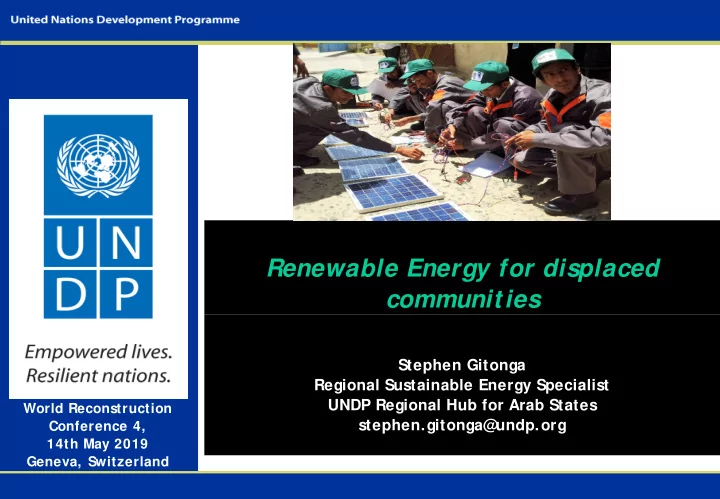
Renewable Energy for displaced communities
World Reconstruction Conference 4, 14th May 2019 Geneva, Switzerland
Stephen Gitonga Regional Sustainable Energy Specialist UNDP Regional Hub for Arab States stephen.gitonga@undp.org
Renewable Energy for displaced communities Stephen Gitonga - - PowerPoint PPT Presentation
Renewable Energy for displaced communities Stephen Gitonga Regional Sustainable Energy Specialist UNDP Regional Hub for Arab States World Reconstruction stephen.gitonga@undp.org Conference 4, 14th May 2019 Geneva, Switzerland The UN
World Reconstruction Conference 4, 14th May 2019 Geneva, Switzerland
Stephen Gitonga Regional Sustainable Energy Specialist UNDP Regional Hub for Arab States stephen.gitonga@undp.org
2
20 most water- stressed countries
14 7%
Renewable energy in the energy mix, despite highest solar radiation levels 2007-2017 saw worst drought in 1000 years famine Of world’s average annual precipitation
2.1% 1˚
Temperature rising faster than world average Risk of reduced food productivity and water availability by 20% by 2050
2-5˚
Conflict in 7 out of 18 countries
Displacement from conflict and climate
4
The Arab region in relation to energy for displaced communities
The Arab region has experienced dramatic crises events in its history
rates in the region are expanding in countries in fragile and crisis contexts owing to rising levels of conflict and displacement.
regions host close to 70% of all the 68.5 million world displaced persons.
dimensional development challenge, targeted actions to integrate energy in crisis recovery is important to ensure that nobody is left behind.
From 2007-2017, the region saw one of its most severe drought cycles in the last 1000 years, triggering large internal displacement, famine, rise of poverty, and social disruption and instability across the entire Arab region
6
Yemen, Syria, Libya, Somalia, Iraq, Sudan, Palestine.
hosting a big number of refugees compared to their populations exerting pressure to energy resources.
are unable to have sufficient energy for the general population as well as for hosted displaced communities.
Role of Energy in crisis context
Energy is about inclusivity, leaving no one behind as an enabler for long-term cost effective solution to recovery from :
8
Prior to an event Actions to prevent disruptions from shocks During an event Ability to cope with crisis as it unfolds After an event Actions to recover sustainably and quickly
9
Downstream Innovative Actions Upstream policy support
Energy in crisis context Deploying energy solutions to broader development goals. Examples in Sudan,
Yemen, Palestine, Somalia, Iraq, etc.
S upport to integrate sustainable energy solutions into national crisis response plans national partners in Jordan and Lebanon, S yria crisis
experiences
manage, maintain and
Entry points Downstream actions: Deployment of decentralized energy solutions for health, education, agriculture, businesses etc. Upstream actions: policy support including de-risking investments, enables accelerated implementation of NDCs in fragile countries.
filling policy gaps
in the integration of sustainable energy into national crisis response and resilience plans Integrating Energy considerations in crisis context
2019-2022; $7 million
It will provide Technical Assistance to crisis countries to scale up energy for recovery, both at upstream and downstream levels.
Dedicated focus on communities affected by converging disastrous forces of climate change, conflict and displacement. integrating energy responses into crisis response and recovery investments to help conflict-affected communities ‘build-back better’ and sustainably integrating climate action into crisis prevention policies to prevent climate induced conflict and displacement Empowered communities Resilient ecosystems
12
Pre-requisites for energy investments in a crisis context for displaced communities
Stephen Gitonga Regional Sustainable Energy Specialist UNDP Regional Hub for Arab States (stephen.gitonga@undp.org)