Remedial Investigation/Feasibility Study (RI/FS) Project Update - - PowerPoint PPT Presentation

remedial investigation feasibility study ri fs project
SMART_READER_LITE
LIVE PREVIEW

Remedial Investigation/Feasibility Study (RI/FS) Project Update - - PowerPoint PPT Presentation

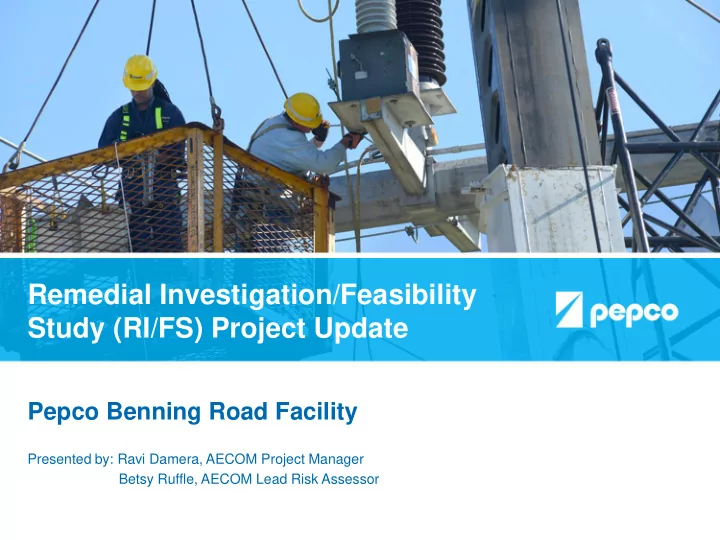
Remedial Investigation/Feasibility Study (RI/FS) Project Update Pepco Benning Road Facility Presented by: Ravi Damera, AECOM Project Manager Betsy Ruffle, AECOM Lead Risk Assessor Introduction Pepco has recently completed an evaluation of

slide-1
SLIDE 1

Remedial Investigation/Feasibility Study (RI/FS) Project Update

Pepco Benning Road Facility

Presented by: Ravi Damera, AECOM Project Manager Betsy Ruffle, AECOM Lead Risk Assessor

slide-2
SLIDE 2

2

Introduction

  • Pepco has recently completed an evaluation of environmental

conditions at the Benning Road Facility and adjacent portions

  • f the Anacostia River.
  • This evaluation is known as Remedial Investigation (RI).
  • After the investigation phase, Pepco will evaluate possible

clean up actions. This phase is known as Feasibility Study (FS).

  • Pepco agreed to undertake this work in accordance with a

court-approved consent decree with the District Department of Energy & Environment (DOEE). The consent decree was approved by the Federal District Court in December 2011.

  • DOEE is overseeing Pepco’s work and is soliciting public input

and comments during the RI/FS process.

slide-3
SLIDE 3

3

Where are we in the RI/FS Process?

RI/FS Work Plan approved by DOEE (Dec 2012) Phase 1 Field Investigation (Jan 2013 – Dec 2014) Draft RI Report (Feb 2016) Phase 2 Field Investigation (Dec 2016 – July 2018) Draft Final RI Report (September 2019) Treatability Study Feasibility Study Remedy Selection

Comment Period: 8/17/12 – 9/28/12 Public Meeting: 9/15/12 Today’s Meeting 11/2/19

Public Input

Comment Period: 3/1/16 – 4/18/16 Public Meeting: 4/2/16 Update Meeting: 3/2/13

slide-4
SLIDE 4

4

Why are we here?

 DOEE has released the Draft Final RI Report for public

comment: https://doee.dc.gov/page/pepco-benning-road-facility-plans-

and-deliverables

 These documents are also available on Benning Service Center

website: http://benningservicecenter.com/benning-consent-

decree/documents.aspx

 Hard copies are available for review at five public libraries

(Francis A. Gregory, Deanwood Public Library, Dorothy Height/Benning Library, Anacostia Library and Rosedale Library)

 Purpose of today’s meeting is to discuss findings from:

  • Field investigation activities (sampling and analysis);
  • Baseline human health risk assessment;
  • Baseline ecological risk assessment; and
  • Next Steps

Public comment period: October 04 – November 18, 2019

slide-5
SLIDE 5

5

Benning Road Facility

  • Pepco has operated this facility for more than 100 years. The facility

is currently home to the Benning Service Center, which supports Pepco's operation of its electric transmission and distribution system.

  • The facility historically housed a power generating station. The

generating station was shut down in June 2012 and was completely demolished by May 2015.

Pepco Benning Road Facility

Outfall 013 Outfall 101

DC DPW Solid Waste Transfer Facility NPS Maintenance Yard

Parkside Community

slide-6
SLIDE 6

6

RI/FS Objectives

 The purpose of the RI/FS is to answer the following:

1. What are the environmental conditions on the Benning site and the adjacent portion of the Anacostia River? 2. Did past or present operations at the Benning site cause or contribute to these conditions? 3. Do these conditions pose any unacceptable risks to human health and the environment? 4. If so, what are the appropriate cleanup options or other actions to address such risks?

  • The RI Report addresses the first three questions. (Today’s

focus)

  • The FS Report will address the fourth question. (Following final

approval of the RI Report)

RI/FS is a phased process requiring regulatory review and approvals each step of the way.

slide-7
SLIDE 7

7

Investigation Summary

  • We have conducted an extensive investigation of the Benning site

and adjacent segment of the River, including field sampling, laboratory analysis, detailed data evaluation, and human health and ecological risk assessments.

  • The investigation has identified some areas of contamination at the

site and in the River sediments consistent with the historical industrial use of the Benning site and other sites along the River, and the general urban character of the surrounding area.

  • There is unacceptable risk from fish consumption over an

extended period of time. Otherwise, the site conditions do not present any immediate health risk to people who live, work, or recreate in the area.

  • Next, we will proceed to identify and evaluate potential cleanup
  • ptions and other actions as necessary to ensure there are no long

term risks to human health or the environment as a result of Pepco’s activities at the site.

slide-8
SLIDE 8

8

Remedial Investigation Overview

slide-9
SLIDE 9

9

Regional Context

  • The Anacostia River begins in

Bladensburg, MD, at the confluence of the Northwest Branch and the Northeast Branch.

  • It flows a distance of

approximately 8.4 miles and joins the Potomac River.

  • DOEE has identified 15 Potential

Environmental Cleanup Sites (PECS) along the River.

  • Pepco Benning Road Site is one
  • f these 15 PECS.
  • For addition information visit

https://doee.dc.gov/release/public- comment-period-remedial- investigation-report-anacostia- river-sediment-project

slide-10
SLIDE 10

10

Upstream Sampling Extent Downstream Sampling Extent

Benning Study Area

Waterside Investigation Area Landside Investigation Area

DC DPW Solid Waste Transfer Facility NPS Maintenance Yard

Pepco Benning Road Facility Parkside Community River Terrace Community

Outfall 013 Outfall 101

slide-11
SLIDE 11

11

Target Contaminants

  • Polychlorinated Biphenyls (PCBs) – manmade chemicals used in a

variety of industries and products including electrical equipment, banned in 1979

  • Polycylic Aromatic Hydrocarbons (PAHs) - widespread in the

environment – some natural, most come from fossil fuels

  • Volatile Organic Compounds (VOCs) - include solvents such as

perchloroethylene (PCE) and gasoline components

  • Semi-volatile Organic Compounds (SVOCs) – include PAHs and
  • ther organic compounds that do not evaporate easily
  • Pesticides – manmade chemicals used for insect and pest control
  • Dioxins – products of incomplete combustion
  • Metals – present naturally in the environment and in many

materials used in industrial, commercial and residential products

slide-12
SLIDE 12

12

Landside Investigation

slide-13
SLIDE 13

13

Landside Conceptual Site Model

slide-14
SLIDE 14

14

Landside Investigation

  • Identified twenty Target Areas (TAs) and eight

historical and current Operational Areas (which in most cases overlap with the Target Areas).

  • A total of approximately 306 borings and 30

monitoring wells were installed to collect approximately 1,267 soil and 235 groundwater samples from the Target and Operational Areas.

  • A “step-out” sampling approach was used to

characterize locations exceeding conservative screening levels.

  • Landside sampling activities also included sampling
  • f sediment residue and water from site storm

drains.

  • Background soil and groundwater samples

collected in park lands around the Benning facility.

slide-15
SLIDE 15

15

LEGEND STORM WATER UTILITY AST ABOVE GROUND STORAGE TANK UST UNDERGROUND STORAGE TANK CT COOLING TOWER

DC DPW Solid Waste Transfer Facility NPS Maintenance Yard

FORMER POWER PLANT

Pepco Benning Road Facility

Outfall 013 Outfall 101

slide-16
SLIDE 16

16

CURRENT AND FORMER SITE OPERATIONAL AREAS LEGEND

DC DPW Solid Waste Transfer Facility NPS Maintenance Yard

Pepco Benning Road Facility

Former Equipment Laydown Area Utility Pole Storage Vehicle Servicing Vehicle Servicing Former Solvent Storage Transformer Operations Transformer Operations Transformer Operations Former Equipment Laydown Area Former Oil Storage Former Oil Tank Former Coal Pile Area Former Solvent Storage

Outfall 013 Outfall 101

slide-17
SLIDE 17

17 PCBS, Dioxins MTBE PCBS, TPH PCBS, PAHs PCE Vanadium, PCBs, PAHs, Dioxins PCBs, PAHs, TPH PAHs Former PCB Excavation Area

Outfall 101

Soil and Groundwater Impacts

5

① ② ③ ④ ⑤ ⑥ ⑦ ⑧ ⑨ ⑩ ⑪ ⑫ ⑬ ⑭ ⑮ ⑯ ⑰ ⑱ ⑲ ⑳

⑪ BUILDING #68 (PCB BUILDING) ⑫ BUILDING #57 (TRANSFORMER SHOPS) ⑱ KENILWORTH FUELING ISLAND MTBE PLUME ⑲ PCE IN GROUNDWATER ⑳ PAHs IN SOIL – FORMER EQUIPMENT LAYDOWN

AREA TARGET AREA KEY:

① FORMER SLUDGE DEWATERING AREA ④ 2003 SALVAGE YARD INVESTIGATION ⑤ FORMER COOLING TOWERS - 1995 & 2017

CLEANUP AREA

⑩ RED TAG STORAGE AREA

LEGEND

STORM WATER UTILITY

  • APPROX. SOIL IMPACT
  • APPROX. GROUNDWATER IMPACT

PCE

slide-18
SLIDE 18

18

Landside Summary

 Free or floating oil was not detected in any of the soil borings or

groundwater monitoring wells.

 Metals, PCBs, PAHs, Dioxins, and Petroleum Hydrocarbons were

detected in soils in several Target Areas in excess of screening levels.

 With the exception of vanadium in soils, metals in soil and groundwater

are generally consistent with or below background levels.

 MTBE (a gasoline additive) and PCE (a common dry cleaning fluid and

solvent) exceeded screening values in groundwater.

 Neither current nor historical groundwater discharges from the site to

the River are a significant pathway for migration of contaminants.

 Storm drain residues sampled during the RI reflect accumulated

sediments over a period of several decades. Presence of PCBs in these samples suggests discharges from Outfall 013 may have contributed to PCB impacts in the Cove.

 These detections and the CSM framework are further subjected to a risk

assessment to determine risks due to landside contamination.

slide-19
SLIDE 19

19

Waterside Investigation

slide-20
SLIDE 20

20

Waterside Conceptual Site Model

Fish and Invertebrate Consumption by Wildlife Kayaker Swimmer Direct contact (incidental ingestion and dermal contact) with fringe surface sediment and surface water Off-Site Sources and Upstream Discharges

Potential Historic Site Contributions

Pepco and Non-Pepco Stormwater Outfalls Tidal Exchange Fish Surface Water Pore Water Benthic Invertebrates Groundwater Discharge Bedded Sediment Bioactive Zone Net Sediment Deposition Recreational/Subsistence Angler:

  • Fish Ingestion
  • Direct contact (incidental ingestion

and dermal contact) with fringe surface sediment and surface water

slide-21
SLIDE 21

21

Landside Investigation

Waterside Investigation

  • River bottom survey to determine location

and depth of river channel and identify buried utilities and debris.

  • Collected 20 water samples and

approximately 449 sediment samples from

  • ver 90 locations.
  • Water and sediment sampling using barge
  • r boat mounted equipment to ~ 8-10 ft

below the mudline.

  • Conducted pore water sampling, benthic

macroinvertebrate surveys, and toxicity testing at 20 locations within the waterside investigation area and upstream background locations.

slide-22
SLIDE 22

22

Landside Investigation

PCB Distribution in the Waterside Investigation Area Elevated PCB levels were detected in the Cove

slide-23
SLIDE 23

23

Waterside Investigation Summary

 Surface water concentrations generally below screening levels and

generally consistent with background conditions.

 Concentrations of several metals, pesticides, PAHs, and PCBs

exceeded ecological screening levels in sediment in the Waterside Investigation Area. The highest concentrations of these constituents are generally located in the River Cove, into which Outfall 013 from the site and three other pipes not associated with the site discharge.

 Concentrations of most chemicals in surface sediment are consistent

with background conditions, but surface sediment PCBs, particularly in the Cove, exceeded site-specific background concentrations.

 Waterside Investigation Area including the Cove is net depositional.  These detections and the CSM framework are further subjected to a risk

assessment to determine risks due to waterside contamination.

The Anacostia River is an urban waterway with numerous off- site and upstream contaminant sources.

slide-24
SLIDE 24

24

Risk Assessments

slide-25
SLIDE 25

25

Risk Assessment

 Two types of risk assessments: Baseline Human Health Risk

Assessment (BHHRA) and Baseline Ecological Risk Assessment (BERA)

 Objective: To evaluate exposure to chemicals in –

  • Landside soil and groundwater
  • Anacostia River surface water, sediment, and fish

 Conducted in accordance with guidance issued by the U.S.

Environmental Protection Agency (EPA) for Superfund sites

slide-26
SLIDE 26

26

Baseline Human Health Risk Assessment

BHHRA evaluated two types of potential health effects:

  • Cancer risks are expressed in terms of probability that exposure

to a carcinogen will result in cancer.

  • EPA acceptable cancer risk level is 1 chance in one million to 1

chance in ten thousand (10-6 to 10-4).

  • Noncancer hazards are effects other than cancer, such as heart
  • r liver disease.
  • Noncancer hazard is estimated using a Reference Dose (RfD), which

is the amount of chemical a person (including sensitive individuals) could be exposed to on a daily basis without developing adverse health effects.

  • Comparison of the Site exposure estimate to the RfD establishes a

Hazard Index (HI).

  • An HI greater than 1 suggests that an adverse effect is possible.
slide-27
SLIDE 27

27

Potential Human Receptors and Exposure Pathways

Media Potential Exposure Pathways Current On-Site Worker Current/ Future Construction Worker Current/ Future Recreational Visitor Future On-Site Worker Soil Ingestion, Skin Contact, Inhalation of Outdoor Air

  • l

l l

Ingestion, Skin Contact, Inhalation of Outdoor Air

  • l
  • Inhalation of Indoor Air
  • (a)

Media Potential Exposure Pathways Current/ Future Swimmer Current/ Future Wader Current/ Future Angler Current/ Future Shoreline Worker Surface Sediment Ingestion and Skin Contact

l l l l

Surface Water Ingestion and Skin Contact

l l l l

Fish Tissue Ingestion

  • l
  • l
  • Not Applicable

(a)

There are no current exposures. A screening level evaluation of the potential for vapors in groundwater to enter the indoor air of a hypothetical future building was conducted. Potentially complete exposure pathway Exposure Pathway considered to be incomplete or insignificant

Groundwater

LANDSIDE

Potential Human Receptors/Exposure Pathways

WATERSIDE

Potential Human Receptors/Exposure Pathways

slide-28
SLIDE 28

28

Findings of Baseline Human Health Risk Assessment

Landside

  • No unacceptable risks/hazards

for all receptors under current conditions

  • No unacceptable risk/hazard for

future recreational visitor

  • Risk/hazard for future workers

exceeds acceptable risk benchmarks in limited areas

  • Potential unacceptable

risk/hazard from hypothetical future vapor intrusion pathway

Waterside

  • No unacceptable surface

water risks/hazards for all receptors

  • Slight sediment contact risk for

worker, angler, and wader

  • Risk > 10-6 but less than 10-5
  • Fish consumption risk/hazard

exceeds acceptable risk benchmarks

  • Fish samples from 3-mile stretch
  • f Upper Anacostia River
  • Similar to risks/hazards for Lower

Anacostia River and Potomac River

slide-29
SLIDE 29

29

Comparison of Regional Fish Consumption Risks

Notes: Upper Potomac River: Upstream of the 14th Street bridge Lower Potomac River: Downstream of the 14th Street bridge Upper Anacostia River: Upstream of the CSX bridge Lower Anacostia River: Downstream of the CSX bridge Non-Tidal Anacostia: Upstream of the Maryland state line

slide-30
SLIDE 30

30

slide-31
SLIDE 31

31

Baseline Ecological Risk Assessment BERA evaluated:

 Direct contact with sediment and pore water by benthic

macroinvertebrates (e.g., worms, insects)

 Ingestion of contaminated food sources and exposure to

contaminated sediments and surface water by fish

 Ingestion of contaminated prey items (fish) and sediment by

birds and mammals

slide-32
SLIDE 32

32

Findings of Baseline Ecological Risk Assessment

 No receptors evaluated in the BERA exhibited a high

potential for ecological risk.

 For the majority of receptors, the BERA found no potential

for ecological risk.

 For benthic macroinvertebrates, the BERA found a low

potential for risk near the cove, however, similar risks were found for the upstream background area.

 No potential risk was identified to fish.  No potential risk was identified to wildlife.

slide-33
SLIDE 33

33

Next Steps

slide-34
SLIDE 34

34

Cleanup Actions Already Underway or Completed

 Closed-circuit television (CCTV) inspection of the facility storm drain

system was conducted in 2015 and repeated in 2018. Based on the investigations, Pepco performed cleanout of the storm drain system and carried out repairs.

  • Removed 47 cubic yards of accumulated sediments (which may have been

a continued source of contamination) (Completed in August 2015)

  • An additional 9.5 tons of sediment was removed (Completed in 2018)
  • Storm drain repairs and replacements (Completed in 2018 and 2019)

 Installed various stormwater treatment measures (biofilters, physical

media filtration and adsorption to remove metals and suspended solids [Completed in 2017 and 2018]).

 Cooling Tower concrete basins and impacted soil removal (completed in

2017).

  • Complete removal and off-site disposal of concrete basins – approximately

6,666 tons of PCB-contaminated concrete

  • Excavation and off-site disposal of approximately 9,923 tons of PCB-

contaminated soil

slide-35
SLIDE 35

35

Next Steps

 Hold a public meeting to update the community on Draft Final RI Report

findings (today’s meeting)

 Address public comments and finalize the RI Report (Pepco and DOEE,

February 2020)

 Conduct Treatability Studies and submit Treatability Study Report to

DOEE (Pepco, October 2020)

 Submit Draft Feasibility Study Report to DOEE per Consent Decree

schedule (Pepco, February 2021)

 Submit the Final FS report after DOEE review of and public comment on

the Draft FS Report (Pepco, September 2021)

 Select remedy and prepare Record of Decision (DOEE)

Detailed schedule is available on the Benning Service Center website (http://benningservicecenter.com/benning-consent-decree/documents.aspx)

slide-36
SLIDE 36

36

Draft RI Report Public Comment

  • DOEE and Pepco are inviting public comments.
  • Public Comment period closes on November 18, 2019.
  • DOEE will accept comments in the following format.
slide-37
SLIDE 37

37

Questions and Comments