Relational Model It is the most popular implementation model CS - - PowerPoint PPT Presentation

relational model
SMART_READER_LITE
LIVE PREVIEW

Relational Model It is the most popular implementation model CS - - PowerPoint PPT Presentation

Relational Model It is the most popular implementation model CS 2550 / Spring 2006 Simplest, most uniform data structures Most formal (algebra to describe operations) Principles of Database Systems Introduced in 1970 (by E. F.


slide-1
SLIDE 1

1

CS 2550 / Spring 2006 Principles of Database Systems

Alexandros Labrinidis University of Pittsburgh 02 – Relational Model

Alexandros Labrinidis, Univ. of Pittsburgh

2

CS 2550 / Spring 2006

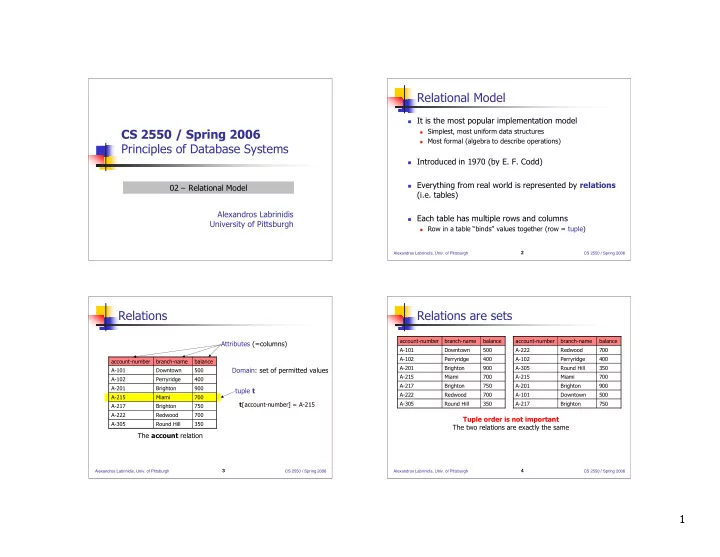
Relational Model

 It is the most popular implementation model

 Simplest, most uniform data structures  Most formal (algebra to describe operations)

 Introduced in 1970 (by E. F. Codd)  Everything from real world is represented by relations

(i.e. tables)

 Each table has multiple rows and columns

 Row in a table “binds” values together (row = tuple) Alexandros Labrinidis, Univ. of Pittsburgh

3

CS 2550 / Spring 2006

tuple t

Relations

350 Round Hill A-305 700 Redwood A-222 750 Brighton A-217 700 Miami A-215 900 Brighton A-201 400 Perryridge A-102 500 Downtown A-101 balance branch-name account-number

The account relation Attributes (=columns) Domain: set of permitted values

t[account-number] = A-215

Alexandros Labrinidis, Univ. of Pittsburgh

4

CS 2550 / Spring 2006

Relations are sets

350 Round Hill A-305 700 Redwood A-222 750 Brighton A-217 700 Miami A-215 900 Brighton A-201 400 Perryridge A-102 500 Downtown A-101 balance branch-name account-number 350 Round Hill A-305 750 Brighton A-217 700 Redwood A-222 500 Downtown A-101 900 Brighton A-201 700 Miami A-215 400 Perryridge A-102 balance branch-name account-number

Tuple order is not important The two relations are exactly the same

slide-2
SLIDE 2

2

Alexandros Labrinidis, Univ. of Pittsburgh

5

CS 2550 / Spring 2006

The Mathematical Concept of Relation

Let D1, D2,…, Dn be domains (not necessarily distinct)

the Cartesian product of these n sets D1 x D2 x … x Dn

is the set of all possible ordered n-tuples

(v1, v2,…, vn ) such that v1∈D1, v2∈D2, …, vn∈Dn

Example: let D1= {Nick, Susan} and D2= {BS, MS, PhD}

D1 x D2 = {(Nick, BS), (Nick, MS), (Nick, PhD), (Susan,BS), (Susan, MS), (Susan, PhD)}

Α relation is any subset of the Cartesian product

 R1= {(Nick,BS),(Nick, MS), (Susan, BS), (Susan, PhD)}  R2= {} Alexandros Labrinidis, Univ. of Pittsburgh

6

CS 2550 / Spring 2006

Relation Schema

 A relation schema specifies:

 Name of relation  Names of attributes of the relation  The domain for each attribute

 Database schema = set of relation schemas, constraints

(i.e. the logical design)

 Database instance = snapshot of the data in database

Alexandros Labrinidis, Univ. of Pittsburgh

7

CS 2550 / Spring 2006

Relation Schema Examples

Account-schema = (account-number, branch-name, balance)

Branch-schema = (branch-name, branch-city, assets)

Customer-schema=(customer-name, customer-street, customer-city)

For simplicity assume customer-name unique

Depositor-schema = (customer-name, account-number)

Loan-schema = (loan-number, branch-name, amount)

Borrower-schema = (customer-name, loan-number)

Alexandros Labrinidis, Univ. of Pittsburgh

8

CS 2550 / Spring 2006

Keys

 Same definitions from Entity-Relationship model  Superkey

 Set of one or more attributes that, taken collectively,

uniquely identify a tuple within the relation

 E.g., {customer-name}, {customer-name, customer-city}

 Candidate key

 Superkey for which no proper subset is superkey (i.e. minimal)  E.g., {customer-name}

 Primary key

 Candidate key chosen by database designer as principal means

  • f identifying tuples within relation
slide-3
SLIDE 3

3

Alexandros Labrinidis, Univ. of Pittsburgh

9

CS 2550 / Spring 2006

Foreign Keys

 A relation r1 may include among its attributes the

primary key of another relation, r2

 This attribute is called foreign key from r1 referencing r2  r1 is called the referencing relation  r2 is called the referenced relation  Example

 loan-schema includes “branch-name” which is a primary key for

branch-schema

 therefore: branch-name is foreign key Alexandros Labrinidis, Univ. of Pittsburgh

10

CS 2550 / Spring 2006

Schema Diagram

branch-city assets branch-name branch branch-name balance account-number account customer-street customer-city customer-name customer customer-name account-number depositor branch-name amount loan-number loan customer-name loan-number borrower

Alexandros Labrinidis, Univ. of Pittsburgh

11

CS 2550 / Spring 2006

Roadmap

 Relational Model  Relational Schema  Keys  Schema Diagrams  Relational Algrebra

 Fundamental operators Alexandros Labrinidis, Univ. of Pittsburgh

12

CS 2550 / Spring 2006

Relational Algebra

 Procedural Query Language  Fundamental Operators  Unary

 Select  Project  Rename

 Binary

 Union  Set Difference  Cartesian-Product

slide-4
SLIDE 4

4

Alexandros Labrinidis, Univ. of Pittsburgh

13

CS 2550 / Spring 2006

Select Operator

 select operator selects tuples that satisfy given predicate

σpredicate (relation)

 selection predicate:

 comparisons: =, !=, <, <=, >, =>  combinations:

and

  • r

not

 Example:  σamount>1200 (loan)

  • ¬

1300 Perryridge L-16 2000 Redwood L-23 1500 Perryridge L-15 1500 Downtown L-14 amount branch-name loan-number 2000 Redwood L-23 1000 Downtown L-17 900 Round Hill L-11 1300 Perryridge L-16 500 Mianus L-93 1500 Perryridge L-15 1500 Downtown L-14 amount branch-name loan-number 2000 Redwood L-23 1000 Downtown L-17 900 Round Hill L-11 1300 Perryridge L-16 500 Mianus L-93 1500 Perryridge L-15 1500 Downtown L-14 amount branch-name loan-number

Alexandros Labrinidis, Univ. of Pittsburgh

14

CS 2550 / Spring 2006

Project Operator

 project operator returns relation with attributes left out

Πattribute-list (relation)

 attribute-list relation

 Example:  Πcustomer-name (depositor)

  • A-215

Smith A-222 Lindsay A-102 Hayes A-217 Jones A-305 Turner A-201 Johnson A-101 Johnson account-number customer-name Smith Lindsay Hayes Jones Turner Johnson customer-name

Alexandros Labrinidis, Univ. of Pittsburgh

15

CS 2550 / Spring 2006

Composition of Relational Operators

 Result of relational operator is a relation!  Can arbitrary combine operators  Relations are sets  eliminate duplicate values  Example:  Πbranch-name (σamount>1200 (loan))

1300 Perryridge L-16 2000 Redwood L-23 1500 Perryridge L-15 1500 Downtown L-14 amount branch-name loan-number Perryridge Redwood Downtown branch-name

Alexandros Labrinidis, Univ. of Pittsburgh

16

CS 2550 / Spring 2006

Union Operator

 Set operation: r U s  Produces union of two sets  For union operation to be valid between r and s:

 1. both relations must be of same arity  2. domains of corresponding attributes must match

 Commutative operation

 r U s = s U r

slide-5
SLIDE 5

5

Alexandros Labrinidis, Univ. of Pittsburgh

17

CS 2550 / Spring 2006

Set Difference Operator

 Set operation: r – s  Allows us to find tuples that are in relation r, but not in s  Relations must have same arity and matching attribute

domains, as with the Union operator

 Non-commutative operation

 r – s != s – r Alexandros Labrinidis, Univ. of Pittsburgh

18

CS 2550 / Spring 2006

Cartesian-Product Operator

 Cartesian product operator (x) allows us to combine

information from any two relations

 Combine attribute-lists:

 Relation r, schema R =(A, B, C)  Relation s, schema S =(C, D, E)  r x s, schema =(r.A, r.B, r.C, s.C, s.D, s.E) =(A, B, r.C, s.C, D, E)

 Cardinality of relation r = number of tuples in r

 notation: cardinality(r) = |r|

 Cardinality of Cartesian product:

 |r x s| = |r| * |s| Alexandros Labrinidis, Univ. of Pittsburgh

19

CS 2550 / Spring 2006

Rename Operator

 rename operator gives name to results

ρnew-name (expression)

 If we also want to rename attributes to A1, A2, …, An

ρ(A1, A2, …, An) (expression)

Alexandros Labrinidis, Univ. of Pittsburgh

20

CS 2550 / Spring 2006

Relational Algebra (Formal Definition)

 A relational algebra expression is:

 A relation in the database  A constant relation, e.g., {(A-101, Pgh, $20), (A-203, Oak, $5)}  E1 U E2  E1 – E2  E1 x E2  σ predicate(E1)  Π attr-list(E1)  ρ new-name(E1)  where E1 and E2 are also relational-algebra expressions

slide-6
SLIDE 6

6

Alexandros Labrinidis, Univ. of Pittsburgh

21

CS 2550 / Spring 2006

Relational Operators

Fundamental Operators

Select

Project

Union

Set Difference

Cartesian Product

Rename Operator

Additional Operators

Set Intersection

Natural Join

Division

Assignment

Extended Relational Operators

Generalized Projection

Aggregation

Aggregation with Grouping

Outer-Join

Alexandros Labrinidis, Univ. of Pittsburgh

22

CS 2550 / Spring 2006

Set Intersection Operator

 Set operation: r s  Allows us to find tuples that are in both relations r and s  Relations must have same arity and matching attribute

domains, as with the Union operator

 r s = r – (r – s)  Question: is it commutative?

I I

Alexandros Labrinidis, Univ. of Pittsburgh

23

CS 2550 / Spring 2006

Natural-Join Operator

 Forms a cartesian product of its two argument relations  Performs selection, forcing equality on attributes that

appear on both relations

 Removes duplicate attributes  If r, s have no common attributes

then r x s = r s

Alexandros Labrinidis, Univ. of Pittsburgh

24

CS 2550 / Spring 2006

Relational Database Example

 Employee (SSN, name, street, city)  Works (SSN, comp-name, salary)  Company (comp-name, comp-city, state)  Manages (SSN, manager-SSN)  Note: we will sometimes use the initials of the relations

instead of their full names

slide-7
SLIDE 7

7

Alexandros Labrinidis, Univ. of Pittsburgh

25

CS 2550 / Spring 2006

Example Queries /1

 Find all employees that live in “Pittsburgh”

σ city = “Pittsburgh” (Employee)

 Find the names of all employees that live in Pittsburgh

Π name (σ city = “Pittsburgh” (Works))

 Find the names of all the employees that work for

“Blockbuster” Π name (σ comp-name = “Blockbuster” (Employee Works))

 OR, equivalently:

Π name (Employee σ comp-name = “Blockbuster” (Works))

Alexandros Labrinidis, Univ. of Pittsburgh

26

CS 2550 / Spring 2006

Example Queries /2

 Find the names and cities of all the employees that work

for “Blockbuster” Π name,city (σ comp-name = “Blockbuster” (Employee Works))

 Find the names, salaries and cities of all employees that

work for “Blockbuster” and make over $15,000 Π name, salary, city (σ comp-name = “Blockbuster” ∧ salary > 15000 (E W))

 Find the names of all employees who live in the same

city as the company they work for Π name (σ city = comp-city (Employee Works Company))

 We would not need the selection, if comp-city was named city. Alexandros Labrinidis, Univ. of Pittsburgh

27

CS 2550 / Spring 2006 

Θ = {=,<, ≤, >, ≥, ≠}

Θ-join of r(R) and s(S)

  • n attributes r.Ai and s.Aj

r ∞ r.Ai θ s.Aj s = σ r.Ai θ s.Aj (r x s)

≥-join of r(R) and s(S): r ∞ r.B ≥ s.D s = ?

Θ-Join (condition-join)

4 3 2 8 8 6 4 2 8 6 2 1 8 6 6 2 3 3 3 C D B A 4 4 2 5 3 2 4 2 1

relation r

D C 8 6 4 3

relation s

Alexandros Labrinidis, Univ. of Pittsburgh

28

CS 2550 / Spring 2006 

Θ in join is = (equi-join)

r ∞ r.Ai = s.Aj s

equi-join of r(R) and s(S): r ∞ r.B = s.D s = ?

Equi-Join

4 3 2 8 8 6 4 2 8 6 2 1 8 6 6 2 3 3 3 C D B A 4 4 2 5 3 2 4 2 1

relation r

D C 8 6 4 3

relation s

slide-8
SLIDE 8

8

Alexandros Labrinidis, Univ. of Pittsburgh

29

CS 2550 / Spring 2006 

Equi-join without duplicate columns r ∗P s

P=list of attributes: P=R ∩ S

r∗s =π R∪S (r ∞ r.P = s.P s)

r∗s = ?

Natural-Join

4 3 2 8 8 6 4 2 8 6 2 1 8 6 6 2 3 3 3 C D B A 4 4 2 5 3 2 4 2 1

relation r

D C 8 6 4 3

relation s

Alexandros Labrinidis, Univ. of Pittsburgh

30

CS 2550 / Spring 2006

Division

Let r(R) and s(S) be relations such as S⊂R

The division of r by s, denoted by r÷s,

 is relation whose

schema is Q=R-S and

 includes all t such as

tr[Q] = t and tr[S] = t

4 3 2 8 8 6 4 2 8 6 2 1 3 3 3 C D B A 4 4 2 5 3 2 4 2 1

relation r

D C 8 6 4 3

relation s

B A 4 2 2 1

r÷s

Alexandros Labrinidis, Univ. of Pittsburgh

31

CS 2550 / Spring 2006

Division Usage

4 CS S F 8 EE L K 8 EE A S CS CS CS DP No LN FN 4 L K 5 K M 4 A S

relation r

No DP 8 EE 4 CS

relation s

LN FN L K A S

r÷s Query: “Retrieve the names of students who took all the classes that John took.”

Note: Division can be expressed using π, x and – operations: r÷s= πQ(r) – πQ((πQ(r) x s) – r)

Alexandros Labrinidis, Univ. of Pittsburgh

32

CS 2550 / Spring 2006

Division

 r ÷ s  suitable for queries that include phrase “for all”  Definition:

 relation r, schema R = (A1, A2, …, Am, B1, B2, …, Bn)  relation s, schema S = (B1, B2, …, Bn)  relation r ÷ s, schema Q = R – S = (A1, A2, …, Am )  Tuple t in r ÷ s if  t in ΠQ(r), and  for every tuple u in s, tu is in r

 Alternative definition

 r ÷ s = ΠQ(r) – ΠQ( (ΠQ(r) x s) – r )

slide-9
SLIDE 9

9

Alexandros Labrinidis, Univ. of Pittsburgh

33

CS 2550 / Spring 2006

Assignment Operator

 Assign parts of relational expression to

temporary variables

 Assignment operation   Works like assignment in programming languages  Example:

 tmp1  ΠQ(r) x s  tmp2  ΠQ( tmp1 – r ) Alexandros Labrinidis, Univ. of Pittsburgh

34

CS 2550 / Spring 2006

Relational Operators

Fundamental Operators

Select

Project

Union

Set Difference

Cartesian Product

Rename Operator

Additional Operators

Set Intersection

Natural Join

Division

Assignment

Extended Operators

Generalized Projection

Aggregation

Aggregation with Grouping

Outer-Join

Alexandros Labrinidis, Univ. of Pittsburgh

35

CS 2550 / Spring 2006

Generalized Projection

 Extend projection operator by allowing arithmetic

functions in the projection list

 General form:

Π F1, F2, …, Fn (expr)

 Example:

 Π customer_name, credit_limit – balance (credit-info)  Π customer_name, (credit_limit – balance) as available_credit (credit-info) Alexandros Labrinidis, Univ. of Pittsburgh

36

CS 2550 / Spring 2006

Aggregate Functions

 Take collection of values and return single result  Examples:

 sum(), min(), max(), count(), avg()

 Notation:

G sum(salary) (employees)

 sets: no duplicates  multisets: duplicates allowed

slide-10
SLIDE 10

10

Alexandros Labrinidis, Univ. of Pittsburgh

37

CS 2550 / Spring 2006

Aggregate Function Example

35K Downtown Johnson 50K Downtown Loreena 30K Austin Rao 40K Downtown Peterson 25K Perryridge Gopal 20K Austin Sato 50K Perryridge Brown 40K Perryridge Adams salary branch-name employee-name

G avg(salary) (employees)

36.25k Sum of salary

Alexandros Labrinidis, Univ. of Pittsburgh

38

CS 2550 / Spring 2006

Aggregate Function Example – II

35K Downtown Johnson 50K Downtown Loreena 30K Austin Rao 40K Downtown Peterson 25K Perryridge Gopal 20K Austin Sato 50K Perryridge Brown 40K Perryridge Adams salary branch-name employee-name

G count-distinct(branch-name) (employees)

3 Count of branch-name

Alexandros Labrinidis, Univ. of Pittsburgh

39

CS 2550 / Spring 2006

 Example:

 total employee salaries per Branch  partition relation employees into groups  apply aggregate per group

Aggregation with Grouping

35K Downtown Johnson 50K Downtown Loreena 30K Austin Rao 40K Downtown Peterson 25K Perryridge Gopal 20K Austin Sato 50K Perryridge Brown 40K Perryridge Adams salary branch-name employee-name

branch-name G sum(salary) (employees)

125K Downtown 50K Austin 115K Perryridge salary branch-name

Alexandros Labrinidis, Univ. of Pittsburgh

40

CS 2550 / Spring 2006

Outer Join

 Join selects only tuples satisfying the join condition  Outer Join

 Left outer join (r ]∞ s) also keeps every tuple in first or left

relation

 Right outer join (r ∞[ s) also keeps every tuple in second or

right relation

 Full outer join (r ]∞[ s) also keeps every tuple

 Attributes of tuples with no matching tuples are set to

NULL

slide-11
SLIDE 11

11

Alexandros Labrinidis, Univ. of Pittsburgh

41

CS 2550 / Spring 2006

Outer Join

C B A d b c f a d c b a

relation r

D B A f a d a g b

relation s

a Null g b Null d b c f c C D B A f a d Null b a

r ]∞[ s

Null d b c f c C D B A f a d Null b a

r ]∞s

a Null g b f C D B A f a d

r ∞[ s

Alexandros Labrinidis, Univ. of Pittsburgh

42

CS 2550 / Spring 2006

Relational Database Example

 Employee (SSN, name, street, city)  Works (SSN, comp-name, salary)  Company (comp-name, comp-city, state)  Manages (SSN, manager-SSN)  Note: we will sometimes use the initials of the relations

instead of their full names

Alexandros Labrinidis, Univ. of Pittsburgh

43

CS 2550 / Spring 2006

Example Queries /1

 Find all employees that live in “Pittsburgh”

σ city = “Pittsburgh” (Employee)

 Find the names of all employees that live in Pittsburgh

Π name (σ city = “Pittsburgh” (Works))

 Find the names of all the employees that work for

“Blockbuster” Π name (σ comp-name = “Blockbuster” (Employee Works))

 OR, equivalently:

Π name (Employee σ comp-name = “Blockbuster” (Works))

Alexandros Labrinidis, Univ. of Pittsburgh

44

CS 2550 / Spring 2006

Example Queries /2

 Find the names and cities of all the employees that work

for “Blockbuster” Π name,city (σ comp-name = “Blockbuster” (Employee Works))

 Find the names, salaries and cities of all employees that

work for “Blockbuster” and make over $15,000 Π name, salary, city (σ comp-name = “Blockbuster” ∧ salary > 15000 (E W))

 Find the names of all employees who live in the same

city as the company they work for Π name (σ city = comp-city (Employee Works Company))

 We would not need the selection, if comp-city was named city.

slide-12
SLIDE 12

12

Alexandros Labrinidis, Univ. of Pittsburgh

45

CS 2550 / Spring 2006

Example Queries /3

 Find the names of all employees who live on the same

street and city as their managers

 Note: we will need to join employee (E), manager (M), and

employee again to get the street, city info for the

  • manager. For this we rename the second instance of

employee as emp2

Π E.name (σ manager-SSN = emp2.SSN

∧ E.city = emp2.city ∧ E.street = emp2.street (E M ρemp2 (E))

Alexandros Labrinidis, Univ. of Pittsburgh

46

CS 2550 / Spring 2006

Example Queries /4

 Find the names of all people who do not work

for “First Bank” Π name (σ comp-name ≠ “First Bank” (Employee Works))

 Note: the above assumes that all people are currently

employed, i.e. have an entry in the Works relation. If we are not to assume this, the query should be written as follows:

Π name (E) – Π name (σ comp-name = “First Bank” (E W))

Alexandros Labrinidis, Univ. of Pittsburgh

47

CS 2550 / Spring 2006

Example Queries /5

 Get the average salary of all employees

G avg(salary) (Works)

 Get the average salary of all employees at “Blockbuster”

G avg(salary) (σ comp-name = “Blockbuster” (Works))

 Get the average salary of all employees per company:

comp-name G avg(salary) (Works)

Alexandros Labrinidis, Univ. of Pittsburgh

48

CS 2550 / Spring 2006

Example Queries /6

 Find all the names of employees who live in Pittsburgh

and make between $30K and $50K Π name (σ salary >= 30000 ∧ salary <= 50000 ∧ city = “PGH”(E W))

 Find the names of the managers of all employees who

live in Pittsburgh and make between $30K and $50K t  Πmgr-SSN (σsalary>=30K ∧ salary<=50K ∧ city=“PGH”((E W)) M Π name (σ SSN = manager-SSN ( t E))