Reducing I will NOT discuss off label/ investigational use of - - PDF document

reducing
SMART_READER_LITE
LIVE PREVIEW

Reducing I will NOT discuss off label/ investigational use of - - PDF document

12/1/17 Financial Relationship Disclosure Reducing Readmissions in Heart Failure Reducing I will NOT discuss off label/ investigational use of products. Liviu Klein MD, MS Readmissions Associate Professor The following financial


slide-1
SLIDE 1

12/1/17 1

Liviu Klein MD, MS

Associate Professor Director, Mechanical Circulatory Support and Heart Failure Device Programs Liviu.Klein@ucsf.edu

Reducing Readmissions in Heart Failure

2

Financial Relationship Disclosure

I will NOT discuss off label/ investigational use of products. The following financial relationships exist: Consultant: Abbott, Boston Scientific, Medtronic.

Reducing Readmissions in Heart Failure

3

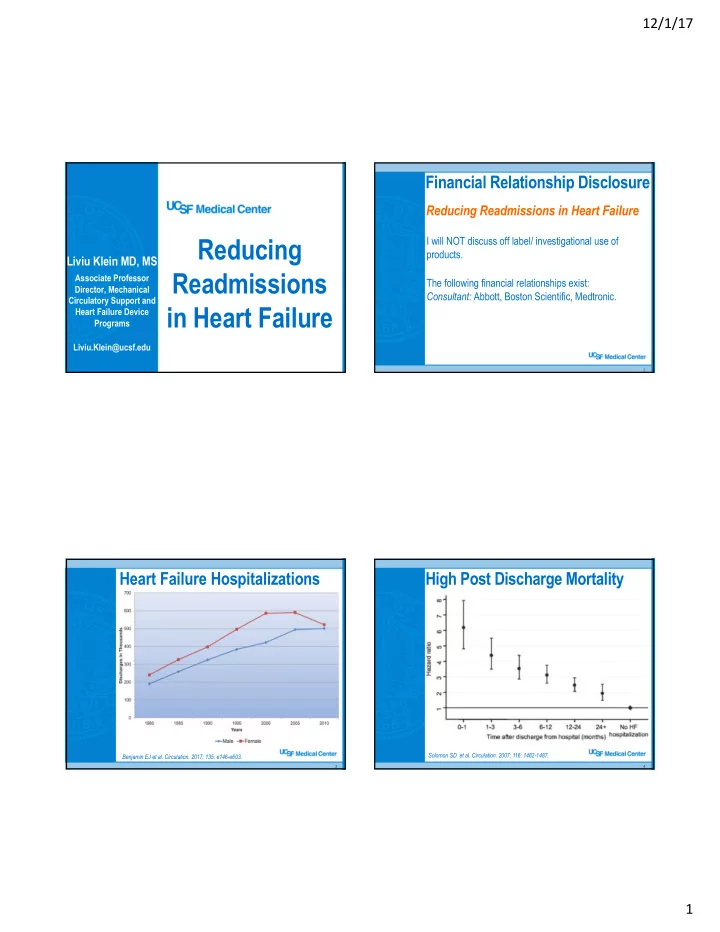
Heart Failure Hospitalizations

Benjamin EJ et al. Circulation. 2017; 135: e146-e603.

4

High Post Discharge Mortality

Solomon SD et al. Circulation. 2007; 116: 1482-1487.

slide-2
SLIDE 2

12/1/17 2

Dharmarajan K et al. JAMA. 2013; 309: 355-363.

Heart Failure ReHospitalizations

6

Heart Failure ReHospitalizations

Dharmarajan K et al. JAMA. 2013; 309: 355-363.

7

Heart Failure Costs

Home Health ($3 billion) 10% Drugs/ Medical Durables ($4 billion) 12% Physicians professional fees ($3 billion) 10% Hospital stay ($21 billion) 68%

Total Costs = $31 billion in 2012 -> $70 billion in 2030

Benjamin EJ et al. Circulation. 2017; 135: e146-e603.

8

CMS Heart Failure Readmission Reduction Program

Dharmarajan K et al. JAMA. 2017; 318: 270-278.

23.5% 21.4%

: A Success!

slide-3
SLIDE 3

12/1/17 3

9

CMS Heart Failure Readmission Reduction Program

Gupta A et al. JAMA Cardiol. 2017; in print.

: A Success?

30-day risk adjusted readmissions: 20.0% -> 18.4% -1.6 30-day risk adjusted mortality: 7.2% -> 8.6% +1.4 1 year risk adjusted readmissions: 57.2% -> 56.3% -0.9 1 year risk adjusted mortality: 31.3% -> 36.3% +5.0

CMS HFRRP and the Standard

  • f Care for Heart Failure in 2017

11

Weights and Heart Failure Hospitalizations

Chaudhry SI et al. Circulation. 2007; 116: 1549-1554.

12

Weights and Non Heart Failure Hospitalizations

Chaudhry SI et al. Circulation. 2007; 116: 1549-1554.

slide-4
SLIDE 4

12/1/17 4

13

Lynga P et al. Eur J Heart Fail. 2012; 14: 438-444.

Weights and Heart Failure Hospitalizations: WISH Trial

14

Pandor A et al. Heart. 2013;99:1717-1726.

Telemonitoring and Heart Failure Hospitalizations

Ong MK et al. JAMA Intern Med. 2016;176:310-318.

Telemonitoring and Heart Failure Hospitalizations: BEAT HF

Ong MK et al. JAMA Intern Med. 2016;176:310-318.

Telemonitoring and Heart Failure Hospitalizations: BEAT HF

slide-5
SLIDE 5

12/1/17 5

Telemonitoring and Readmissions Main Reasons for Broken Care

Symptoms worsen

Patient MD Office

ED

Hospitalization Readmission

Doesn’t recognize early signs and symptoms Limited time Limited staff Limited diagnostics Limited monitoring Limited intervention Limited patient education Only alternative ED MD with no patient relationship Safest route medically and legally Pressure on length

  • f stay shortens

time to test new medication regimen

  • r educate

Symptoms worsen

Heart Failure Signs/ Symptoms in Hospitalized Patients

Admission Discharge

Symptoms (%)

Dyspnea on exertion 79 58 Dyspnea at rest 42 5 Orthopnea 50 12 PND 33 4 Fatigue 53 57

Signs (%)

JVP > 8 cm 33 6 Rales 57 13 S3 gallop 20 6 Edema > 2+ 50 13

Gattis WA et al. J Am Coll Cardiol. 2004; 43: 1534-1540.

20

Congestion Precedes Most Heart Failure Hospitalizations

Zile MR et al. Circulation. 2008; 118: 1433-1441.

slide-6
SLIDE 6

12/1/17 6

21

Congestion Precedes Most Heart Failure Hospitalizations

Zile MR et al. Circulation. 2008; 118: 1433-1441.

Ability to Predict High PWP

  • Sens. Spec. PPV

NPV Dyspnea on exertion 66 52 45 27 Orthopnea 66 47 61 37 Edema 46 73 79 46 JVD 70 79 85 62 S3 73 42 66 44 CXR Cardiomegaly 97 10 61

  • Redistribution

60 68 75 52 Interstitial edema 60 73 78 53 Pleural effusion 43 79 76 47

Adapted from Chakko S. et al. Am J Med. 1991; 90: 353-358. Adapted from Butman SM. Et al. J Am Coll Cardiol. 1993; 22: 968-975.

Abnormal LV function (Sys and/or Dia)

Neurohormonal activation => ­ Blood volume ­ LV diastolic pressure Hemodynamic congestion (Increased PWP)

Alveolar edema ­ PA Pressure

­ RV + RA Pressure Systemic congestion (Leg edema; JVD; Hepatomegaly)

S Y M P T O M S

The Congestion Iceberg in Heart Failure

Redistribution in pulmonary vascular bed + interstitial edema

­ Hydrostatic pressure ­ Oncotic pressure ­ Permeability Lymphatic drainage capacity Alveolar-capillary membrane integrity Abnormal lung mechanics Respiratory muscle dysfunction Other factors

Dyspnea

HF Diagnostics in a Device Package

Cowie MR et al. Eur Heart J. 2013;34:2472-2480.

slide-7
SLIDE 7

12/1/17 7

HF Diagnostics in a Package

Cowie MR et al. Eur Heart J. 2013;34:2472-2480.

Proof is the Pudding (REM HF)...

Cowie MR et al. ESC Congress 2016

A New Logic? HeartLogicTM MULTISENSE

Boehmer JP et al. AHA Scientific Sessions 2016

A New Logic? HeartLogicTM

Boehmer JP et al. AHA Scientific Sessions 2016

slide-8
SLIDE 8

12/1/17 8

  • Current devices are used for arrhythmia treatment
  • HF Diagnostics are indirect physiological

assessment and a byproduct of CIED

  • Only 20-25% of heart failure patients qualify for an

implantable device

  • 5-10% complication rate for the implant procedures
  • Costly ~ $ 30,000 per device
  • Newer implantable devices target diagnostics

– Cost ? – Complications?

Issues with CIED in HF Patients Hemodynamic vs. Clinical Congestion in Heart Failure

Heart Rate Variability Resting heart rate Activity level Respiration rate Intrathoracic fluid

Adapted from Adamson P. Curr Heart Fail Rep. 2009;6:287-292. Zile MR et al. Circ Heart Fail. 2017;10:e3594-e3604.

Hemodynamics and Outcomes

CardioMEMS™ HF System

PA Sensor and Delivery System

120 cm 4.5 cm

Patient Electronics System PA Pressure Database

Physician Access Via Secure Website

slide-9
SLIDE 9

12/1/17 9

Abraham WT et al. Lancet. 2016;387:453-461.

CHAMPION Trial – Long Term

Adamson PB et al. Circ Heart Fail. 2016;9:e2600-e2610.

CHAMPION Trial – Readmissions

slide-10
SLIDE 10

12/1/17 10

Desai AS et al. J Am Coll Cardiol. 2016;69:2357-2365.

CardioMeMS Hospitalizations: Real World Experience Success of a CHAMPION: Treatment Algorithm

Costanzo MR et al. J Am Coll Cardiol HF. 2016;4:333-344.

2517 1113 1404 1061 1061 500 1000 1500 2000 2500 3000 Total Pressure-based Non-pressure based Number of medication changes during Primary Endpoint Period NA Based on knowledge

  • f PA pressures

Based on signs & symptoms Total

~1 per patient month

Reasons for Medication Changes in CHAMPION Trial

Abraham WT et al. Lancet. 2016;387:453-461. Costanzo MR et al. J Am Coll Cardiol HF. 2016;4:333-344.

CHAMPION Trial: Medications Changes

slide-11
SLIDE 11

12/1/17 11

Costanzo MR et al. J Am Coll Cardiol HF. 2016;4:333-344.

CHAMPION Trial: Diuretic Changes by PA Pressures

Costanzo MR et al. J Am Coll Cardiol HF. 2016;4:333-344.

CHAMPION Trial: Vasodilator Changes by PA Pressures

Givertz MM et al. J Am Coll Cardiol. 2017;70:1875-1886.

HFrEF Mortality Benefit with Hemodynamic Management

Givertz MM et al. J Am Coll Cardiol. 2017;70:1875-1886.

HFrEF: Best Neurohormonal and Hemodynamic Management

slide-12
SLIDE 12

12/1/17 12

Givertz MM et al. J Am Coll Cardiol. 2017;70:1875-1886.

HFrEF: Best Neurohormonal and Hemodynamic Management

Goldberg LR et al. HRS 2015

CHAMPION Trial: Symptoms vs. PAP Management

  • Improve symptoms

– ↓filling pressures, ↓ volume, ? ↑ CO without further myocardial, renal and liver damage

  • Identify triggering events

– Ischemia, hypertensive emergency, arrhythmias (AF), worsening CKD, infections, compliance

  • Change substrate (heart, kidney)
  • Initiate life saving therapies
  • Address the “vulnerable phase”
  • Palliative care/ hospice where appropriate

Management Goals During Hospitalization Identifying Triggers for Hospitalization

Fonorow GC et al. Arch Intern Med. 2008; 168: 847-854.

slide-13
SLIDE 13

12/1/17 13

Diuresis: How Far to Go – Check CVP!

Thalhammer C et al. J Am Coll Cardiol. 2007; 50: 1584-1589.

  • Symptoms significantly improved

– Assess exertional dyspnea!

  • Test exercise capacity

– 6MWD > 1000 feet

  • Volume management achieved

– Stable on oral diuretics (euvolemic) > 24 hrs.

  • Education achieved

– Teach back techniques!

  • Guideline directed medical therapy implement

– ACE-I/ ARB; BB; MRB; Diuretics

  • Post discharge follow-up within a week

– PCP/ Cardiologist, Home Health

Assessing Readiness for Discharge Mortality After Hospitalization

Harikrishnan S et al. Eur J Heart Fail. 2015; 17: 794-800.

Readmission After Hospitalization

Harikrishnan S et al. Am Heart J. 2017; 189: 193-199.

slide-14
SLIDE 14

12/1/17 14

Importance of Post Discharge Follow-up

Lee DS et al. Circulation. 2010; 122: 1806-1814.

  • Congestion is the lead cause of HF hospitalizations
  • Congestion contributes to progression of HF
  • Patients leave hospital with congestion, resulting in

high rehospitalization rate

  • Congestion is often subclinical and difficult to assess

when present

  • Significant dissociation between hemodynamic and

clinical congestion, even when hemodynamics are very abnormal

  • Need for better monitoring of degree and changes in

congestion (more accurate and sensitive)

Conclusions

  • Heart failure hospitalizations are common/ costly
  • Risk stratify and start appropriate treatment early
  • Use all means to reduce filling pressures/ volume,

without damaging myocardium, kidney and liver

  • Identify triggers of admission and change the

substrate (ischemia, arrhythmias, non compliance)

  • Implement life saving therapies
  • Discharge patients only when ready
  • Early post-discharge follow-up is key
  • Future management will involve remote home

management (wearable devices)

Conclusions

Conclusions

  • Monitoring PA Pressures can provide early

warning of condition worsening/ decompensation much better than body weight and long before symptoms

  • Most changes occur over a few days - weeks
  • Having a treatment algorithm based on PA

Pressures values is key to successful treatment and preventing heart failure readmissions

  • Always treat to max: drive pressures down to

patient’s normal

slide-15
SLIDE 15

12/1/17 15

Liviu Klein MD, MS

Associate Professor Director, Mechanical Circulatory Support and Heart Failure Device Programs Liviu.Klein@ucsf.edu 312-203-5354

New HFrEF Management

Diuretics/Vasodilators PA Pressure Monitoring ARNI Digoxin, ARB, Hy-ISDN Ivabradine ? Treat Congestion: Slow Disease Progression: Treat Residual Symptoms: BB MRB CRT ICD Sudden Death: BB MRB CRT Advanced Disease: LVADs Heart transplant Hospice

ACE-I: angiotensin converting enzyme inhibitors; ARB: angiotensin 2 receptor blockers; MRB: mineralocorticoid receptor blockers; Hy-ISDN: hydralazine/ isosorbide dinitrate; ICD: implantable cardioverter defibrillator; CRT: cardiac resynchronization therapy

New HFpEF Management

Diuretics/Vasodilators PAP Monitoring MRB ? ARNI ACE, ARB, Digoxin, Ivabradine ? Treat Congestion: Slow Disease Progression: Treat Residual Symptoms: Treat comorbidities CAD HTN A Fib Advanced Disease: Heart transplant Hospice

ACE-I: angiotensin converting enzyme inhibitors; ARB: angiotensin 2 receptor blockers; MRB: mineralocorticoid receptor blockers