Recommended Reading A Brief Introduction to OpenMP OpenMP FAQ - - PowerPoint PPT Presentation

recommended reading a brief introduction to openmp
SMART_READER_LITE
LIVE PREVIEW

Recommended Reading A Brief Introduction to OpenMP OpenMP FAQ - - PowerPoint PPT Presentation

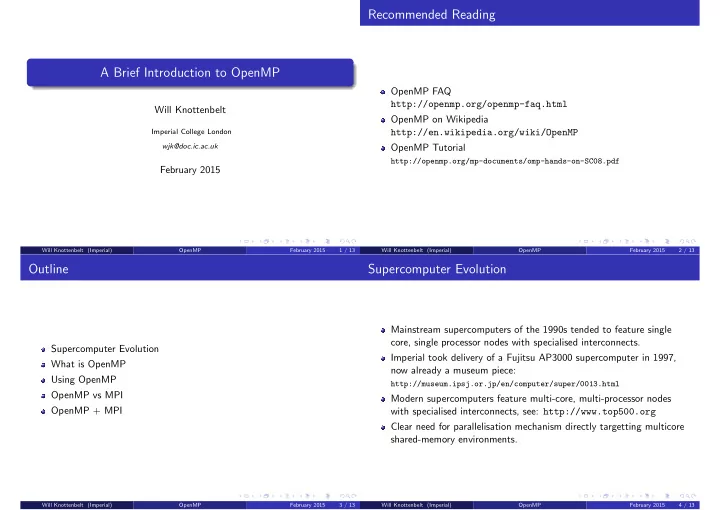
Recommended Reading A Brief Introduction to OpenMP OpenMP FAQ http://openmp.org/openmp-faq.html Will Knottenbelt OpenMP on Wikipedia http://en.wikipedia.org/wiki/OpenMP Imperial College London wjk@doc.ic.ac.uk OpenMP Tutorial


slide-1
SLIDE 1

A Brief Introduction to OpenMP

Will Knottenbelt

Imperial College London wjk@doc.ic.ac.uk

February 2015

Will Knottenbelt (Imperial) OpenMP February 2015 1 / 13

Recommended Reading

OpenMP FAQ http://openmp.org/openmp-faq.html OpenMP on Wikipedia http://en.wikipedia.org/wiki/OpenMP OpenMP Tutorial

http://openmp.org/mp-documents/omp-hands-on-SC08.pdf

Will Knottenbelt (Imperial) OpenMP February 2015 2 / 13

Outline

Supercomputer Evolution What is OpenMP Using OpenMP OpenMP vs MPI OpenMP + MPI

Will Knottenbelt (Imperial) OpenMP February 2015 3 / 13

Supercomputer Evolution

Mainstream supercomputers of the 1990s tended to feature single core, single processor nodes with specialised interconnects. Imperial took delivery of a Fujitsu AP3000 supercomputer in 1997, now already a museum piece:

http://museum.ipsj.or.jp/en/computer/super/0013.html

Modern supercomputers feature multi-core, multi-processor nodes with specialised interconnects, see: http://www.top500.org Clear need for parallelisation mechanism directly targetting multicore shared-memory environments.

Will Knottenbelt (Imperial) OpenMP February 2015 4 / 13

slide-2
SLIDE 2

What is OpenMP

OpenMP is a specification for a set of compiler directives, library routines, and environment variables for specifying shared-memory parallelism A primary design goal was to take away the pain of programming multithreaded applications and increase their portability C/C++ and Fortran supported Evolution directed by the OpenMP Architecture Review Board

Will Knottenbelt (Imperial) OpenMP February 2015 5 / 13

Using OpenMP

Supports incremental parallelisation of sequential code via addition of compiler directives. So int main() { cout << "hello world" << endl; return 0; } becomes: #include <omp.h> int main() { #pragma omp parallel { cout << "hello world" << endl; } return 0; }

Will Knottenbelt (Imperial) OpenMP February 2015 6 / 13

Using OpenMP (cont.)

Support built into gcc/g++:

g++ omp_basic_hello.cpp -o omp_basic_hello -fopenmp

Default number of threads controlled by environment variable OMP_NUM_THREADS (use setenv or export to set depending on your shell) Execute as normal: ./omp_basic_hello

Will Knottenbelt (Imperial) OpenMP February 2015 7 / 13

Using OpenMP (cont.)

In addition to parallel constructs there are various useful runtime routines e.g.: void omp_set_num_threads(int num_threads); int omp_get_num_threads(); int omp_get_thread_num(); int omp_in_parallel(); double omp_get_wtime();

Will Knottenbelt (Imperial) OpenMP February 2015 8 / 13

slide-3
SLIDE 3

Using OpenMP (cont.)

int main(int argc, char *argv[]) { int th_id, nthreads; #pragma omp parallel private(th_id) shared(nthreads) { th_id = omp_get_thread_num(); #pragma omp critical { cout << "Hello World from thread " << th_id << ’\n’; } #pragma omp barrier #pragma omp master { nthreads = omp_get_num_threads(); cout << "There are " << nthreads << " threads" << ’\n’; } } return 0; }

Will Knottenbelt (Imperial) OpenMP February 2015 9 / 13

Using OpenMP (cont.)

For loops can be scheduled in parallel, in a dynamic or static fashion:

#pragma omp for schedule(dynamic,chunk) for (i=0; i<N; i++) { c[i] = a[i] + b[i]; } return 0; }

Reductions are possible:

double ave=0.0, A[MAX]; int i; #pragma omp parallel for reduction (+:ave) for (i=0;i< MAX; i++) { ave + = A[i]; } ave = ave/MAX;

Will Knottenbelt (Imperial) OpenMP February 2015 10 / 13

OpenMP vs MPI

OpenMP is a predominantly implemented as a compiler extension; MPI is implemented as a library of functions. OpenMP uses threads, MPI processes. OpenMP is restricted to shared-memory multiprocessor platforms, the architecture of which can limit its scalability; MPI works on both shared-memory and distributed-memory platforms. OpenMP requires less expertise than MPI, allows concise incremental parallelism and yields unified code for sequential and parallel

  • applications. MPI requires more knowledge and more programming to

go from serial to parallel code. Performance comparable.

Will Knottenbelt (Imperial) OpenMP February 2015 11 / 13

OpenMP + MPI (cont.)

Increasingly popular as a complementary combination Could it really be as simple as: mpic++ program.cpp -o program -fopenmp Let’s try!

Will Knottenbelt (Imperial) OpenMP February 2015 12 / 13

slide-4
SLIDE 4

OpenMP + MPI

#include <iostream> #include <omp.h> #include "mpi.h" int main(int argc, char **argv) { int rank, tid; MPI_Init(&argc, &argv); MPI_Comm_rank(MPI_COMM_WORLD, &rank); #pragma omp parallel private(tid) num_threads(4) { tid = omp_get_thread_num(); #pragma omp critical std::cout << "[" << rank << "] Started thread " << tid << std::endl; } MPI_Finalize(); return 0; }

Will Knottenbelt (Imperial) OpenMP February 2015 13 / 13