Recent Highlights from the DEEP & AEGIS Surveys David C. Koo - - PowerPoint PPT Presentation
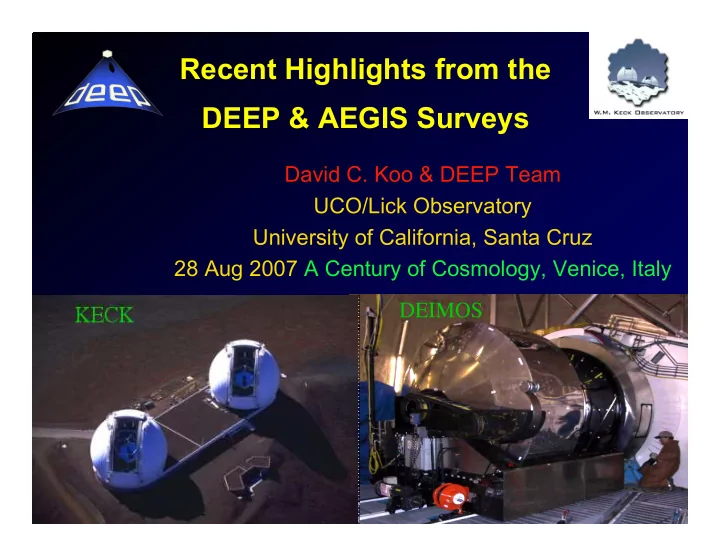
Recent Highlights from the DEEP & AEGIS Surveys David C. Koo & DEEP Team UCO/Lick Observatory University of California, Santa Cruz 28 Aug 2007 A Century of Cosmology, Venice, Italy DEIMOS KECK Outline 1) Whats DEEP? Why useful
Outline
1) What’s DEEP? Why useful for cosmology? Status. 2) What’s AEGIS? Why useful ? 3) A few recent science highlights:
- New Velocity vs Stellar Mass Relation
- Merger rates of Blue & Red Galaxies
- Young ? Massive Galaxies at z ~ 0.7
- Panchromatic Study of a HyperLIRG
4) Summary
The DEEP Collaboration
UC Berkeley: M. Davis (PI), A. Coil (AZ), C. Conway (Princeton), M. Cooper (AZ), J. Comerford, D. Croton, B. Gerke (KITP), R. Griffith, J. Newman (Pitt), R. Yan (Toronto), UCSC: S. Faber (DEIMOS PI), J. Miller, P. Guhathakurta, D. Koo, J. Cheng, A. Dutton, G. Graves, J. Harker, S. Kassin (Oxford), E. Kirby, N. Konidaris, E. Laird (London), L. Lin (N. Taiwan U.), J. Lotz (AZ), A. Metevier (Sonoma),
- K. Noeske (Harvard), A. Phillips, D. Rosario, K. Rubin, B. Weiner (AZ), C.
Willmer (AZ), Associates & AEGIS: K. Bundy(Toronto), S. Chapman (Caltech), A. Connolly (Pitt), C. Conselice (Nottingham-UK), P. Eisenhardt (JPL), D. Finkbeiner (SDSS), J. Gallego (UCM), R. Guzman(UFl), C. Hoyos (UFl), R. Ivison (Edinb), M. Hudson (Waterloo), N. Kaiser (HI), G. Luppino(HI), J. Lowenthal (Smith), C. Martin (UCSB), L. Moustakas (JPL), L. Parker (ESO), F. Prada & N. Rodriquez (Granada), V. Sarajedini (Ufl), R. Schiavon (UVa), L. Simard (HIA), V. Villar(UCM), G. Wirth (Keck), & Spitzer IRAC MIPS GTO, GALEX, Keck, & Chandra Teams Supported by: NSF, NASA, UCO/Lick, CARA, Sun, Quantum
DEEP’s DEEPs
- DEEP: Deep Extragalactic Evolutionary Probe (initiated by CfPA 1991)
- DEEP1: Pilot Survey for DEEP2 & DEEP3, 1995-2001
- Keck spectra (1st generation instruments) & HST images (V & I)
- Targets: Groth Survey Strip (GSS) & Selected Area 68
- Redshifts: 600 in GSS to I~23.5 at z = 0.2 to 3.0
- Science: Kinematics, structure, luminosity & colors, abundances, SFR, etc.
- DEEP2: Main Survey (1 H): 80 Keck nights, 2002-2005
- Keck spectra : DEIMOS, Resolution (λ/Δλ) = 5000 & CFHT images (BRI)
- Targets: 3 fields 0.5x2 deg & Special one of 0.25x2 deg Extended Groth
Strip (EGS) with Spitzer, GALEX, VLA, Chandra, CFHT Legacy, & others
- Redshifts: 40,000 to R = 24.1; except EGS, uses photo-z for z = 0.7 - 1.4
- Science: DEEP1 + clustering, environment, densities, lensing, etc.
- DEEP3: Follow-up Surveys: ??? Keck nights, 2003-2010
- Bluer & deeper spectra R ~ 2500 in EGS, GOODS-N, GOODS-S
- Follow-up spectra of special subsamples: e.g., X-ray, Spitzer sources
- Near-IR spectroscopy with Adaptive Optics & Integral Field Units
Las Campanas Redshift Survey vs DEEP2
MIRROR: 2.5m vs 10m NUMBER: ~26K vs ~35K MEDIAN Z: ~0.1 vs ~0.9 DEPTH: R < 18 vs ~ 24 RES (km/s): >300 vs ~70 FINISHED: 1995 vs 2007 Z ~ 1.5 ~9 Gyr Z ~ 0.7 ~6 Gyr
GALEX (UV) CHANDRA (X-ray) Hubble (Optical) SPITZER (IR) VLA (Radio) KECK (Spectra) CFHT (Images)
Extended Groth Strip
http://aegis.ucolick.org
AEGIS SURVEYS
very deep
Why use DEEP for Cosmological &
Multiwavelength Studies ?
1) VERY FAINT R ~ 24: reaches redshifts z ~ 1+ where a lot of action exists:
- dark energy overtakes gravity;
- major transition for star formation & AGN ;
- galaxies assembling and converging on their
present day structure and morphology;
- Many counterparts expected & detectable
with current very deep to deepest X-ray, far- UV, mid to far IR, & radio surveys.
Why use DEEP for Cosmological &
Multiwavelength Studies ?
2) LARGE NUMBERS: allows studies
- of large scale structure ;
- of rarer targets expected from X-ray to
radio (e.g, ULIRGs & AGN);
- of diverse environments (close pairs,
groups, clusters); and
- of stacked data of special subsets for
reaching ultra-deep limits (e.g. Radio signal of non-AGN)
Why use DEEP for Cosmological and Multiwavelength Studies?
3) HIGH SPECTRAL RESOLUTION (~ 30km/s)
- internal kinematics that give dynamical
masses that can be surrogates for halo virial masses and compared to stellar masses (e.g. from IRAC on Spitzer);
- provide kinematic signatures of mergers,
which play a major role in galaxy assembly, starbursts, and AGNs;
- Detects and measures of low inter-galaxy
velocities for studies of halos and small groups & environment;
- Yields spectral line profile shape , due, e.g. to
flow velocities, & tests of time variation of the fine structure constant
Why use DEEP for Cosmological & Multi-Wavelength Studies?
4) HIGH S/N SPECTRA: provides:
- Better survey completeness in both total
number and surface density on the sky;
- rich suite of spectral line data that
complement key measures from other wavelength surveys: star formation (OII vs Ha in NIR, X-ray, FUV, FIR, submm, radio), metallicity (O/H, Fe/H vs IRAC colors and dust), and age (e.g., vs dust from Spitzer & rest FUV upturn from NUV from GALEX)
DEEP2 STATUS
(28 August 2007)
1) DEIMOS was commissioned in mid-2002 and is FULLY OPERATIONAL 2) DEEP2 1HS: First Light in JULY 2002 DEEP3 Some data in GOODS-N, GOODS-S, & EGS 3) Keck NIGHTS: 92 from Fall 2002 to Spring 2007 4) REDSHIFTS: DEEP2: ~35K spectra = 90% done 2002 Fall data (10%): 5K z’s (DR1 Nov 2004)
All DEEP2 except EGS: 25K z’s (DR2 Jan 2007)
All DEEP2 through 2005: 35K z’s (DR3 Aug 2007) 5) DEEP3 approved for ~25 DEIMOS Keck nights over 3- 4 years: finish orig. EGS; go fainter; X-ray & Spitzer sources
DEEP2 ARCHIVE: http://deep.berkeley.edu/
Redshift vs Luminosity
Galaxies exist in large numbers beyond z = 1 R~24 I~24 R~24 I~22.5
# L > L* & z > 1
L*
Four Highlights from DEEP2
Since its inception, DEEP1 and DEEP2 have produced about 60 refereed papers in topics ranging from large scale structure, groups, and correlation functions; the nature and evolution in the structure, chemical abundances, star formation rates, environments, and kinematics of various subsets of galaxies and their subcomponents; the luminosity, stellar mass, star formation and merger functions for galaxies; and the evolution of infrared bright galaxies and AGNs. DEEP is an on-going project. The following are recent examples to highlight the range of science only possible with DEEP2’s spectral resolution and large sample size.
Dramatic Reduction in Scatter with use
- f new Kinematic Measure:
S = √ 0.5 Vrot 2 + σ2
Kassin et al (2007) Weiner et al (2006)
M*: stellar mass uses IRAC Morphology:
- J. Lotz’s
M20 & Gini
Blue: deep2; red: TKRS; green: MGC+CNOC2
Best fit to (1+z)m yields
m ~ 0.36+-0.21,
which is consistent with almost no evolution from Lin et al. (2004). Rising line shows m~ 3 claimed by
- ther groups.
Pair Fraction vs Redshift
Lin et al. 07, in prep. Using DEEP2 sample of 21,500 galaxies, and kinematic selection of over 500 pairs with velocity difference of < 500 km/s:
Averaged No. Companions per Galaxy Redshift
Lin et al. 2007
Co-moving Merger Rates from DEEP2
- at z~0.8: Blue mergers : Red mergers: Blue-Red mergers ~ 6 : 1 : 2
- the red mergers (dry mergers) becomes more important at lower z
But integrated rate is still low at about 0.15 for L* galaxies since redshift z~1.
Lin et al. 07, in prep.
Co-moving Merger Rate Mergers/Mpc3/Gyr
Near Perfect Match to the Predictions of Khochar and Burkert 2003
Metal-Poor Massive Galaxies discovered at z ~ 0.7 using [OIII] 4363A (“Gold Standard” for O/H metallicity): Youngest Massive Galaxies?
Hoyos et al 2007
CXO-J141741.9+522823
Galaxy evolution with Spitzer and Herschel, June 1st, 2006
ACS Chandra MIPS 24 µm AGN z=1.15
CXO-J141741.9+522823
X-ray Optical Mid-IR
AGN
Sub-mm Radio Starburst Far-IR (1-3 1012 L )
4.5 1012 4.5 1012
LeFloch et al. 2007
Nandra+05 Barmby+06 Ashby+06 Higdon+04 Eales+00 Webb+03 Fomalont+91 Chapman+05 References
Summary
- DEEP2 & AEGIS provide powerful surveys to study
cosmology and galaxy & AGN evolution with: 1) solid access to z ~ 1, 2) large numbers, 3) star formation rates, 4) metallicities, 5) Ages, 6) stellar and dynamical Masses, & 7) environment
- Some science highlights near z ~ 1 include:
- Discovery and use of a new “total” kinematic measure that shows
little evolution and scatter to redshifts z ~ 1.
- Merger rates for dry-dry and dry-wet increase with time while wet-
wet decline, but all are at relatively low rates.
- Discovery of a rare class of very low-metallicity but luminous
galaxies with high mass. Are these recent counterpart to z ~ 3 galaxies?
- Re-discovery of a very rare Hyper LIRG at z ~ 1.15 that shows equal
star formation and AGN luminosities and thus support for co- evolution growth of SMBH and spheroid.
Summary
Future: DEEP3 will be even richer in info:
- AEGIS is growing to be a premier panchromatic survey
field with deeper MIPS, AKARI, & Chandra data forthcoming, and expected longer term support from SCUBA2, LMT, Herschel, and JWST.
- Keck will continue with deeper and wider wavelength