RECENT DEVELOPMENT AND CHALLENGES OF WIND TURBINE TECHNOLOGY - - PowerPoint PPT Presentation

recent development and challenges of wind turbine
SMART_READER_LITE
LIVE PREVIEW

RECENT DEVELOPMENT AND CHALLENGES OF WIND TURBINE TECHNOLOGY - - PowerPoint PPT Presentation

JST Japan & Denmark embassy, Fukuoka, 2012 RECENT DEVELOPMENT AND CHALLENGES OF WIND TURBINE TECHNOLOGY Chuichi Arakawa The University of Tokyo This wind farm withstood Tsunami on 3.11 7 units of 2MW Wind Turbine Being developed


slide-1
SLIDE 1

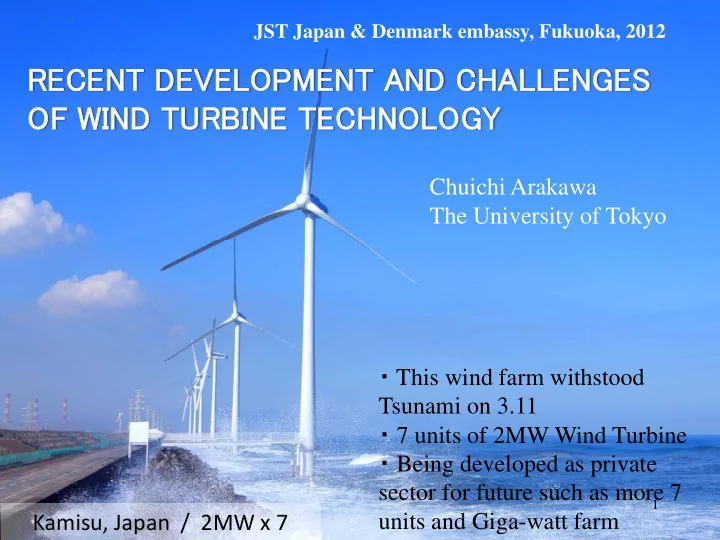
Kamisu, Japan / 2MW x 7 ・ This wind farm withstood Tsunami on 3.11 ・ 7 units of 2MW Wind Turbine ・ Being developed as private sector for future such as more 7 units and Giga-watt farm

RECENT DEVELOPMENT AND CHALLENGES OF WIND TURBINE TECHNOLOGY

Chuichi Arakawa The University of Tokyo

JST Japan & Denmark embassy, Fukuoka, 2012

1

slide-2
SLIDE 2
slide-3
SLIDE 3
slide-4
SLIDE 4

4

slide-5
SLIDE 5

Typhoon Attack Miyako Island was hit by huge Typhoon #14 on 11.Sep.2003 and all 7 WT were destroyed; 3 fallen down, 3 lost blades, 1 lost nacelle roof

New Guideline for Wind Turbines in Japan and Asian Area

5

slide-6
SLIDE 6

MWT92 (MHI) 2.4MW WT SUBARU 80/2.0 (FHI) 2 MW WT

NEW MW-class Machines in Japan

6

slide-7
SLIDE 7

Grid Connection in Japan

  • Wind power was not allowed to use grid connection between each area.
  • Wind potential exists strongly in Hokkaido, Tohoku and Kyushu.

7

slide-8
SLIDE 8

However, we have delay of more than 10 years for offshore in Europe. Furthermore, the national project is planned to have only one turbine. We should accelerate wind power to cover nuclear in high speed. 8

slide-9
SLIDE 9

Domestic Project of Deep Offshore

Scale model of Spar type: Prof. Utsunomiya in Kyoto Uni. , Toda-Kensetsu, etc Semi-sub type ; Prof. Ishihara in

  • Uni. of Tokyo, TEPC O, etc

Spar type ; Prof. Suzuki in Uni. of Tokyo Sailing type ; Environment Institute &

  • Prof. Kinoshita in Uni. of Tokyo

9

slide-10
SLIDE 10

After the Disaster

  • n March 11, 2011

10

slide-11
SLIDE 11

2011 Earthquake off the Pacific Coast of Tohoku, Japan

March 11, 2011, Magnitude 9.0 Tsunami reached heights of up to 40.5m and travelled up to 10km. It caused meltdown of three reactors in Fukushima nuclear power plants.

From interim report of TEPCO, Japan

11

slide-12
SLIDE 12

12

slide-13
SLIDE 13

Potential Map of Wind Power in Japan

  • Report of investigation for renewable energy in Ministry of Environment in 2011
  • 280 GW for onshore, 1600 GW for offshore as potential value
  • 273 GW for onshore , 141 GW for offshore under some scenario such as half-price

13

slide-14
SLIDE 14

14

This milestone should be accelerated to 2030 from 2050.

slide-15
SLIDE 15

エネ庁HPに掲載された委員会資料より

Feed In Tariff (FIT) in Japan

PV Wind Geothermal Small Hydro Biomass Price Price Period for payment Period for payment

slide-16
SLIDE 16

○Affected areas in the east , in particular, Fukushima, are

recovering from the earthquake damage. These areas are expected to provide large scale job creation due to accumulation

  • f industries focused on renewable energy.

○This project will clarify the safety, reliability and economic potential of floating offshore wind by demonstration and experiments of the world's largest level floating offshore wind power generation system off the coast of Fukushima prefecture. ○After the completion of this project, This project is sought to make a new power generation business through the development

  • f equipment as a result of this project.

By doing so, we aim to make a Japan a hub of wind power and contribute to the industrial revival in Fukushima

○Demonstration area : offshore of Fukushima Prefecture

○Such areas as well as a better wind conditions, are expected to take advantage of the former facilities of the offshore gas field, already being developed or currently in not use, offshore areas of Fukushima Prefecture are favorable.

Contents of project Image of project

Summary / Purpose Conditions(applicant, subsidiary rate, etc.)

METI

Private Organization , etc

Image of floating offshore wind power

(provision:MES, Tokyo Univ., TEPCO)

Demonstration assumed area

地上高70mの年平均風速(m/s)

Entrust

Floating offshore wind farm demonstration project

(FY2011 3rd supplementary budget : 12.5 billion yen)

METI Offshore Wind Energy Project, Fukushima (FY2011~15)

Source : METI, Japan

16
slide-17
SLIDE 17

17

Schematic View of METI Deep Offshore Project, Fukushima

17

slide-18
SLIDE 18

Source : MOE, Japan

18

MOE Deep Offshore Project of Spar Type 1

slide-19
SLIDE 19

19

MOE Deep Offshore Project of Spar Type 2

slide-20
SLIDE 20

From TEPCO Website National project of offshore wind in Cho-shi area By NEDO in October, 2012

slide-21
SLIDE 21

First Offshore Wind Farm in the World, 2000

slide-22
SLIDE 22

Hywind Project in Norway (2009) Water depth 200m(120-700m),Float depth of 100m,Turbine of 2.4 MW Photo: Øyvind Hagen / Statoil

Advanced Offshore Wind in the World

slide-23
SLIDE 23

Tour to Norway to observe Hywind in last September

23

slide-24
SLIDE 24

24

slide-25
SLIDE 25

5GW of total accumulation of offshore wind More that 30% growth rate of year Following the growth of onshore behind 10 years Global Offshore Wind London 2013 より

slide-26
SLIDE 26

Nobert Giese, “Are fast-developing turbines the right approach for offshore?”, Renewable UK 2012, GLOBAL OFFSHORE WIND,

slide-27
SLIDE 27

Concluding Remarks

  • Roadmap is discussed for wind power with estimation
  • f potential for wind power.
  • FIT is expected to work well to develop wind power.
  • Primary grid connection of wind power is important

with the electric power company using the connections with other areas.

  • Offshore wind power has large potential due to the huge

area of ocean around Japanese island of EEZ 6th.

  • Deep offshore system will be a key technology for

future development of wind power and recovery from the disaster.

  • Fisherman’s right will be reasonably taken into account

for cooperating with developer instead of compensation.

27