
SLIDE 1
Jonathan Worthington Linuxwochenende 2008
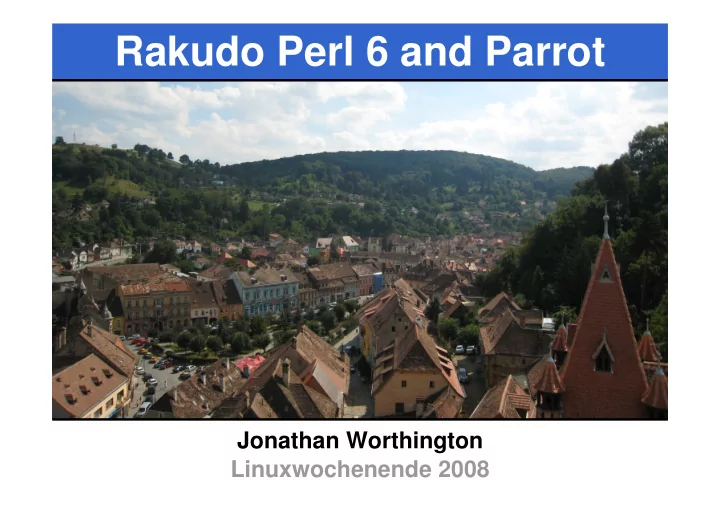
Rakudo Perl 6 and Parrot Jonathan Worthington Linuxwochenende 2008 - - PowerPoint PPT Presentation
Rakudo Perl 6 and Parrot Jonathan Worthington Linuxwochenende 2008 Rakudo Perl 6 and Parrot Me From England Rakudo Perl 6 and Parrot Me From England And yes, I do like tea Rakudo Perl 6 and Parrot Me From England And
Jonathan Worthington Linuxwochenende 2008
Rakudo Perl 6 and Parrot
Me
From England
Rakudo Perl 6 and Parrot
Me
From England And yes, I do like tea…
Rakudo Perl 6 and Parrot
Me
From England And yes, I do like tea… …but I prefer it without milk in.
Rakudo Perl 6 and Parrot
Me
From England And yes, I do like tea… …but I prefer it without milk in. Currently living in Bratislava, Slovakia.
Rakudo Perl 6 and Parrot
Me
From England And yes, I do like tea… …but I prefer it without milk in. Currently living in Bratislava, Slovakia Just an hour from here Like Vienna, it's beautiful…
Rakudo Perl 6 and Parrot
Me
From England And yes, I do like tea… …but I prefer it without milk in. Currently living in Bratislava, Slovakia Just an hour from here Like Vienna, it's beautiful… …but beer only costs 1 euro a pint
Rakudo Perl 6 and Parrot
Me
From England And yes, I do like tea… …but I prefer it without milk in. Currently living in Bratislava, Slovakia Just an hour from here Like Vienna, it's beautiful… …but beer only costs 1 euro a pint Er, half litre
Rakudo Perl 6 and Parrot
My Talk
An overview of three technologies The Parrot VM – a virtual machine for
dynamic languages
The Parrot Compiler Toolkit (= PCT)
– a tool chain for rapidly developing compilers targeting Parrot
Rakudo, a Perl 6 implementation on
Parrot built using PCT
Rakudo Perl 6 and Parrot
Rakudo Perl 6 and Parrot
Parrot Is A Virtual Machine
Virtual instruction set Hides away the details of the
underlying hardware
Interface to IO, threading, etc. Hides away the details of the
underlying operating system
"Write once, run anywhere" Or as close as is realistically possible
Rakudo Perl 6 and Parrot
Register Architecture
.Net CLR and JVM are stack based Parrot is register based Faster to interpret, since no stack
pointer to keep (need to run on many
A little easier to JIT-compile too; "just"
a register allocation problem
Variable sized register frames per sub
Rakudo Perl 6 and Parrot
HLL Feature Support
Parrot provides support for a range of
high-level language features
By providing support for them at the VM
level…
Compilers for different languages
don't need to re-invent the wheel
Different languages can inter-operate
Rakudo Perl 6 and Parrot
Examples Of HLL Features In The VM
Common set of calling conventions Multiple dispatch Classes, attributes, methods, objects,
inheritance, introspection (reflection)
Namespaces Continuations, co-routines, closures Lexically scoped variables And more…
Rakudo Perl 6 and Parrot
But Languages Are Different!
We want to support a load of existing
languages
Python Ruby PHP JavaScript But they all have slightly different ideas
about how certain things work…
Rakudo Perl 6 and Parrot
PMCs
PMC = Parrot Magic Class Implement some of a fixed set of
methods that perform a range of common operations
Range from simple things, like get an
integer representation of this thing…
…to more complex OO-related things,
such as adding a parent class
Rakudo Perl 6 and Parrot
Examples Of PMCs
Integer PMC – implements methods
relating to arithmetic
Array PMC – implements methods
relating to keyed access
Class PMC – implements object
Sub PMC – implements invoke method,
and a few others (name, etc.)
Rakudo Perl 6 and Parrot
Different Semantics, Common Interface
The PMCs all provide the same
interface
Languages can implement this
common interface to provide their own semantics
For example, a Perl array can return
"undefined" on access to an out-of- range element, whereas a Java array could throw an exception
Rakudo Perl 6 and Parrot
Extensibility
Don't need to have all the PMCs in the
Parrot core; can build them into a dynamically linked library
Can also dynamically load additional
VM's instruction set
Language distribution = compiler +
(optionally) PMC Library + (optionally) Opcode Library
Rakudo Perl 6 and Parrot
PIR
Parrot Intermediate Representation Essentially, the Parrot VM's "assembly" However, for some common things (like
method calls), it turns some syntactic sugar into the several real instructions it takes to do it
Also does register allocation for you, so
compiler writers needn't worry about it
Rakudo Perl 6 and Parrot
Some Simple PIR Examples
"Hello, world!" – of course Compute The Answer
.sub 'main' :main print "Hello, world!\n" .end .sub 'main' :main $I0 = 25 $I1 = 17 $I2 = $I0 + $I1 print $I2 print "\n" .end
Rakudo Perl 6 and Parrot
Some Simple PIR Examples
Factorial
.sub 'fact' .param int n if n > 1 goto rec .return (1) rec: $I0 = n – 1 $I1 = fact($I0) $I1 *= n .return ($I1) .end
Rakudo Perl 6 and Parrot
Rakudo Perl 6 and Parrot
Writing Compilers Is Easy…
…if you have the right tools PCT aims to be a Right Tool You write the "front end": Grammar, which specifies syntax Actions, to produce an Abstract
Syntax Tree from the Parse Tree
The backend (from the AST down to
Parrot bytecode) is done for you
Rakudo Perl 6 and Parrot
Compilation Process
Program Source Parse Tree Abstract Syntax Tree Opcode Syntax Tree PIR (Parrot IL) Parrot Bytecode
Rakudo Perl 6 and Parrot
Compilation Process
Program Source Parse Tree Abstract Syntax Tree Opcode Syntax Tree PIR (Parrot IL) Parrot Bytecode PGE NQP PCT PCT Parrot
Rakudo Perl 6 and Parrot
Compilation Process
Program Source Parse Tree Abstract Syntax Tree Opcode Syntax Tree PIR (Parrot IL) Parrot Bytecode PGE NQP PCT PCT Parrot
Rakudo Perl 6 and Parrot
Compilation Process
Program Source Parse Tree Abstract Syntax Tree Opcode Syntax Tree PIR (Parrot IL) Parrot Bytecode PGE NQP PCT PCT Parrot
Rakudo Perl 6 and Parrot
PGE = Parrot Grammar Engine
Implementation of Perl 6 rules A bit like regexes, but taken a step
further so we can use them to write a full grammar
Unlike more traditional tools like lex and
yacc, where you write a tokenizer and a grammar, here you just write the parse rules and the tokenizer is generated for you
Rakudo Perl 6 and Parrot
An Example Rule
You use PGE to write the grammar for
your language
For example, here's how we could
parse an if statement
You put a {*} in place to indicate that
we should run an action
rule if_statement { 'if' <expression> <block> {*} }
Rakudo Perl 6 and Parrot
Compilation Process
Program Source Parse Tree Abstract Syntax Tree Opcode Syntax Tree PIR (Parrot IL) Parrot Bytecode PGE NQP PCT PCT Parrot
Rakudo Perl 6 and Parrot
NQP = Not Quite Perl 6
A subset of Perl 6 Contains just enough to allow you to
produce an Abstract Syntax Tree from the parse tree
Variables and literals Binding (but not assignment) Conditionals and loops Object instantiation and method calls
Rakudo Perl 6 and Parrot
NQP = Not Quite Perl 6
This method is called when the parser
encounters the {*} in the grammar
method if_statement($/) { my $then := $( $<block> ); $then.blocktype('immediate'); my $past := PAST::Op.new( $( $<EXPR> ), $then, :pasttype('if'), :node( $/ ) ); make $past; }
Rakudo Perl 6 and Parrot
NQP = Not Quite Perl 6
We are passed $/, the match object,
which describes what was parsed
method if_statement($/) { my $then := $( $<block> ); $then.blocktype('immediate'); my $past := PAST::Op.new( $( $<EXPR> ), $then, :pasttype('if'), :node( $/ ) ); make $past; }
Rakudo Perl 6 and Parrot
NQP = Not Quite Perl 6
Named captures ($<….>) give you the
match object for the sub rules
method if_statement($/) { my $then := $( $<block> ); $then.blocktype('immediate'); my $past := PAST::Op.new( $( $<EXPR> ), $then, :pasttype('if'), :node( $/ ) ); make $past; }
Rakudo Perl 6 and Parrot
NQP = Not Quite Perl 6
Writing $( $<…> ) gets you the AST for
that match object
method if_statement($/) { my $then := $( $<block> ); $then.blocktype('immediate'); my $past := PAST::Op.new( $( $<EXPR> ), $then, :pasttype('if'), :node( $/ ) ); make $past; }
Rakudo Perl 6 and Parrot
NQP = Not Quite Perl 6
We instantiate a new AST node of type
Op
method if_statement($/) { my $then := $( $<block> ); $then.blocktype('immediate'); my $past := PAST::Op.new( $( $<EXPR> ), $then, :pasttype('if'), :node( $/ ) ); make $past; }
Rakudo Perl 6 and Parrot
NQP = Not Quite Perl 6
This node has two children: the
condition and the block to run
method if_statement($/) { my $then := $( $<block> ); $then.blocktype('immediate'); my $past := PAST::Op.new( $( $<EXPR> ), $then, :pasttype('if'), :node( $/ ) ); make $past; }
Rakudo Perl 6 and Parrot
NQP = Not Quite Perl 6
Also specify the type of operation; PCT
will then generate the appropriate code
method if_statement($/) { my $then := $( $<block> ); $then.blocktype('immediate'); my $past := PAST::Op.new( $( $<EXPR> ), $then, :pasttype('if'), :node( $/ ) ); make $past; }
Rakudo Perl 6 and Parrot
NQP = Not Quite Perl 6
Also specify the match object that we
made this from, for line numbers etc.
method if_statement($/) { my $then := $( $<block> ); $then.blocktype('immediate'); my $past := PAST::Op.new( $( $<EXPR> ), $then, :pasttype('if'), :node( $/ ) ); make $past; }
Rakudo Perl 6 and Parrot
NQP = Not Quite Perl 6
The "make" statement specifies the
tree node we have made
method if_statement($/) { my $then := $( $<block> ); $then.blocktype('immediate'); my $past := PAST::Op.new( $( $<EXPR> ), $then, :pasttype('if'), :node( $/ ) ); make $past; }
Rakudo Perl 6 and Parrot
Compilation Process
Program Source Parse Tree Abstract Syntax Tree Opcode Syntax Tree PIR (Parrot IL) Parrot Bytecode PGE NQP PCT PCT Parrot
Rakudo Perl 6 and Parrot
PAST to POST
POST is the Parrot Opcode Syntax
Tree
Tree representation of Parrot
assembly program
Often one node = one instruction The PAST compiler, part of PCT,
transforms a PAST node into (usually many) POST nodes
Rakudo Perl 6 and Parrot
Compilation Process
Program Source Parse Tree Abstract Syntax Tree Opcode Syntax Tree PIR (Parrot IL) Parrot Bytecode PGE NQP PCT PCT Parrot
Rakudo Perl 6 and Parrot
POST to PIR
PIR = Parrot Intermediate
Representation
Text based rather than tree based The Parrot VM itself understands PIR,
so for now we have to turn the POST tree into PIR
One day, we may be able to go direct
from the tree to the bytecode
Rakudo Perl 6 and Parrot
Compilation Process
Program Source Parse Tree Abstract Syntax Tree Opcode Syntax Tree PIR (Parrot IL) Parrot Bytecode PGE NQP PCT PCT Parrot
Rakudo Perl 6 and Parrot
PIR to Parrot Bytecode
The Parrot VM actually executes
bytecode – a binary representation of the program
It contains a compiler that turns PIR
into Parrot Bytecode
We can write the bytecode to disk so
we can load it again in the future => don't need to compile our program every time => performance!
Rakudo Perl 6 and Parrot
Languages
PCT is being used to build compilers
for a range of languages…
Perl 6 (Rakudo) PHP (Pipp) Python (Pynie) Ruby (Cardinal) SmallTalk (ChitChat) LOLCODE
Rakudo Perl 6 and Parrot
Yes, LOLCODE
HAI CAN HAS STDIO? I HAS A VAR IM IN YR LOOP UP VAR!!1 VISIBLE VAR IZ VAR BIGGER THAN 10? KTHXBYE IM OUTTA YR LOOP KTHXBYE
Rakudo Perl 6 and Parrot
Rakudo Perl 6 and Parrot
What is Perl 6?
Perl 5 has been and continues to be
very widely used
Perl community is still very active Perl is less fashionable than it once
was, but no less useful
Perl 6 is a ground-up re-design and re-
implementation of the language
Not backward compatible
Rakudo Perl 6 and Parrot
Why start from scratch?
Perl was first released in 1987 It's now more than 20 years later; it'd
be nice to think we learned a few things about languages in that time
Perl 5 internals are difficult to get into
and extend
Breaking backwards compatibility gives
much more design freedom
Rakudo Perl 6 and Parrot
Migration
As usual with Perl, There's More Than
One Way To Do It
Implementation of a Perl 5 to Perl 6
translator is underway
Will retrain comments and all that a
parser usually throws away
Will be able to use Perl 5 modules from
Perl 6
Rakudo Perl 6 and Parrot
Isn't it taking a while?
Yes, because… It's a large and complex project Doing some things that haven't been
done in other languages before
Much is done by volunteers, though
there has been and is some funding
Perl 5 is still very powerful and being
actively developed too
Rakudo Perl 6 and Parrot
So What's New?
Covering all of the new features of Perl
6, along with the changes from Perl 5, would take quite a while
Going to give you a very quick look at
some of the highlights
Rakudo Perl 6 and Parrot
Chained Comparisons
How often do you write stuff like: In Perl 6 that is just: Note that we can drop the parentheses
if ($x >= 0 && $x <= 100) { ... } if 0 <= $x <= 100 { ... }
Rakudo Perl 6 and Parrot
Junctions
How often do you write stuff like: In Perl 6 that is just: Junction = something that you can use
where you'd use a single value, but acts as all of them simultaneously
if ($drink eq 'Beer' || $drink eq 'Wine') { ... } if $drink eq 'Beer' | 'Wine' { ... }
Rakudo Perl 6 and Parrot
Powerful New Object Model
Now syntax for declaring classes,
attributes and methods
The method call operator is now .
class Beer is Drink { has $.units; has $.type; method consume($consumer) { $consumer.alcohol += $.units; self.spill() if $consumer.drunk; } }
Rakudo Perl 6 and Parrot
New Signature Syntax
Rather than just getting an array of
parameters, you can write a signature
sub add($x, $y) { return $x + $y; } say add(37, 5); # 42 sub greet($name, :$greeting = 'Guten Tag') { say "$greeting, $name"; } greet('Hans'); # Guten Tag, Hans greet('Lena', greeting => 'Privet'); # Privet, Lena
Rakudo Perl 6 and Parrot
New Regex Syntax
Many languages today use Perl
Compatible Regular Expressions
Regex are known for being rather, well,
scary and line-noise-ish
Perl 6 gives them a thorough re-
working
Easy to build reusable bits of regex and
compose them
Rakudo Perl 6 and Parrot
New Regex Syntax
Whitespace not matched as part of the
regex now – so space stuff out!
[…] is a non-capturing group Put a literal in quotes, like elsewhere Build other regex out of it
regex Decimal { \d+ ['.' \d+]? }; regex Temperature { <Decimal> \s* [C|F] }; regex HighTemp { 'High' \W+ <Temperature> } regex LowTemp { 'Low' \W+ <Temperature> }
Rakudo Perl 6 and Parrot
Grammars
Can collect a bunch of regex together
into grammars (like classes but with regex instead of methods)
Good for building parsers Unlike traditional regex, has control of
backtracking
Auto-generates a lexer for you Perl 6 will parse itself
Rakudo Perl 6 and Parrot
Multiple Dispatch
One name, different signatures When you do a call, it dispatches to the
best candidate
All operators are really just multiple
dispatch subs => overloading is just writing a multi-sub
sub win(Paper $x, Stone $y) { True } sub win(Scissors $x, Paper $y) { True } sub win(Stone $x, Scissors $y) { True } sub win(Any $x, Any $y) { False }
Rakudo Perl 6 and Parrot
Rakudo Perl 6 and Parrot
Rakudo vs. Perl 6
Perl 6 is the name of the language Rakudo is an implementation of the
Perl 6 language
However, it's not the only one that is in
progress, or that exists
Pugs = Perl 6 in Haskell, currently not
maintained
kp6 and SMOP are two others
Rakudo Perl 6 and Parrot
Why "Rakudo"?
Suggested by Damian Conway Some years ago, Con Wei Sensei
introduced a new martial art in Japan named "The Way Of The Camel"
In Japanese, this is "Rakuda-do" The name quickly became abbreviated
to "Rakudo", which also happens to mean "paradise" in Japanese
Rakudo Perl 6 and Parrot
Status
Rakudo is not a complete
implementation of Perl 6 yet
However, all of the code that I showed
in the previous section of the talk will run on Rakudo today…
…and much more. Uses PCT, meaning much of it is in
Perl 6 rules and a subset of Perl 6
Rakudo Perl 6 and Parrot
What's (Mostly) Implemented?
Variables: scalars, arrays, and hashes Wide range of operators Conditionals and loops Subroutines with signatures Classes, attributes, methods,
inheritance, delegation, roles and composition, runtime mix-ins
Enumerations
Rakudo Perl 6 and Parrot
What's (Mostly) Implemented?
Regexes and grammars Type constraints on variables,
parameters and attributes
Multiple dispatch (very much a work in
progress, but getting there)
Basic junction support (but much, much
more to do here)
Basic I/O
Rakudo Perl 6 and Parrot
Compilation To Bytecode
You can compile your programs or
modules down to Parrot bytecode
Means you don't have to run the
compiler every time you want to run the program
Additionally, use mmap when it's
available, so Parrot instances can share the bytecode file
Rakudo Perl 6 and Parrot
mod_perl6
There is also basic support for writing
Apache handlers in Perl 6 now
mod_parrot provides most of what is
needed, and mod_perl6 is a thin layer (written mostly in Perl 6 itself) on top of that
Easy to make mod_your_language Yes, we do have mod_lolcode
Rakudo Perl 6 and Parrot
Rakudo Perl 6 and Parrot
Where To Learn More
The Parrot Website
http://www.parrot.org/
The Parrot Blog recently had an 8-part
PCT tutorial posted http://www.parrotblog.org/
The Perl 6 implementation on Parrot
(named Rakudo) has a site here http://www.rakudo.org/
Rakudo Perl 6 and Parrot
Get Involved!
Join the Parrot and/or Perl 6 compiler
mailing list
Pop onto the IRC channel Get the source and start hacking Partial implementations of many
languages – come and help us get your favorite one running on Parrot
Or if you like C, lots of VM guts work
Rakudo Perl 6 and Parrot
Come!
There will be a Perl Workshop, one day
in Vienna, one day in Bratislava
7th and 8th of November
http://conferences.yapceurope.org/tcpw2008/
Rakudo Perl 6 and Parrot
Rakudo Perl 6 and Parrot