
SLIDE 1
T.Ishida | High Power Targetry R&D Roadmap WS, FNAL, 31 May 2017
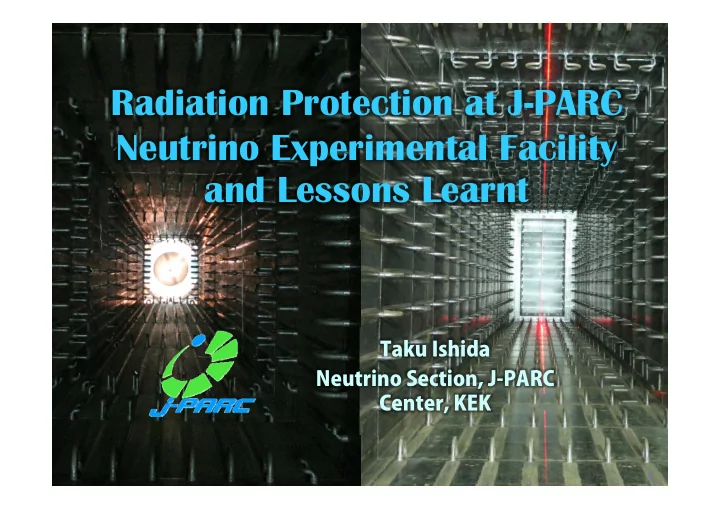
Radiation Protection at J-PARC Neutrino Experimental Facility and Lessons Learnt
Taku Ishida Neutrino Section, J-PARC Center, KEK
1
Radiation Protection at J-PARC Neutrino Experimental Facility and - - PowerPoint PPT Presentation
Neutrino Section, J-PARC Taku Ishida Center, KEK Radiation Protection at J-PARC Neutrino Experimental Facility and Lessons Learnt T.Ishida | High Power Targetry R&D Roadmap WS, FNAL, 31 May 2017 1 thought capacity of beam intercepting
T.Ishida | High Power Targetry R&D Roadmap WS, FNAL, 31 May 2017
1
T.Ishida | High Power Targetry R&D Roadmap WS, FNAL, 31 May 2017
2
T.Ishida | High Power Targetry R&D Roadmap WS, FNAL, 31 May 2017
3
J-PARC, Tokai
N
Beam Dump Extraction Point Muon Monitors 110m 280m 295km To Kamioka Target Horns
Decay Volume Near Neutrino Detectors
MLF RCS
NU1 NU2 TS NC NU3 NM NA
T.Ishida | High Power Targetry R&D Roadmap WS, FNAL, 31 May 2017
Water circulation system for downstream half of DV and BD [B1] Air circulation system for BD / MuPit [B1+4.5]
Beam 1st FL B1+ 4.5 stand B1 FL B2 FL
[Super Hot] [Hot Machine Room] 18.5 m
4
Decay Volume Beam Dump Pit Muon Pit
Pipe/Duct Shaft Passage
Neutrino Utility Building #3 (NU3) Beam
10.2m 1m 4m 6m
T.Ishida | High Power Targetry R&D Roadmap WS, FNAL, 31 May 2017
0.05Bq/cc TS exhaust 01:50 07:50 NU3 exhaust 0.07
The first continuous (only 20kW) beam NU3 exhaust signal: Alert level= 0.05Bq/ cc(Raw data) ⇔ Observed 0.06 Bq/ cc
Beam operation w as lim ited w ithin only ~ 3 0 m in due to the radiation in the exhaust air.
5
0.05Bq/cc 20min 25min 30min 20min 25min 30min
T.Ishida | High Power Targetry R&D Roadmap WS, FNAL, 31 May 2017
6
/ penetration of cable bundles
@ pipe/duct shaft (B2) 1/14
Dump pit PS/DS B1
Test with a smoke machine, normally used for theater plays !
T.Ishida | High Power Targetry R&D Roadmap WS, FNAL, 31 May 2017
7
900mBq/cc 400mBq/cc 30mBq/cc
Exhaust monitor 50mBq/cc (Raw data) Service hatch Super-hot Machine Room (B1F) Machine room (1F)
Dump pit Cooling loop Mupit cooling loop Environment air monitor suggests that irradiated air was leaked into super-hot machine room from (air-tightened) dump pit cooling loop. [ Most probably from degasifier of radioactive cooling water ] The air is going into 1F through service hatch and cable penetrations
Negative Pressure control [-20Pa] Cable penetrations Clean air Contained, As-Is Pressure
T.Ishida | High Power Targetry R&D Roadmap WS, FNAL, 31 May 2017
Remove insulation around ducts seal with thin iron plates and caulking Liquid silicone glue for the cable penetrations Seal edges of concrete blocks at the delivery entrance to downstairs Doors sealed with tape, repeat smoke tests to find remaining leaks
8
T.Ishida | High Power Targetry R&D Roadmap WS, FNAL, 31 May 2017
Guess: Exhaust from pumps (evacuating hollow fiber membrane filters) may contain radioactive gas from cooling water
9
DV BD
Hollow fiber membrane
T.I shida J-PARC 2 0 1 4 : The 2 nd I nternational Sym posium on Science at J-PARC, Jul.1 5 , 2 0 1 4
1 0
10.6m Baffle
Graphite Collimator
Horn-1 Horn-2 Horn-3
Beam window Ti-alloy
DV collimator
3 electromagnetic horns / a baffle are supported from the wall of vessel by support modules. Apparatus on the beam-line are highly irradiated after
OTR Target
Beam
Horn dock Storage area Service pit
T.Ishida | High Power Targetry R&D Roadmap WS, FNAL, 31 May 2017
1 1
Chimney stack
【Negative pressure control】
外気 13,000m3/h
Ventilation 【 closed 】 Service pit 【circulating ] Superhot Machine room
~1.5mBq/cc 900mBq/cc 300mBq/cc
⇔ law:0.5mBq/cc [ 3month average ]
Storage area
Caulking to block gap Sheemles balloon sheet Add cyricone
Air-tightened duct And dumper
T.Ishida | High Power Targetry R&D Roadmap WS, FNAL, 31 May 2017
1 2
13,000m3/h Total 13,000m3/h 1,300m3/h
Reduce ventilation flow to 10% w/ o changing total flow ⇒41Ar(110 min) to decay
signal×0.3
EA
入口除塩 フィルタ HEPA HEPA 排気ファン 給気ファン
OA
スタックへ
スタックへ OA EA HEP HEPA
給気ファン (インバータ) 軸流ファン (インバータ) 排気ファン 2012年1月
Exhaust signal :0.4mBq/cc@130 kW ⇒ 0.13mBq/cc 0.1mBq/cc(190kW) ⇒ 950kW acceptable !
T.Ishida | High Power Targetry R&D Roadmap WS, FNAL, 31 May 2017
The control panel was located in B1F machine room, since limitation of 1F floor space. (Later we noticed it was around the level of target..) “Single event upset” on a CPU unit of the PLC by beam-induced fast neutrons. As temporary fix during Run-1, extract / relocate the CPU unit by 10m to area with less neutrons, then covered with LG blocks. Whole control panels of air-conditioning/ cooling water at TS moved to the ground floor in 2010, summer.
1 3
T.Ishida | High Power Targetry R&D Roadmap WS, FNAL, 31 May 2017
It can be very standard idea at reactor facilities (JAEA ?) Worth to introduce to J-PARC
1 4
Negative pressure Control (- 20Pa ) Pressure: As-Is Negative pressure Control (-20Pa) Deeper Negative pressure (-40Pa) Very long duct (decay) Past CENF facility design
T.Ishida | High Power Targetry R&D Roadmap WS, FNAL, 31 May 2017
Although radioactive nuclear ions (7Be..) can be removed using ion- exchange resins, there is no way to extract tritiated water (HTO) . Disposal after dilution under control of Radiation Hazard Prevention Act Based on the working procedures by current drainage system, it is very hard to deal tritiated water from 750kW operation within the same year. 750kW x 107sec (116 days) = 15.6x10²⁰pot 390GBq x ~2 larger than current capability
1 5
25GBq HTO produced per 1x10²⁰POT
In Horn/TS He Vessel/Decay Volume Cooling Water
11.5GBq 13.5GBq
3.5GBq x 60disposal/year = 210GBq
210 / 25 = 8.4
84m3 x 42 Bq/cc (70% of 60Bq/cc limit)
= 3.5GBq/disposal
T.Ishida | High Power Targetry R&D Roadmap WS, FNAL, 31 May 2017
Piles of the building are not strong enough. New facility building with larger tanks ?
1.
Frequency of drainage (every 3d/ 60 times 2d/90 : 600kWx107s)
2.
Takeover by tank truck (+150kWx 107s)
3.
Shortcut in the circulation system and apply partial dilution
Rehearsal of tank-truck takeover at NU3. (Dec. 2015) 1st real takeover took place on Jan. 2016
2.0m 4.0 m 1.5 m 5.0 m
(5m x 5m x 2m) x 2tanks (5m x 5m x 5m) x 2tanks
T.Ishida | High Power Targetry R&D Roadmap WS, FNAL, 31 May 2017
Improvement scenario is under consideration, which will count for > 700kW operation. In the future MW operation we need new facility building with larger tank. Or, to carry forward (part of) tritiated water to following years by keeping them in the system (risk when water leak happens)
Nested negative pressure control may solve the problem.
1 7