
SLIDE 1
- R. J. Jox: WMA Meeting Vatican 2017
1
Dealing with public and published opinions
Ralf J. Jox Institute of Ethics, History and Theory of Medicine Ludwig-Maximilians University Munich, Germany WMA European Region Meeting On End-of-Life Questions Vatican, 16-17 November 2017
Outline
- R. Jox - WMA Meeting Vatican
2
- 1. Why public and published opinion?
- 2. What are the public opinions?
- 3. Conclusions for the political debate
Death
- R. Jox - WMA Meeting Vatican
3
§ Death does not only constitute a challenge for every individual person, but also a threat to society § Public practices: death announcements, funerals, cemeteries, obituaries, art & culture about death… § Modern taboo around death creates anxiety and impedes our coping with death § Death as the “great equalizer” calls for considering each person’s voice on the same level Death calls for public discourse!
Ethics
- R. Jox - WMA Meeting Vatican
4
§ The essence of ethics is about the right way to live together as a community and society § Core ethical concepts of respect, dignity and fairness require giving a voice to every person § The historical origins of ethics in the European Antiquity were on the “agora” (Sokrates), in the synagogues and churches § Today, ethics is both a scientific discipline (academia) and an everyday activity (agora) Ethics calls for public discourse!
Biopolitics
- R. Jox - WMA Meeting Vatican
5
§ Bioethical issues are increasingly becoming political § Political history is full of warning examples of moral authoritarianism § Open, plural societies are based on the competition of value systems using debate and argument § Discourse is no supreme epistemological way to truth, but the best political way to compensate for the lack of a supreme way to truth Biopolitics calls for public discourse!
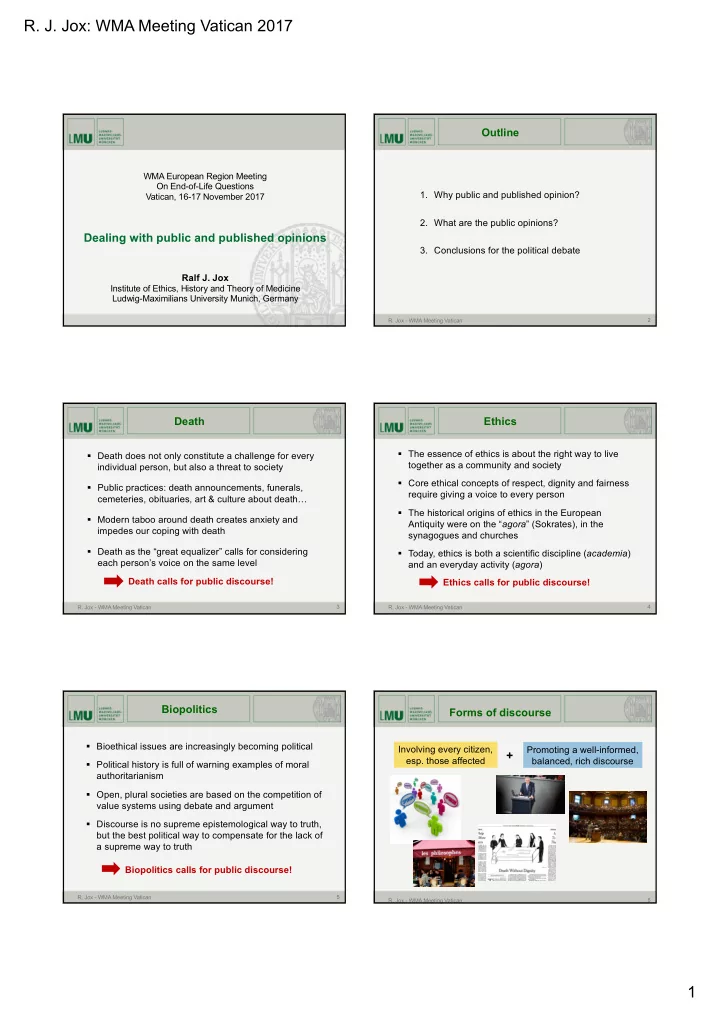
Forms of discourse
- R. Jox - WMA Meeting Vatican
6
Involving every citizen,
- esp. those affected