R EFERENCE M ATERIAL Income-Tax Act, 1922 Section 33A. Power of - - PDF document

r eference m aterial income tax act 1922
SMART_READER_LITE
LIVE PREVIEW

R EFERENCE M ATERIAL Income-Tax Act, 1922 Section 33A. Power of - - PDF document

R EFERENCE M ATERIAL Income-Tax Act, 1922 Section 33A. Power of revision by Commissioner . (1) The Commissioner may of his own motion call for the record of any proceeding under this Act in which an order has been passed by any authority


slide-1
SLIDE 1

REFERENCE MATERIAL Income-Tax Act, 1922

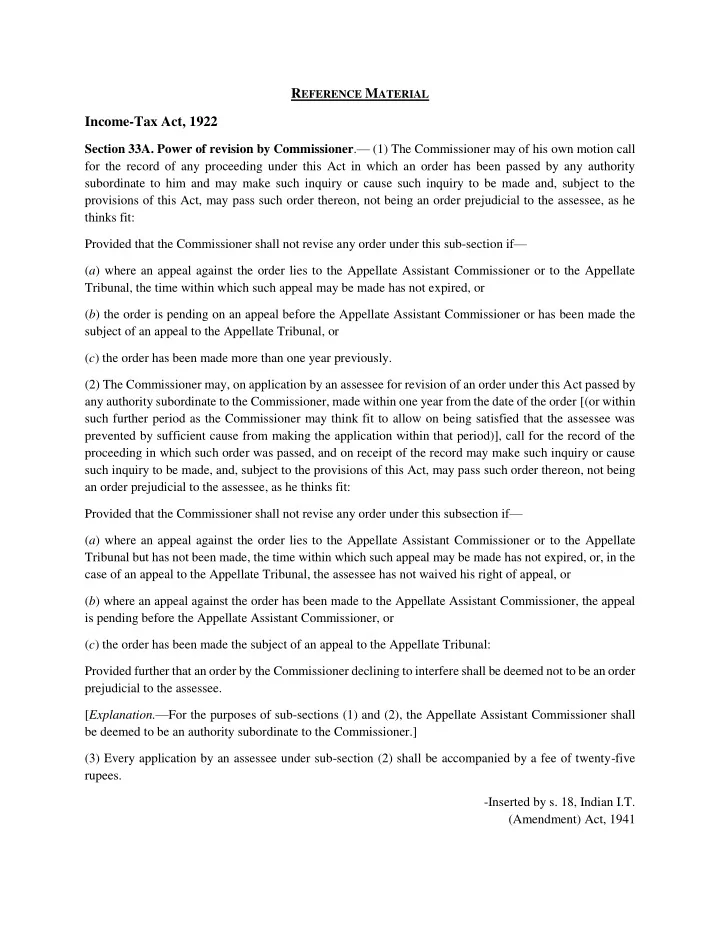
Section 33A. Power of revision by Commissioner.— (1) The Commissioner may of his own motion call for the record of any proceeding under this Act in which an order has been passed by any authority subordinate to him and may make such inquiry or cause such inquiry to be made and, subject to the provisions of this Act, may pass such order thereon, not being an order prejudicial to the assessee, as he thinks fit: Provided that the Commissioner shall not revise any order under this sub-section if— (a) where an appeal against the order lies to the Appellate Assistant Commissioner or to the Appellate Tribunal, the time within which such appeal may be made has not expired, or (b) the order is pending on an appeal before the Appellate Assistant Commissioner or has been made the subject of an appeal to the Appellate Tribunal, or (c) the order has been made more than one year previously. (2) The Commissioner may, on application by an assessee for revision of an order under this Act passed by any authority subordinate to the Commissioner, made within one year from the date of the order [(or within such further period as the Commissioner may think fit to allow on being satisfied that the assessee was prevented by sufficient cause from making the application within that period)], call for the record of the proceeding in which such order was passed, and on receipt of the record may make such inquiry or cause such inquiry to be made, and, subject to the provisions of this Act, may pass such order thereon, not being an order prejudicial to the assessee, as he thinks fit: Provided that the Commissioner shall not revise any order under this subsection if— (a) where an appeal against the order lies to the Appellate Assistant Commissioner or to the Appellate Tribunal but has not been made, the time within which such appeal may be made has not expired, or, in the case of an appeal to the Appellate Tribunal, the assessee has not waived his right of appeal, or (b) where an appeal against the order has been made to the Appellate Assistant Commissioner, the appeal is pending before the Appellate Assistant Commissioner, or (c) the order has been made the subject of an appeal to the Appellate Tribunal: Provided further that an order by the Commissioner declining to interfere shall be deemed not to be an order prejudicial to the assessee. [Explanation.—For the purposes of sub-sections (1) and (2), the Appellate Assistant Commissioner shall be deemed to be an authority subordinate to the Commissioner.] (3) Every application by an assessee under sub-section (2) shall be accompanied by a fee of twenty-five rupees.

  • Inserted by s. 18, Indian I.T.

(Amendment) Act, 1941

slide-2
SLIDE 2

Section 33B. Power of Commissioner to revise Income-tax Officer's orders.—(1) The Commissioner may call for and examine the record of any proceeding under this Act and if he considers that any order passed therein by the Income-tax Officer is erroneous in so far as it is prejudicial to the interests of the revenue, he may, after giving the assessee an opportunity of being heard and after making or causing to be made such enquiry as he deems necessary, pass such order thereon as the circumstances of the case justify, including an order enhancing or modifying the assessment, or cancelling the assessment and directing a fresh assessment. (2) No order shall be made under sub-section (1)— (a) to revise an order of reassessment made under the provisions of section 34; or (b) after the expiry of two years from the date of the order sought to be revised. (3) Any assessee objecting to an order passed by the Commissioner under sub-section (1) may appeal to the Appellate Tribunal within sixty days of the date on which the order is communicated to him. (4) An appeal to the Appellate Tribunal under sub-section (3) shall be in the prescribed form and shall be verified in the prescribed manner and shall be accompanied by a treasury receipt in support of having paid the fee of Rs. 100, and such appeal shall be dealt with in the same manner as if it were an appeal under subsection (1) of section 33.

  • Inserted by s. 7, I.T. and B.P.T. (Amendment)

Act, 1948, w.e.f. 30-3-1948

Income-tax Act, 1961

Section 263. (1) The Principal Commissioner or Commissioner may call for and examine the record of any proceeding under this Act, and if he considers that any order passed therein by the Assessing Officer is erroneous in so far as it is prejudicial to the interests of the revenue, he may, after giving the assessee an

  • pportunity of being heard and after making or causing to be made such inquiry as he deems necessary,

pass such order thereon as the circumstances of the case justify, including an order enhancing or modifying the assessment, or cancelling the assessment and directing a fresh assessment. Explanation 1.—For the removal of doubts, it is hereby declared that, for the purposes of this sub-section,— (a) an order passed on or before or after the 1st day of June, 1988 by the Assessing Officer shall include— (i) an order of assessment made by the Assistant Commissioner or Deputy Commissioner or the Income- tax Officer on the basis of the directions issued by the Joint Commissioner undersection 144A; (ii) an order made by the Joint Commissioner in exercise of the powers or in the performance of the functions of an Assessing Officer conferred on, or assigned to, him under the orders or directions issued by the Board or by the Principal Chief Commissioner or Chief Commissioner or Principal Director General or Director General or Principal Commissioner or Commissioner authorised by the Board in this behalf under section 120; (b) "record" shall include and shall be deemed always to have included all records relating to any proceeding under this Act available at the time of examination by the Principal Commissioner or Commissioner;

slide-3
SLIDE 3

(c) where any order referred to in this sub-section and passed by the Assessing Officer had been the subject matter of any appeal filed on or before or after the 1st day of June, 1988, the powers of the Principal Commissioner or] Commissioner under this sub-section shall extend and shall be deemed always to have extended to such matters as had not been considered and decided in such appeal. Explanation 2.—For the purposes of this section, it is hereby declared that an order passed by the Assessing Officer shall be deemed to be erroneous in so far as it is prejudicial to the interests of the revenue, if, in the

  • pinion of the Principal Commissioner or Commissioner,—

(a) the order is passed without making inquiries or verification which should have been made; (b) the order is passed allowing any relief without inquiring into the claim; (c) the order has not been made in accordance with any order, direction or instruction issued by the Board under section 119; or (d) the order has not been passed in accordance with any decision which is prejudicial to the assessee, rendered by the jurisdictional High Court or Supreme Court in the case of the assessee or any other person. (2) No order shall be made under sub-section (1) after the expiry of two years from the end of the financial year in which the order sought to be revised was passed. (3) Notwithstanding anything contained in sub-section (2), an order in revision under this section may be passed at any time in the case of an order which has been passed in consequence of, or to give effect to, any finding or direction contained in an order of the Appellate Tribunal, National Tax Tribunal, the High Court

  • r the Supreme Court.

Explanation.—In computing the period of limitation for the purposes of sub-section (2), the time taken in giving an opportunity to the assessee to be reheard under the proviso to section 129 and any period during which any proceeding under this section is stayed by an order or injunction of any court shall be excluded. Amendments to Section 263- Finance Act 1988: In section 263

  • f

the Income-tax Act, in sub-section (1), for the Explanation, the following Explanation shall be substituted with effect from the 1st day of June, 1988, namely:— 'Explanation—For the removal of doubts, it is hereby declared that, for the purposes of this sub-section,— (a) an order passed by the Assessing Officer shall include— (i) an order of assessment made by the Assistant Commissioner or the Income-tax Officer on the basis of the directions issued by the Deputy Commissioner under section 144A; (ii) an order made by the Deputy Commissioner in exercise of the powers or in the performance of the functions of an Assessing Officer conferred on, or assigned to him under the orders or directions issued by the Board or by the Chief Commissioner or Director General or Commissioner authorised by the Board in this behalf under section 120;

slide-4
SLIDE 4

(b) "record" includes all records relating to any proceeding under this Act available at the time of examination by the Commissioner; (c) where any order referred to in this sub-section and passed by the Assessing Officer had been the subject- matter of any appeal the powers of the Commissioner under this subsection shall extend to such matters as had not been considered and decided in such appeal.’. Finance Act 1989: In section 263 of the Income-tax Act, in sub-section (1), in the Explanation,— (i) in clause (a), after the words "an order passed", the words, figures and letters "on or before or after the 1st day of June, 1988," shall be inserted and shall be deemed to have been inserted with effect from the 1st day of June, 1988; (ii) in clause (b), for the word "includes", the words "shall include and shall be deemed always to have included" shall be substituted and shall be deemed to have been substituted with effect from the 1st day of June, 1988; (iii) in clause (c),— (a) after the words "of any appeal", the words, figures and letters "filed on or before or after the 1st day of June, 1968" shall be inserted and shall be deemed to have been inserted with effect from the 1st day of June, 1988; (b) after the words "shall extend", the words "and shall be deemed always to have extended" shall be, inserted and shall be deemed to have been inserted with effect from the 1st day of June, 1988. Amendment to Section 263 vide Finance Act, 2015-w.e.f 01.06.2015 In section 263 of the Income-tax Act, in sub-section (1), the Explanation shall be numbered as Explanation 1 thereof and after Explanation 1 as so numbered, the following Explanation shall be inserted with effect from the 1st day of June, 2015, namely:— "Explanation 2.—For the purposes of this section, it is hereby declared that an order passed by the Assessing Officer shall be deemed to be erroneous in so far as it is prejudicial to the interests of the revenue, if, in the

  • pinion of the Principal Commissioner or Commissioner,—

(a) the order is passed without making inquiries or verification which should have been made; (b) the order is passed allowing any relief without inquiring into the claim; (c) the order has not been made in accordance with any order, direction or instruction issued by the Board under section 119; or (d) the order has not been passed in accordance with any decision which is prejudicial to the assessee, rendered by the jurisdictional High Court or Supreme Court in the case of the assessee or any other person.".

slide-5
SLIDE 5

Explanatory Memorandum In order to provide clarity on the issue it is proposed to provide that an order passed by the Assessing Officer shall be deemed to be erroneous in so far as it is prejudicial to the interests of the revenue, if, in the opinion

  • f the Principal Commissioner or Commissioner.

Section 264. (1) In the case of any order other than an order to which section 263 applies passed by an authority subordinate to him, the Principal Commissioner or Commissioner may, either of his own motion

  • r on an application by the assessee for revision, call for the record of any proceeding under this Act in

which any such order has been passed and may make such inquiry or cause such inquiry to be made and, subject to the provisions of this Act, may pass such order thereon, not being an order prejudicial to the assessee, as he thinks fit. (2) The Principal Commissioner or Commissioner shall not of his own motion revise any order under this section if the order has been made more than one year previously. (3) In the case of an application for revision under this section by the assessee, the application must be made within one year from the date on which the order in question was communicated to him or the date on which he otherwise came to know of it, whichever is earlier : Provided that the Principal Commissioner or Commissioner may, if he is satisfied that the assessee was prevented by sufficient cause from making the application within that period, admit an application made after the expiry of that period. (4) The Principal Commissioner or Commissioner shall not revise any order under this section in the following cases— (a) where an appeal against the order lies to the Deputy Commissioner (Appeals) or to the Commissioner (Appeals) or to the Appellate Tribunal but has not been made and the time within which such appeal may be made has not expired, or, in the case of an appeal to the Commissioner (Appeals) or to the Appellate Tribunal, the assessee has not waived his right of appeal; or (b) where the order is pending on an appeal before the Deputy Commissioner (Appeals); or (c) where the order has been made the subject of an appeal to the Commissioner (Appeals) or to the Appellate Tribunal. (5) Every application by an assessee for revision under this section shall be accompanied by a fee of five hundred rupees. (6) On every application by an assessee for revision under this sub-section, made on or after the 1st day of October, 1998, an order shall be passed within one year from the end of the financial year in which such application is made by the assessee for revision. Explanation.—In computing the period of limitation for the purposes of this sub-section, the time taken in giving an opportunity to the assessee to be re-heard under the proviso to section 129 and any period during which any proceeding under this section is stayed by an order or injunction of any court shall be excluded.

slide-6
SLIDE 6

(7) Notwithstanding anything contained in sub-section (6), an order in revision under sub-section (6) may be passed at any time in consequence of or to give effect to any finding or direction contained in an order

  • f the Appellate Tribunal, National Tax Tribunal, the High Court or the Supreme Court.

Explanation 1.—An order by the Principal Commissioner or Commissioner declining to interfere shall, for the purposes of this section, be deemed not to be an order prejudicial to the assessee. Explanation 2.—For the purposes of this section, the Deputy Commissioner (Appeals) shall be deemed to be an authority subordinate to the Principal Commissioner or Commissioner.

  • 154. Rectification of mistake.

(1) With a view to rectifying any mistake apparent from the record an income-tax authority referred to in section 116 may,— (a) amend any order passed by it under the provisions of this Act ; (b) amend any intimation or deemed intimation under sub-section (1) of section 143; (c) amend any intimation under sub-section (1) of section 200A; (d) amend any intimation under sub-section (1) of section 206CB. (1A) Where any matter has been considered and decided in any proceeding by way of appeal or revision relating to an order referred to in sub-section (1), the authority passing such order may, notwithstanding anything contained in any law for the time being in force, amend the order under that sub-section in relation to any matter other than the matter which has been so considered and decided. (2) Subject to the other provisions of this section, the authority concerned— (a) may make an amendment under sub-section (1) of its own motion, and (b) shall make such amendment for rectifying any such mistake which has been brought to its notice by the assessee or by the deductor or by the collector, and where the authority concerned is the Commissioner (Appeals), by the Assessing Officer also. (3) An amendment, which has the effect of enhancing an assessment or reducing a refund or otherwise increasing the liability of the assessee or the deductor or the collector, shall not be made under this section unless the authority concerned has given notice to the assessee or the deductor or the collector of its intention so to do and has allowed the assessee or the deductor or the collector a reasonable opportunity of being heard. (4) Where an amendment is made under this section, an order shall be passed in writing by the income-tax authority concerned. (5) Where any such amendment has the effect of reducing the assessment or otherwise reducing the liability

  • f the assessee or the deductor or the collector, the Assessing Officer shall make any refund which may be

due to such assessee or the deductor or the collector. (6) Where any such amendment has the effect of enhancing the assessment or reducing a refund already made or otherwise increasing the liability of the assessee or the deductor or the collector, the Assessing Officer shall serve on the assessee or the deductor or the collector, as the case may be a notice of demand in the prescribed form specifying the sum payable, and such notice of demand shall be deemed to be issued under section 156 and the provisions of this Act shall apply accordingly.

slide-7
SLIDE 7

(7) Save as otherwise provided in section 155 or sub-section (4) of section 186 no amendment under this section shall be made after the expiry of four years from the end of the financial year in which the order sought to be amended was passed. (8) Without prejudice to the provisions of sub-section (7), where an application for amendment under this section is made by the assessee or by the deductor or by the collector on or after the 1st day of June, 2001 to an income-tax authority referred to in sub-section (1), the authority shall pass an order, within a period

  • f six months from the end of the month in which the application is received by it,—

(a) making the amendment; or (b) refusing to allow the claim.

Civil Procedure Code, 1908

113.Refence to High Court.- Subject to such conditions and limitations as may be prescribed, any Court may state a case and refer the same for the opinion of the High Court, and the High Court may make such order thereon as it thinks fit: {Added by Act 24 of 1951, s.2.} [Provided that where the Court is satisfied that a case pending before it involves a question as to the validity of any Act, Ordinance or Regulation or of any provision contained in an Act, Ordinance or Regulation, the determination of which is necessary for the disposal of the case, and is of opinion that such Act, Ordinance, Regulation or provision is invalid or inoperative, but has not been so declared by the High Court to which that Court is subordinate or by the Supreme Court, the Court shall state a case setting out its opinion and the reasons therefor, and refer the same for the opinion of the High Court. Explanation.-In this section, " Regulation" means any Regulation of the Bengal, Bombay or Madras Code

  • r Regulation as defined in the General Clauses Act, 1897, or in the General Clauses Act of a State.

114.Review.- Subject as aforesaid, any person considering himself aggrieved- (a) by a decree or order from which an appeal is allowed by this Code, but from which no appeal has been preferred, (b) by a decree or order from which no appeal is allowed by this Code' or (c) by a decision on a reference from a Court of Small Causes, may apply for a review of judgment to the Court which passed the decree or made the order, and the Court may make such order thereon as it thinks fit

slide-8
SLIDE 8

115.Revision.- The High Court may call for the record of any case which has been decided by any Court subordinate to such High Court and in which no appeal lies thereto, and if such subordinate Court appears- (a) to have exercised a jurisdiction not vested in it by law, or (b) to have failed to exercise a jurisdiction so vested, or (c) to have acted in the exercise of its jurisdiction illegally or with material irregularity, the High Court may make such order in the case as it thinks fit.

Income-tax Act, 1961

Section 254. Orders of Appellate Tribunal: (1) The Appellate Tribunal may, after giving both the parties to the appeal an opportunity of being heard, pass such orders thereon as it thinks fit. (2) The Appellate Tribunal may, at any time within *[six months from the end of the month in which the

  • rder was passed], with a view to rectifying any mistake apparent from the record, amend any order passed

by it under sub-section (1), and shall make such amendment if the mistake is brought to its notice by the assessee or the Assessing Officer : Provided that an amendment which has the effect of enhancing an assessment or reducing a refund or

  • therwise increasing the liability of the assessee, shall not be made under this sub-section unless the

Appellate Tribunal has given notice to the assessee of its intention to do so and has allowed the assessee a reasonable opportunity of being heard : Provided further that any application filed by the assessee in this sub-section on or after the 1st day of October, 1998, shall be accompanied by a fee of fifty rupees. *Substituted for “four years from the date of the order” by the Finance Act, 2016, w.e.f. 1-6-2016

Income-tax (Appellate Tribunal) Rules, 1963

Rule 24. Hearing of appeal ex parte for default by the appellant: Where, on the day fixed for hearing or on any other date to which the hearing may be adjourned, the appellant does not appear in person or through an authorised representative when the appeal is called on for hearing, the Tribunal may dispose off the appeal on merits after hearing the respondent : Provided that where an appeal has been disposed of as provided above and the appellant appears afterwards and satisfies the Tribunal that there was sufficient cause for his non-appearance, when the appeal was called

  • n for hearing, the Tribunal shall make an order setting aside the ex parte order and restoring the appeal.
slide-9
SLIDE 9

Rule 25. Hearing of appeal ex parte for default by the respondent: Where, on the day fixed for hearing or any other day to which the hearing may be adjourned, the appellant appears and the respondent does not appear in person or through an authorised representative when the appeal is called on for hearing, the Tribunal may dispose of the appeal on merits after hearing the appellant: Provided that where an appeal has been disposed of as provided above and the respondent appears afterwards and satisfies the Tribunal that there was sufficient cause for his non-appearance when the appeal was called on for hearing, the Tribunal shall make an order setting aside the ex parte order and restore the appeal. Rule 34A. Procedure for dealing with applications under section 254(2): (1) An application under section 254(2) of the Act shall clearly and concisely state the mistake apparent from the record of which the rectification is sought. (2) Every application made under sub-rule (1) shall be in triplicate and the procedure for filing of appeals in these rules will apply mutatis mutandis to such applications. The Applicant shall also state whether any Miscellaneous Application under section 254(2) was filed earlier before the Tribunal against the same order and if so, the fate of such application. Copies of the orders passed by the Tribunal on such applications shall also be filed before the Tribunal in triplicate along with the Miscellaneous Application (3) The Bench which heard the matter giving rise to the application unless the President, the Senior Vice- President, the Vice-President or the Senior Member present at the station otherwise directs shall dispose it after giving both the parties to the application a reasonable opportunity of being heard : (4) An order disposing of an application, under sub-rule (3), shall be in writing giving reasons in support

  • f its decision.

Rajendra Prasad Borah v. ITAT [2008] 302 ITR 243 “Apart from the fact that, section 254 (earlier section 33) of the Act makes it incumbent on the learned Tribunal to dispose of the appeals on merits as has been enunciated by the apex court in CIT v. S. Chenniappa Mudaliar [1969] 74 ITR 41, rule 24 as it stands, per se does not empower the learned Tribunal to dismiss an appeal for default in the absence of the appellant. The learned Tribunal’s reliance on the decision of the Income-tax Appellate Tribunal, Delhi, rendered in CIT v. Multiplan India (P.) Ltd. [1991] 38 ITD 320, is apparently misplaced in the teeth of the decision of the apex court in CIT v. S. Chenniappa Mudaliar [1969] 74 ITR 41.” Basisth Kumar Jaiswal v. ACIT, M.A. No.18/LKW/2012 “From a careful perusal of the provisions of section 254(2) of the Act, we find that order passed under section 254(1) of the Act can only be rectified under section 254(2) of the Act if an error or mistake apparent from record is pointed out by either of the parties. But in the instant case, the assessees had earlier moved applications under section 254(2) of the Act pointing out certain mistakes in the order of the Tribunal dated 22.10.2008 passed under section 254(1) of the Act, but those applications were dismissed by the Tribunal. Now the assessees are seeking rectification in the order passed under section 254(2) of the Act pointing out certain mistakes therein, but as per provisions of section 254(2) of the Act, the order passed under section

slide-10
SLIDE 10

254(1) of the Act can only be rectified by moving an application and not the order passed section 254(2) of the Act. We are, therefore, of the view that the order passed under section 254(2) of the Act cannot be rectified by passing an order under section 254(2) of the Act.” Blue Star Engineering Co. v. CIT, 1969 73 ITR 283 Bom “The power intended to be given under section 154 is to rectify an error apparent on the fact of the record. Amendment of the order is the consequence of the rectification and its purpose is to give effect to the

  • rectification. If the rectification involves an amendment, which will affect the whole of the order, it cannot

be said that simply because of the use of the word "amend", which normally may not mean the cancellation

  • f the whole order, the Income-tax Officer should be powerless to rectify the mistake or error which is

apparent on the face of the order. The word "amend" with reference to legal documents means correct an error and the expression "amend the order" would mean correct the error in the order. Under section 154 power to rectify the error is to be exercised by correcting the error in the order and the correction must, therefore, extend to the elimination of the error. What the effect of the elimination of the error will be on the original order will depend upon each case. It may be that the elimination of the error may affect only a part of the order. It may also be that the error may be such as may go to the root of the order and its elimination may result in the whole order falling to the ground. In our opinion the Income-tax Officer will be able to amend or correct the order to the extent to which the correction is necessary for rectification of the error and such correction may extend either to the whole of the order or only to part of it.”