R. Daniel Shephard, CFRE Dan Shephard, a veteran of the - - PDF document

r daniel shephard cfre
SMART_READER_LITE
LIVE PREVIEW

R. Daniel Shephard, CFRE Dan Shephard, a veteran of the - - PDF document

PRESENTATION BRIEFS Are you responsible for providing quality training programs for your AFP Chapter, Gift Planning Council, Estate Planning Council, CASE or AHP conference, your statewide association, your national organization, or internally


slide-1
SLIDE 1

10821 Cypresswood Drive ⚫ Independence, Kentucky ⚫ 41051 ⚫ 843.693.5719 dan@thefrontlinefundraiser.com ⚫ www.thefrontlinefundraiser.com

PRESENTATION BRIEFS

Are you responsible for providing quality training programs for your AFP Chapter, Gift Planning Council, Estate Planning Council, CASE or AHP conference, your statewide association, your national organization,

  • r internally for your own charitable organization? Dan Shephard offers a number of presentations and

workshops that can be tailored to your group. Fees are based on length of the program. Travel expenses will be billed at actual cost. Please contact dan@thefrontlinefundraiser.com to discuss and schedule a program.

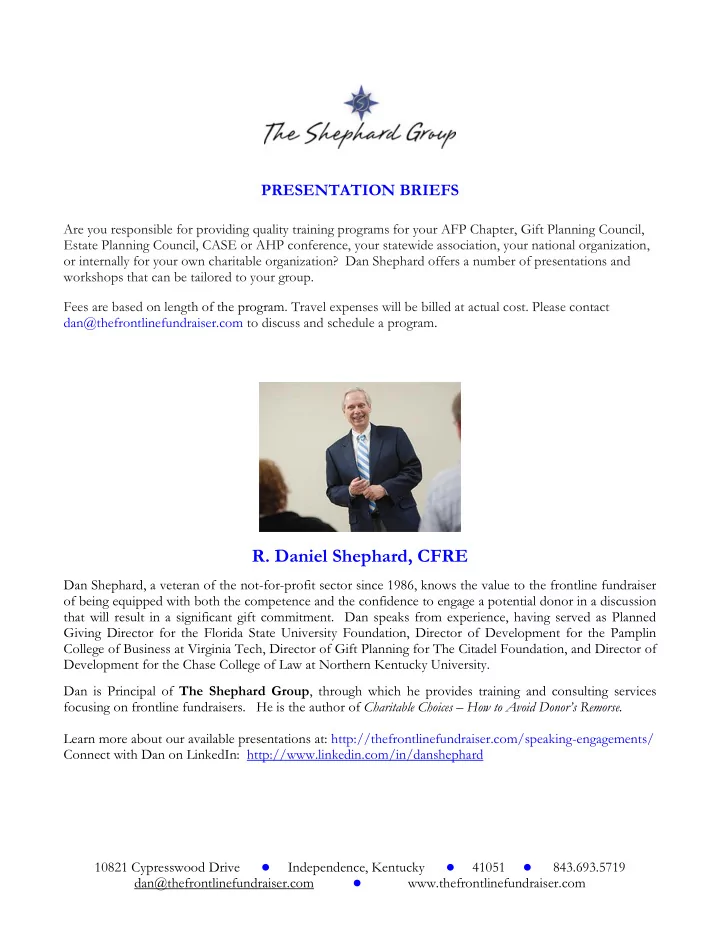
  • R. Daniel Shephard, CFRE

Dan Shephard, a veteran of the not-for-profit sector since 1986, knows the value to the frontline fundraiser

  • f being equipped with both the competence and the confidence to engage a potential donor in a discussion

that will result in a significant gift commitment. Dan speaks from experience, having served as Planned Giving Director for the Florida State University Foundation, Director of Development for the Pamplin College of Business at Virginia Tech, Director of Gift Planning for The Citadel Foundation, and Director of Development for the Chase College of Law at Northern Kentucky University. Dan is Principal of The Shephard Group, through which he provides training and consulting services focusing on frontline fundraisers. He is the author of Charitable Choices – How to Avoid Donor’s Remorse. Learn more about our available presentations at: http://thefrontlinefundraiser.com/speaking-engagements/ Connect with Dan on LinkedIn: http://www.linkedin.com/in/danshephard

slide-2
SLIDE 2

10821 Cypresswood Drive ⚫ Independence, Kentucky ⚫ 41051 ⚫ 843.693.5719 dan@thefrontlinefundraiser.com ⚫ www.thefrontlinefundraiser.com

SKILLS TRAINING SESSIONS THE FOUR DECISIONS

How To Lead Your Donor To Each 60-90 Minutes Recommended Audience: all frontline fundraisers Solicitation is only one component of securing a new charitable gift, and usually (as it should be) the last to be addressed. Even when the fundraiser opens a new relationship by announcing his/her intent to request a contribution, that fundraiser will almost always address three other topics and come to a decision on each with the new donor. That totals four issues to pursue, four decisions to be made by your new donor. Learning Objectives Learn a deliberate, donor-centered approach to a successful gift conversation. Learn WHY the prospective donor wants to discuss giving with you. Learn for WHAT the gift will be designated, what impact the donor wants to make with the gift. Learn HOW the gift plan will be structured – when, with what assets, and in conjunction with what

  • ther considerations and priorities.

Learn why “WILL YOU give?” is usually the last thing you should ask. Learn how to partner with colleagues and key volunteers in pursuing The Four Decisions.

Extend Your Reach How Major Gift Officers Become Active Partners in Gift Planning Efforts

60-90 Minutes Recommended Audience: major gift and planned gift fundraisers, those who manage them In the fundraising sector synergy is the result of collaboration and shared success. This presentation

  • ffers practical tools to create synergy in your development office, combining the skillsets of major gifts

and planned gifts in ways that do more than just multiply results. Learning Objectives Learn how to lead donors through purposeful discovery conversations, and how those conversations lead to the effective integration of planned giving and major giving; Learn how interactive case studies serve as the tool for sustainable in-house training that equips major gift fundraisers to find more and greater gifts, and positions planned giving experts as collaborative partners; Learn how such purposeful conversations help uncover more outright, deferred, and blended gifts.

Navigating the Hurdles to Conversational Gift Planning

60-90 Minutes Recommended Audience: all frontline fundraisers There are two critical moments in building a donor relationship, even for the most experienced charitable gift planner. The first is when you invite your possible donor to transition from an emotional discussion of your nonprofit to an actionable gift conversation. The second happens once your prospect identifies an

slide-3
SLIDE 3

10821 Cypresswood Drive ⚫ Independence, Kentucky ⚫ 41051 ⚫ 843.693.5719 dan@thefrontlinefundraiser.com ⚫ www.thefrontlinefundraiser.com appealing gift purpose, offering you the opportunity to invite an in-depth exploration of the best way to give. Learning Objectives

This mini-workshop introduces tools you can use immediately to navigate these hurdles. Learn how to identify the gift plan that’s available, whether it’s outright, deferred, or blended.

The workshop includes two practice exercises, introducing a proven structure and a language that can be introduced at each key juncture in the relationship.

GET THE APPOINTMENT

60-90 Minutes Recommended Audience: all frontline fundraisers Jerry Panas writes in his definitive book Mega Gifts that “getting the appointment is 85 % of getting the gift.” We spend a lot of time and attention on cultivation and solicitation techniques, both of which assume that we have already engaged with the possible donor. But nothing gets done until you’re in the living room

  • r the conference room sitting with that possible donor.

Learning Objectives Learn how to intentionally invite meetings with possible donors, how to claim control from the

  • utset, how to set the agenda for all that will follow.

Learn how to invite meetings, both in person and by telephone. Draft your personal Call Scripts for telephoning. Learn how to Go APE(Anticipate, Prepare, Execute) as you invite the meetings that will result in meaningful gift discussions.

GET TO THE POINT

60-90 Minutes Recommended Audience: all frontline fundraisers At some time during the discovery / assessment process with your new possible donor you must get to the point and invite a gift discussion. You must learn whether you are investing bad time after good and either continue building this relationship or move on. Rather than go into the meeting hoping your possible donor shares something useful with you, go into that meeting with a plan to invite the person to share something with you – to begin with the end in mind. Learning Objectives Learn how to set the agenda in a new donor relationship Learn how to break the ice with triggering questions and invitations Learn & practice The Two Part Conversation that identifies for WHAT and HOW the gift plan will be designed

slide-4
SLIDE 4

10821 Cypresswood Drive ⚫ Independence, Kentucky ⚫ 41051 ⚫ 843.693.5719 dan@thefrontlinefundraiser.com ⚫ www.thefrontlinefundraiser.com

EXERCISES in ETHICS

60-90 Minutes Recommended Audience: all nonprofit leaders Fundraising professionals interact on a confidential, often intimate level with colleagues, with volunteer leadership, and with potential donors. Challenges and temptations arise that are difficult to interpret, much less to respond to appropriately. The consequences of poor choices can have far-reaching implications on your career. Learn the three sources of ethical pressure Identify resources that will protect you:

  • Pertinent tax law
  • Organizational policies
  • codes and standards of ethics
  • The Mama Rule

Solution Session – role play the scenarios you will encounter during your career

INFORMATIVE PRESENTATIONS THE SELF-LIMITING ASK

from Dan’s article, “The Self-Limiting Ask,” published in the October, 2018 issue of Advancing Philanthropy

30-60 Minutes Recommended Audience: all nonprofit leaders If you’re thinking the $1,000 annual gift from each of your top donors is a major gift and that your fundraising program is on cruise control, think again. Is it possible that:

  • Your donor thinks much about that $1,000 annual gift?
  • Your is the only nonprofit she supports?
  • No other fundraisers ask her for support, and some ask for far more than $1,000?
  • Your donor might be considering larger gifts to some of those others?

Learning Objectives Learn how to stop asking for contributions, and start asking for gift conversations. Learn how to discover gift motivation and major gift capacity Learn the two part gift conversation that will lead you to gifts from assets, not only from income

SIMPLIFYING CHARITABLE REMAINDER TRUSTS

60 – 90 Minutes Recommended Audience: gift planning experts and those who aspire to be Unitrusts, Annuity Trusts, NICRUTs & NIMCRUTs, FLIP CRUTs, Education Unitrusts, Retirement Unitrusts – how does one even begin to sort through it all? Here’s the key: the basic structure of every charitable trust is identical. What distinguishes the specific variation of the trust your donor will gravitate toward has more to do with listening to the donor’s concerns and priorities, and with packaging to get the prospect’s attention. Learn the language of charitable remainder trusts in a way that will give you confidence

slide-5
SLIDE 5

10821 Cypresswood Drive ⚫ Independence, Kentucky ⚫ 41051 ⚫ 843.693.5719 dan@thefrontlinefundraiser.com ⚫ www.thefrontlinefundraiser.com to discuss them with your prospects. Learn how your nonprofit, regardless of its size or level of investment sophistication, can seek and discuss gifts through charitable remainder trusts. Learning Objectives Learn the basic language and structure of all trusts. Learn how this applies to charitable trusts. Review various types of charitable remainder trusts. Learn how charitable trust nomenclature is based on packaging and marketing, to appeal to donors.

THE MONEY LEFT ON THE TABLE

How the Silo Mentality Separating Major Gifts and Planned Gifts Short-Changes Everyone

from Dan’s article, “Don’t Leave Money on the Table,” published in the fall 2015 issue of CASE Currents

30-45 Minutes Recommended Audience: major gift and planned gift fundraisers, those who manage them Frontline fundraising professionals tend to work in silos, and we leave a whole lot of gift money on the

  • table. Yet the separation of responsibilities persists, year after year, in charity after charity. Fundraising

professionals are hired as major gift officers or planned gift officers and embrace their assigned roles within their respective silos. Their managers either passively enable this silo mentality, or insist that their staffs work separately. Gift reporting and valuation policies only encourage and exacerbate the problem. Learning Objectives Examine definitions and distinctions-- “planned gift” and “major gift.” Examine the Silo Mentality and determine what can be done about:

  • Thoughtless fundraiser credit
  • Management: insecurity, bias, lack of time, or disinterest
  • Poor training of frontline fundraisers
  • Short-sighted policies
  • Turf issues

Address common fears about getting out of your silo. Complete an assessment checklist to guide your next steps.

TWO STEPS TO A SUCCESSFUL PLANNED GIVING PROGRAM

from Dan’s article, “Two Steps to a Successful Planned Giving Program,” published in the July-August 2015 issue of The Grassroots Fundraising Journal

60-90 Minutes Recommended Audience: the nonprofit leader who wants to start a planned giving program Development directors and executive directors of nonprofits of all sizes fantasize about the day they will be ready to start a planned giving program. For far too many that day never comes. Some don’t know what to do first. Some assume they can’t afford to start. Some are frozen with the fear of learning the legal and technical aspects of charitable gift planning. Here’s the first point – it ain’t rocket science.

slide-6
SLIDE 6

10821 Cypresswood Drive ⚫ Independence, Kentucky ⚫ 41051 ⚫ 843.693.5719 dan@thefrontlinefundraiser.com ⚫ www.thefrontlinefundraiser.com Learning Objectives Define planned giving from both pertinent perspectives – your organization’s, your donor’s. Learn what to avoid. Learn steps your organization can take today to start your program:

  • preparation: determine what types of gifts you will pursue and accept, design marketing

materials, design a donor recognition program, identify needed expertise, identify possible donors

  • execution: start in-house, intentional discovery and assessment

Plan follow up steps to build your program: next steps, ongoing training, expand your menu.

REAP A RICHER HARVEST a Template for a Targeted Planned Giving Mail Plan

from Dan’s two-part article, “ Technology and a Direct Mail Template,” published in the Nov 2016 and Dec 2016 issues of Planned Giving Today

30-45 Minutes OR 60-90 Minutes Recommended Audience: planned giving councils, estate planning councils Every gift planning manager/marketer wants a big bang-for-the-buck return on what is mailed to constituents. Consider the farming analogy – you want more of the seeds you spread to take root and grow. You also want to manage the upfront costs of such mailings to keep management happy. This invites a careful examination

  • f what you mail to those on your contacts list you hope to cultivate for planned gifts.

Learning Objectives Examine the two key considerations when deciding to mail planned giving materials to your constituents: 1) short-term cost-effectiveness and 2) long-term return on investment Learn how to integrate wealth screening and gift capacity rating software into your plan Learn how to design an age-based matrix from your constituency database Discuss considerations on what to mail, when, and to which market segment

THE FIVE DEFINITIONS OF GIFT VALUATION What To Count, Where, When, and Why

30-45 Minutes Recommended Audience: all nonprofit leaders concerned about gift reporting The opinions among colleagues at most nonprofits regarding the value of a multi-year pledge, of a will bequest, of a charitable remainder trust are as varied as are the number of professionals engaged in those

  • conversations. This presentation breaks it all down to a level at which you and your colleagues can make an

informed decision about what dollar values to assign to your pledges and deferred commitments that will best serve your organization and your donors. Learning Objectives Distinguish among laws, regulations, and recommendations for charitable gift valuation. Identify the five definitions of gift valuations. Examine valuation choices for outright and deferred gifts Discuss transparent reporting that benefits all parties to a charitable gift.

slide-7
SLIDE 7

10821 Cypresswood Drive ⚫ Independence, Kentucky ⚫ 41051 ⚫ 843.693.5719 dan@thefrontlinefundraiser.com ⚫ www.thefrontlinefundraiser.com

DIRECT CHARITIES VS INDIRECT CHARITIES The Quiet Competition

30-45 Minutes OR 60-90 Minutes Recommended Audience: gift planning councils, estate planning councils Representatives of many of those organizations to which a donor might transfer charitable contributions are reluctant to acknowledge that they are in competition with each other for that donor’s attention; it invites perceptions that run counter to their stated charitable missions or their intent to promote philanthropy. The competition is benign with some, while others tend to mask or distort details to give themselves a competitive advantage. The professional advisor who encourages the donor to establish a Private Foundation may not be inclined to explore the less costly alternative of a Supporting Organization. An investment firm offering Donor Advised Funds may choose not to offer comparative information on giving to a Direct Public Charity. A Direct Public Charity might not be inclined to suggest that you research giving to the local Community Foundation. It simply is not in their best interest. But is it in the donor’s? taken from Dan’s book, Charitable Choices – How to Avoid Donor’s Remorse Learning Objectives: Identify the five different types of organizations to which charitable donors might direct their giving. Plan to position your organization to serve your donors/clients in this competitive marketplace. Learn what questions to ask in order to guide your prospective donors/clients to their best choices.