
SLIDE 1
Pilot ran Aug to Dec 2019
Mathew Hillier – now at Macquarie University, Sydney, Australia
Back to the future –
using a pen in STEM e-exams
22nd June to 1st July
Quick context UNSW top 100 research intensive, 59,000 students and - - PowerPoint PPT Presentation
Back to the future 22nd June to 1st July using a pen in STEM e-exams Mathew Hillier now at Macquarie University, Sydney, Australia Pilot ran Aug to Dec 2019 Quick context UNSW top 100 research intensive, 59,000 students and
Pilot ran Aug to Dec 2019
Mathew Hillier – now at Macquarie University, Sydney, Australia
22nd June to 1st July
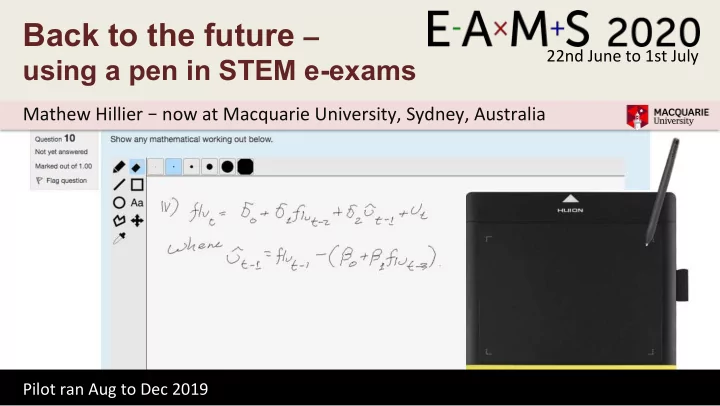
Moodle free hand drawing (Poodll) installed 8 Aug – 1st pilot 15 Oct remote online exam Annotate an image, free hand drawing, wriMng formulae, drawing diagrams – in Moodle. Commodity $60 USB graphics tablet (needs some pracMce) or touch screen device.
In future … images could be transferred to arMficial intelligence marking tool? (e.g. work of Dr. D. Kellerman, UNSW)
Steps:
Set up exam rules. Schedule in invigilaMon service.
(create account, set Mme zone, set up ID).
invigilaMon service and does technology checks.
check, pre-id checks, room scan. Invigilator does system checks. Clicks start exam. Is taken to Moodle (or other tool). Does exam while monitored by invigilaMon service. Follow exit steps when done (submit file, clear cache etc).
and recording reviewed/flagged by invigilator. Video viewable by teacher.
Home: BYO Laptop with webcam + Tablet Windows or Apple MacOS Internet connecMon 3MBS up 3MBS down InvigilaMon Service provider Web browser InvigilaMon monitoring system Moodle or assessment tool Teacher
cam
LMS Server on AWS Off-campus invigilated exams architecture
Equipment at home: BYO laptop with
connecMons to invigilaMon service provider and exam materials in Moodle. Digital inking add-on: USB graphics tablet (digital pen) for digital ink input.
Feedback following two remote online exams (responses = 26 ~ low response): Students did not have a good Mme... Why? But - Many didn’t engage with prac%ce opportuniMes as was instructed.
5 10 15 20 Easier No different More difficult
Onsite v remote: I think this exam was pracMcally…
Yes No
a) Drawing tool was clunky. b) Vendor staff unfamiliar/unhelpful. c) Problem with internet during exam:
Successful as a ‘minimum viable product’. It worked largely as expected on a technical level given the known caveats and context. 25% negaNve feedback from the cohort – but low response rate. Issues partly due to:
usability and min technical requirements (provided well in advance).
required to become proficient in use).
A first run - early days, so feedback reflects this. Difficult and complex confounding factors: i.e, course design did not include scaffold inking pracMce and this was not able to be addressed, minimal/opMonal
instrucMons that included usability caveats, remote proctors unfamiliar with system despite the provider being briefed, could not use surface pros due to web cam angle requirement. ProblemaNc data collecNon: Feedback could only be collected late, it was online
picture of altude/usability.
a) Refine/fix the drawing tool to address usability caveats – e.g. fix text tool, remove the ‘move’ tool, bener autosave, copy/paste drawing elements. Will require some funding to address (although minor in the scheme of things!). b) Refine user documentaNon, add videos of use etc. c) PracNce and instrucNons to be built-into the course itself – i.e. scaffold use of the graphics tablet for formaMve/lower stakes learning tasks during the term before students get to the exam. d) Run an inking pilot using on-campus lab machines to minimise confounding factors and move forward from that (that includes the other points!). i.e follow procedures used in DET e-exam grant pilots. e) Revisit the remote proctoring use case later!
Cite this: Hillier, M (2020) “Back to the future - using a pen in STEM e-exams”, e-Assessment in mathemaMcs and science conference (online), Newcastle University, PresentaMon 22nd June. Conference site: hnps://eams.ncl.ac.uk/