Quaternions Alan Pryde 24/11/11 1 . Introduction The set H of - - PDF document

quaternions
SMART_READER_LITE
LIVE PREVIEW

Quaternions Alan Pryde 24/11/11 1 . Introduction The set H of - - PDF document

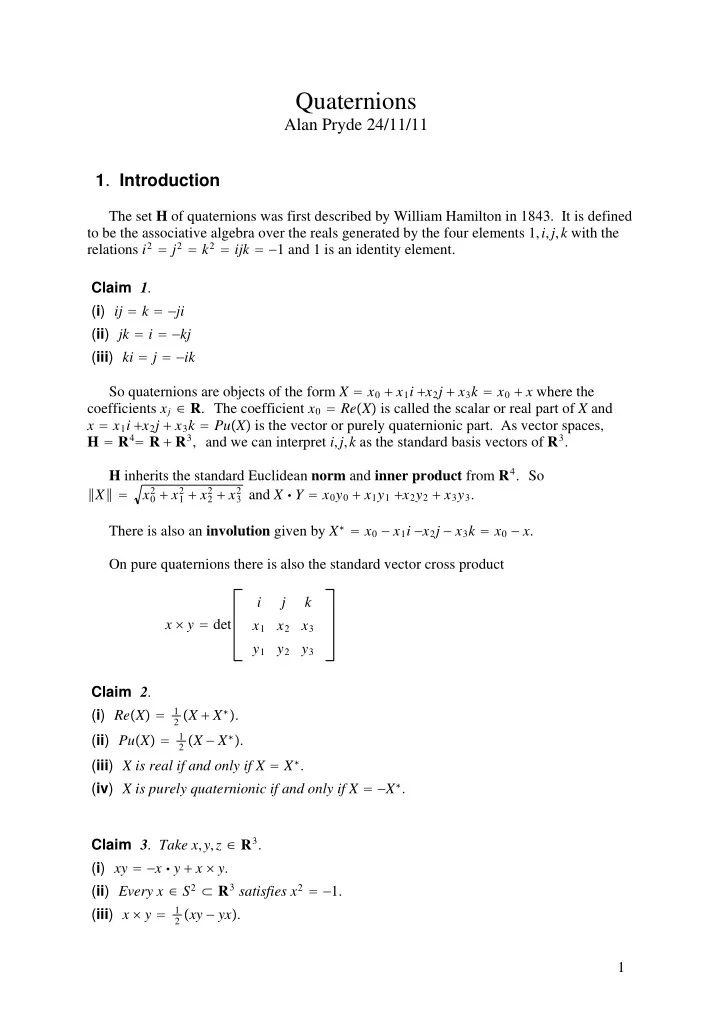
Quaternions Alan Pryde 24/11/11 1 . Introduction The set H of quaternions was first described by William Hamilton in 1843. It is defined to be the associative algebra over the reals generated by the four elements 1, i , j , k with the relations i 2


slide-1
SLIDE 1

Quaternions

Alan Pryde 24/11/11

  • 1. Introduction

The set H of quaternions was first described by William Hamilton in 1843. It is defined to be the associative algebra over the reals generated by the four elements 1,i,j,k with the relations i2  j2  k2  ijk  −1 and 1 is an identity element. Claim 1. (i) ij  k  −ji (ii) jk  i  −kj (iii) ki  j  −ik So quaternions are objects of the form X  x0  x1i x2j  x3k  x0  x where the coefficients xj ∈ R. The coefficient x0  ReX is called the scalar or real part of X and x  x1i x2j  x3k  PuX is the vector or purely quaternionic part. As vector spaces, H  R4 R  R3, and we can interpret i,j,k as the standard basis vectors of R3. H inherits the standard Euclidean norm and inner product from R4. So ‖X‖  x0

2  x1 2  x2 2  x3 2 and X  Y  x0y0  x1y1 x2y2  x3y3.

There is also an involution given by X∗  x0 − x1i −x2j − x3k  x0 − x. On pure quaternions there is also the standard vector cross product x  y  det i j k x1 x2 x3 y1 y2 y3 Claim 2. (i) ReX 

1 2 X  X∗.

(ii) PuX 

1 2 X − X∗.

(iii) X is real if and only if X  X∗. (iv) X is purely quaternionic if and only if X  −X∗. Claim 3. Take x,y,z ∈ R3. (i) xy  −x  y  x  y. (ii) Every x ∈ S2 ⊂ R3 satisfies x2  −1. (iii) x  y 

1 2 xy − yx.

1

slide-2
SLIDE 2

(iv) xyx  ‖x‖2y − 2x  yx (v) Rexyz  −x  y  z  −detx,y,z. Claim 4. (i) XY∗  Y∗X∗. (ii) X∗X  ‖X‖2. (iii) ‖XY‖  ‖X‖‖Y‖. (iv) Each non-zero X is invertible with X−1  X∗/‖X‖2. (v) Each quaternion X is the product of 2 pure quaternions. Claim 5. (i) H is a four-dimensional associative division algebra over the reals. (ii) H is a C∗-algebra (a Banach algebra with involution satisfying ‖X∗X‖  ‖X‖2. Theorem 6. (Frobenius, 1878) .The only finite dimensional associative division algebras over the reals are R,C and H. Theorem 7. (Hurwitz, 1898) .The only finite dimensional multiplicatively normed division algebras over the reals are R,C,H and O. Claim 8. (i) The set H# of non-zero quaternions is a group. (ii) The set of unit quaternions coincides with the unit sphere S3 in R4 and is a subgroup

  • f H#.

2

slide-3
SLIDE 3
  • 2. Matrix representations

Define the maps  : H → M2C by X  x0  x1i x2  x3i −x2  x3i x0 − x1i and  : H → M4R by X  x0 x1 x2 x3 −x1 x0 −x3 x2 −x2 x3 x0 −x1 −x3 −x2 x1 x0 . Claim 9. (i)  : H → M2C is an injective *-homomorphism of algebras. (ii) detX  ‖X‖2. (iii) Restricted to the unit quaternions we get a *-isomorphism  : S3 → SU2. Claim 10. (i)  : H → M4R. is an injective *-homomorphism of algebras. (ii) detX  ‖X‖4. (iii) Restricted to the unit quaternions we get an injective *-homomorphism . : S3 → SO4. 3

slide-4
SLIDE 4
  • 3. Quaternions and rotations in 3-space.

Theorem 11. (Cartan–Dieudonné ) An element of O3 is a rotation if and only if it is the composite of two planar reflections. Take X ∈ S3 ⊂ H. .So,. X is a unit quaternion and XX∗  X∗X  ‖X‖2  1..Now define a map X : H → H by XY  XYX∗. Claim 12. Let X be a unit quaternion. (i) X : H → H is an injective *-homomorphism of algebras. (ii) X : R3 → R3. (iii) If x is a unit pure quaternion, then −x : R3 → R3 is reflection in the plane x. (iv) In general, X : R3 → R3 is a rotation, that is X ∈ SO3. Now define the map . : S3 → SO3 .by. X  X. Claim 13.  : S3 → SO3 .is a surjective group homomorphism with kernel. S0  1,−1. So the group of unit quaternions .S3 is a double cover of the special orthogonal group. SO3. This is the definition of the spin group Spin3. .So Spin3  S3  SU2. Note that Spin3 is a simply connected Lie group. On the other hand SO3 is connected but not simply connected. Its fundamental group is Z2  S0. Finally, .for a unit quaternion X, we can write X  x0  x  x0  ‖x‖ x  cos  sin  x where 0 ≤   . Claim 14. For X ∈ S3, the map X : R3 → R3 is rotation through the angle 2  2arccosReX about the axis given by x  PuX.

Reference

I.R. Porteous "Clifford algebras and the classical groups" (Cambridge, 1995) 4