Quantum metrology gets real Konrad Banaszek Faculty of Physics, - - PowerPoint PPT Presentation

quantum metrology gets real
SMART_READER_LITE
LIVE PREVIEW

Quantum metrology gets real Konrad Banaszek Faculty of Physics, - - PowerPoint PPT Presentation

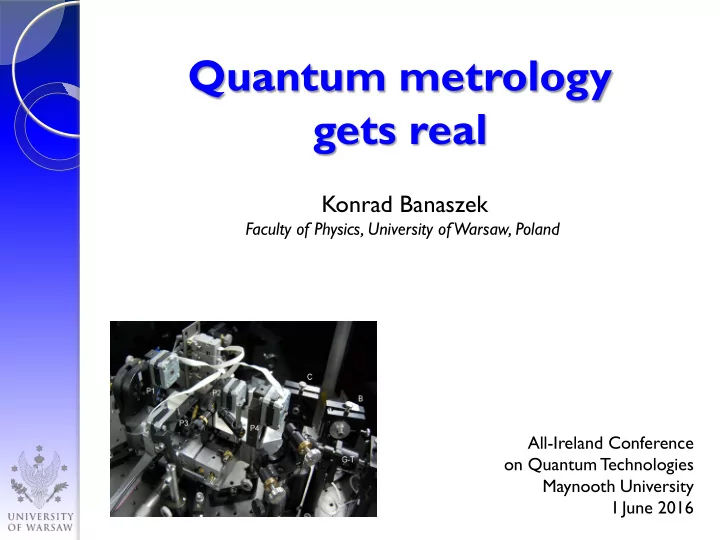
Quantum metrology gets real Konrad Banaszek Faculty of Physics, University of Warsaw, Poland All-Ireland Conference on Quantum Technologies Maynooth University I June 2016 Phase measurement N photons photons photons Estimation procedure

slide-1
SLIDE 1

Quantum metrology

Konrad Banaszek

Faculty of Physics, University of Warsaw, Poland

gets real

All-Ireland Conference

  • n Quantum Technologies

Maynooth University I June 2016

slide-2
SLIDE 2

Phase measurement

N photons photons photons

slide-3
SLIDE 3

Estimation procedure

Actual value Measurement result Estimate Example: around operating point:

slide-4
SLIDE 4

Fisher information

Cramér-Rao bound: for unbiased estimators Shot noise limit: for independently used photons

slide-5
SLIDE 5

T wo-photon interferometry

& Coincidence between ports: Double count on one port:

slide-6
SLIDE 6

Two photons sent one-by-one (shot noise limit):

Experiment

  • J. G. Rarity et al., Phys. Rev. Lett. 65, 1348 (1990)

Two-photon interference:

slide-7
SLIDE 7

General picture

Detection

For any measurement where Quantum Fisher information reads

Preparation

slide-8
SLIDE 8

Heisenberg limit

– photon number uncertainty in the sensing arm – precision of phase estimation

N

N photons

Maximum possible defines the Heisenberg limit:

N independently used

photons (shot noise limit):

  • J. J. Bollinger et al., Phys. Rev. A 54, R4649(R) (1996)
  • J. P. Dowling, Phys. Rev. A 57, 4736 (1998)
slide-9
SLIDE 9

N00N state

Preparation

One photon lost: More photons… No photon lost:

M.A. Rubin and S. Kaushik, Phys. Rev. A 75, 053805 (2007)

  • G. Gilbert, M. Hamrick, and

Y.S. Weinstein, J. Opt. Soc. Am. B 25, 1336 (2008)

slide-10
SLIDE 10

Numerical optimisation

One-arm losses Two-arm losses Optimal Chopped n00n N00N state

  • U. Dorner, R. Demkowicz-Dobrzański et al.,
  • Phys. Rev. Lett. 102, 040403 (2009)
  • R. Demkowicz-Dobrzański, U. Dorner et al.,
  • Phys. Rev. A 80, 013825 (2009)
slide-11
SLIDE 11

T wo-photon experiment

Component weights

slide-12
SLIDE 12

Phase uncertainty

 Optimal  2-NOON  Shot noise

  • M. Kacprowicz et al., Nature Photon. 4, 357 (2010)
slide-13
SLIDE 13

Scaling

Phase uncertainty Sample transmission 100% • shot noise ultimate quantum limit

K.Banaszek, R. Demkowicz-Dobrzański, and I. Walmsley, Nature Photon. 3, 673 (2009)

80% • 60% • 90% • Number of photons (probes) N

slide-14
SLIDE 14

General picture

Actual value

  • R. Demkowicz-Dobrzański, J. Kołodyński, and M. Guţă, Nature Commun. 3, 1063 (2012)
slide-15
SLIDE 15

T wo-arm losses

Preparation

For a quantum state with average photon number

*Assuming no external phase reference is available:

  • M. Jarzyna and R. Demkowicz-Dobrzański, Phys. Rev. A 85, 011801(R) (2012)

Shot noise limit Ultimate quantum limit

slide-16
SLIDE 16

Shot noise revisited

– Strong laser beams photons

  • C. M. Caves,
  • Phys. Rev. D 23, 1693 (1981)
slide-17
SLIDE 17

Gravitational wave detection

  • J. Abadie et al. (The LIGO Scientific Collaboration), Nature Phys. 7, 962 (2011)

GEO600

slide-18
SLIDE 18

Noise analysis

  • R. Demkowicz-Dobrzański, K. Banaszek, and R. Schnabel, Phys. Rev. A 88, 041802(R) (2013)

Shot noise limit 10dB squeezing (implemented) 16dB squeezing and ultimate bound

When most power comes from the laser beam

slide-19
SLIDE 19

Optimality of squeezed states

  • R. Demkowicz-Dobrzański, K. Banaszek, and R. Schnabel, Phys. Rev. A 88, 041802(R) (2013)
slide-20
SLIDE 20

Operating point

1 1

slide-21
SLIDE 21

Partial spectral distinguishability

shot noise limit

Fisher information

slide-22
SLIDE 22

One- and two-photon interference

slide-23
SLIDE 23

Transverse displacement

Fisher information

slide-24
SLIDE 24

Partial transverse overlap

Fisher information

Coherent superposition

slide-25
SLIDE 25

Coherent superposition

No postselection or any attempt to resolve the spectral degree

  • f freedom inducing !!!!!
slide-26
SLIDE 26

Optimal measurement

slide-27
SLIDE 27

Projection basis

Spatial modes Optimal two-photon projections

slide-28
SLIDE 28

Enhancement

Relative uncertainty

No spatial displacement Spatial overlap optimized for individual operating point

slide-29
SLIDE 29

Shot-by-shot imaging

  • R. Chrapkiewicz, W. Wasilewski,

and K.Banaszek, Opt. Lett. 39, 5090 (2014)

  • M. Jachura and R. Chrapkiewicz,
  • Opt. Lett. 40, 1540 (2015)
slide-30
SLIDE 30

Imaging experiment

slide-31
SLIDE 31

Coincidence events

slide-32
SLIDE 32

Transverse displacement

slide-33
SLIDE 33

Coincidence events

  • M. Jachura et al., Nature Commun. 7, 11411 (2016)
slide-34
SLIDE 34

locally

  • ptimized

Relative uncertainty

spatial displacement

  • M. Jachura et al., Nature Commun. 7, 11411 (2016)
slide-35
SLIDE 35

2 + 1 photons

  • M. Jachura et al., Nature Commun. 7, 11411 (2016)
slide-36
SLIDE 36

Conclusions

  • Benefit analysis of quantum metrology needs

to take into account noise and imperfections

  • Even in noisy scenarios quantum enhancement

is possible – and worthwhile!

  • (Nearly) optimal operation can be achieved with

(relatively) modest means

  • Applications where fixed-scale enhancement

is useful / critical

  • Qubits live in a vast physical space – explore!
slide-37
SLIDE 37

Acknowledgements

Uwe Dorner Brian Smith Jeff Lundeen Ian A. Walmsley

University of Oxford

Mădălin Guţă

University of Nottingham

Roman Schnabel

Universität Hannover

Radosław Chrapkiewicz Rafał Demkowicz-Dobrzański Michał Jachura Marcin Jarzyna Jan Kołodyński Wojciech Wasilewski

Uniwersytet Warszawski

Marcin Kacprowicz

Uniwersytet Mikołaja Kopernika w Toruniu