Q1. I understand that the group is undertaking diverse fee - - PDF document

q1 i understand that the group is undertaking diverse fee
SMART_READER_LITE
LIVE PREVIEW

Q1. I understand that the group is undertaking diverse fee - - PDF document

Investor Meeting on Financial Results for FY2018 (May 21, 2019) Questions and Answers Q1. I understand that the group is undertaking diverse fee businesses and the ageing of the society as a whole is beneficial for the group. However, as the


slide-1
SLIDE 1

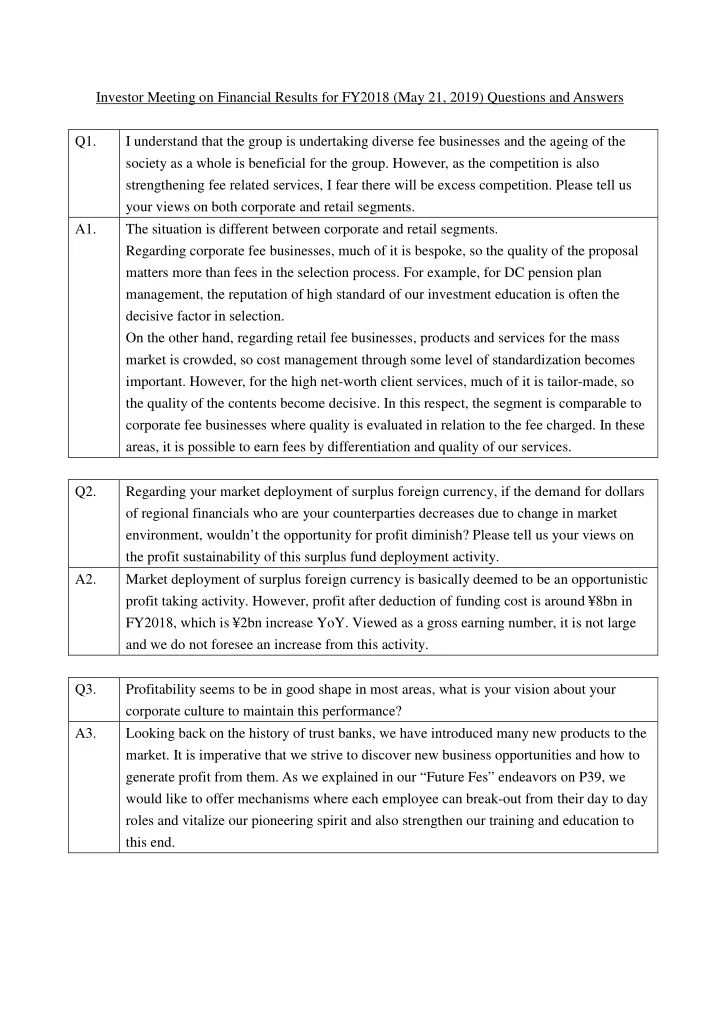
Investor Meeting on Financial Results for FY2018 (May 21, 2019) Questions and Answers Q1. I understand that the group is undertaking diverse fee businesses and the ageing of the society as a whole is beneficial for the group. However, as the competition is also strengthening fee related services, I fear there will be excess competition. Please tell us your views on both corporate and retail segments. A1. The situation is different between corporate and retail segments. Regarding corporate fee businesses, much of it is bespoke, so the quality of the proposal matters more than fees in the selection process. For example, for DC pension plan management, the reputation of high standard of our investment education is often the decisive factor in selection. On the other hand, regarding retail fee businesses, products and services for the mass market is crowded, so cost management through some level of standardization becomes

  • important. However, for the high net-worth client services, much of it is tailor-made, so

the quality of the contents become decisive. In this respect, the segment is comparable to corporate fee businesses where quality is evaluated in relation to the fee charged. In these areas, it is possible to earn fees by differentiation and quality of our services. Q2. Regarding your market deployment of surplus foreign currency, if the demand for dollars

  • f regional financials who are your counterparties decreases due to change in market

environment, wouldn’t the opportunity for profit diminish? Please tell us your views on the profit sustainability of this surplus fund deployment activity. A2. Market deployment of surplus foreign currency is basically deemed to be an opportunistic profit taking activity. However, profit after deduction of funding cost is around ¥8bn in FY2018, which is ¥2bn increase YoY. Viewed as a gross earning number, it is not large and we do not foresee an increase from this activity. Q3. Profitability seems to be in good shape in most areas, what is your vision about your corporate culture to maintain this performance? A3. Looking back on the history of trust banks, we have introduced many new products to the

  • market. It is imperative that we strive to discover new business opportunities and how to

generate profit from them. As we explained in our “Future Fes” endeavors on P39, we would like to offer mechanisms where each employee can break-out from their day to day roles and vitalize our pioneering spirit and also strengthen our training and education to this end.

slide-2
SLIDE 2

Q4. When you categorize the group’s businesses by client segment and business function, which areas need attention? For those areas that are weak, please categorize them into areas that you intend to reinforce through alliances with external partners or M&A and areas where you intend to fortify independently. A4. From a client category aspect, for retail business, private banking is one area where we are deploying additional human resources to further strengthen our comprehensive consultation services to the segment. From a business function perspective, we have been contending that we intend to further strengthen our broadly-defined asset management and administration services. We shall strive to broaden our asset management and administration to non-financial assets. Also, as I mentioned in our digitalization strategy, we would like to challenge to build platform type businesses. However, this is an area where we cannot act alone, so we intend to co-work with both domestic and international firms. Q5 (1). Retail business is an area where all major banks and securities firms are struggling to make profit. Does your group consider this segment to be attractive in areas such as private banking and have positive long-term views, or do you think profitability will shrink due to tough competition? A5 (1). Services oriented towards affluent seniors are one area where trust banks can definitely leverage its unique strengths. By offering diverse services covering real estate and asset administration, we believe we can maintain our competitive edge. We have been actively deploying human resources into this area to strengthen our consultation services. Q5 (2). Also, please tell us your views about alliances with major securities firms. A5 (2). I believe there might be opportunities on a case by case basis, but as we possess asset management and administration function ourselves, I do not foresee a comprehensive alliance as of now. Q6 (1). Mega banks have raised their dividend payout ratio to more than 35%. Is there any possibility to raise your payout ratio in the next Midterm Management Plan to catch up? A6 (1). We would like to achieve a stable and sustainable growth by pursuing a business model unique to a trust bank. Our shareholder return policy should be in alignment with this business model. We have been discussing our shareholder return policy as part of our next Midterm Management Plan, and we would like to strengthen our shareholder returns over the medium to long term.

slide-3
SLIDE 3

Q6 (2). Also, if the probability of attaining target of CET1 Ratio on Basel III finalized basis becomes apparent, is there a chance that you will alter your shareholder return policy before reaching your target? A6 (2). Our CET1 Ratio on Basel III finalized basis is currently in the lower 9% range, and we are still in the accumulation stage towards our goal of stably maintaining 10%. Even during this accumulation stage, we shall explore the strengthening of our shareholder return policy while taking the balance of capital, shareholder return and growth strategy into consideration. We shall also revisit the balance between dividend and share buyback as well. Q7. I would like to hear about your next Midterm Management Plan. My impression is that IT related costs are going to increase going forward; is your new Plan going to be able to demonstrate a stable profit growth trajectory despite this trend? A7. During our transition phase to the cloud, we cannot avoid a certain level of duplication as we are required to run some systems in parallel, which would result in additional IT costs during the period. We anticipate that positive impact from IT transition would materialize in about 5 years, in the interim during the next Midterm Management Plan’s timespan, we shall aim to cover the increased costs through strengthened profitability. Our base assumption for the economy is that the low interest rate environment due to global excess liquidity would remain unchanged during the next Midterm Management Plan, thereby making any assumption that certain segments’ profitability to increase drastically would be difficult to justify. In the three years covered by the next Plan starting from 2020, while envisioning a substantial upward trajectory would be unrealistic, we would like to extend our sober efforts to enhance profitability of each business and continue our stable and sustainable growth which is our forte. Q8. Regarding your hedging strategy for strategic shareholdings, Basel III finalized basis might not recognize the risk-asset netting effect from holding of bear-type equity investment trusts. Would this impact your hedging strategy or the speed of your divestment? A8. We have been executing our 5-year plan to reduce strategic shareholdings by ¥200bn from

  • FY2016. Our plan to divest ¥100bn in the remaining two years is a challenge given current

market environment, but we remain committed to achieving it. As for our hedging strategy, we intend to maintain it to reduce price volatility risk, but our policy after Basel III finalization is being considered with the outstanding volume of shares in mind.

slide-4
SLIDE 4

Q9. Real estate prices have risen substantially since the Lehman-Shock, I would like to hear your views about price correction risk in domestic and overseas markets. A9. Regarding real estate risk, we believe some areas have become overheated. However, office demand is still elevated and vacancy rates are still low, making imminent price correction in commercial real estate such as offices in Tokyo and Osaka unlikely. We believe hotels and logistics are also robust. That being said, there are not only offices and commercial properties but also residential properties in central Tokyo yielding only around 3%, which leads us to worry about real estate price correction risk over the longer term. For our overall real estate portfolio, we have been set a limit of ¥4trn and managing our portfolio prudently within this limit. For example, our non-recourse loans are offered at 50%

  • LTV. Overseas non-recourse loans are sponsored by large Japanese developers or trading

houses and geographically limited to major US cities, London and other major cities. Q10. Please comment on your efforts to cultivate asset-formation generation client base. A10. We are strengthening our approach to the asset formation generations as the next generation’s core client base. For example, we are offering mortgages from both SuMi TRUST Bank and SBI Sumishin Net Bank and our share of loans extended is high. Client numbers have reached 400,000. We are offering insurance and instalment type investment trusts to our mortgage client base and around 50% of new mortgage clients have signed onto level premium illness protection insurance policies. Also, we are pursuing strategies to entice clients to hold accounts at both SuMi TRUST Bank and SBI Sumishin Net Bank and encouraging SuMi TRUST Club (Diners Club) members to commence banking at SuMi TRUST Bank. Q11. Regarding your IT strategy, what are the issues and limitations we you proceed to digitalize your core trust services? A11. To utilize broad and detailed data of our clients held by ourselves to improve client experience, we need to obtain consent from relevant parties, which is one of the issues. Also, though not a constraint, there are limits to platform-based businesses that can be developed

  • n our own, so we need to carefully assess what kind of partners to work with in various

business segments.

slide-5
SLIDE 5

Q12. How do you intend to stably earn profit from SuMi TRUST Club that operates Diners Club Card? A12. It can be used for daily transactions, but we would like that to be ancillary and offer high added-value in other areas. For example, we would like to make the club into a tool to offer “prosperity” and “pleasure” to our over-60s clients as active seniors. We intend to make necessary investments to enhance its attractiveness as a club. As healthy lifespan has extended, we believe our clients’ interests are not limited to inheritance and asset transfer, but also covers gastronomy, travel, entertainment and health. We would like to offer these services to enrich life and this matches our clients’ expectations. I explained that since the purchase in FY2015, transaction volume is increasing centered on premium cards, but I would like to add that the number of premium cards has also increased. I believe there are ample opportunities to utilize the Diners brand in our overall group strategy. Q13. Typical IT cost can be grouped into new development and system maintenance; wouldn’t maintenance cost increase in the future as the need for tighter security measures and other costs become bloated? A13. Trust banks cover a wide range of businesses and operate a diverse range of systems that naturally requires a certain level of maintenance cost. Also enhanced security is expected to become more important in the future. To mitigate this burden, we would like to move what we can to the cloud, to reduce our maintenance costs. Q14. Please explain your anti-money laundering efforts? A14. Anti-money laundering is one our important initiatives for FY2019. We have established a dedicated team for this effort, and working group-wide to improve our resilience through system development and coordination with authorities. Cautionary Statement regarding Forward-Looking Statements This document contains information that constitutes forward-looking statements. Such forward-looking statements are not guarantees of future performance and involve risks and uncertainties, and actual results may differ from those in the forward-looking statements as a result of various factors including changes in managerial circumstances. Information regarding companies and other entities outside the group in this document has been

  • btained from publicly available information and other sources. The accuracy and appropriateness of

that information has not been verified by the group and cannot be guaranteed. This document does not constitute an offer to sell or a solicitation of an offer to subscribe for or purchase any securities.