Proteomics pathway Proteomics pathway Sample Data Analysis - - PDF document

proteomics pathway proteomics pathway
SMART_READER_LITE
LIVE PREVIEW

Proteomics pathway Proteomics pathway Sample Data Analysis - - PDF document

Proteomics pathway Proteomics pathway Sample Data Analysis Separation Selection of spot(s) G Q R E N K T M E Post-separation analysis ... NRTKGG ... Databases Data Processing Major steps in gel image Major steps in gel image


slide-1
SLIDE 1

1

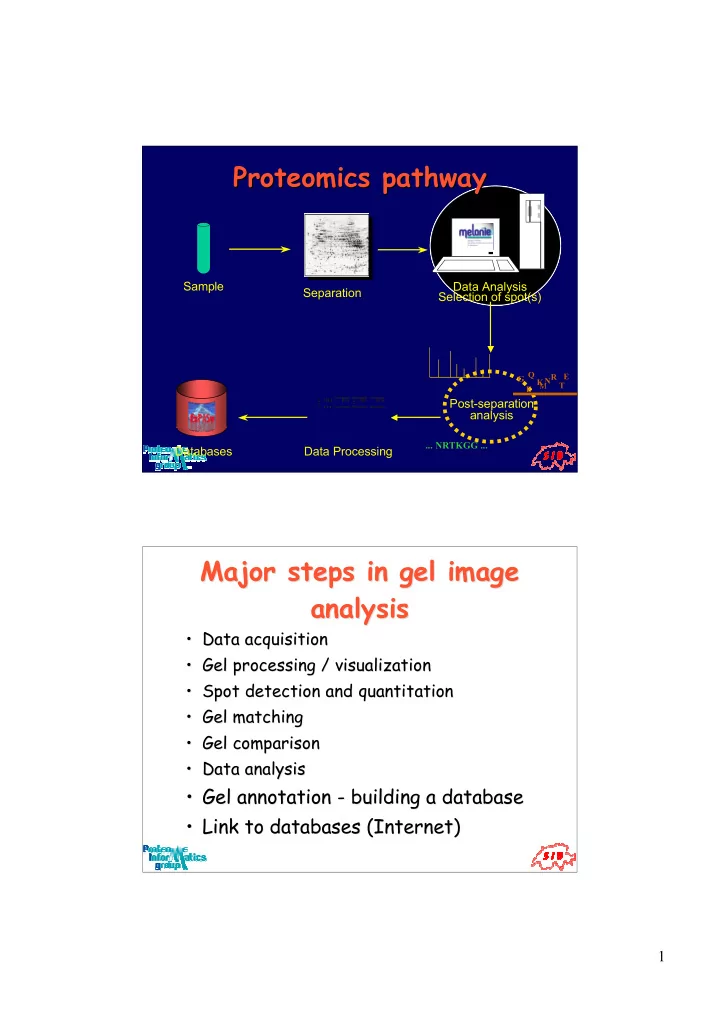
Proteomics pathway Proteomics pathway

Databases Separation Sample Data Processing Data Analysis Selection of spot(s)

G Q M R T N E K E

... NRTKGG ...

Post-separation analysis

Major steps in gel image Major steps in gel image analysis analysis

  • Data acquisition

Data acquisition

  • Gel processing / visualization

Gel processing / visualization

  • Spot detection and

Spot detection and quanti quantit tation ation

  • Gel matching

Gel matching

  • Gel comparison

Gel comparison

  • Data analysis

Data analysis

  • Gel annotation - building a database

Gel annotation - building a database

  • Link to databases (Internet)

Link to databases (Internet)

slide-2
SLIDE 2

2

MELANIE 2D gel analysis software

Swiss Institute of Bioinformatics, Geneva, Switzerland

2-D PAGE Analysis 2-D PAGE Analysis (other software)

(other software)

 Progenesis (Nonlinear Dynamics)  Z3 and Z4 (Compugen)  Proteomweaver (Definiens)  PdQuest (Biorad)  ImagepIQ (Proteome Systems)  Decyder (Amersham Biosciences)  ProteinMine (Scimagix) Phoretix (many names, many distributors ) Delta2D (Decodon )

slide-3
SLIDE 3

3

slide-4
SLIDE 4

4

Image analysis

Visualisation Visualisation

slide-5
SLIDE 5

5

 Visual comparison  By matching

  • automatic or semi-automatic

Pairwise Pairwise Comparison Comparison Gel matching Gel matching

slide-6
SLIDE 6

6

Transparent mode & aligning Transparent mode & aligning Transparent mode & aligning Transparent mode & aligning

Variation of spot Variation of spot intensity intensity Proteins unique to Proteins unique to a particular state a particular state. .

slide-7
SLIDE 7

7

t = 1 t = 2 t = 3 t = 4

Analyzing populations of gels Analyzing populations of gels

Progression Based Comparison Progression Based Comparison

Disease Control Analyzing populations of gels Analyzing populations of gels

Population Based Comparison Population Based Comparison

slide-8
SLIDE 8

8

Data analysis Data analysis

slide-9
SLIDE 9

9

Data management Data management

Laboratory Analysis Identification Visualisation Query Data Data types Exports Gels Analysis Matching Classes Annotations External links Samples Data Warehouse Spot Cutter MS Experimental conditions Images

Data management / workspace Data management / workspace

slide-10
SLIDE 10

10

Proteomic Proteomic databases databases

  • Collection of data obtained by 2D gels

Collection of data obtained by 2D gels analysis analysis

  • includes:

includes:

– Annotated images of 2D gels – description of identified proteins

Definition

Identification Selection

  • f spots

2D Gel Sample

Proteome Proteome analysis analysis

P22323 P54001

Annotation of 2D image Database update

slide-11
SLIDE 11

11

  • Comparison with a reference gel

Comparison with a reference gel

  • Extraction of spots and biochemical

Extraction of spots and biochemical analysis analysis

  • Search into databases

Search into databases

Identification of spots Identification of spots Identification Identification

slide-12
SLIDE 12

12

Master gel Master gel E.

  • E. coli

coli

  • Created in 1993

Created in 1993

  • Collaboration

Collaboration

– Central Laboratory of Clinical Chemistry, University Hospital of Geneva – Swiss Institute of Bioinformatics

SWISS-2DPAGE SWISS-2DPAGE

slide-13
SLIDE 13

13

Release 17.0, February 2004 Release 17.0, February 2004

  • 36 reference maps

36 reference maps

– Plasma (27%), E. coli (18%, 8 maps), Mouse (17%, 6 maps)

– Human lymphocytes, Staphyloccocus aeurus

  • 1265 protein entries

1265 protein entries

  • 4309 identified spots

4309 identified spots

Human 34%

  • E. coli

26% Dictyostelium 1% Arabidopsis 4% Yeast 5% Mouse 14% Staphylococcus 16%

slide-14
SLIDE 14

14

Annotation examples Annotation examples General information General information

slide-15
SLIDE 15

15

2D Annotations 2D Annotations Cross-references Cross-references

slide-16
SLIDE 16

16

Query into the databases Query into the databases

  • http://www.

http://www.expasy expasy.org/ch2d/ .org/ch2d/

  • Query by keywords

Query by keywords

  • Graphical query

Graphical query

  • List of identified proteins per master

List of identified proteins per master

Query by keywords Query by keywords

slide-17
SLIDE 17

17

Graphical query Graphical query Query result Query result

slide-18
SLIDE 18

18

Other public proteomics Other public proteomics databases databases

  • 50 2-DE databases

50 2-DE databases

– (fully fed: 20, partially: 22, other: 8)

  • 270 2-DE map images

270 2-DE map images

  • WORLD-2DPAGE (updated list):

WORLD-2DPAGE (updated list):

http://www.expasy.org/ch2d/2d-index.html

< 5 <10 <15 >15 2000 2001 2002 2003 5 10 15 20 25 30 35 2-DE 2-DE maps maps / / databases databases

Other Other proteomic proteomic databases databases

slide-19
SLIDE 19

19

Make2ddb Make2ddb

  • Objectives:

Objectives:

– helps to publish your own 2D data on the Web – proposes query tools – proposes a friendly interface

  • Characteristics:

Characteristics:

– implements the rules of federated databases – completely automated