PROTECTION OF THE ENVIRONMENT AND FIGHT AGAINST CLIMATE CHANGE - - PDF document

protection of the environment and fight against climate
SMART_READER_LITE
LIVE PREVIEW

PROTECTION OF THE ENVIRONMENT AND FIGHT AGAINST CLIMATE CHANGE - - PDF document

JUNE 2020 EXECUTIVE COMMITTEE MEETING PRESENTATION OF SELECTED PROJECTS 9 3 200 4 94 200 OF FUNDING PROJECTS RUN BY WOMEN COUNTRIES IN 2020 BENEFICIARIES ASSOCIATIONS PROTECTION OF THE ENVIRONMENT AND FIGHT AGAINST CLIMATE CHANGE


slide-1
SLIDE 1

PROTECTION OF THE ENVIRONMENT AND FIGHT AGAINST CLIMATE CHANGE

Univers-Sel

Sustainable development of agriculture in mangroves (DEDURAM)

THE PROJECT

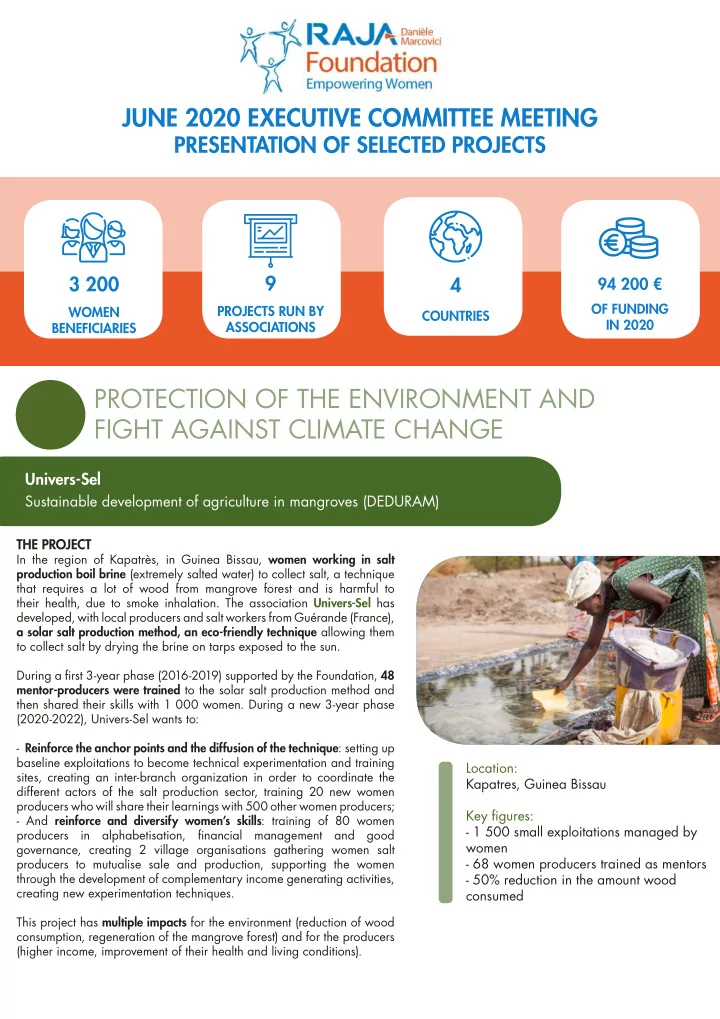
In the region of Kapatrès, in Guinea Bissau, women working in salt production boil brine (extremely salted water) to collect salt, a technique that requires a lot of wood from mangrove forest and is harmful to their health, due to smoke inhalation. The association Univers-Sel has developed, with local producers and salt workers from Guérande (France), a solar salt production method, an eco-friendly technique allowing them to collect salt by drying the brine on tarps exposed to the sun. During a fjrst 3-year phase (2016-2019) supported by the Foundation, 48 mentor-producers were trained to the solar salt production method and then shared their skills with 1 000 women. During a new 3-year phase (2020-2022), Univers-Sel wants to:

  • Reinforce the anchor points and the diffusion of the technique: setting up

baseline exploitations to become technical experimentation and training sites, creating an inter-branch organization in order to coordinate the different actors of the salt production sector, training 20 new women producers who will share their learnings with 500 other women producers;

  • And reinforce and diversify women’s skills: training of 80 women

producers in alphabetisation, fjnancial management and good governance, creating 2 village organisations gathering women salt producers to mutualise sale and production, supporting the women through the development of complementary income generating activities, creating new experimentation techniques. This project has multiple impacts for the environment (reduction of wood consumption, regeneration of the mangrove forest) and for the producers (higher income, improvement of their health and living conditions).

Location: Kapatres, Guinea Bissau Key fjgures:

  • 1 500 small exploitations managed by

women

  • 68 women producers trained as mentors
  • 50% reduction in the amount wood

consumed

JUNE 2020 EXECUTIVE COMMITTEE MEETING

PRESENTATION OF SELECTED PROJECTS

3 200

WOMEN BENEFICIARIES

9

PROJECTS RUN BY ASSOCIATIONS

4

COUNTRIES

94 200 €

OF FUNDING IN 2020

slide-2
SLIDE 2

CIDFF Bas-Rhin 67

Together!

THE PROJECT

In Kaltenhouse, sedentary Gypsy families live in 3 communal properties in very precarious conditions: unfjt housing (vans and bungalows) and high poverty rate. The family and women’s rights information centre in the Bas-Rhin area (CIDFF 67), that has been supporting these marginalised and stigmatised populations for 10 years, notes gender inequalities within this community, where few women have completed school, and a majority of girls become mothers from the age of 15. The CIDFF 67 team’s goal is to intensify their work towards this community through social and professional integration programs for 150 Gipsy women and girls, in order to reinforce their autonomy and improve their living conditions. The project plans 20 counselling sessions in a partnering middle school (in the city of Bischwiller) to support girls dealing with learning diffjculties, 10 job discovery workshops, 10 workshops on training and employment, 10 workshops for the mobilisation and the valorisation of skills through cultural outings and 10 wellness workshops.

EDUCATION AND SOCIAL INTEGRATION

EKO!

Low-tech with Refugees

THE PROJECT

Located on the Greek island of Lesbos, Moria is the biggest refugee camp in the European Union: 21 000 asylum seekers live there, in precarious conditions with little access to basic services such as water, healthcare and education… Despite the physical presence of humanitarian NGOs, their interventions have shown to be very ineffjcient considering the needs of this populations, particularly for women who face specifjc issues (feeling of unsafety, reluctance to take part in mixed-gender activities…). In this context, the EKO! association undertakes actions to answer these migrants’ immediate needs through low-tech which are simple, accessible (in terms of required skills and funds) environment friendly (local renewable or second-hand materials, low energy requiring methods…)

  • solutions. The association trains them in the repair and/or construction
  • f objects that are essential to their autonomy (boxes, mattresses, lamps

etc.) through the recycling of waste found the camp. In spite of their wish to participate in the workshops, women face diffjculties to access the tools and materials, often monopolised by men. This project is a pilot program aiming to facilitate the integration of women to these activities, dedicating them workshops adapted to their

  • needs. This will be put in place in collaboration with WISH (Women in

Solidarity House), a women-only community space located 5 km away from the Moria camp and right in front of the Kara Tepe refugee camp. 2 weekly training sessions will be held in line with women’s priority needs: wood and metalwork, pottery, plastic recycling, sewing and bike repair.

Location: Kaltenhouse, France Key fjgure:

  • 150 Gipsy girls and women

accompanied Location: Lesbos Islands, Greece Key fjgures:

  • 30 women trained to low-tech
  • 6 women sharing their skills with other

women

slide-3
SLIDE 3

Femmes SDF

Daytime care: fjrst steps towards social integration

THE PROJECT

The city of Grenoble, in the prefecture of Isère, is home to an increasingly precarious and numerous migrant population, among which many single women and their children. To offset this situation and the progressive impoverishment of this population it has been supporting for 16 years, the association Femmes SDF, specialised on the issue of wandering women, wants to provide a more comprehensive support to the women hosted since 2004 in the “Local des Femmes”, French for “Women’s place” (408 women and 219 children hosted in 2019, of which 70% were migrants). This project aims to continue the daily hosting service offered by the association and to consolidate new intervention axes to better meet the specifjc needs of migrant women in terms of access to rights and social

  • integration. The association plans to host 400 femmes (and children) 3

times per week, to organise weekly counselling sessions to help them access support (health, employment, administrative formalities, housing) as well as activities to develop their self-esteem and encourage citizen participation (writing workshops, movie debates, support groups). Face and body care, as well as hairdressing services, will also be offered to interested women.

Utopia 56

Guidance, support, accommodation for single women and their children

THE PROJECT

Refugees arriving in France are tired, helpless, disoriented and most

  • f them have suffered traumatic experiences and violence during their
  • journey. Oftentimes, they cannot fjnd accommodation and gather in

makeshift camps in the North of Paris and its suburbs. The association Utopia 56 operates day and night times roundups to meet these vulnerable populations, distribute meals, clothes and hygiene products and inform them about the existing help programs (application for asylum, minor’s protection…) and direct them towards relevant structures. During these roundups, members of the Utopia 56 association have noted that many women – single, in a relationship, with children or unaccompanied minors - were not supported by accommodation centres, either due to a lack of available beds, or due to the lack of information

  • n the procedure to seek housing. To remedy this emergency situation,

the association has developed a “solidary accommodation” facility for these women and girls. This facility aims to establish connections between volunteering citizens and people seeking for an accommodation solution, who will be hosted for one or several nights in these citizens’ homes. In addition to this temporary solution, all benefjciaries will be accompanied through administrative and juridical formalities. Moreover, unaccompanied minors will benefjt from a tailored medical care in collaboration with the NGO Doctors Without Borders, before being taken charge of by Child protection services.

Location: Paris, France Key fjgures:

  • 350 citizens benevolently hosting

women refugees and minor unaccompanied girls

  • 800 to 1 000 nights spent safely by

women each year

  • 2 500 women refugees met each week

in Paris during roundups Location: Grenoble, France Key fjgures:

  • 400 women (and their children) hosted

in the Local des Femmes every year

  • 250 women accompanied towards a

greater access to rights

  • 150 women receive care services
slide-4
SLIDE 4

THE PROJECT

For 40 years, the Maison des Femmes de Paris (MDF – House of Women), located in the 12th district of Paris, has been accompanying women migrants, women suffering from exclusion and women victims

  • f violence. It hosts women, without appointment, 3 days per week and
  • ffers them many other complementary services: social, psychological

and juridical counselling, support groups, job search counselling, sports and creative workshops. Every day, about 15 women are welcome and take part in one or several actions led by the association. The ability to use digital tools is essential for an effjcient socio-professional

  • integration. Nevertheless, the MDF team notes that many women do

not have access to these tools and do not know how to use them. To solve this problem, the association’s program has been completed with a digital inclusion program including:

  • Group workshops on the use of IT tools for administrative, social

and professional integration procedures (taxes, national employment agency, national family allowances fund, townhalls, social housing) with professionals from these same services.

  • Tailored workshops to allow women to apply their learnings from groups

workshops (creation of e-mail addresses, administrative formalities on the administrative websites, creation of resumes and cover letters…).

  • Online counselling with free access to computers.

Thanks to an effjcient use of digital tools, women will become autonomous in their administrative procedures, enabling them to have better access to rights and a successful socio-professional integration.

Maison des Femmes de Paris

Acting for women’s emancipation through digital tools

Location: Paris, France Key fjgure:

  • 100 women trained to the use of digital

each year THE PROJECT

In the priority neighbourhoods and slums located in the North of the Essonne district, women and girls face numerous diffjculties for their integration, yet they do not have access to programs aimed at accompanying them (language barrier, especially for Rom women and girls, childcare issues preventing them from completing administrative formalities, unawareness of institutions). The Intermèdes Robinson association goes out to meet these women to inform them on the existing programs and offering them access to rights and to integration. During these meeting sessions, Intermèdes Robinson encourages women to take part in sociolinguistics workshops aiming to improve their French speaking skills and identify issues they face to better solve them. During these workshops, with more attendants each time, children are taken care of by members of the association. The project’s goal is to develop these actions and allow women to be supported for a long-term period. 80 women will be able to attend sociolinguistics workshops (twice a week), as well as support groups each week. They will also benefjt from an individual follow-up based

  • n their needs. Moreover, 20 Roms girls will be accompanied by the

association in order to facilitate their socio-professional integration.

Intermèdes Robinson

Sociolinguistics workshops Location:

Île-de-France, France

Key fjgures:

  • 80 precarious women taking part in the

workshops each year

  • 20 Rom girls accompanied through

their socio-professional integration process

slide-5
SLIDE 5

THE PROJECT

The situation of girls in Niger is particularly worrisome. Indeed, 78%

  • f them get married before the age of 18 and suffer harshly from the

resulting social and sanitary consequences: early pregnancy, social exclusion, school dropout… In bush villages like those in the area of Zinder, where this project is implemented, social parameters preventing girls from getting an education are all the more embedded and diffjcult to

  • counter. The distance between schools and these marginalized villages

contribute to a greater isolation of the girls and to the reinforcement of their precarious living conditions, offering them no opportunities for the future. In this situation, the association Yara LNC leads an action program in Zinder and in the city of Niamey, in order to provide education to 400 children and young people – from both cities and rural areas. The association has opened 4 schools for these children and aims at reinforcing its actions in favour of girls, through the project presented

  • hereby. This project will allow 106 girls aged 8 to 20, to receive an

education and facilitate their social and professional integration. Supported until the end of their education, these girls will get a chance to become independent and will see their living conditions improved. The comprehensive support offered within the boarding schools will thus have a signifjcant impact on their physical and mental health. Actions led across the villages will help raise awareness among parents on the importance of girls’ education and will guarantee the support of all members of the different communities.

YARA LNC

Improving the social status of girls from precarious rural families living in bush villages in the region of Zinder

Mouvement du Nid Martinique

Accompanying migrants involved in prostitution

THE PROJECT

The neighbourhood of Terres Sainville (2 000 inhabitants), located at the heart of the city of Fort-de-France in Martinique, is home to a low-income migrant population - mainly from neighbouring islands (Dominican Republic, Haïti, Dominica and Saint-Lucie) – and suffers from poor and aging housing, a lack of services and shops, as well as cases of violence and smuggling (drugs and prostitution). Many women feel compelled to prostitute themselves to survive after escaping poverty in neighbouring Caribbean islands. Oftentimes single mothers, overindebted and isolated, these women have a low level of French and are unaware of their rights and the support they could benefjt from. In 2019, to remedy the lack of support services catered to this vulnerable population, the Martinican branch of the Mouvement du Nid association, providing support to people involved in prostitution, accompanied 30 women prostitutes through French language lessons and practical workshops on the access to social rights, with the support

  • f the Foundation.

For the second phase of the project, the association wants to offer these women a basic knowledge learning program (reading, calculations, and digital tools) revolving around cooking and to integrate them to the preparation of a public event, “Les saveurs des valeurs” Festival, in collaboration with the cityhall of Fort-de-France, where they will hold a booth (introduction to their personal stories and to recipes).

@Fondation RAJA-Danièle Marcovici @FondationRAJA

Visite our website here! Subscrire to our newsletter here!

Location: Area of Zinder, Niger Key Figures:

  • 106 girls aged 8 to 20 receiving edu-

cation in the boarding schools of Zinder and Niamey

  • The inhabitants of 8 bush villages

made aware of the importance of girls’ education Location: Martinica, France Key fjgures:

  • 30 women trained to the basics of

reading, calculations and digital tools

  • 1 public awareness event organised
  • 1 recipe presentation leafmet