Prostate Cancer 2016 Since 2008, up from 258,000 Smarter Screening - - PDF document

prostate cancer 2016
SMART_READER_LITE
LIVE PREVIEW

Prostate Cancer 2016 Since 2008, up from 258,000 Smarter Screening - - PDF document

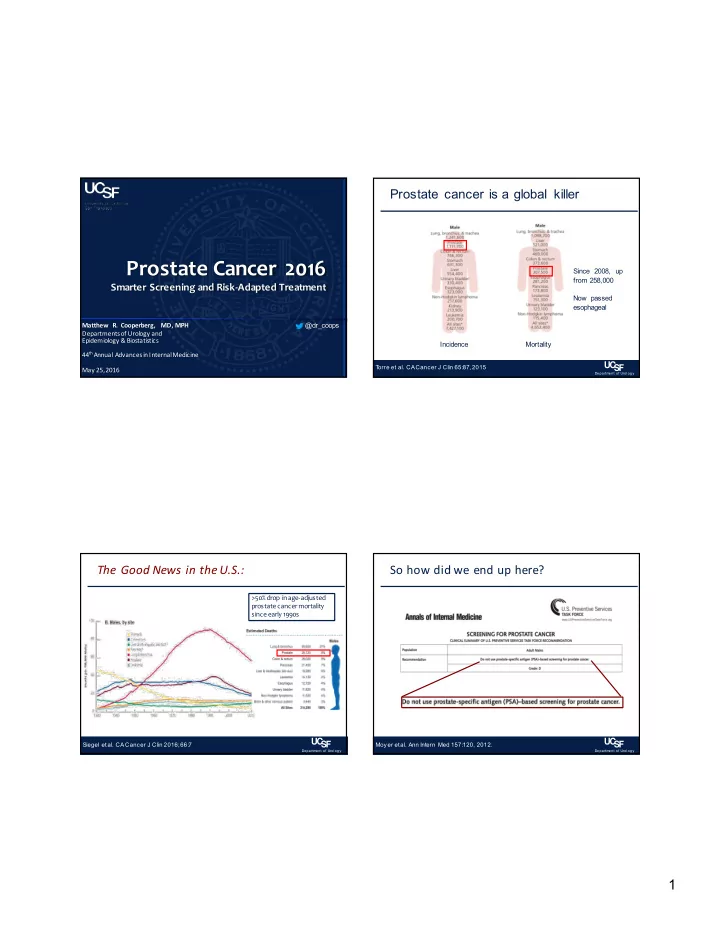
Prostate cancer is a global killer Prostate Cancer 2016 Since 2008, up from 258,000 Smarter Screening and Risk-Adapted Treatment Now passed esophageal Matthew R. Cooperberg, MD, MPH @dr_coops Departments of Urology and Epidemiology &


slide-1
SLIDE 1

1

Prostate Cancer 2016

Smarter Screening and Risk-Adapted Treatment

Matthew R. Cooperberg, MD, MPH Departments of Urology and Epidemiology & Biostatistics 44th Annual Advances in Internal Medicine May 25, 2016 @dr_coops

Departm ent of Urology

T

  • rre et al. CA Cancer J Clin 65:87, 2015

Prostate cancer is a global killer

Incidence Mortality Since 2008, up from 258,000 Now passed esophageal

Departm ent of Urology

Siegel et al. CA Cancer J Clin 2016; 66:7

The Good News in the U.S.:

>50% drop in age-adjusted prostate cancer mortality since early 1990s

Departm ent of Urology

Moyer et al. Ann Intern Med 157:120, 2012.

So how did we end up here?

slide-2
SLIDE 2

2

This is (mostly) our fault.

Departm ent of Urology

Prostate cancer is heterogeneous

Esserman et al. JAMA 2009; 302:1685

Departm ent of Urology

Goal: Prostate Cancer Risk Assessment

Goal: inform physician-patient decisions about

  • ptimal initial treatment approach and timing

Active surveillance Early local therapy Multimodal therapy Systemic therapy

What do the trials (really) tell us?

slide-3
SLIDE 3

3

Departm ent of Urology

PLCO

Prostate, Lung, Cancer, & Ovarian Cancer Screening Trial

Andriole et al. NEJM 2009; 360:1310

Departm ent of Urology

  • 76,693 men aged 55-74 randomly assigned to annual PSA

screening for 6 years vs. “usual care” at 10 U.S. centers 1993-2001

  • “52”% of men in the “usual care” group had at least one

PSA test drawn

  • Only 30-40% of men with high PSAs had biopsies
  • Virtually no difference between types of tumors seen in

screening vs. usual care groups

PLCO

“…the study was not a fair comparison between screening and no screening; instead, it was a comparison between annual and ad hoc screening.” – Cooperberg and Carroll, NEJM 2009; 361:203

Andriole et al. NEJM 2009; 360:1310

Departm ent of Urology

PLCO: the contamination problem

Data from surveys of the “control” arm of the PLCO study:

Pinsky et al. Clin Trials 2010; 7:303

Departm ent of Urology

PLCO: Update

Andriole et al. J Natl Cancer Inst 2012; 104:1

slide-4
SLIDE 4

4

Departm ent of Urology

Shoag et al. N Engl J Med 2016; 374:1795

PSA testing in the PLCO “control” arm

Departm ent of Urology

Shoag et al. N Engl J Med 2016; 374:1795

PSA testing in the PLCO “control” arm

PLCO was not a trial of screening vs. no screening Meta-analysis including PLCO is invalid !

Departm ent of Urology

ERSPC

European Randomized Study of Screening for Prostate Cancer

Schröder et al. NEJM 2009; 360:1320

Departm ent of Urology

  • Population-based trials at 7 European centers
  • 182,160 men age 50-74 randomized (162,387 in core age

55-69)

  • Screening interval 4 years at most centers (2 at one)
  • 21% risk reduction for cancer-specific mortality with

screening (up to 38% in years 10-11)

  • 29% risk reduction with adjustment for noncompliance
  • Initial NNS 1410, NNT 48

ERSPC

Schröder et al. NEJM 2009; 360:1320

slide-5
SLIDE 5

5

Departm ent of Urology

ERSPC: update

Rate ratio 0.73-0.79 for prostate cancer mortality, NND 27

Schröder et al. Lancet 2014; 384:2027

Departm ent of Urology

Short-Term Long-Term Lives saved 0.7 6 Overdiagnoses 34 42 Overdiagnoses/Live s saved 48 7

A guideline based on

  • utcomes at 8 or 10 years is

completely meaningless!

Taking the long view on screening

Gulati et al. J Clin Epidemiol 64:1412, 2011

Departm ent of Urology

The Göteborg randomized trial

  • Göteborg vs. PLCO & ERSPC
  • Younger mean at start of screening
  • Lower PSA threshold for referral
  • Q2 year interval
  • Higher rate of biopsy among those with high PSA
  • Lower early rates of PSA contamination
  • Longer followup (though still relatively short)
  • 44% of men were managed with initial surveillance

Hugosson J. Lancet Oncol 2010; 11:725

Departm ent of Urology

The Göteborg randomized trial

RR 0.56 (0.39-0.82, p=0.002) RR 0.56 (0.39-0.82, p=0.002) NNS: 293, NNT: 12

Hugosson J. Lancet Oncol 2010; 11:725

slide-6
SLIDE 6

6

Departm ent of Urology

Even Göteborg now faces contamination

Arnsrud Godtman. Eur Urol 2015; 68:354

Departm ent of Urology

Did the USPSTF assess harms fairly?

“Adequate evidence shows that up to 5 in 1000 men will die within 1 month of prostate cancer surgery and between 10 and 70 men will have serious complications but survive. Radiotherapy and surgery result in long-term adverse effects, including urinary incontinence and erectile dysfunction in at least 200 to 300 of 1000 men treated with these therapies. Radiotherapy is also associated with bowel dysfunction”

Moyer et al. Ann Intern Med 157:120, 2012.

The real problems:

Over- and under-screening, Over- and under-treatment

Departm ent of Urology

Cooperberg et al. J Clin Oncol 2010; 28:1117

Over-treatment and under-treatment

slide-7
SLIDE 7

7

Departm ent of Urology

Treatment by risk and age

Bechis et al. J Clin Oncol 2011; 29:235

Departm ent of Urology

Savage et al, J Urol 2009 182:2677

And too much care is by low-volume providers

Departm ent of Urology

Who gets screened? 2000-05

Drazer et al. J Clin Oncol 2011; 29:1736

Departm ent of Urology

Sammon et al. JAMA Intern Med 174:1839, 2014

Who gets screened? 2012-13

slide-8
SLIDE 8

8

Departm ent of Urology

Walter et al. JAMA 2006; 296:2336

It’s even worse than that

Departm ent of Urology

T asian et al. Urol Oncol 30:155, 2012

Does the USPSTF Recommendation Matter?

The AUA, EAU, ACS, ASIM, and NCCN all recommend some variation on shared decision making.

Departm ent of Urology

Prasad et al. JAMA 307:1692, 2012

Does the USPSTF Recommendation Matter?

National Health Interview Survey (NHIS)

Departm ent of Urology

Siegel et al. CA Cancer J Clin 2016; 66:7

This time seems to be different

slide-9
SLIDE 9

9

Departm ent of Urology

Jemal et al. JAMA 2015; 314:2054

JAMA 314:2054, 2015

This time seems to be different

Departm ent of Urology

Jemal et al. JAMA 2015; 314:2054

JAMA 314:2054, 2015

This time seems to be different

Departm ent of Urology

Barocas et al. J Urol epub 2015

This time seems to be different

Departm ent of Urology

The disproportionate weight of the USPSTF

slide-10
SLIDE 10

10

Departm ent of Urology

What explains this curve?

Etzioni et al. Cancer 2012; 118:5955

No treatment Treatment Treatment and screening ERSPC benefit

Departm ent of Urology

What if we really listen to the USPSTF?

Gulati et al. Cancer 2014; 120:3519

~60,000 avoidable deaths 2013-2025

Departm ent of Urology

Would the USPSTF at least save money?

Where do we go from here?

slide-11
SLIDE 11

11

Or can we do it all better?

Departm ent of Urology

PSA should not be interpreted in a vacuum

http://tinyurl.com/caprisk

Departm ent of Urology

Vickers et al. BMJ 341:c4521, 2010; Vickers et al BMJ 346:f2023, 2013

The value of establishing an early baseline

  • If PSA <1.0 at age 60, likelihood of prostate cancer death

<0.3%

  • 90% of prostate cancer deaths occurred in men with PSA

>2.0 (top quartile)

slide-12
SLIDE 12

12

Departm ent of Urology

Don’t underestimate reassurance

Detsky et al. JAMA 307:1035, 2012

“What seems to be missing from most of the PSA discussion is that the majority of men will have a normal PSA value and they will be reassured… A normal PSA level offers peace of mind, a valued commodity in a world that is frequently full of troubling news.”

Departm ent of Urology

“Simple schema” for SDM

Vickers et al. Ann Intern Med 2014; 161:441

Departm ent of Urology

Sum of points from each variable for 0-10 score Validated in 14 studies on 4 continents, N>20,000 http://urology.ucsf.edu/capra.html

Cooperberg et al. J Urol 173:1938, 2005

Risk stratification works!

The UCSF-CAPRA score

Departm ent of Urology

So we can tell the rabbits from the turtles

C-index = 0.79

slide-13
SLIDE 13

13

Departm ent of Urology

Precision medicine 2016

Draw PSA?

  • SNPs?

1s t biopsy?

  • PCA3
  • phi
  • 4K score

2nd biopsy?

  • ConfirmMDx
  • PCA3
  • phi
  • 4K panel

Pre- treatment

  • OncoType
  • Prolaris

Post-op treatment?

  • Decipher
  • Prolaris
  • OncoType

Advanced disease

  • ARv7?

MRI PSMA-PET/CT

Departm ent of Urology

Don’t treat most low-risk disease

Wilt T et al. NEJM 2012; 367:203

Departm ent of Urology

Latini et al. J Urol 2007; 178:826; Esserman and Thompson, JAMA 2013

Active Surveillance: Anxiety

Treatment decision driven by PSA velocity and “anxiety velocity”

Change nomenclature? PUNLUMP IDLE

Departm ent of Urology

Times are changing – fast

slide-14
SLIDE 14

14

Departm ent of Urology

Womble et al. Eur Urol epub 2014.

Surveillance is gaining in the real world

Departm ent of Urology

Times are changing – fast

Cooperberg and Carroll. JAMA 2015 314:80

Departm ent of Urology

Trends for men ≥75 years old

Cooperberg and Carroll. JAMA 2015 314:80

Departm ent of Urology

Older men with high-risk tumors should be treated aggressively

Lu-Yao et al. JAMA 2009, 302:1202

slide-15
SLIDE 15

15

Departm ent of Urology

Do treat most high-risk disease

Wilt T et al. NEJM 2012; 367:203

Departm ent of Urology

“Noncontroversial” statements re: high-risk

  • RP is more effective than WW (PIVOT)
  • RT+ADT is more effective than ADT (NCIC/PR07)
  • RT+ADT is more effective than RT (many RCTs)
  • ADT monotherapy is only marginally more effective than WW

(Lu-Yao 2008)

  • Adding early postop RT to RP improves survival for locally

advanced cases (3 RCTs)

Departm ent of Urology

Wallis et al. Eur Urol epub 2015

What about RP vs. RT? No RCTs but…

Departm ent of Urology

Predicted 15-year CSM

Cooperberg et al. AUA 2015

slide-16
SLIDE 16

16

Departm ent of Urology

Track quality and outcomes systematically

Departm ent of Urology

  • Don’t screen men with limited life expectancy
  • Do offer PSA testing to younger men in good

health—with the explicit goal of identifying high-risk prostate cancer within a window of curability

  • If the baseline is below ~1, don’t recheck for ≥5

years

  • Refer early to a urologist you trust to biopsy

selectively and treat—well— only when needed

The bottom line

Departm ent of Urology

  • The “D” recommendation downplayed benefits,
  • verstated harms, and was predicated on too

short of a time horizon.

  • Overtreatment is without question a major

public health problem, and we have to fix it.

  • But the answers lie in smarter screening and

better treatment decisions, not in wholesale cessation of screening.

  • The future can be bright – or bleak. It’s up to us.

Standing at the crossroads in 2016