SLIDE 1
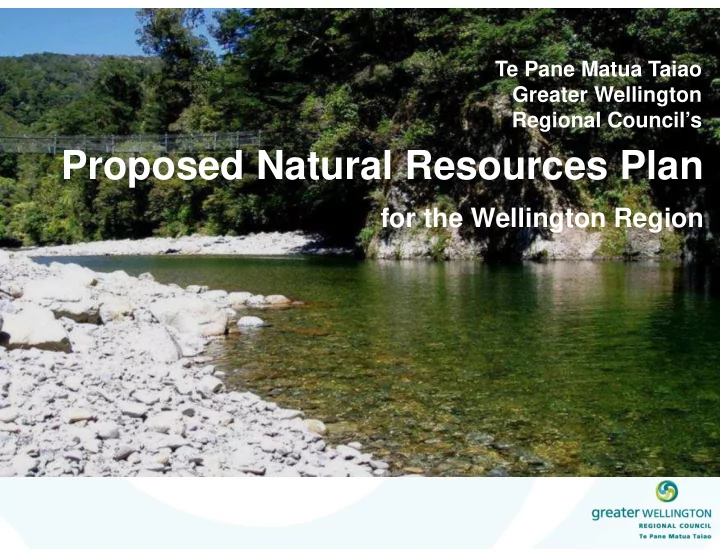
Te Pane Matua Taiao Greater Wellington Regional Council’s
Proposed Natural Resources Plan
for the Wellington Region
SLIDE 2
What is in the Plan that is relevant to your whaitua process ?
SLIDE 3
Goals in the Proposed Natural Resources Plan
Provide a framework for Integrated Land and Water Management (Whaitua) Improve water quality and water use efficiency Identify values and places for protection Support economic wellbeing Provide opportunities for partnerships with communities and TAs A clear single plan and greater certainty to natural resources users
SLIDE 4
Whaitua committees are making RMA law
The whaitua committees are working to write parts of the regional plan which means
Giving effect to the Regional Policy Statement Giving effect to the New Zealand Coastal Policy Statement, National Policy Statement for Freshwater Management Implementing the RMA Identifying programmes and investments that may shape investment under council plans, So you are doing the local bits in a regional context
SLIDE 5 Improving water quality
SLIDE 6
Process for developing whaitua chapters
SLIDE 7
Whaitua - Integrated Catchment Management
SLIDE 8
What’s the difference?
‘Water quality limits for freshwater set for the catchment in partnership with the community of the catchment’
Catchment based water allocation and water
quality management Equal focus on both urban and rural uses Changing the way we do things – combining rules and non regulatory actions Working in defined catchment areas - whaitua process
SLIDE 9 Water Quality – the big picture
Maintain or improve water quality
- Describe water quality that supports ecosystem health and
mahinga kai, contact recreation and mana whenua use
- Series of targeted non – statutory programmes to improve
water quality in priority catchments Water quality limits, targets and timeframes - focus of the whaitua process Achieving secondary and primary contact recreation,
Approaches to improve water quality, over time
SLIDE 10
Water Quality – Objectives
Objective O5 Freshwater bodies as a minimum are managed to safeguard ecosystem health and mahinga kai, provide for contact recreation and Māori customary use and health needs of people (freshwater) Objective O23- water quality maintained or improved Objective O24 water contact recreation, secondary every where, primary contact in significant contact recreation water bodies Objective O25 - aquatic ecosystem health and mahinga kai – maintain and improve over time where outcomes not met Note whaitua sections take precedence
SLIDE 11 Water quality for recreation
Secondary contact - everywhere to meet national bottom-line
- Of RSoE two sites will need improvement, over time – other methods
- Priorities sites/river close to national bottom-line – whaitua
Primary contact – swimming in our rivers
- Regional Policy Statement – significant rivers for swimming
- Minimum for primary contact recreation – Match the national approach
- Priorities – two Significant Rivers will need improvement, overtime
Coast - Primary contact standards outside of the Port Area – priorities for improvement identified.
SLIDE 12 Rural water quality
No specific nutrient limits or leaching loads
- Limits through the whaitua process
- Integrated catchment management solutions a major focus
Actions to maintain or improve water quality in rural area
- Riparian setbacks for cultivation and break-feeding
- Livestock excluded from most surface waters in intensively
farmed areas – 2015-2022
- Control activities on steep slopes
- Priority catchment programmes to advance good management
practice, linked to areas with poorer water quality
SLIDE 13 Urban water quality
Stormwater management
Two step process for community/council networks
- 1st - Controlled activity (2+5 years)
- Identify networks – work with storm water managers
- Prepare Stormwater Management Plans – link with Whaitua
- 2nd – Longer-term consents and Stormwater
Management Plan
- Set objectives and priorities – Whaitua
- Integrate asset management and planning processes
- Longer-term plans to improve water quality
SLIDE 14
Urban water quality
Wastewater
Effects based approach to minimise adverse effects of
wastewater – fresh and coastal The quality of existing discharges progressively improved and the quantity reduced - no time Existing discharges to fresh or coastal following rainfall progressively reduced - no timeframes New discharges to freshwater are non-complying New discharges to the coast are discretionary Engagement with Iwi - reasonable steps to reflect interests and values – NPS-FM
SLIDE 15
Water allocation
SLIDE 16 Water allocation
Integrate surface and ground water resource management No claw backs
Existing users retain their water New users meet allocation limits
Transition period (4 years) to meet efficiency criteria Minimum flows effectively unchanged – whaitua whaitua also -
Review allocation limits explore options for transfer and for maximising efficient allocation and use
SLIDE 17 Where to from here?
Notification 31 July 2015:
- 2 month submission period to end of September/October
- Summary of submissions and further submissions through
to January/February 2016
Early-mid 2016
- Pre-hearing meetings
- Officers s42A reports and circulation of evidence
- Hearings late 2016- early 2017
SLIDE 18
Questions…
SLIDE 19 Internal Contact details
Miranda Cross Environment Policy Team leader 04 830 4204 Miranda.cross@gw.govt.nz Lucy Harper Environment Policy Team leader 06 826 1529 lucy.harper@gw.govt.nz Jonathan Streat Environment Policy Manager 04 830 4320 jonathan.streat@gw.govt.nz