Proofs A proof is a mechanically derivable demonstration that a - - PowerPoint PPT Presentation

proofs
SMART_READER_LITE
LIVE PREVIEW

Proofs A proof is a mechanically derivable demonstration that a - - PowerPoint PPT Presentation

Proofs A proof is a mechanically derivable demonstration that a formula logically follows from a knowledge base. Given a proof procedure, KB g means g can be derived from knowledge base KB . Recall KB | = g means g is true in all models of KB


slide-1
SLIDE 1

Proofs

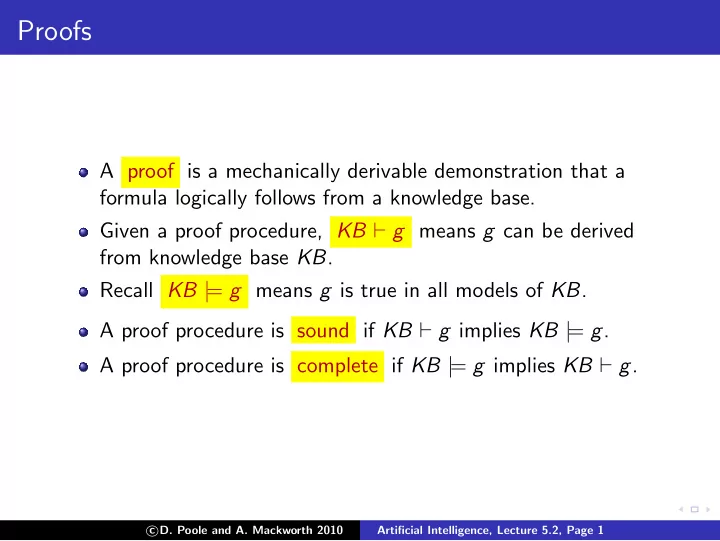
A proof is a mechanically derivable demonstration that a formula logically follows from a knowledge base. Given a proof procedure, KB ⊢ g means g can be derived from knowledge base KB. Recall KB | = g means g is true in all models of KB. A proof procedure is sound if KB ⊢ g implies KB | = g. A proof procedure is complete if KB | = g implies KB ⊢ g.

c

  • D. Poole and A. Mackworth 2010

Artificial Intelligence, Lecture 5.2, Page 1

slide-2
SLIDE 2

Bottom-up Ground Proof Procedure

One rule of derivation, a generalized form of modus ponens: If “h ← b1 ∧ . . . ∧ bm” is a clause in the knowledge base, and each bi has been derived, then h can be derived. This is forward chaining on this clause. (This rule also covers the case when m = 0.)

c

  • D. Poole and A. Mackworth 2010

Artificial Intelligence, Lecture 5.2, Page 2

slide-3
SLIDE 3

Bottom-up proof procedure

KB ⊢ g if g ∈ C at the end of this procedure: C := {}; repeat select clause “h ← b1 ∧ . . . ∧ bm” in KB such that bi ∈ C for all i, and h / ∈ C; C := C ∪ {h} until no more clauses can be selected.

c

  • D. Poole and A. Mackworth 2010

Artificial Intelligence, Lecture 5.2, Page 3

slide-4
SLIDE 4

Example

a ← b ∧ c. a ← e ∧ f . b ← f ∧ k. c ← e. d ← k. e. f ← j ∧ e. f ← c. j ← c.

c

  • D. Poole and A. Mackworth 2010

Artificial Intelligence, Lecture 5.2, Page 4

slide-5
SLIDE 5

Soundness of bottom-up proof procedure

If KB ⊢ g then KB | = g. Suppose there is a g such that KB ⊢ g and KB | = g. Then there must be a first atom added to C that isn’t true in every model of KB. Call it h. Suppose h isn’t true in model I

  • f KB.

There must be a clause in KB of form h ← b1 ∧ . . . ∧ bm Each bi is true in I. h is false in I. So this clause is false in I. Therefore I isn’t a model of KB. Contradiction.

c

  • D. Poole and A. Mackworth 2010

Artificial Intelligence, Lecture 5.2, Page 5

slide-6
SLIDE 6

Fixed Point

The C generated at the end of the bottom-up algorithm is called a fixed point. Let I be the interpretation in which every element of the fixed point is true and every other atom is false. I is a model of KB. Proof: suppose h ← b1 ∧ . . . ∧ bm in KB is false in I. Then h is false and each bi is true in I. Thus h can be added to C. Contradiction to C being the fixed point. I is called a Minimal Model.

c

  • D. Poole and A. Mackworth 2010

Artificial Intelligence, Lecture 5.2, Page 6

slide-7
SLIDE 7

Completeness

If KB | = g then KB ⊢ g. Suppose KB | = g. Then g is true in all models of KB. Thus g is true in the minimal model. Thus g is in the fixed point. Thus g is generated by the bottom up algorithm. Thus KB ⊢ g.

c

  • D. Poole and A. Mackworth 2010

Artificial Intelligence, Lecture 5.2, Page 7