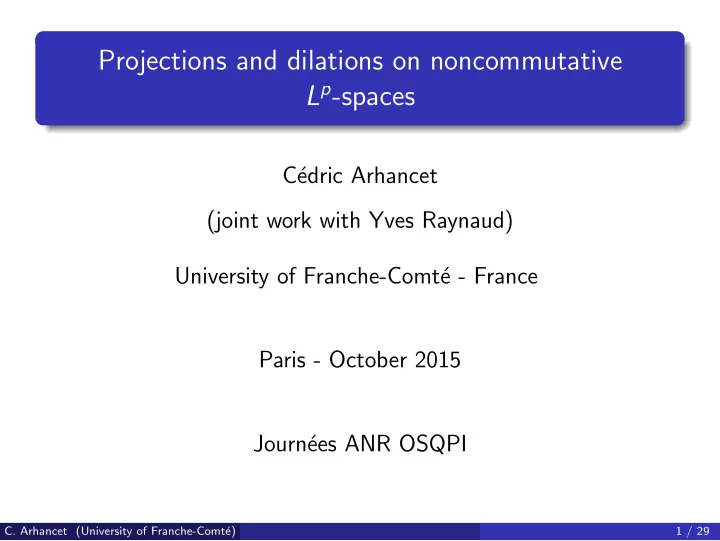
Projections and dilations on noncommutative L p -spaces C edric - - PowerPoint PPT Presentation

projections and dilations on noncommutative l p spaces
SMART_READER_LITE
LIVE PREVIEW

Projections and dilations on noncommutative L p -spaces C edric - - PowerPoint PPT Presentation

Projections and dilations on noncommutative L p -spaces C edric Arhancet (joint work with Yves Raynaud) University of Franche-Comt e - France Paris - October 2015 Journ ees ANR OSQPI C. Arhancet (University of Franche-Comt e) 1 /


slide-1
SLIDE 1

Projections and dilations on noncommutative Lp-spaces

C´ edric Arhancet (joint work with Yves Raynaud) University of Franche-Comt´ e - France Paris - October 2015 Journ´ ees ANR OSQPI

  • C. Arhancet (University of Franche-Comt´

e) 1 / 29

slide-2
SLIDE 2

Projections and complemented subspaces

Let X be a Banach space. A projection is a bounded operator P : X → X such that P2 = P. A complemented subspace Y of X is the range of a bounded linear projection P. If the projection is contractive, we say that Y is contractively complemented.

Proposition

Let X be a Hilbert space. Then a subspace Y of X is contractively complemented if and only if Y is isometrically isomorphic to a Hilbert space.

Problem

To describe the contractively complemented subspaces of each Banach space X.

  • C. Arhancet (University of Franche-Comt´

e) 2 / 29

slide-3
SLIDE 3

Projections on usual Lp-spaces

Theorem (Ando, Bernau, Douglas, Lacey, 1974 for the general measures)

Let Ω be a mesure space. Suppose 1 < p < ∞ with p = 2. For a subspace Y of Lp(Ω), the following statements are equivalent.

  • Y is the range of a positive contractive projection.
  • Y is a closed sublattice of Lp(Ω).
  • there exists a positive isometrical isomorphism from Y onto

some Lp-space Lp(Ω′). For a subspace Y of Lp(Ω), the following statements are equivalent.

  • Y is the range of a contractive projection.
  • Y is isometrically isomorphic to some Lp(Ω′).
  • C. Arhancet (University of Franche-Comt´

e) 3 / 29

slide-4
SLIDE 4

Projections on C ∗-algebras and von Neumann algebras

Theorem (Effros, Ruan, 1974)

The range of any completely positive contractive projection P : A → A

  • n a C ∗-algebra A is complete order isometric to a C ∗-algebra.

Theorem (Effros, Ruan, 1974)

The range of any normal completely positive contractive projection P : M → M on a von Neumann algebra M is ∗-isomorphic to a von Neumann algebra.

  • C. Arhancet (University of Franche-Comt´

e) 4 / 29

slide-5
SLIDE 5

Contractives projections on Schatten spaces

The range of a contractive projection on the Schatten space Sp is not necessarily isometric to a Schatten space ! We let σ: Sp → Sp be the transpose map defined by σ([xij]) = [xji]. We introduce the spaces Symp = {x ∈ Sp : σ(x) = x} and Asymp = {x ∈ Sp : σ(x) = −x}. These subspaces are contractively complemented subspaces of Sp. Indeed, Ps = Id + σ 2 and Pa = Id − σ 2 are contractive projections whose ranges are Symp and Asymp.

  • C. Arhancet (University of Franche-Comt´

e) 5 / 29

slide-6
SLIDE 6

Contractives projections on Schatten spaces

Arazy and Friedman have succeeded in establishing a complete classification of contractively complemented subspaces of Sp !

Theorem (Arazy, Friedman, 1992)

Suppose 1 ≤ p < ∞, p = 2. Let Y be a contractively complemented subspace of Sp. Then Y is isometric to the ℓp-sum of subspaces of Sp, each of which is isometric to a subspace of Sp induced by a Cartan factor :

1 a space of rectangular matrices 2 a space of anti-symmetric matrices 3 a space of symmetric matrices 4 a“spinorial space”

.

  • C. Arhancet (University of Franche-Comt´

e) 6 / 29

slide-7
SLIDE 7

Completely contractive projections on Schatten spaces

Using Arazy-Friedman Theorem, we have :

Theorem (Le Merdy, Ricard, Roydor, 2009)

Suppose 1 ≤ p < ∞, p = 2. Let Y be a subspace of Sp. The following statements are equivalent.

  • The subspace Y is completely contractively complemented in Sp.
  • There exist, for some countable set A, two families (Iα)α∈A and

(Jα)α∈A of indices such that Y is completely isometric to the p-direct sum

p

  • α∈A

Sp

Iα,Jα.

  • C. Arhancet (University of Franche-Comt´

e) 7 / 29

slide-8
SLIDE 8

Contractive projections on noncommutative L1-spaces

Theorem (Friedman, Russo, 1985)

The range of contractive projection on the predual M∗ of a von Neumann algebra M is isometric to the predual of a JW∗-triple, that is a weak∗-closed subspace of B(H) closed under the triple product xy∗z + zy∗x.

Theorem (Ng, Ozawa, 2002)

Let M be a von Neumann algebra. Let Y be a finite dimensional completely contractively complemented subspace of the predual M∗ of

  • M. Then Y is completely isometric to

S1

n1,m1 ⊕1 · · · ⊕1 S1 nk,mk

for some positive integers ni, mi.

  • C. Arhancet (University of Franche-Comt´

e) 8 / 29

slide-9
SLIDE 9

Noncommutative Lp-spaces

Let M ⊂ B(H) be a von Neumann algebra, i.e. a weak∗ closed involutive unital subalgebra of B(H). Suppose that M is equipped with a semifinite faithful normal trace τ : M+ → [0; ∞]. Let S+ be the set of all positive x ∈ M such that τ(x) < ∞ and S its linear span. If 1 ≤ p < ∞, the non-commutative Lp-space Lp(M) = Lp(M, τ) is defined to be : Lp(M) = completion of

  • x ∈ S : xLp(M) = τ((x∗x)

p 2 ) 1 p

  • .

We have L1(M) = M∗. We let L∞(M) = M. If M = L∞(Ω) and τ =

  • Ω · dµ we obtain Lp(M) = Lp(Ω).

If M = B(ℓ2) and τ = Tr , we obtain Lp(M) = Sp. Haagerup, Connes-Hilsum, Kosaki-Terp, Araki-Masuda... have given definitions of noncommutative Lp-spaces for a type III von Neumann algebra M equipped with a weight ψ: M → [0 + ∞].

  • C. Arhancet (University of Franche-Comt´

e) 9 / 29

slide-10
SLIDE 10

c.c.p. projections on noncommutative Lp-spaces

Theorem (C. A., Y. Raynaud, 2015)

  • Suppose 1 ≤ p < ∞.
  • Let P : Lp(M) → Lp(M) be a contractive completely positive

projection. Then there exists a complete order isometrical isomorphism from the range of P onto some noncommutative Lp-space Lp(N). True for Haagerup Lp spaces.

  • C. Arhancet (University of Franche-Comt´

e) 10 / 29

slide-11
SLIDE 11

Idea of the proof

Consider a projection P : Lp(M) → Lp(M). First we consider the σ-finite case i.e. M equipped with a state ϕ. Let s(P) the supremum in M of the supports of the positive elements in Ran(P). We begin to show that there exists a positive h ∈ Ran(P) such that support(h) = s(P). We consider the restriction of P to s(P)Lp(M)s(P) = Lp(s(P)Ms(P)). We show this restriction is induced by a faithful normal conditional expectation. For the non σ-finite case, we use some“covering and gluing argument” .

  • C. Arhancet (University of Franche-Comt´

e) 11 / 29

slide-12
SLIDE 12

Akcoglu Theorem

Theorem (Akcoglu, 1977)

Suppose 1 ≤ p < ∞. Let T : Lp(Ω) → Lp(Ω) is a positive contraction on Lp(Ω). Then there exists another measure space Ω′, an isometric embedding J : Lp(Ω) ֒ → Lp(Ω′) and a contraction P : Lp(Ω′) → Lp(Ω), an invertible isometry U : Lp(Ω′) → Lp(Ω′) such that T n = PUnJ, n ≥ 0.

  • C. Arhancet (University of Franche-Comt´

e) 12 / 29

slide-13
SLIDE 13

Dilation on noncommutative Lp-spaces

Definition (Le Merdy, Junge, 2007)

We say that a contraction T : Lp(M) → Lp(M) is dilatable if there exist a noncommutative Lp-space Lp(M′), an isometric embedding J : Lp(M) → Lp(M′) and a contractive map P : Lp(M′) → Lp(M), an invertible isometry U : Lp(M′) → Lp(M′) such that T n = PUnJ, n ≥ 0. In this context, Akcoglu Theorem has no noncommutative analog for completely positive contractions on Schatten spaces Sp (Junge, Le Merdy, 2007). However, a lot of contractive operators on noncommutative Lp-spaces admits some dilations : some Schur multipliers MA : Sp → Sp and some Fourier multipliers...

  • C. Arhancet (University of Franche-Comt´

e) 13 / 29

slide-14
SLIDE 14

Strongly continuous semigroups

Definition

A strongly continuous semigroup (or C0-semigroup) on a Banach space X is a family of operators (Tt)t≥0 where Tt : X → X such that : T0 = I, and Tt+s = TtTs, t, s ≥ 0 with t → Ttx continuous for any x ∈ X.

  • C. Arhancet (University of Franche-Comt´

e) 14 / 29

slide-15
SLIDE 15

Fendler Theorem

Fendler showed a continuous version of Akcoglu theorem :

Theorem (Fendler, 1997)

  • Suppose 1 < p < ∞.
  • Let (Tt)t≥0 be a strongly continuous semigroup of positive

contractions acting on Lp(Ω). Then there exists a measure space Ω′, a strongly continuous group of invertible isometries (Ut)t≥0 acting on Lp(Ω′), an isometric embedding J : Lp(Ω) ֒ → Lp(Ω′) and a contractive map P : Lp(Ω′) → Lp(Ω) such that Tt = PUtJ, t ≥ 0.

  • C. Arhancet (University of Franche-Comt´

e) 15 / 29

slide-16
SLIDE 16

Dilation of semigroups on noncommutative Lp-spaces

Theorem (C. A., Y. Raynaud, 2015)

Suppose 1 < p < ∞. Let M be a von Neumann algebra equipped with a state. Let (Tt)t≥0 be a C0-semigroup of completely positive contractions on Lp(M). Suppose that each Tt : Lp(M) → Lp(M) is dilatable. Then there exists a noncommutative Lp-space Lp(M′), a strongly continuous group of isometries Ut : Lp(M′) → Lp(M′),

  • an isometric embedding J : Lp(M) → Lp(M′) and a contractive

map P : Lp(M′) → Lp(M) such that Tt = PUtJ, t ≥ 0.

  • C. Arhancet (University of Franche-Comt´

e) 16 / 29

slide-17
SLIDE 17

Idea of the proof

We have a dilation of T 1

n :

(T 1

n )k = P 1 n (U 1 n )kJ 1 n ,

k ≥ 0. For a finite set B ⊂ Q+ let VB = {n ∈ N : nt ∈ N for any t ∈ B}. The set of all sets VB (B ⊂ Q+, B finite) is the basis of some filter which is contained in some ultrafilter U on N. For t ∈ Q+, we define the operator Un,t : Lp(N 1

n ) → Lp(N 1 n ) by

Un,t =

  

(U 1

n )nt

if nt ∈ N IdLp(N 1

n )

if nt / ∈ N. For any finite subset B of Q+, any t ∈ B and any n ∈ VB, we obtain : Tt = (T 1

n )nt = P 1 n Un,tJ 1 n .

  • C. Arhancet (University of Franche-Comt´

e) 17 / 29

slide-18
SLIDE 18

Idea of the proof

We consider the ultraproduct

  • U

Lp(N 1

n ) = Lp(˜

N) for some von Neumann algebra ˜ N. If I : Lp(M) → Lp(M)U, x → (x, x, . . .)• is the canonical map and, by letting

  • J =

U

J 1

n

  • I,
  • P = Q
  • U

P 1

n ,

  • Ut =
  • U

Un,t, t ∈ Q+, where Q : Lp(M)U → Lp(M) is the canonical projection we obtain a dilation Tt = ˜ P ˜ Ut˜ J, t ∈ Q+.

  • n a“big”noncommutative Lp-space Lp(˜

N). We need to extend this dilation by continuity to obtain some (˜ Ut)t≥0. But the ultraproduct may be to large for the map Q+ → Lp(˜ N), t → ˜ Utx to be continuous if x ∈ Lp(˜ N) !

  • C. Arhancet (University of Franche-Comt´

e) 18 / 29

slide-19
SLIDE 19

Idea of the proof

We have Tt = ˜ P ˜ Ut˜ J, t ∈ Q+. We construct some completely positive contractive projection Q from Lp( ˜ M) on the subspace of“continuously translating elements” Lp( ˜ M)c =

x ∈ Lp( ˜

M) : s → ˜ Utx is continuous on Q+ using some tricks from de Leeuw and Glicksberg (1965). This space is a noncommutative Lp-space by the result on projections. With this projection, we can restrict the dilation on a smaller space since we can show that ˜ J(Lp(M)) ⊂ Lp( ˜ M)c. Finally we obtain a dilation Tt = PUtJ, t ∈ R. with Ut : Lp( ˜ M)c → Lp( ˜ M)c.

  • C. Arhancet (University of Franche-Comt´

e) 19 / 29

slide-20
SLIDE 20

Markov maps

Definition

Let (M, φ) and (N, ψ) be von Neumann algebras equipped with normal faithful states φ and ψ respectively. A linear map T : M → N is called a (φ, ψ)-Markov map if T is unital and completely positive, ψ ◦ T = φ, T ◦ σφ

t = σψ t ◦ T, for all t ∈ R, where (σφ t )t∈R and (σψ t )t∈R

denote the automorphism groups of the states φ and ψ respectively. When (M, φ) = (N, ψ), we say that T is a φ-Markov map. It is known that there exists a unique completely positive, unital map T ∗ : N → M such that φ

T ∗(y)x = ψ yT(x) ,

x ∈ M, y ∈ N. We say that T is selfadjoint if T ∗ = T.

  • C. Arhancet (University of Franche-Comt´

e) 20 / 29

slide-21
SLIDE 21

Factorizable maps

Definition (Anantharaman-Delaroche, 2006)

A (φ, ψ)-Markov map T : M → M is called factorizable if there exist a von Neumann algebra P equipped with a faithful normal state χ, and some ∗-monomorphisms J0 : M → P and J1 : M → P, such that J0 is (φ, χ)-Markov and J1 is (ψ, χ)-Markov satisfying T = J∗

0 ◦ J1.

If T is factorizable then we have a“dilation”: there exists a von Neumann algebra M′ with a normal faithful state ψ, an automorphism U of M′ leaving ψ invariant, a (φ, ψ)-Markov ∗-monomorphism J : M → M′ satisfying T n = J∗ ◦ Un ◦ J, n ≥ 0. Here J∗ : M′ → M is a conditional expectation (Haagerup-Musat).

  • C. Arhancet (University of Franche-Comt´

e) 21 / 29

slide-22
SLIDE 22

Examples of factorizable maps

Selfadjoint unital completely positive Schur multipliers MA : B(ℓ2) → B(ℓ2) are factorizable Tr -Markov maps (Ricard, 2008). Here“selfadjoint”translates into“defined by a real matrix A” . Selfadjoint unital completely positive Fourier multipliers Mϕ : VN(G) → VN(G)

  • n a discrete group G are factorizable τG-Markov maps (Ricard,

2008). Here“selfadjoint”translates into“defined by a real function ϕ: G → R” . Completely positive second quantization operators Γq(T): Γq(H) → Γq(H) are factorizable if T is selfadjoint (in the usual sense !).

  • C. Arhancet (University of Franche-Comt´

e) 22 / 29

slide-23
SLIDE 23

Dilations of semigroups

Definition

Let M be a von Neumann algebra equipped with a normal faithful state φ. Let (Tt)t≥0 be a w∗-continuous semigroup of φ-Markov maps on M. We say that the semigroup is dilatable if there exist a von Neumann algebra M′ equipped with a normal faithful state ψ, a w*-continuous group (Ut)t∈R of φ-Markov ∗-automorphisms of M′, a (φ, ψ)-Markov ∗-monomorphism J : M → M′ such that Tt = E ◦ Ut ◦ J, t ≥ 0, where E = J∗ : M′ → M is the canonical faithful normal conditional expectation preserving the states associated with J.

  • C. Arhancet (University of Franche-Comt´

e) 23 / 29

slide-24
SLIDE 24

Dilation of semigroups on von Neumann algebras

Using a similar ultraproduct approach to the case p < ∞, we obtain :

Theorem (C.A., Y. Raynaud, 2015)

  • Let M be a von Neumann algebra equipped with a normal

faithful state φ.

  • Let (Tt)t≥0 be a w∗-semigroup of factorizable φ-Markov maps
  • n M.

Then the semigroup (Tt)t≥0 is dilatable. Junge, Ricard and Shlyakhtenko announced the same result for finite traces for selfadjoint φ-Markov maps but no assumption of factorizability using different methods.

  • C. Arhancet (University of Franche-Comt´

e) 24 / 29

slide-25
SLIDE 25

Dilations of semigroups of Fourier multipliers

Our result gives a short proof of the following result :

Corollary

Let G be a discrete group and VN(G) be its von Neumann algebra equipped with its trace τG. Let (Tt)t≥0 be a w∗-semigroup of completely positive unital self-adjoint Fourier multipliers on VN(G). Then the semigroup (Tt)t≥0 is dilatable. We also have a similar result for semigroups of Schur multipliers (already known with an elementary construction, C.A. 2010)

  • C. Arhancet (University of Franche-Comt´

e) 25 / 29

slide-26
SLIDE 26

Schur multipliers

An operator in B(ℓ2) can be seen as a matrix with the canonical basis

  • f ℓ2.

A Schur multiplier defined by a matrix A is a linear map MA : B(ℓ2) − → B(ℓ2) [xij] − → [aijxij]. Recall that Sp =

  • x ∈ B(ℓ2): xSp =

Tr |x|p 1

p < ∞

  • where |x| = (x∗x)

1 2 .

  • C. Arhancet (University of Franche-Comt´

e) 26 / 29

slide-27
SLIDE 27

Contractive Schur multipliers

Theorem (Grothendieck, 1956)

Let MA : B(ℓ2) → B(ℓ2) be a Schur multiplier defined by a matrix A. It is contractive if and only if there exist a Hilbert space H two sequences of vectors α1, α2, . . . , β1, β2, . . . of H of norm ≤ 1 such that aij = αi, βjH. Moreover if MA is selfadjoint (i.e. selfadjoint on S2), we can take a real hilbert space H. If MA is positive, we can take αi = βi.

  • C. Arhancet (University of Franche-Comt´

e) 27 / 29

slide-28
SLIDE 28

Semigroups of Schur multipliers

Theorem (C. A., 2014)

The w∗-semigroups of contractive Schur multipliers on B(ℓ2) which are selfadjoint on S2 are precisely the semigroups Tt =

  • e−tαi−βj2

H

  • i,j≥1

where αi, βj are elements of a real Hilbert space H. If each Tt is positive, we can take αi = βi. This theorem is a continuous analog of Grothendieck Theorem. The proof uses again ultraproducts and the discrete case ! Ultraproducts are a bridge between discrete analysis and continuous analysis.

  • C. Arhancet (University of Franche-Comt´

e) 28 / 29

slide-29
SLIDE 29

Projections and dilations on noncommutative Lp-spaces It was a pleasure to present this work to you !

  • C. Arhancet (University of Franche-Comt´

e) 29 / 29