Project Goals Collect data on amphibian presence, population - - PDF document

project goals
SMART_READER_LITE
LIVE PREVIEW

Project Goals Collect data on amphibian presence, population - - PDF document

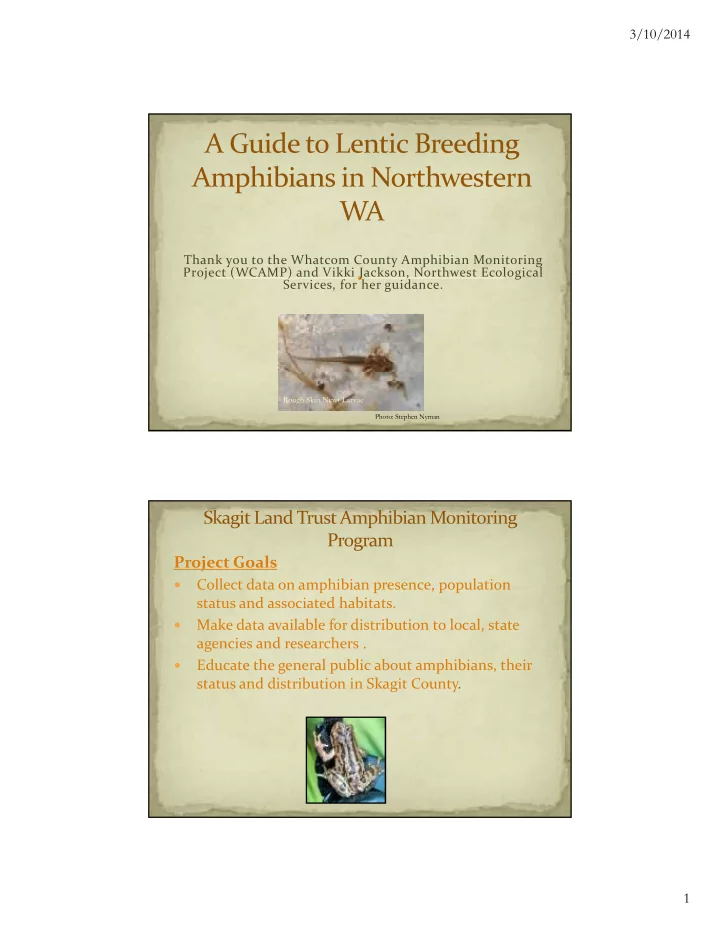
Thank you to the Whatcom County Amphibian Monitoring Project (WCAMP) and Vikki Jackson, Northwest Ecological Services, for her guidance.


slide-1
SLIDE 1
  • Thank you to the Whatcom County Amphibian Monitoring

Project (WCAMP) and Vikki Jackson, Northwest Ecological Services, for her guidance.

  • Project Goals
  • Collect data on amphibian presence, population

status and associated habitats.

  • Make data available for distribution to local, state

agencies and researchers .

  • Educate the general public about amphibians, their

status and distribution in Skagit County.

slide-2
SLIDE 2
  • !!"

#$% &'' ($&# !!)'*% ++

           !

! "# $

slide-3
SLIDE 3
  • Amphibian means two lives: aquatic and terrestrial life

stages.

They have permeable skin- they breath through their

skin.

Their eggs do not have shells, but are surrounded by a

jelly layer.

They are cold-blooded Includes: frogs, toads, newts, salamanders and

caecilians

There are over 6,500 species and they occur on all

continents except Antarctica.

They play an important role in nature as both predator and

prey, sustaining the delicate balance of nature.

They eat pest insects, benefiting successful agriculture

around the world and minimizing the spread of disease, including malaria.

The skin of amphibians has substances that protect them

from some microbes and viruses, offering possible medical cures for a variety of human diseases, including AIDS.

They are excellent indicators of environmental health due

to their permeable skins.

Frogs have had a special place in various human cultures

for centuries, cherished as agents of life and good luck.

slide-4
SLIDE 4
  • !%

    &

'( '% ') ' '*% ""+,(-

 %'&

,- ,$$ ,.$/$ ,0 ,

slide-5
SLIDE 5
  • ./0"112

'% 3,4$ '"525 '67 ,% '7

  • '
  • %

829:+*#*89- ,;< '≤ ≤ ≤ ≤ "="8 % ,+7

  • >%

%

slide-6
SLIDE 6
  •  %'&

,

  • ,1$/

 2++

,$ ,/ ,/

  • %
  • ./0"112
slide-7
SLIDE 7
  • ?&

' '@ '

  • '6
  • A,%

'7

  • '%%6">555

'"=2 % '%>8° ° ° °:+*#° ° ° °-%

./0"112

,$ ,3 ,// ,

  •  2++

,#4 )!!"!!!5

!"

slide-8
SLIDE 8
  • #

, , ,3 3- , ,3/6 ,3/$ ,/ ,7)°

  • "!$%

"&'($ "&'($

slide-9
SLIDE 9
  • )

'± ± ± ± '@ '

  • '%

6 ' '%

  • '

2° ° ° °: +*8° ° ° °- ,; &4 '%%">555 '%6"=2 %

,%+38-

./0"112

BCD +%

, ,/ , ,3

*

slide-10
SLIDE 10
  • BCD +%
  • ,

,/3 4 ,4

  • *

'>7

  • '67

) A"% '6 ' '7 32 '% A"$9:+$1- ,& 89 ? ' '%% @7"="8 "=2

.&E"11*

slide-11
SLIDE 11
  •  %'&

+ + + +

%

  •  :(;

  %

,4 /

  • , 37
  • 34

 #9#*

4 4

%

slide-12
SLIDE 12
  • %
  • ,

,/ ,46<4

%

  • ?%

'% % '%

slide-13
SLIDE 13
  • FD

, ,

, -$

  • ,
  • =8

,/ ,46<4 + $,-,,.$"-$,,$$

* *

 ;

  • 4
  • ,

,/ ,

 8:

4

, ;$ // $

  • &4"
slide-14
SLIDE 14
  • ,± %

, @ ,%67"5% , ,7 , $89:+*"*#9- '% % '%

./0"112 ./0"112

!%

  • ,
  • ,>4

'%=%

  • 6

%( '%6G %

slide-15
SLIDE 15
  • !%
  • ;C!%D

 8:

,3 ,7 ,$/$ ,

slide-16
SLIDE 16
  • '%

3, '",$ '67 ,% '7

  • '
  • %

$89:+*"*#9- '%@"="8 "=2 % ,+7- ,%%

./0"112

'%%%

slide-17
SLIDE 17
  • 0! D

 %'&

, ,4< , ,/4$ , , ,0 ,0 , ,4 ,/4$

slide-18
SLIDE 18
  • #

Do not handle animals unless you need to. Make sure your hands are free of any chemicals (insect

repellent, sun screen, etc).

Do not eat anything until you have washed your hands

if you handle animals.

Keep your hands wet when handling Do not remove or detach egg masses from brace or

water.

Follow boot cleaning instructions between site visits.

Foot Gear Cleaning

It is important to thoroughly clean your footwear between sites to reduce the potential for disease or pathogen transmission.

After using footwear, knock off as much mud / organic debris as

  • possible. If footwear is still muddy, dunk them in your site’s pond to rinse
  • ff the remaining mud (if safe to do so).

If there is mud caked in the crevices of your footwear, at home in a sink,

scrub the waders with a brush or sponge dedicated to this purpose and rinse the footwear till they’re clean.

Make a 10% bleach solution in a spray bottle (9 parts water, 1 part

bleach).

Saturate the outside of the footwear and the inside of the plastic bag by

spraying on the 10% bleach solution.

Let items sit for 10 minutes, then rinse in a sink (not outside with a hose

to avoid cross contaminating your yard).

Let items dry. Your hip waders are now clean enough to monitor at

another site!

slide-19
SLIDE 19
  • )

!(/.

01$ 2(3$40,0/$-,%$ 500$$0 "3&45 6#6 # # 7, ,*$,0$8 *$,0$ 01$9$4-$ 8$,0$8 .(4-$ 8.$8