Program From the Inside Out Patsy Astarita, LCSW-C, OSW-C Michelle - - PowerPoint PPT Presentation

program from the inside out
SMART_READER_LITE
LIVE PREVIEW

Program From the Inside Out Patsy Astarita, LCSW-C, OSW-C Michelle - - PowerPoint PPT Presentation

Building a Palliative Care Program From the Inside Out Patsy Astarita, LCSW-C, OSW-C Michelle Abramowski, CRNP 1 Driving Factors Population Health Cost of Oncology Care Choosing Wisely (ASCO & ASTRO) Better qualityof life

slide-1
SLIDE 1

1

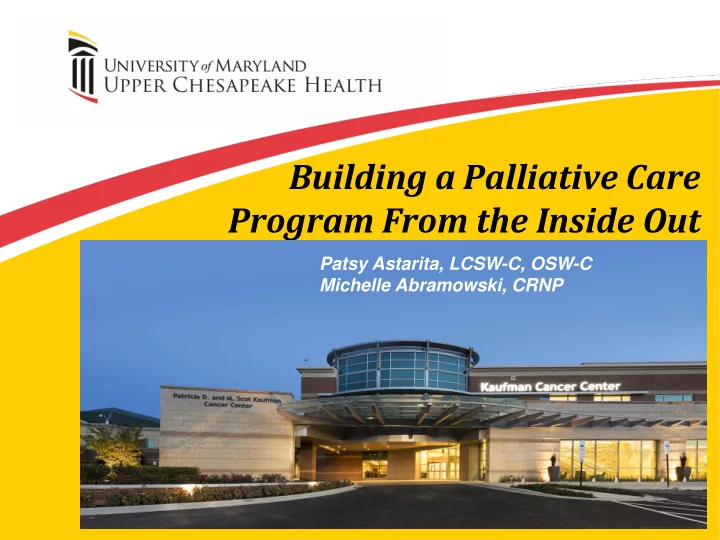
Building a Palliative Care Program From the Inside Out

Patsy Astarita, LCSW-C, OSW-C Michelle Abramowski, CRNP

slide-2
SLIDE 2

University of Maryland Upper Chesapeake Health 2

Driving Factors

  • Population Health
  • Cost of Oncology

Care

  • Choosing Wisely

(ASCO & ASTRO)

  • Better qualityof life at

EOL (Temel, 2010)

  • Standard of Care—

NCCN, ASCO, CoC

slide-3
SLIDE 3

University of Maryland Upper Chesapeake Health

Population Health in Oncology

3

slide-4
SLIDE 4

University of Maryland Upper Chesapeake Health

Studies Listed

4

  • Glare, P.A., et al. (2011). Palliative Care in the Outpatient Oncology Setting:

Evaluation of a Practical Set of Referral Criteria. Journal of Oncology Practice, 7(6), 366-370.

  • May, P., et al. (2015). Prospective Cohort Study of Hospital Palliative Care Teams

For Inpatients with Advanced Cancer: Earlier Consultation Is Associated With Larger Cost-Saving Effect. Journal of Clinical Oncology, 33, 1-8.

  • Temel, J.S., et al. (2010). Early Palliative Care for Patients with Metastatic

Non-Small-Cell Lung Cancer. New England Journal of Medicine, 363(8), 733-742.

slide-5
SLIDE 5

University of Maryland Upper Chesapeake Health University of Maryland Upper Chesapeake Health

Choosing Wisely

ASCO Recommendations Don’t use therapy for:

  • Solid tumor pts with low

ECOG

  • No benefit from prior

interventions

  • Not eligible for clinical trial
  • No strong evidence

supporting clinical value ASTRO Recommendations Don’t routinely:

  • Use extended

fractionation schemes (>10 fractions) for palliation of bone metastasis

  • Use non-curative therapy

without defining goals of treatment and considering palliative care referral

5

slide-6
SLIDE 6

University of Maryland Upper Chesapeake Health 6

Challenges Identified within KCC

  • Inadequate communication between

department/treatment teams

  • Lack of education related to PC or EOL
  • No budget, use existing resources
  • Lack of documentation/ data mgmt on Advance

Directives

  • Hospital PC team focused on ICU
  • Focus of CLN team was on newly diagnosed

patients, not on PC or EOL care

  • Reactive versus proactive use of resources
slide-7
SLIDE 7

University of Maryland Upper Chesapeake Health University of Maryland Upper Chesapeake Health

Starting Point

  • In-patient PC team
  • Limited out-pt PC clinic with the KCC
  • Cancer LifeNet Program in place
  • Updating Advance Directive policy and in-servicing all

team members

  • Physician Champion--Oncologist board certified in
  • ncology & PC and Medical Director on-board
  • NP expertise
  • Leadership with background in PC/Hospice care

7

slide-8
SLIDE 8

University of Maryland Upper Chesapeake Health 8

Workgroup

  • Established workgroup Summer 2014
  • Identified key TMs/leaders
  • Included physicians in the early planning phases
  • Literature review as to what has been done
  • Reviewed national metrics and determined outcome

measures

  • Looked at various existing models
  • Developed our model
slide-9
SLIDE 9

University of Maryland Upper Chesapeake Health 9

Palliative Care Models

 Embedded Specialist RN/MD  Inpatient Consult Service

  • Dedicated Inpatient Unit

 Outpatient Clinic

  • Home-Based Care

 Existing at UM UCMC

slide-10
SLIDE 10

University of Maryland Upper Chesapeake Health

Hallmarks of an Integrated Program

Advisory Board, 2013

 Oncologists trust the palliative care team  Palliative care team scrupulous about care coordination  Advance Care Planning routine for all cancer patients  Palliative care team highly visible in cancer center  Clinicians share responsibility for initiating palliative care  Oncology clinicians trained to provide palliative care

10

slide-11
SLIDE 11

University of Maryland Upper Chesapeake Health

Integrated Palliative Care Model, Kaufman Cancer Center

11

  • Assessing symptoms--physical,

emotional, psychological, financial toxicity

  • Recommendations from PC Case

Conference-

  • Medication Management
  • Specialist Referral
  • Behavioral Health & Supportive Care
  • KCC Treatment Teams --Infusion,

Radiation , Surgery, & Support Care

  • Multi-D Providers
  • In-patient Care Teams--Palliative
  • Out-Patient Palliative Care Clinic
  • Community-based Providers--home

care, hospice, other MDs

  • Choosing Wisely
  • PC Case Conference
  • Patient & Family
  • KCC Providers & Team Members
  • Community-Based Health Care

Providers

  • Goal of Care Meetings
  • PC Case Conference
  • EMR Documentation
  • Patient -Centered Care
  • Advance Care Planning
  • AD & MOLST
  • Body, Mind, & Spirit--Integrative

Health--Meditation, Yoga, massage, MBSR, exercise

  • Support Groups
  • Individual & Family Counseling
  • Community Resources--Hospice,

Hooper House, Palliative HC

  • ST Bereavement

Support

Communication

Symptom Management Coordination

  • f Care
slide-12
SLIDE 12

University of Maryland Upper Chesapeake Health

Palliative Care Decision Process

12

Physical

  • Evidence of non-curative disease and/or
  • Performance Status Assessment 2 or >

Trigger

  • Nurse Navigator reminder
  • Palliative Care 5-Item Questionnaire in ARIA
  • Names forwarded to Multi-D secretary for conference

PC Confirmed

  • Palliative Care Conference
  • Communicate with oncologist the PCC recommendations
  • Goals of Care Meeting with MD & MSW, other disciplines prn

Schedule Appt

  • Practice schedules appointment
  • Notifies Multi-D secretary to reserve consult room
slide-13
SLIDE 13

University of Maryland Upper Chesapeake Health

Palliative Care 5-Item Questionnaire

13

Glare, P.A., et al. (2011). Palliative Care in the Outpatient Oncology Setting: Evaluation of a Practical Set of Referral Criteria. Journal of Oncology Practice, 7(6), 366-370.

slide-14
SLIDE 14

University of Maryland Upper Chesapeake Health University of Maryland Upper Chesapeake Health

Palliative Care Conference Model

PC Conference

  • Weekly at 8am Palliative Care

Conference Summary Sheet completed

  • Interdisciplinary team reviews

newly identified patients

  • Recommendations

communicated to oncologist for further direction and/or schedule Goals of Care meeting

  • Started meeting October 2014

PC CC Team Members

  • Nurse Practitioners
  • Nurse Navigators
  • Infusion Center Nurses
  • Radiation Nurses
  • Social Workers
  • Nutritionist
  • Pharmacists
  • Hospice House rep
  • In-pt PC nurse practitioner
  • Physicians ad hoc

14

slide-15
SLIDE 15

University of Maryland Upper Chesapeake Health

Palliative Care Conference Overview

  • Patient Presented--review of current status

 Understanding of the disease status ,treatment response & overall prognosis of patient  Current functional status of patient  Patient/family dynamics

  • Discipline Report

 MD/NP  Nurse Navigator & Treatment Nurse  SW  RD

  • Summary & Recommendations:

 Symptom management  Goals of Care/Advance Care Planning Patient & Family meetings  Document in EMR

15

slide-16
SLIDE 16

University of Maryland Upper Chesapeake Health University of Maryland Upper Chesapeake Health

PC Specialists Workgroup

  • Self-selected group with

interest in PC

  • Agree to attend meetings

and commit to additional educational development

  • Education module

developed

  • Invite subject experts to

present

  • Moving towards—

Subject Experts i.e: Pharmacist –pain mgmt./conversions ONN –Goals of Care meetings

  • Palliative Care

Certifications

16

slide-17
SLIDE 17

University of Maryland Upper Chesapeake Health 17 17

Goals of Care Meeting

  • Pt/Family understand

current medical status

  • Summarize “big

picture”

  • Respond to emotions
  • Decision-making
  • Goal Setting
  • Document and update

team

slide-18
SLIDE 18

University of Maryland Upper Chesapeake Health University of Maryland Upper Chesapeake Health

Goals of Care & AD Resources & References

  • SPIKES protocol (CMAJ, 2013)
  • The Mount Sinai Hospital

Palliative Care Goal-Setting- Conference Pocket Card

http://emupdates.com/wp- content/uploads/2009/11/goal-setting- conference-pocket-card-mssm.pdf

  • Palliative Care and the Human

Connection: Ten Steps for What To Say and Do (Video from, CAPC)

  • The One Slide Project
  • Respecting Choice
  • The Conversation Project
  • Advance Care Planning Canada

18

Setting up the interview P assessing patient’s

Perception

I obtaining the patient’s

Invitation

K giving Knowledge and

information to the patient

E addressing the

patient’s Emotional with Empathic responses

S Strategy & Summary

slide-19
SLIDE 19

University of Maryland Upper Chesapeake Health 19 19

A Shift in Culture in the KCC

  • Proactive vs reactive
  • Expanded awareness &

language sensitivity

  • Palliative care & hospice
  • Advance Directives/MOLST

& Advance Care Planning

  • Population Health & Value-

based care

slide-20
SLIDE 20

University of Maryland Upper Chesapeake Health 20 20

Community Partnerships

  • Hospice and Palliative

Care Agencies

  • Meet and Greet-Dec

2014

  • Hospice House Rep

March 2015

slide-21
SLIDE 21

University of Maryland Upper Chesapeake Health

Palliative Care Dashboard

Advisory Board, 2013 21

slide-22
SLIDE 22

University of Maryland Upper Chesapeake Health

KCC Palliative Care Outcome Measures

22

2014-2015 National Benchmarks Oct Nov Dec 2014 Jan Feb Mar 2015 Apr May Jun 2015 July Aug Sept 2015 Yearly Percentages Proportion receiving chemotherapy in the last 14 days of life Average: 5.6%-6.4%

13% 3% 4% 1% 5%

Proportion with more than one emergency room visit in the last days of life Average : 8-10% Best Observed: 2%

7% 14% 0% 3% 6%

Proportion admitted to the ICU in the last 30 days of life Average: 8-12% Best Observed: <4%

4% 11% 2% 6% 5%

Proportion admitted to hospice for less than 3 days Average 27-35% Best Observed: 8%

12% 12% 35% 6% 14%

Proportion not admitted to hospice Average 65-85% Best Observed: <55%

55% 38% 45% 53% 50%

Advance Care Plan Observed Average: 41%

38% 46% 87% 70% 61%

slide-23
SLIDE 23

University of Maryland Upper Chesapeake Health 23

Next Steps

The Evolving Model

  • On-going staff education and palliative expert

certifications.

  • Incorporating palliative consult into multi-d clinic

(beginning with thoracic)

  • Incorporating Palliative & Advance Care Planning

information into patient education materials

  • Updating our community partners-local hospice

agencies & palliative home care programs

  • Continuing to track outcome via Palliative Care Metrics
  • Increasing visibility & awareness of in-house palliative

resources(both staff & patient & families).

slide-24
SLIDE 24

24

Thank you