Program 2 Corrections/Clarifications CPSC 314 Computer Graphics - - PDF document

program 2 corrections clarifications
SMART_READER_LITE
LIVE PREVIEW

Program 2 Corrections/Clarifications CPSC 314 Computer Graphics - - PDF document

University of British Columbia Program 2 Corrections/Clarifications CPSC 314 Computer Graphics handin 314 proj2 (not 414) Jan-Apr 2005 f not s to toggle flat/smooth shading Tamara Munzner s already in use for camera


slide-1
SLIDE 1

University of British Columbia CPSC 314 Computer Graphics Jan-Apr 2005 Tamara Munzner http://www.ugrad.cs.ubc.ca/~cs314/Vjan2005

Prog 2, Kangaroo Hall of Fame, Midterm Review, (Interpolation if time) Week 6, Wed Feb 9

2

Program 2 Corrections/Clarifications

handin 314 proj2 (not 414) ‘f’ not ‘s’ to toggle flat/smooth shading

‘s’ already in use for camera

add: ‘t’ to toggle between randomly colored and

grey terrain

makes it easier to check if lighting correct

add: ‘u’ to replace terrain with new randomly

generated geometry

consider adding for a bit of extra credit:

‘+/-’ toggle to increment/decrement abs cam speed 3

Program 2 Corrections/Clarifications

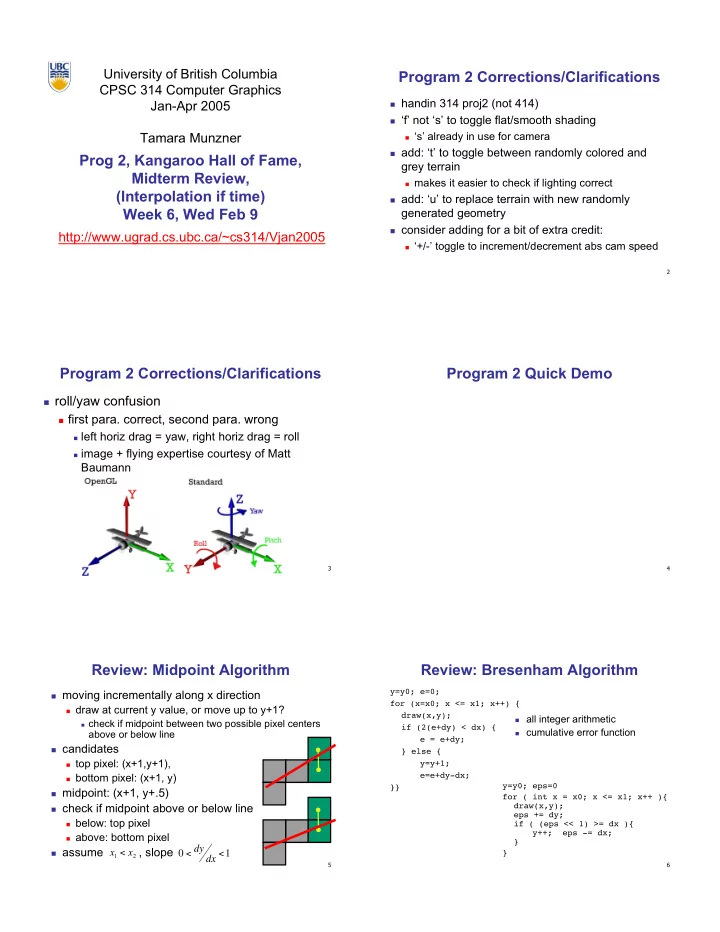
roll/yaw confusion

first para. correct, second para. wrong

left horiz drag = yaw, right horiz drag = roll image + flying expertise courtesy of Matt

Baumann

4

Program 2 Quick Demo

5

Review: Midpoint Algorithm

moving incrementally along x direction

draw at current y value, or move up to y+1?

check if midpoint between two possible pixel centers

above or below line

candidates

top pixel: (x+1,y+1), bottom pixel: (x+1, y)

midpoint: (x+1, y+.5) check if midpoint above or below line

below: top pixel above: bottom pixel

assume , slope

2 1

x x < 0 < dy dx <1

6

Review: Bresenham Algorithm

all integer arithmetic cumulative error function

y=y0; e=0; for (x=x0; x <= x1; x++) { draw(x,y); if (2(e+dy) < dx) { e = e+dy; } else { y=y+1; e=e+dy-dx; }} y=y0; eps=0 for ( int x = x0; x <= x1; x++ ){ draw(x,y); eps += dy; if ( (eps << 1) >= dx ){ y++; eps -= dx; } }

slide-2
SLIDE 2

7

P

Review: Flood Fill

draw polygon edges, seed point, recursively

set all neighbors until boundary is hit to fill interior

drawbacks: visit pixels up to 4x, per-pixel

memory storage needed

1 2 3 4 5=0 P

Review: Scanline Algorithms

set pixels inside polygon boundary along

horizontal lines one pixel apart

use bounding box to speed up

9

Review: Edge Walking

basic idea:

draw edges vertically

interpolate colors down edges

fill in horizontal spans for each

scanline

at each scanline, interpolate

edge colors across span

10

Review: General Polygon Rasterization

idea: use a parity test

for each scanline edgeCnt = 0; for each pixel on scanline (l to r) if (oldpixel->newpixel crosses edge) edgeCnt ++; // draw the pixel if edgeCnt odd if (edgeCnt % 2) setPixel(pixel);

11

Hall of Fame

12

But Wait, There’s More!

nice comment :)

“this project is fun, only one of the very few

that I actually enjoyed. Too bad there's only

  • ne CG course in UBC =(

two fourth year CG courses await you!

424 Geometric Modelling 426 Animation

slide-3
SLIDE 3

13

Midterm Review

14

Midterm Exam

Friday Feb 11 10am-10:50am

you may use one handwritten 8.5”x11” sheet

  • ne side of page

no other notes, no books nonprogrammable calculators OK arrive on time! sit every other seat, ID out in front of you coats and bags in front of room

15

What’s Covered

transformations viewing and projections coordinate systems of rendering pipeline lighting and shading not scan conversion

16

Reading

FCS book, Red book

see web page for details you can be tested on material in book but not

covered in lecture

you can be tested on material covered in

lecture but not covered in book

17

Old Exams Posted

see course web page

18

The Rendering Pipeline

pros and cons of pipeline approach Geometry Database Geometry Geometry Database Database Model/View Transform. Model/View Model/View Transform. Transform. Lighting Lighting Lighting Perspective Transform. Perspective Perspective Transform. Transform. Clipping Clipping Clipping Scan Conversion Scan Scan Conversion Conversion Depth Test Depth Depth Test Test Texturing Texturing Texturing Blending Blending Blending Frame- buffer Frame- Frame- buffer buffer

slide-4
SLIDE 4

19

Transformations

  • =
  • 1

1 1 1 1 1 ' ' ' z y x c b a z y x translate(a,b,c) translate(a,b,c)

  • =
  • 1

1 cos sin sin cos 1 1 ' ' ' z y x z y x

  • )

, ( Rotate

  • x
  • =
  • 1

1 1 ' ' ' z y x c b a z y x scale(a,b,c) scale(a,b,c)

  • 1

cos sin 1 sin cos

  • )

, ( Rotate

  • y
  • 1

1 cos sin sin cos

  • )

, ( Rotate

  • z

20

Homogeneous Coordinates

  • x

x y y w w w= w=1 1

  • w

w y w x

  • w

w y w x

  • 1

y x

  • 1

y x

21

Composing Transformations

Ta Tb = Tb Ta, but Ra Ta Tb = Tb Ta, but Ra Rb Rb != != Rb Rb Ra and Ta Ra and Ta Rb Rb != != Rb Rb Ta Ta

22

Composing Transformations

example: rotation around arbitrary center

23

Composing Transformations

example: rotation around arbitrary center

step 1: translate coordinate system to rotation

center

24

Composing Transformations

example: rotation around arbitrary center

step 2: perform rotation

slide-5
SLIDE 5

25

Composing Transformations

example: rotation around arbitrary center

step 3: back to original coordinate system

26

Composing Transformations

rotation about a fixed point

p’ = TRT-1p

rotation around an arbitrary axis considering frame vs. object

p’ = DCBAp

  • bject

frame

OpenGL:

D C B A draw p

27

Transformation Hierarchies

hierarchies don’t fall apart when changed transforms apply to graph nodes beneath

28

Matrix Stacks

push and pop matrix stack

avoid computing inverses or incremental

xforms

avoid numerical error World coordinates World coordinates

T T1

1(x)

(x) T T2

2(x)

(x) T T3

3(x)

(x)

29

Matrix Stacks

glPushMatrix glPushMatrix() () glPopMatrix glPopMatrix() () A A B B C C A A B B C C A A B B C C C C glScale3f(2,2,2) glScale3f(2,2,2) D = C scale(2,2,2) trans(1,0,0) D = C scale(2,2,2) trans(1,0,0) A A B B C C D D DrawSquare DrawSquare() () glTranslate3f(1,0,0) glTranslate3f(1,0,0) DrawSquare DrawSquare() () glPushMatrix glPushMatrix() () glPopMatrix glPopMatrix() ()

30

Transformation Hierarchies

example 4

  • 1
  • 5
  • 3
  • 2
  • x

x y y glTranslate3f(x,y,0); glTranslate3f(x,y,0); glRotatef glRotatef( ,0,0,1); ( ,0,0,1); DrawBody DrawBody(); (); glPushMatrix glPushMatrix(); (); glTranslate3f(0,7,0); glTranslate3f(0,7,0); DrawHead DrawHead(); (); glPopMatrix glPopMatrix(); (); glPushMatrix glPushMatrix(); (); glTranslate glTranslate(2.5,5.5,0); (2.5,5.5,0); glRotatef glRotatef( ,0,0,1); ( ,0,0,1); DrawUArm DrawUArm(); (); glTranslate glTranslate(0,-3.5,0); (0,-3.5,0); glRotatef glRotatef( ,0,0,1); ( ,0,0,1); DrawLArm DrawLArm(); (); glPopMatrix glPopMatrix(); (); ... (draw other arm) ... (draw other arm)

1

  • 2
  • 3
slide-6
SLIDE 6

31

Display Lists

reuse block of OpenGL code more efficient than immediate mode

code reuse, driver optimization

good for static objects redrawn often

can’t change contents not just for multiple instances

interactive graphics: objects redrawn every

frame

nest when possible for efficiency

32

Double Buffering

two buffers, front and back

while front is on display, draw into back when drawing finished, swap the two

avoid flicker

33

Projective Rendering Pipeline

OCS - object coordinate system WCS - world coordinate system VCS - viewing coordinate system CCS - clipping coordinate system NDCS - normalized device coordinate system DCS - device coordinate system

OCS OCS WCS WCS VCS VCS CCS CCS NDCS NDCS DCS DCS

modeling modeling transformation transformation viewing viewing transformation transformation projection projection transformation transformation viewport viewport transformation transformation alter w alter w / w / w

  • bject

world viewing/ camera device normalized device clipping

perspective perspective division division glVertex3f(x,y,z) glVertex3f(x,y,z) glTranslatef glTranslatef(x,y,z) (x,y,z) glRotatef glRotatef( (th th,x,y,z) ,x,y,z) .... .... gluLookAt gluLookAt(...) (...) glFrustum glFrustum(...) (...) glutInitWindowSize glutInitWindowSize(w,h) (w,h) glViewport glViewport(x,y,a,b) (x,y,a,b)

34

Projection

theoretical pinhole camera image image plane plane eye eye point point

– image inverted, more convenient equivalent

image image plane plane eye eye point point

35

Projection Taxonomy

planar planar projections projections perspective: perspective: 1,2,3-point 1,2,3-point parallel parallel

  • blique
  • blique
  • rthographic
  • rthographic

cabinet cabinet cavalier cavalier top, top, front, front, side side axonometric: axonometric: isometric isometric dimetric dimetric trimetric trimetric

36

Projective Transformations

transformation of space

center of projection moves to infinity viewing frustum transformed into a

parallelpiped

  • z
  • z

x x

  • z
  • z

x x Frustum Frustum

slide-7
SLIDE 7

37

Normalized Device Coordinates

left/right x =+/- 1, top/bottom y =+/- 1, near/far z =+/- 1

  • z
  • z

x x Frustum Frustum z=-n z=-n z=-f z=-f

right right left left

z z x x x= -1 x= -1 z=1 z=1 x=1 x=1 Camera coordinates Camera coordinates NDC NDC z= -1 z= -1

38

Projection Normalization

distort such that orthographic projection of

distorted objects is desired persp projection

  • z
  • z

x x z z x x

39

Transforming View Volumes

x z

NDCS

y

(-1,-1,-1) (1,1,1)

  • rthographic view volume
  • rthographic view volume

x z VCS y x=left y=top x=right z=-far z=-near y=bottom perspective view volume perspective view volume x=left x=right y=top y=bottom z=-near z=-far x VCS y

40

Basic Perspective Projection

similar triangles similar triangles

  • = z

y d y' z d y y

  • =

'

z z P(x,y,z) P(x,y,z) P( P(x x’ ’, ,y y’ ’,d) ,d) z=d z=d y y also also

z d x x

  • =

'

nonuniform foreshortening

not affine

d z = '

but but

41

Basic Perspective Projection

can express as homogenous 4x4 matrix!

  • =
  • 1

/ 1 1 1 1 / z y x d d z z y x

  • d

z d y z d x / /

  • d

z z y x / w /

42

Projective Transformations

determining the matrix representation

need to observe 5 points in general position,

e.g.

[left,0,0,1]T[-1,0,0,1]T [0,top,0,1]T[0,1,0,1]T [0,0,-f,1]T[0,0,1,1]T [0,0,-n,1]T[0,0,-1,1]T [left*f/n,top*f/n,-f,1]T[-1,1,1,1]T

solve resulting equation system to obtain matrix

slide-8
SLIDE 8

43

OpenGL Orthographic Matrix

scale, translate, reflect for new coord sys

understand derivation from VCS!

P near far near far near far bot top bot top bot top left right left right left right P

  • +
  • +
  • +
  • =

1 2 2 2 '

44

OpenGL Perspective Matrix

shear, scale, reflect for new coord sys

understand derivation from VCS!

  • +
  • +
  • +
  • 1

2 ) ( 2 2 n f fn n f n f b t b t b t n l r l r l r n

45

Viewport Transformation

x x (0,0) (0,0) (w,h) (w,h) DCS DCS a a b b y y (0,0) (0,0) (w,h) (w,h) DCS DCS a a b b x x y y

(-1,-1)

(1,1) (1,1) NDCS NDCS

x x y y display display viewport viewport x x y y

  • nscreen pixels: map from [-1,1] to [0, displaywidth]

DCS DCS

confusion on hw

pixel locations should

not be negative or huge!

46

Light Sources

directional/parallel lights

point at infinity: (x,y,z,0)T

point lights

finite position: (x,y,z,1)T

spotlights

position, direction, angle

ambient lights

47

Reflectance

specular: perfect mirror with no scattering gloss: mixed, partial specularity diffuse: all directions with equal energy

+ + =

specular + glossy + diffuse = reflectance distribution

48

Review: Reflection Equations

Idiffuse = kd Ilight (n • l)

n l

  • 2 ( N (N · L)) – L = R

Ispecular = ksIlight(v•r)nshiny

slide-9
SLIDE 9

49

Review: Reflection Equations 2

Blinn improvement full Phong lighting model

combine ambient, diffuse, specular components

l l n n v v h h

Itotal = ksIambient + Ii(

i=1 #lights

  • kd(n•li) + ks(v•ri)nshiny )

Ispecular = ksIlight(h•n)nshiny h = (l + v)/2

50

Lighting vs. Shading

lighting

simulating the interaction of light with surface

shading

deciding pixel color continuum of realism: when do we do lighting

calculation?

51

Shading Models

flat shading

compute Phong lighting once for entire

polygon

Gouraud shading

compute Phong lighting at the vertices and

interpolate lighting values across polygon

Phong shading

compute averaged vertex normals interpolate normals across polygon and

perform Phong lighting across polygon

52

apply nonuniform scale: stretch along x by 2

can’t transform normal

by modelling matrix

solution:

Transforming Normals

MP P = '

P N

QN N = '

( )

T

M Q

1

  • =

normal to any surface transformed by inverse transpose of modelling transformation

53

Interpolation

54

Scan Conversion

done:

how to determine pixels covered by a primitive

next:

how to assign pixel colors

interpolation of colors across triangles interpolation of other properties

slide-10
SLIDE 10

55

z y x

N N N , ,

Interpolation During Scan Conversion

interpolate values between vertices

z values r,g,b colour components use for Gouraud shading u,v texture coordinates surface normals

equivalent methods (for triangles)

bilinear interpolation barycentric coordinates 56

Bilinear Interpolation

interpolate quantity along L and R edges,

as a function of y

then interpolate quantity as a function of x

y y P(x,y) P(x,y) P P1

1

P P2

2

P P3

3

P PL

L

P PR

R 57

  • 3. Barycentric Coordinates

weighted combination of vertices

3 2 1

P P P P

  • +
  • +
  • =
  • 1

P

3

P

2

P P

(1,0,0) (1,0,0) (0,1,0) (0,1,0) (0,0,1) (0,0,1)

5 . =

  • 1

=

  • =
  • 1

, , 1

  • =

+ +

“convex combination convex combination

  • f points
  • f points”

58

P P2

2

P P3

3

P P1

1

P PL

L

P PR

R

P P d d

2 2

: d : d

1 1 3 2 1 1 2 2 1 2 3 2 1 1 2 2 1 1 2 3 2 1 1 2

) 1 ( ) ( P d d d P d d d P d d d P d d d P P d d d P P

L

+ + + = = + + +

  • =
  • +

+ =

Computing Barycentric Coordinates

for point P on scanline

59

Computing Barycentric Coords

similarly

b b1

1 : b

: b2

2

P P2

2

P P3

3

P P1

1

P PL

L

P PR

R

P P d d

2 2

: d : d

1 1 1 2 1 1 2 2 1 2 1 2 1 1 2 2 1 1 2 1 2 1 1 2

) 1 ( ) ( P b b b P b b b P b b b P b b b P P b b b P P

R

+ + + = = + + +

  • =
  • +

+ =

60

R L

P c c c P c c c P

  • +

+

  • +

=

2 1 1 2 1 2

b b

1 1

: b : b

2 2

P P2

2

P P3

3

P P1

1

P PL

L

P PR

R

P P d d

2 2

: d : d

1 1 3 2 1 1 2 2 1 2

P d d d P d d d P

L

+ + + =

1 2 1 1 2 2 1 2

P b b b P b b b P

R

+ + + =

c c1

1: c

: c2

2

  • +

+ + + +

  • +

+ + + =

1 2 1 1 2 2 1 2 2 1 1 3 2 1 1 2 2 1 2 2 1 2

P b b b P b b b c c c P d d d P d d d c c c P

Computing Barycentric Coords

combining gives

slide-11
SLIDE 11

61

Computing Barycentric Coords

thus

with

3 3 2 2 1 1

P a P a P a P

  • +
  • +
  • =

2 1 1 2 1 2 3 2 1 2 2 1 1 2 1 2 2 1 2 2 2 1 1 2 1 1 1

d d d c c c a b b b c c c d d d c c c a b b b c c c a + + = + + + + + = + + =

62

Computing Barycentric Coords

can verify barycentric properties

1 , , 1

3 2 1 3 2 1

  • =

+ + a a a a a a