Professional Communication in Computer Science Writing a scientific - - PowerPoint PPT Presentation

professional communication in computer science
SMART_READER_LITE
LIVE PREVIEW

Professional Communication in Computer Science Writing a scientific - - PowerPoint PPT Presentation

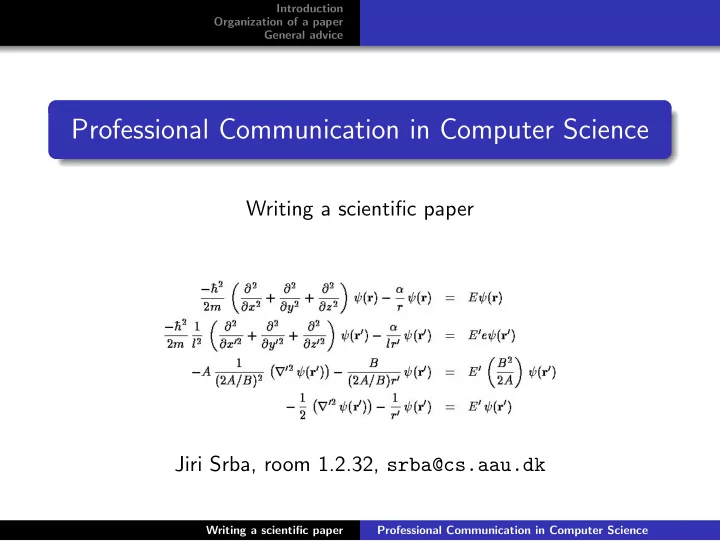
Introduction Organization of a paper General advice Professional Communication in Computer Science Writing a scientific paper Jiri Srba Jiri Srba, room 1.2.32, srba@cs.aau.dk Writing a scientific paper Professional Communication in Computer


slide-1
SLIDE 1

Introduction Organization of a paper General advice

Professional Communication in Computer Science

Writing a scientific paper Jiri Srba Jiri Srba, room 1.2.32, srba@cs.aau.dk

Writing a scientific paper Professional Communication in Computer Science

slide-2
SLIDE 2

Introduction Organization of a paper General advice Today’s plan Organization of writing IMRAD approach

Today’s Plan

Introduction Organization of a typical paper Notes on technical writing How to write mathematics Group work Summary and discussion Credits and Many Thanks To Luca Aceto, Olivier Danvy, Emmanuel Fleury and Albrecht Schmidt

Writing a scientific paper Professional Communication in Computer Science

slide-3
SLIDE 3

Introduction Organization of a paper General advice Today’s plan Organization of writing IMRAD approach

Introduction

“The preparation of a scientific paper has almost nothing to do with literary skills. It is a question of organization.” – Robert A. Day, How to Write and Publish a Scientific Paper “ I feel disloyal, but doubtlessly truthful in saying that most scientists do not know how to write ... The only way to learn how to write is above all to read, to study good models, and to practice.” – P. B. Medawar

Writing a scientific paper Professional Communication in Computer Science

slide-4
SLIDE 4

Introduction Organization of a paper General advice Today’s plan Organization of writing IMRAD approach

IMRAD Approach

Introduction Methods Results And Discussion This approach can/should be used for most forms of expository writing.

Writing a scientific paper Professional Communication in Computer Science

slide-5
SLIDE 5

Introduction Organization of a paper General advice Today’s plan Organization of writing IMRAD approach

Writing a Paper

A scientific paper is written to be read by:

  • ther researchers,

reviewers, and yourself in the future. The main demands on the paper: logic, clarity, precision. The key word to scientific writing is clarity.

Writing a scientific paper Professional Communication in Computer Science

slide-6
SLIDE 6

Introduction Organization of a paper General advice Title, authors, abstract Introduction Development, conclusion, references

Organization of a Typical Paper in Computer Science

Title, authors, abstract. Introduction, compelling example, related work, overview. Development. Conclusion. Acknowledgments. References.

Writing a scientific paper Professional Communication in Computer Science

slide-7
SLIDE 7

Introduction Organization of a paper General advice Title, authors, abstract Introduction Development, conclusion, references

Title

It should be informative. It should be concise. It should be catchy and memorable. It should be original. It does not have to be funny. Hints: Title is a label, not a sentence. Avoid abbreviations, jargon, maths formulas and symbols.

Writing a scientific paper Professional Communication in Computer Science

slide-8
SLIDE 8

Introduction Organization of a paper General advice Title, authors, abstract Introduction Development, conclusion, references

Title: Examples

Standard titles (majority of all titles): Labelling Schemes for Dynamic Tree Networks Recognizable Sets of Message Sequence Charts On Dualization in Products of Forests What do you think about these titles? Why Is Simulation Harder Than Bisimulation? To Store or Not to Store Silence Is Golden: Branching Bisimilarity Is Decidable for Context-Free Processes L(A) = L(B)? Types, or: Where’s the Difference Between CCS and π?

Writing a scientific paper Professional Communication in Computer Science

slide-9
SLIDE 9

Introduction Organization of a paper General advice Title, authors, abstract Introduction Development, conclusion, references

On the Temptation of Making a Funny Title

Be aware of potential risks: The messenger can hide the message. Most funny titles do not convey concrete message; they tend to be insiders’ jokes. Do you want to be remembered as the funny one, or for the content of your work?

Writing a scientific paper Professional Communication in Computer Science

slide-10
SLIDE 10

Introduction Organization of a paper General advice Title, authors, abstract Introduction Development, conclusion, references

Common Practice in Capitalization of Titles

Capitalize First and last word, nouns, pronouns, verbs, adverbs, adjectives, subordinating conjunctions (Before, After, When, If, Than, While, As...), hyphenated compound words (Depth-First Search), first word following a colon (Vegas: The City of Gamble) .

Writing a scientific paper Professional Communication in Computer Science

slide-11
SLIDE 11

Introduction Organization of a paper General advice Title, authors, abstract Introduction Development, conclusion, references

Common Practice in Capitalization of Titles

Do Not Capitalize Articles (a, an, the), coordinating conjunctions (for, and, nor, but, or, yet, so — FANBOYS) the word ’to’ when it precedes a verb (infinitive) prepositions (sometimes only with fewer than five letters).

Writing a scientific paper Professional Communication in Computer Science

slide-12
SLIDE 12

Introduction Organization of a paper General advice Title, authors, abstract Introduction Development, conclusion, references

Capitalization of Titles: Examples

Petri Nets and Their Properties (‘their’ is adjective) Do It Right (‘it’ is a pronoun) When Is a Continuous Function Continuous? (‘is’ is a verb) Analyzing Protocols in Hierarchical Networks (‘in’ is a preposition) Bringing In Parallel Schemes (‘in’ is functioning as adverb) See also: www.writersblock.ca/tips/monthtip/tipmar98.htm

Writing a scientific paper Professional Communication in Computer Science

slide-13
SLIDE 13

Introduction Organization of a paper General advice Title, authors, abstract Introduction Development, conclusion, references

List of Authors

Alphabetically ordered, or

  • rdered by degrees of contribution, or

student first, advisor second, or any other scheme. I almost always use an alphabetical order. The list should also include: Authors’ institutions with mail addresses. Email addresses. Contact/corresponding author (sometimes).

Writing a scientific paper Professional Communication in Computer Science

slide-14
SLIDE 14

Introduction Organization of a paper General advice Title, authors, abstract Introduction Development, conclusion, references

Abstract

Abstract is a “mini-version” of the paper, a summary. It identifies the area and main contribution, and helps the reader to decide whether to read the paper or not. Abstract should be brief (5-20 lines, or max 250 words), be as informative as possible, state the main objectives and the scope of the work, summarize the main results, and possibly state a principal conclusion. Abstract should be written (updated) last, to account to the actual content of the paper!

Writing a scientific paper Professional Communication in Computer Science

slide-15
SLIDE 15

Introduction Organization of a paper General advice Title, authors, abstract Introduction Development, conclusion, references

Abstract: Example

“ We describe a probabilistic polynomial-time process calculus for analyzing cryptographic protocols and use it to derive compositionally properties of protocols in the presence of computationally bounded adversaries. We illustrate these concepts

  • n oblivious transfer, an example from cryptography. We also

compare our approach with a framework based on interactive Turing machines. ”

Writing a scientific paper Professional Communication in Computer Science

slide-16
SLIDE 16

Introduction Organization of a paper General advice Title, authors, abstract Introduction Development, conclusion, references

More on Abstracts

Abstracts are the key to locate papers on the web. Avoid references, tables, maths-formulas and special symbols because abstracts are stored as plain-text. Many more people will read your abstract than your paper!

Writing a scientific paper Professional Communication in Computer Science

slide-17
SLIDE 17

Introduction Organization of a paper General advice Title, authors, abstract Introduction Development, conclusion, references

Even More on Abstracts

Pitfalls Exaggerating: “We solve a problem X by using highly sophisticated technique which is without any doubt superior to all other known approaches.” Seeking effect for seeking effect: “This paper bridges a much needed gap in the literature.” Unnecessary words/phrases: In this paper, we are going to study the problem of whether we can ...

  • Misspelling. (Always use a spell checker!)

Writing a scientific paper Professional Communication in Computer Science

slide-18
SLIDE 18

Introduction Organization of a paper General advice Title, authors, abstract Introduction Development, conclusion, references

Introduction

“A bad beginning makes a bad ending.” – Euripides The introduction often decides the destiny of a paper. The introduction is often the only part of your paper to be read. Remember The first paragraph should be your best paragraph, the first sentence should be your best sentence.

Writing a scientific paper Professional Communication in Computer Science

slide-19
SLIDE 19

Introduction Organization of a paper General advice Title, authors, abstract Introduction Development, conclusion, references

Introduction to Introduction

Purpose of Introduction It should present first, and in all possible clarity, the nature and scope of the problem you study. It should review and comment on the related work. It should clearly say what are the achievements of the paper. Hints: Avoid the same pitfalls as in abstract. A compelling example is always good. It should not be too technical. Avoid too long sentences. Start with a bang!

Writing a scientific paper Professional Communication in Computer Science

slide-20
SLIDE 20

Introduction Organization of a paper General advice Title, authors, abstract Introduction Development, conclusion, references

Introduction: Examples

What do you think about these first sentences? “In this paper, we apply to the framework of Pure Type Systems the insights into the relationship between sequent calculus and natural deduction as developed in previous papers by Herbelin [Her94, Her95], the second author and others [DP99b, PD00, DU03].” “Termination of computer programs has received continuous interest in the history of computer science, and classical applications are total correctness and termination of partial evaluation.

Writing a scientific paper Professional Communication in Computer Science

slide-21
SLIDE 21

Introduction Organization of a paper General advice Title, authors, abstract Introduction Development, conclusion, references

Introduction: More Examples

“In [4] Cartwright, Curien and Felleisen have shown that for SPCF, an extension of PCF with error elements and a catch construct,

  • ne can construct extensional fully abstract models whose induced

theory in the finitary case (i.e. over base type boolean) is still decidable and thus much simpler than the fully abstract models for PCF (see [1,7,15]) as demonstrated by Loader’s result [11].” “Model checking is one of the popular methods used in automated verification of concurrent systems like hardware circuits, communication protocols and distributed programs.” “Let us consider an m × n binary matrix A : R × C → {0, 1}, and an integral threshold value t ∈ {1, . . . , m}. ”

Writing a scientific paper Professional Communication in Computer Science

slide-22
SLIDE 22

Introduction Organization of a paper General advice Title, authors, abstract Introduction Development, conclusion, references

A Possible Structure of Introduction

1 Argue briefly for the relevance of the studied area/problem —

start from general and end with your concrete problem.

2 Explain the problem that you study — be clear, do not dive

into unnecessary details.

3 Describe your achievements — you can for example list them. 4 Comment on related work — compare your approach with

  • thers; mention both the strengths and weaknesses.

5 Give an overview of the sections to follow. Writing a scientific paper Professional Communication in Computer Science
slide-23
SLIDE 23

Introduction Organization of a paper General advice Title, authors, abstract Introduction Development, conclusion, references

A Good Tip

1 Write headings of the things you want to mention in

introduction on pieces of paper.

2 Order the headings so that they have a natural flow (one

motivates the other to follow). Is the progression logical?

3 Connect the headings into a smooth text.

Different areas of science have different standards. Learn by reading good introductions and mimic their organization and style. Rest on the shoulders of giants.

Writing a scientific paper Professional Communication in Computer Science

slide-24
SLIDE 24

Introduction Organization of a paper General advice Title, authors, abstract Introduction Development, conclusion, references

Development — Presenting Your Results

Start with technical preliminaries/background (setting up the scene). Progressive development of the material (organized in sections). Do not be afraid to state where you think that your contribution lies. Be as complete as possible. Be as concise as possible, but always precise. Anticipate, and answer, possible questions that a reader might have.

Writing a scientific paper Professional Communication in Computer Science

slide-25
SLIDE 25

Introduction Organization of a paper General advice Title, authors, abstract Introduction Development, conclusion, references

Anticipating Questions

  • Lemma. Let P and Q be CCS processes and let a, b, c be
  • actions. Then a.(b.P + c.Q) is trace equivalent to a.b.P + a.c.Q.

Good practice Follow claims, essential definitions and examples with a remark answering possible reader’s questions.

  • Remark. In fact, the reader can easily verify that the previous

lemma does not hold for bisimulation equivalence, because ...

Writing a scientific paper Professional Communication in Computer Science

slide-26
SLIDE 26

Introduction Organization of a paper General advice Title, authors, abstract Introduction Development, conclusion, references

Obvious Things That Are Often Forgotten

Present your results in a logical way. If the reader needs A to understand B, then present first A, then B! Always introduce technical terms, symbols, abbreviations and definitions before using them.

Writing a scientific paper Professional Communication in Computer Science

slide-27
SLIDE 27

Introduction Organization of a paper General advice Title, authors, abstract Introduction Development, conclusion, references

Related Work

Mandatory! Situates the novelty and significance of your work. Should answer the questions:

Where do the ideas come from? Have similar ideas been published/proposed earlier? What is really new in the paper?

Either a part of introduction, conclusion or a stand-alone section. Pitfalls: Forgetting or misinterpreting somebody else’s work. Overestimating one’s own contribution. “Present to inform, not to impress; if you inform, you will impress.” – Fred Brooks

Writing a scientific paper Professional Communication in Computer Science

slide-28
SLIDE 28

Introduction Organization of a paper General advice Title, authors, abstract Introduction Development, conclusion, references

Conclusion

Recapitulates the problem and the contribution. Assesses the significance of the contribution. Suggests and outlines future work, open problems, etc. There is often no conclusion in the mathematical tradition. In computer science I would strongly recommend to write a conclusion.

Writing a scientific paper Professional Communication in Computer Science

slide-29
SLIDE 29

Introduction Organization of a paper General advice Title, authors, abstract Introduction Development, conclusion, references

References

Must be accurate (correct year, series, etc.). Must be complete (authors, full title, forum or journal, series/issue/number, publisher, year). Tip: Use Bib T EX! Set up your own collection of bibitems as you start reading papers, you can store there also your own

  • annotations. Bibitems can be often downloaded from the

internet! Always cite the best primary publication for some work. (For example journal versions have priority to conference versions.)

Writing a scientific paper Professional Communication in Computer Science

slide-30
SLIDE 30

Introduction Organization of a paper General advice Title, authors, abstract Introduction Development, conclusion, references

Acknowledgments

Give credit where it is due. It does not cost anything and creates friends. Science is more of a social activity than you might think. Acknowledge the input from the anonymous referees (or from your supervisor).

Writing a scientific paper Professional Communication in Computer Science

slide-31
SLIDE 31

Introduction Organization of a paper General advice Passive and active voice Writing style Final word

General Tips

Passive vs. active voice. Bibliographical references. Remarks on writing style. Writing maths.

Writing a scientific paper Professional Communication in Computer Science

slide-32
SLIDE 32

Introduction Organization of a paper General advice Passive and active voice Writing style Final word

Passive Voice Versus Active Voice

Passive Voice Use it for work done by others: “It is known that ...” “It has been proved that ...” Passive voice can be replaced by writing for example: “Wiles proved Fermat’s Last Theorem [4].” Active Voice Use it to report on the achievements you have done in the paper: “In Section 5 we prove that ...” “We shall investigate the problem of ...” Note: If you are a solo author, we means “the reader and I”.

Writing a scientific paper Professional Communication in Computer Science

slide-33
SLIDE 33

Introduction Organization of a paper General advice Passive and active voice Writing style Final word

Bibliographical References

Should be provided in parenthesis so that they do not disturb

  • ne’s reading.

Style depends on the conference/journal. For example: [4], [KM’98], (Kucera and Mayr, 1998), (Kucera et al., 2004) “[2] shows that ...” is ugly, “... as seen in [2].” is little bit better, and “... as introduced by Church in his monograph on the λ-calculus [2].” is best.

Writing a scientific paper Professional Communication in Computer Science

slide-34
SLIDE 34

Introduction Organization of a paper General advice Passive and active voice Writing style Final word

Remarks on Writing Style

Refer to lemmas, propositions, theorems, examples, tables, figures, sections:

without articles, with first capital letter.

Examples: “In Theorem 6 we show ...” or “... as argued in Section 3.” Replace let’s, won’t, can’t, ... with let us, will not, cannot, ... Use neutral language. Avoid emotional adjectives and superlatives, in particular when describing your own results. If possible, avoid “could”, “would” and “might”, use rather “can”, “will”, “shall”, “may”. Do not use more words where fewer will do.

Writing a scientific paper Professional Communication in Computer Science

slide-35
SLIDE 35

Introduction Organization of a paper General advice Passive and active voice Writing style Final word

Two More Remarks on Writing Style

When introducing/recalling an entity X do not say “A bla, bla, bla is X.” but rather “X is a bla, bla, bla.” Sentences should be readable from left to right without ambiguity. “A framework where infinite-state systems are verified by the use of automata theory is called Regular Model Checking.” “Regular Model Checking is a framework for verification of infinite-state systems based on automata theory.” “Regular Model Checking is an automata based framework for verification of infinite-state systems.”

Writing a scientific paper Professional Communication in Computer Science

slide-36
SLIDE 36

Introduction Organization of a paper General advice Passive and active voice Writing style Final word

Writing Maths

L

AT

EX is nowadays a standard in computer science (in particular if some maths is involved). Learn it, it is very useful!!! Symbols in different formulas should be separated by words.

Bad: Consider Sq, q < p. Good: Consider Sq, where q < p.

Do not start a sentence with a symbol.

Bad: 2x = 3 has no integer solution. Good: The equation 2x = 3 has no integer solution.

Do not omit “that” when it helps to parse the sentence.

Bad: Assume A is a group. Good: Assume that A is a group.

However: “We have that x = y.” → “We have x = y.” Do not say “which” when “that” sounds better.

Writing a scientific paper Professional Communication in Computer Science

slide-37
SLIDE 37

Introduction Organization of a paper General advice Passive and active voice Writing style Final word

More on Writing Maths

Don’t use the same notation for two different things.

Bad: Let A be an n × m matrix. For every n ∈ {1, . . . , m} let A[n] be the .. Good: Let A be an n × m matrix. For every i ∈ {1, . . . , m} let A[i] be the ...

Use consistent notation for the same thing when it appears in several places.

Example: Do not say “Aj, for 1 ≤ j ≤ n” in one place and “Ak, for 1 ≤ k ≤ n” in another.

More hints in: Mathematical Writing by D.E. Knuth, T. Larrabee and P.M. Roberts.

Writing a scientific paper Professional Communication in Computer Science

slide-38
SLIDE 38

Introduction Organization of a paper General advice Passive and active voice Writing style Final word

The Paper is Written, Is the Process Over?

NO WAY! Part of the hard work is still ahead of you. Proof-read the paper as carefully as you can. Do not be lazy to make changes! Let the paper rest of a couple of days and then proof-read it again. Ask other people to read the paper and listen to their comments.

Writing a scientific paper Professional Communication in Computer Science

slide-39
SLIDE 39

Introduction Organization of a paper General advice Passive and active voice Writing style Final word

Final Word

“What is written without effort is, in general, read without pleasure.” – Samuel Johnson

Writing a scientific paper Professional Communication in Computer Science

slide-40
SLIDE 40

Introduction Organization of a paper General advice Passive and active voice Writing style Final word

Deliverable 2 (group discussion, individual writing)

Rewrite the title and abstract of your last year project. You should try to apply the rules/suggestions mentioned during the lecture and your target audience are computer science students that just finished their second year at the university. In the report write the names of all students participating at the preparation of the title/abstract.

Writing a scientific paper Professional Communication in Computer Science