
SLIDE 1
1
- 3. Cost Reimbursement Contracts
- These are sometimes referred to as ‘cost plus’ contracts.
- The contractor undertakes to carry out an indeterminate
amount of work and he is paid based on the actual cost
- f labour, plant and materials (‘honestly and properly’)
plus an agreed fee to cover overheads and profit.
- Checking the prime costs which are directly related to
the works is relatively straightforward. The variable is the fee, which should be agreed beforehand and establishing precisely what it covers.
There are three types:
- Cost plus percentage fee:
The fee charged is directly related to the prime cost. It is a percentage of the prime cost. The contractor has no incentive to work at maximum efficiency.
- Cost plus fixed fee:
The fee is a fixed lump sum usually based upon an agreed estimated
- cost. This is mostly used for works that are largely foreseeable. The
contractor has an incentive to work efficiently so as to remain profitable within agreed fee.
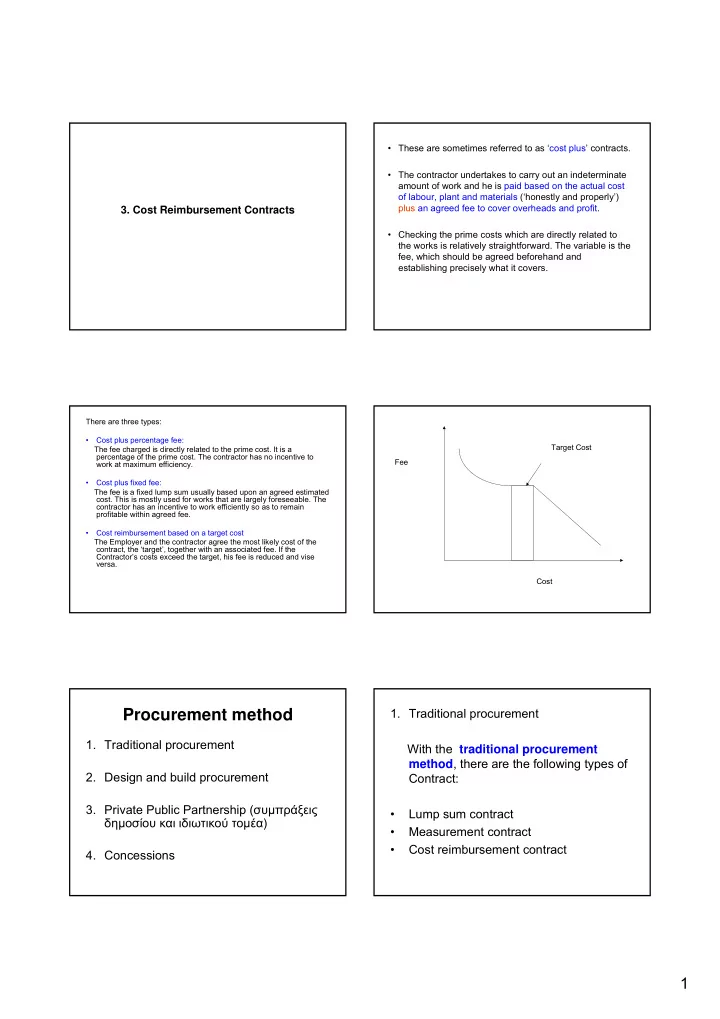
- Cost reimbursement based on a target cost
The Employer and the contractor agree the most likely cost of the contract, the ‘target’, together with an associated fee. If the Contractor’s costs exceed the target, his fee is reduced and vise versa. Fee Cost Target Cost
Procurement method
- 1. Traditional procurement
- 2. Design and build procurement
- 3. Private Public Partnership (συµπράξεις
δηµοσίου και ιδιωτικού τοµέα)
- 4. Concessions
- 1. Traditional procurement
With the traditional procurement method, there are the following types of Contract:
- Lump sum contract
- Measurement contract
- Cost reimbursement contract