
SLIDE 1
Investor Presentation June 2020
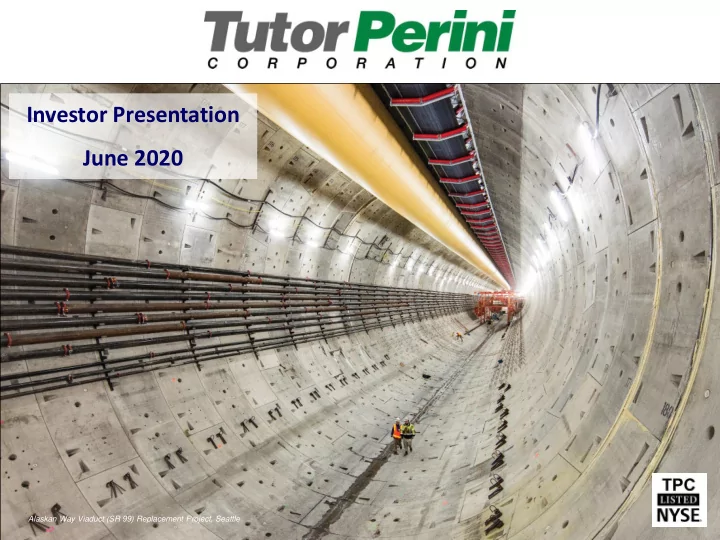
Alaskan Way Viaduct (SR 99) Replacement Project, Seattle
Investor Presentation June 2020 Alaskan Way Viaduct (SR 99) - - PowerPoint PPT Presentation
Investor Presentation June 2020 Alaskan Way Viaduct (SR 99) Replacement Project, Seattle Forward-Looking Statements Statements contained in this presentation that are not purely historical are forward-looking statements within the meaning of the
Alaskan Way Viaduct (SR 99) Replacement Project, Seattle
Statements contained in this presentation that are not purely historical are forward-looking statements within the meaning of the Private Securities Litigation Reform Act of 1995, including without limitation, statements regarding the Company’s expectations, hopes, beliefs, intentions
statements are based on the Company’s current expectations and beliefs concerning future developments and their potential effects on the
basis for them, there can be no assurance that future developments affecting the Company will be those that we have anticipated. These forward- looking statements involve a number of risks, uncertainties (some of which are beyond the control of the Company) or other assumptions that may cause actual results or performance to be materially different from those expressed or implied by such forward-looking statements. These risks and uncertainties include, but are not limited to: the impact of the COVID-19 pandemic and related events that are beyond our control, including possible effects on our business and operations, customers and suppliers, and employees, contractors and subcontractors, which could affect adversely our projects and the geographic regions in which we conduct business; a significant slowdown or decline in economic conditions; revisions of estimates of contract risks, revenue or costs, the timing of new awards or the pace of project execution, which may result in losses or lower than anticipated profit; unfavorable outcomes of existing or future litigation or dispute resolution proceedings against clients (project
invested in projects subject to such matters; the requirement to perform extra, or change order, work resulting in disputes or claims or adversely affecting our working capital, profits and cash flows; risks and other uncertainties associated with assumptions and estimates used to prepare financial statements; inability to retain key members of our management, to hire and retain personnel required to complete projects or implement succession plans for key officers; failure to meet contractual schedule requirements, which could result in higher costs and reduced profits or, in some cases, exposure to financial liability for liquidated damages and/or damages to customers; failure to meet our obligations under our debt agreements; decreases in the level of government spending for infrastructure and other public projects; downgrades in our credit ratings; failure of our joint venture partners to perform their venture obligations, which could impose additional financial and performance
increased competition and failure to secure new contracts; impairment of our goodwill or other indefinite-lived intangible assets; the impact of inclement weather conditions on projects; possible systems and information technology interruptions, including due to cyberattack, systems failures or other similar events; failure to comply with laws and regulations related to government contracts; the potential dilutive impact of our Convertible Notes in our EPS calculation; economic, political and other risks, including civil unrest, security issues, labor conditions, corruption and
the London Interbank Offered Rate and transition to any other interest rate benchmark; conversion of our outstanding Convertible Notes that could dilute ownership interests of existing stockholders and could adversely affect the market price of our common stock; and other risks and uncertainties discussed under the heading “Risk Factors” in our Annual Report on Form 10-K for the year ended December 31, 2019 filed on February 26, 2020 and in other reports that we file with the Securities and Exchange Commission from time to time. The Company undertakes no
as may be required under applicable securities laws.
2
* Includes multiple subsidiaries The Cosmopolitan Resort and Casino, Las Vegas
3
4
(approximate contract values)
5
California High-Speed Rail Project, Central California East Side Access Project, New York Newark Airport Terminal One, Newark Central Subway T-Line Extension, San Francisco
(financials are LTM through Q1-20; backlog as of quarter-end) A Leading Construction Services Firm
Revenue: $4.7B Adjusted Income from Construction Ops.(1) (ICO): $39.2M(2) Adjusted Op. Margin (1): 0.8% Q1-20 Backlog: $10.6B
Building Segment
Revenue: $1.8B ICO: $37.5M(3)
Q1-20 Backlog: $2.5B
Civil Segment
Revenue: $1.9B ICO: $63.8M(3)
Q1-20 Backlog: $5.7B Commonly uses guaranteed maximum price and cost plus fee contracts Specializes in:
Commonly uses fixed price and unit price contracts Specializes in:
Facilities
Specialty Contractors Segment
Revenue: $1.0B ICO: ($0.7M)(3)
Q1-20 Backlog: $2.4B Commonly uses fixed price, unit price and cost plus fee contracts Specializes in:
6
(1) Non-GAAP financial measure. See Appendix for a reconciliation of non-GAAP financial measures to the most nearly comparable GAAP financial measures. (2) Excludes a $379.9M pre-tax goodwill impairment charge; includes a pre-tax charge of $166.8M related to an adverse jury verdict on the SR 99 project that primarily impacted the Civil segment, as well as corporate general and administrative expenses of $61.4M (3) Segment ICO amounts do not sum to total ICO amount due to corporate general and administrative expenses and rounding.
Construction and rehabilitation of highways, bridges, tunnels, mass-transit systems and wastewater treatment facilities TPC’s highest margin segment Focused on large-scale, complex projects ($100M to $1B+) One of few leaders in the industry positioned to capture the largest projects
— Faces fewer competitors, as smaller contractors lack the technical experience, capability and bonding capacity to support large projects — Strong self-performance capabilities — Centralized, experienced cost estimating capabilities and sizeable equipment fleet
Very strong bidding activity and bid pipeline over the next several years Significant infrastructure spending boost expected due to recent voter- approved funding measures (e.g., $120B L.A. County Measure M; $54B Seattle Sound Transit 3), $52B 10-year California transportation bill and any potential new federal infrastructure program Experience and past performance on projects Financial strength key to obtaining bonding and pre-bid qualification Only major U.S. or international contractor with an office in Guam (presence for 40 years)
— Prepared for multi-billion-dollar troop relocation project opportunities CA High-Speed Rail, CA East Side Access Project, NY
Mass Transit 76% Bridges 6% Highways 4% Tunneling 1% Military Defense Facilities 7% Water 3% Other 3% 7
Large and active bid pipeline across diverse end markets — Significant volume of prospective projects in California and nationwide Strong customer relationships and end market expertise Integrated business model with significant self-perform capabilities Established track record on numerous large government contracts Leading Builder in California Large Corporate Customer Base Private / Non-Residential and Public Projects Expertise in Hospitality and Gaming, Design-Build and Accelerated Delivery Southeastern U.S. Focus Private / Non-Residential and Public Projects Construction and design-build services worldwide for U.S. military and government agencies and surety companies
CityCenter Las Vegas
8
The Cosmopolitan Resort & Casino, Las Vegas
Commercial and Industrial Facilities 20% Hospitality and Gaming 27% Municipal and Government 25% Mass Transit 12% Health Care Facilities 3% Education Facilities 8% Mixed Use 3% Other 2%
Solid demand, especially in New York City and California Strong electrical and mechanical proficiencies Performing substantial work for the Civil and Building groups — Positions TPC as a full-service contractor with greater control over scheduled work, project delivery, and cost and risk management Continuing to serve existing external customers Focused on New York City, Texas, California and Florida 9
East Side Access Queens Tunnels, NY World Trade Center, NY
One of the largest electrical contractors in New York City Electrical contractor with offices in Houston, Miami, New Orleans and Los Angeles Mechanical contractor with offices in New York City and Miami Mechanical contractor with offices in Los Angeles and Las Vegas Expertise in Pneumatic Concrete Placement Offices in Los Angeles and New York City
Mass Transit 57% Commercial and Industrial Facilities 7% Multi-Unit Residential 13% Education Facilities 2% Mixed Use 2% Health Care Facilities 2% Other 17%
capabilities proving to be a competitive advantage
Greater control over schedule Greater visibility into price
10
Hudson Yards Development, New York Central Subway T-Line Extension, San Francisco
11
Private 24% $2.5B Federal Gov't 8% $0.8B State and Local Government 69% $7.3B Civil 54% $5.7B Building 24% $2.5B Specialty Contractors 22% $2.4B
(as of Q1-20)
12
(as of May 6, 2020)
13
14
East Side Access Project, New York
15
16
(1) Consists of corporate general and administrative expenses
Reconciliation of Income (Loss) from Construction Operations and Operating Margin to Adjusted Income (Loss) from Construction Operations and Adjusted Operating Margin ($ in Thousands) LTM Q1-20 Revenue 4,743,074 Income (Loss) from Construction Operations (340,693) Operating Margin (7.2%) Adjust for Goodwill Impairment Charge (Q2 2019, pre-tax) 379,863 Adjusted Income (Loss) from Construction Operations 39,170 Adjusted Operating Margin 0.8% Breakdown by Segment: Civil Segment Revenue 1,932,487 Income (Loss) from Construction Operations (146,461) Operating Margin (7.6%) Adjust for Goodwill Impairment Charge (Q2 2019, pre-tax) 210,215 Adjusted Income (Loss) from Construction Operations 63,754 Adjusted Operating Margin 3.3% Building Segment Revenue 1,790,338 Income (Loss) from Construction Operations 24,038 Operating Margin 1.3% Adjust for Goodwill Impairment Charge (Q2 2019, pre-tax) 13,455 Adjusted Income (Loss) from Construction Operations 37,493 Adjusted Operating Margin 2.1% Specialty Contractors Segment Revenue 1,020,249 Income (Loss) from Construction Operations (156,870) Operating Margin (15.4%) Adjust for Goodwill Impairment Charge (Q2 2019, pre-tax) 156,193 Adjusted Income (Loss) from Construction Operations (677) Adjusted Operating Margin (0.1%) Corporate (1) (61,400)