Problem statement Probability based severity of conflicts using - - PDF document

problem statement probability based severity of conflicts
SMART_READER_LITE
LIVE PREVIEW

Problem statement Probability based severity of conflicts using - - PDF document

Problem statement Probability based severity of conflicts using bivariate Extreme Value models Attila Borsos, University of Gy r, Hungary Haneen Farah, TU Delft, Netherlands Aliaksei Laureshyn, Lund University, Sweden 32 nd ICTCT Workshop,


slide-1
SLIDE 1

Probability based severity of conflicts using bivariate Extreme Value models

Attila Borsos, University of Győr, Hungary Haneen Farah, TU Delft, Netherlands Aliaksei Laureshyn, Lund University, Sweden

32nd ICTCT Workshop, Warsaw, Poland October 24th – 25th 2019

2

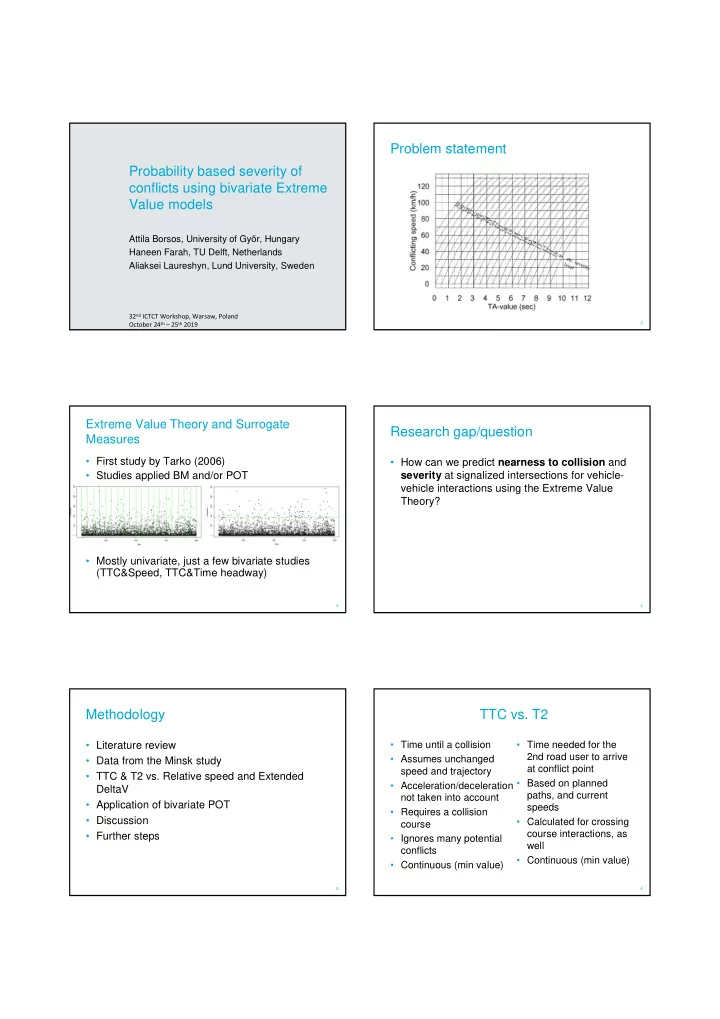
Problem statement

3

Extreme Value Theory and Surrogate Measures

  • First study by Tarko (2006)
  • Studies applied BM and/or POT
  • Mostly univariate, just a few bivariate studies

(TTC&Speed, TTC&Time headway)

4

Research gap/question

  • How can we predict nearness to collision and

severity at signalized intersections for vehicle- vehicle interactions using the Extreme Value Theory?

5

Methodology

  • Literature review
  • Data from the Minsk study
  • TTC & T2 vs. Relative speed and Extended

DeltaV

  • Application of bivariate POT
  • Discussion
  • Further steps

6

TTC vs. T2

  • Time until a collision
  • Assumes unchanged

speed and trajectory

  • Acceleration/deceleration

not taken into account

  • Requires a collision

course

  • Ignores many potential

conflicts

  • Continuous (min value)
  • Time needed for the

2nd road user to arrive at conflict point

  • Based on planned

paths, and current speeds

  • Calculated for crossing

course interactions, as well

  • Continuous (min value)
slide-2
SLIDE 2

7

Relative speed / Extended DeltaV

  • speed of a moving

vehicle relative to another moving vehicle

  • takes into account

speeds only

  • change of the velocity

vector by a road user during a crash

  • takes into account

vehicle masses, speeds and angle

  • highest of the two is

used

8

Case

  • Two-phase signalized intersection in Minsk
  • 32 PDO crashes (5 straight-left turn) 1999-2009
  • Recordings for 2 days (6AM – 9PM)
  • Straight moving – left turning interactions
  • Subsets for indicators

– TTC: n=193 – T2: n=789

9

CDFs

10

Severity vs. probability based risk levels

TTCmin or T2min (s) Relative speed or Delta-V0 (m/s) Severity levels Severity levels

u1 u2

R1,1 R1,1 R1,0 R1,0 R0,1 R0,1 R0,0 R0,0

11

Modeling – focusing on R1,1

Threshold selection (spectral measure plot + univariate POT plots) Bivariate GPD with logistic distribution (other distr.s tested) Copula (entire range of data + univariate POT) Risk levels Risk levels Modeling dependence and marginal distributions separately Modeling dependence and marginal distributions simultaneously

12

Bivariate POT

Marginal distributions

  • excesses above threshold (u) have a Generalized

Pareto Distribution (GPD) with two parameters, the shape and the scale parameters Dependence (parametric – logistic)

  • dependence parameter (α)
slide-3
SLIDE 3

13

Dependence

14

Bivariate GPD results

  • Threshold selection

– e.g. TTCmin & rel. speed (4s and 15m/s) – e.g. T2min & rel. speed (2s and 18m/s)

  • Dependence

– TTCmin & rel. speed or Delta-V0: 0.746 & 0.897 – T2min & rel. speed or Delta-V0: 0.999 both – Overall: there is weak or no dependence between temporal and speed related indicators

15

Bivariate GPD results

  • Logistic distribution performs well
  • Probability based risk levels
  • Validation (?)

16

Severity levels

  • What is known
  • What is unknown

u1

TTCmin or T2min (s) Relative speed or Delta- V0 (m/s) Severity levels Severity levels

u2

R1,1 R1,1 R1,0 R1,0 R0,1 R0,1 R0,0 R0,0 17

Severity combined with risk levels

u1

TTCmin or T2min (s) Relative speed or Delta- V0 (m/s) Severity levels Severity levels

u2

R1,1 R1,1 R1,0 R1,0 R0,1 R0,1 R0,0 R0,0 18

How about the other 3 regions?

  • Empirical copula (TTC-relative speed)
slide-4
SLIDE 4

19

How about the other 3 regions?

  • Empirical copula (T2-relative speed)

20

Conclusions

  • No or weak dependence – vehicles getting closer

do not show high relative speed or Delta-V

  • Crash severity distribution can be constructed –

validation even more problematic

  • Shape of empirical CDFs are different – steeper

for crossing course T2

  • No differences found between relative speed and

Extended DeltaV

  • Resulting risk levels can be combined with

severity levels

21

Further research

  • Validation – crash severity distribution

– Video based accident data for longer period – Speeds at collision

  • Bivariate models

– Research on a dataset where Swedish TCT plane is available, or – Construct the severity lines first for other variable pairs

  • Other interactions
  • Threshold selection

Thank you!