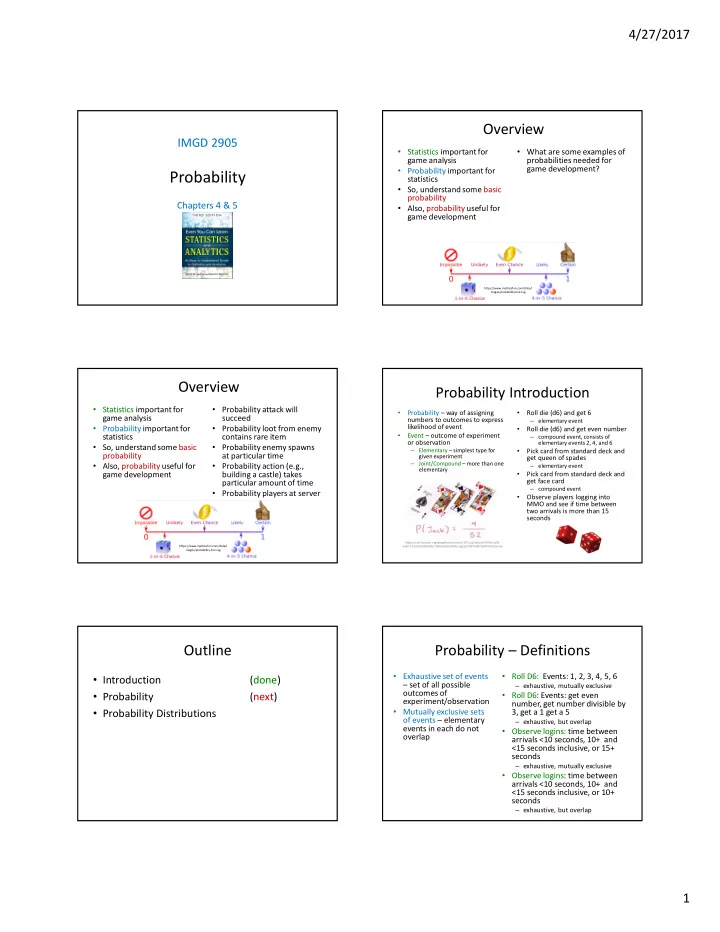
Probability statistics So, understand some basic probability - - PDF document

probability
SMART_READER_LITE
LIVE PREVIEW

Probability statistics So, understand some basic probability - - PDF document

4/27/2017 Overview IMGD 2905 Statistics important for What are some examples of game analysis probabilities needed for Probability important for game development? Probability statistics So, understand some basic probability


slide-1
SLIDE 1

4/27/2017 1

Probability

IMGD 2905

Chapters 4 & 5

Overview

  • Statistics important for

game analysis

  • Probability important for

statistics

  • So, understand some basic

probability

  • Also, probability useful for

game development

  • What are some examples of

probabilities needed for game development?

https://www.mathsisfun.com/data/i mages/probability-line.svg

Overview

  • Statistics important for

game analysis

  • Probability important for

statistics

  • So, understand some basic

probability

  • Also, probability useful for

game development

  • Probability attack will

succeed

  • Probability loot from enemy

contains rare item

  • Probability enemy spawns

at particular time

  • Probability action (e.g.,

building a castle) takes particular amount of time

  • Probability players at server

https://www.mathsisfun.com/data/i mages/probability-line.svg

Probability Introduction

  • Probability – way of assigning

numbers to outcomes to express likelihood of event

  • Event – outcome of experiment
  • r observation

– Elementary – simplest type for given experiment – Joint/Compound – more than one elementary

  • Roll die (d6) and get 6

– elementary event

  • Roll die (d6) and get even number

– compound event, consists of elementary events 2, 4, and 6

  • Pick card from standard deck and

get queen of spades

– elementary event

  • Pick card from standard deck and

get face card

– compound event

  • Observe players logging into

MMO and see if time between two arrivals is more than 15 seconds

https://cdn.kastatic.org/googleusercontent/Z0TuLq2KolavsrfDXSbLqi0S- wnlCrC13cKGG68wK9ljrTiXzRqvfq7IpWNzcwgzlpEOI8YmMafp4K4zO0sanvXu

Outline

  • Introduction

(done)

  • Probability

(next)

  • Probability Distributions

Probability – Definitions

  • Exhaustive set of events

– set of all possible

  • utcomes of

experiment/observation

  • Mutually exclusive sets
  • f events – elementary

events in each do not

  • verlap
  • Roll D6: Events: 1, 2, 3, 4, 5, 6

– exhaustive, mutually exclusive

  • Roll D6: Events: get even

number, get number divisible by 3, get a 1 get a 5

– exhaustive, but overlap

  • Observe logins: time between

arrivals <10 seconds, 10+ and <15 seconds inclusive, or 15+ seconds

– exhaustive, mutually exclusive

  • Observe logins: time between

arrivals <10 seconds, 10+ and <15 seconds inclusive, or 10+ seconds

– exhaustive, but overlap

slide-2
SLIDE 2

4/27/2017 2

Probability – Definition

  • Probability – likelihood of event to occur, measured by ratio
  • f favorable cases to unfavorable cases
  • Set of rules that probabilities must follow

– Probabilities must be between 0 and 1 (but often written/said as percent) – Probabilities of set of exhaustive, mutually exclusive events must add up to 1

  • e.g., D6: events 1, 2, 3, 4, 5, 6. Probability of 1/6th to each

 legal set of probabilities

  • e.g., D6: events 1, 2, 3, 4, 5, 6. Probability of ½ to 1, ½ to 2,

and 0 to all the others

 Also legal set of probabilities – Not how honest d6’s behave in real life!

So, how to assign probabilities?

Assigning Probabilities

  • Classical (by theory)

– In many cases, exhaustive, mutually exclusive outcomes equally likely  assign each outcome probability of 1/n – e.g., d6: 1/6, Coin: prob heads ½, tails ½, Cards: pick Ace 1/13

  • Empirically (by observation)

– Obtain data through measuring/observing – e.g., Watch how often people play League of Legends in lab versus some other game. Say, 30% LoL. Assign that as probability

  • Subjective (by hunch)

– Based on expert opinion or other subjective method – e.g., e-sports writer says probability Team SoloMid (League team) will win World Championship is 25%

Rules About Probabilities (1 of 2)

  • Complement: A an event, event “A does not
  • ccur” called complement of A, denoted A’

P(A’) = 1 - P(A) – e.g., d6: P(6) = 1/6, complement is P(6’) and probability of not 6 is 1-1/6, or 5/6 – Note: when using p, complement is often q

  • Mutually exclusive: Have no simple outcomes

in common – can’t both occur in same experiment

P(A or B) = P(A) + P(B) – e.g., d6: P(3 or 6) = P(3) + P(6) = 1/6 + 1/6 = 2/6

Rules About Probabilities (2 of 2)

  • Independence: One occurs doesn’t affect probability that
  • ther occurs

– e.g., 2d6: A= die 1 get 5, B= die 2 gets 6. Independent, since result of one roll doesn’t affect roll of other – Probability both occur P(A and B) = P(A) x P(B) – e.g., 2d6: prob of “snake eyes” is P(1) x P(1) = 1/6 x 1/6 = 1/36

  • Not independent: One occurs affects probability that other
  • ccurs

– Probability both occur P(A and B) = P(A) x P(B | A)

  • Where P(B | A) means the prob B given A happened

– e.g., MMO has 10% mages, 40% warriors, 80% Boss defeated. Probability Boss fights mage and is defeated? – You might think that = P(mage) x P(defeat B) = .10 * .8 = .08 – But likely not independent. P(defeat B | mage) < 80%. So, need not-independent formula P(mage)* P(defeat B | mage)

Probability Example

  • Probability drawing King?

Probability Example

  • Probability drawing King?

P(K) = ¼

  • Draw, put back. Now?
slide-3
SLIDE 3

4/27/2017 3

Probability Example

  • Probability drawing King?

P(K) = ¼

  • Draw, put back. Now?

P(K) = ¼

  • Probability not King?

Probability Example

  • Probability drawing King?

P(K) = ¼

  • Draw, put back. Now?

P(K) = ¼

  • Probability not King?

P(K’) = 1-P(K) = ¾

  • Draw, put back. 2 Kings?

Probability Example

  • Probability drawing King?

P(K) = ¼

  • Draw, put back. Now?

P(K) = ¼

  • Probability not King?

P(K’) = 1-P(K) = ¾

  • Draw, put back. 2 Kings?

Probability Example

  • Probability drawing King?

P(K) = ¼

  • Draw, put back. Now?

P(K) = ¼

  • Probability not King?

P(K’) = 1-P(K) = ¾

  • Draw, put back. 2 Kings?

P(K) x P(K) = ¼ x ¼ = 1/16

  • Draw. King or Queen?

Probability Example

  • Probability drawing King?

P(K) = ¼

  • Draw, put back. Now?

P(K) = ¼

  • Probability not King?

P(K’) = 1-P(K) = ¾

  • Draw, put back. 2 Kings?

P(K) x P(K) = ¼ x ¼ = 1/16

  • Draw. King or Queen?

P(K or Q) = P(K) + P(Q) = ¼ + ¼ = ½

Probability Example

  • Probability drawing King?

P(K) = ¼

  • Draw, put back. Now?

P(K) = ¼

  • Probability not King?

P(K’) = 1-P(K) = ¾

  • Draw, put back. 2 Kings?

P(K) x P(K) = ¼ x ¼ = 1/16

  • Draw. King or Queen?

P(K or Q) = P(K) + P(Q) = ¼ + ¼ = ½

  • Draw, put back. Not 2

Kings?

slide-4
SLIDE 4

4/27/2017 4

Probability Example

  • Probability drawing King?

P(K) = ¼

  • Draw, put back. Now?

P(K) = ¼

  • Probability not King?

P(K’) = 1-P(K) = ¾

  • Draw, put back. 2 Kings?

P(K) x P(K) = ¼ x ¼ = 1/16

  • Draw. King or Queen?

P(K or Q) = P(K) + P(Q) = ¼ + ¼ = ½

  • Draw, put back. Not 2

Kings?

P(K’) x P(K’) = ¾ x ¾ = 9/16

  • Draw, don’t put back.

Not 2 Kings?

Probability Example

  • Probability drawing King?

P(K) = ¼

  • Draw, put back. Now?

P(K) = ¼

  • Probability not King?

P(K’) = 1-P(K) = ¾

  • Draw, put back. 2 Kings?

P(K) x P(K) = ¼ x ¼ = 1/16

  • Draw. King or Queen?

P(K or Q) = P(K) + P(Q) = ¼ + ¼ = ½

  • Draw, put back. Not 2

Kings?

P(K’) x P(K’) = ¾ x ¾ = 9/16

  • Draw, don’t put back.

Not 2 Kings?

P(K’) x P(K’ | K’) = ¾ x 2/3 = 6/12 = ½

  • Draw, don’t put back.

King 2nd card?

Probability Example

  • Probability drawing King?

P(K) = ¼

  • Draw, put back. Now?

P(K) = ¼

  • Probability not King?

P(K’) = 1-P(K) = ¾

  • Draw, put back. 2 Kings?

P(K) x P(K) = ¼ x ¼ = 1/16

  • Draw. King or Queen?

P(K or Q) = P(K) + P(Q) = ¼ + ¼ = ½

  • Draw, put back. Not 2

Kings?

P(K’) x P(K’) = ¾ x ¾ = 9/16

  • Draw, don’t put back.

Not 2 Kings?

P(K’) x P(K’ | K’) = ¾ x 2/3 = 6/12 = ½

  • Draw, don’t put back.

King 2nd card?

P(K’) x P(K | K’) = ¾ x ⅓ = 3/12 = ¼

Outline

  • Intro

(done)

  • Probability

(done)

  • Probability Distributions

(next)

Probability Distributions

  • Probability distribution –

values and likelihood of those values that random variable can take

  • Why? If can model

mathematically, can use to predict occurrences

– e.g., probability slot machine pays out on given day – e.g., probability game server hosts player today – e.g., probability certain game mode is chosen by player – Also, some statistical techniques for some distributions only

https://goo.gl/jqomFI

Types discussed: Uniform (discrete) Binomial (discrete) Poisson (discrete) Normal (continuous)

Uniform Distribution

  • “So what?”
  • Can use known

formulas

Mean = (1 + 6) / 2 = 3.5 Variance = ((6 – 1 + 1)2 – 1)/12 = 2.9 Std Dev = sqrt(Variance) = 1.7

slide-5
SLIDE 5

4/27/2017 5 Binomial Distribution Example (1 of 3)

  • Suppose toss 3 coins
  • Random variable

X = number of heads

  • Want to know probability
  • f exactly 2 heads

P(X=2) = ? How to assign probabilities?

Binomial Distribution Example (1 of 3)

  • Suppose toss 3 coins
  • Random variable

X = number of heads

  • Want to know probability
  • f exactly 2 heads

P(X=2) = ? How to assign probabilities?

  • Could measure (empirical)

– Q: how?

  • Could use “hunch”

(subjective)

– Q: what do you think?

  • Could use theory

(classical)

– Math using our probability rules (not shown) – Enumerate (next)

All equally likely (p is 1/8 for each)  P(HHT) + P(HTH) + P(THH) = 3/8

http://web.mnstate.edu/peil/MDEV102/U3/S25/Cartesian3.PNG

Can draw histogram of number of heads

Binomial Distribution Example (2 of 3)

http://www.mathnstuff.com/math/spoken/here/2class/90/binom2.gif

Binomial Distribution Example (3 of 3)

These are all binomial distributions

Binomial Distribution (1 of 2)

  • In general, any number of

trials (n) & any probability

  • f successful outcome (p)

(e.g., heads)

  • Characteristics of

experiment that gives random number with binomial distribution:

– Experiment consists of n identical trials. – Each trial results in only two possible outcomes, S or F – Probability of S each trial is same, denoted p – Trials are independent – Random variable of interest (X) is number of S’s in n trials

http://www.vassarstats.net/textbook/f0603.gif

Binomial Distribution (2 of 2)

  • “So what?”
  • Can use known formulas

http://www.s-cool.co.uk/gifs/a-mat-sdisc-dia12.gif http://www.s-cool.co.uk/gifs/a-mat-sdisc-dia08.gif

Excel: binom.dist() – 2 heads, 3 flips =binom.dist(2,3,0.5,FALSE) =0.375 (i.e., 3/8)

slide-6
SLIDE 6

4/27/2017 6

Poisson Distribution

  • Distribution of probability of events occurring in

certain interval (broken into units)

– Interval can be time, area, volume, distance – e.g., number of players arriving at server lobby in 5- minute period between noon-1pm

  • Requires
  • 1. Probability of event same for all units
  • 2. Number of events in one unit independent of

number of events in any other unit

  • 3. Events occur singly (not simultaneously). In other

words, as unit gets smaller, probability of two events

  • ccurring approaches 0

Poisson Distributions?

Not Poisson

  • Number of people arriving at

restaurant during dinner hour

– People frequently arrive in groups

  • Number of students register

for course in BannerWeb per hour on first day of registration

– Prob not equal – most register in first few hours – Not independent – if too many register early, system crashes

Probably Poisson

  • Number of logins to MMO

during prime time

  • Number of groups arriving

at restaurant during dinner hour

  • Number of defects (bugs)

per 100 lines of code

  • People arriving at cash

register (if they shop individually) Phrase people use is “random arrivals”

Poisson Distribution

  • Distribution of probability of events occurring

in certain interval

http://www.dummies.com/education/math/business-statistics/how-to-compute-poisson-probabilities/

Poisson Distribution Example

  • Number of games student plays per day averages
  • ne per day
  • Number of games played per day independent of

all other days

  • Can only play 1 game at a time
  • What’s probability of playing two games next

day?

  • In this case, the value of λ = 1

Poisson Distribution

  • “So what?”  Known formulas
  • Mean

= λ

  • Variance = λ
  • Std Dev = sqrt (λ)

Excel: poisson.dist()

1 game per day, chance for 2 = poisson.dist(2,1,false) = 0.18394

Outline

  • Intro

(done)

  • Probability

(done)

  • Probability Distributions

– Discrete (done)

So far random variable could take only discrete set of values Q: What does that mean? Q: What other distributions might we consider?

slide-7
SLIDE 7

4/27/2017 7

Outline

  • Intro

(done)

  • Probability

(done)

  • Probability Distributions

– Discrete (done) – Continuous (next)

Continuous Distributions

  • Many random variables are

continuous

– e.g., recording time (time to perform service) or measuring something (height, weight, strength)

  • For continuous, doesn’t

make sense to talk about P(X=x)  continuum of possible values for X

– Mathematically, if all non- zero, total probability infinite (this violates our rule)

  • So, continuous distributions

have probability density, f(x)  How to use to calculate probabilities?

  • Don’t care about specific

values

– e.g., P(Height = 60.1946728163 inches)

  • Instead, ask about range of

values

– e.g., P(59.5 < X < 60.5)

  • Uses calculus (integrate

area under curve) (not shown here)

What continuous distribution is especially important?

Continuous Distributions

  • Many random variables are

continuous

– e.g., recording time (time to perform service) or measuring something (height, weight, strength)

  • For continuous, doesn’t

make sense to talk about P(X=x)  continuum of possible values for X

– Mathematically, if all non- zero, total probability infinite (this violates our rule)

  • So, continuous distributions

have probability density, f(x)  How to use to calculate probabilities?

  • Don’t care about specific

values

– e.g., P(Height = 60.1946728163 inches)

  • Instead, ask about range of

values

– e.g., P(59.5 < X < 60.5)

  • Uses calculus (integrate

area under curve) (not shown here)

What continuous distribution is especially important?  The Normal Distribution

Normal Distribution (1 of 2)

  • “Bell-shaped” or “Bell-curve”

– Distribution from -∞ to +∞

  • Symmetric
  • Mean, median, mode all

same

– Mean determines location, standard deviation determines “width”

  • Super important!

– Lots of distributions follow normal (“bell curve”) – Basis for inferential statistics (e.g., statistical tests) – “Bridge” between probability and statistics Aka “Gaussian” distribution

https://www.mathsisfun.com/data/images/normal-distribution-2.svg

+∞

50% area to right 50% area to left

Normal Distribution (2 of 2)

  • Many normal

distributions

  • However, “the” normal

distribution refers to standard normal

– Subtract mean (μ) – Divide by standard deviation (σ)

green - mean -3, std dev 0.5 red - mean 0, std dev 1 black - mean 2, std dev 3

=norm.dist()

http://images.slideplayer.com/10/2753952/slides/slide_2.jpg

Standard Normal Distribution

  • Standardize

– Subtract mean – Divide by standard deviation

  • Mean μ = 0
  • Standard Deviation σ = 1
  • Total area under curve = 1

– Sounds like probability!

Use to predict how likely an observed sample is given a population mean

slide-8
SLIDE 8

4/27/2017 8

http://ci.columbia.edu/ci/premba_test/c0331/s6/s6_4.html

Using the Standard Normal

  • Suppose League of

Legends Champion released once every 24 days on average, standard deviation of 3 days

  • What is the probability

Champion released 30+ days?

  • x = 30, μ = 24, σ = 3

Z = (x - μ) / σ = (30 - 24) / 3 = 2

  • Want to know P(Z > 2)

Use table (Z-table). Or Empirical Rule?

http://ci.columbia.edu/ci/premba_test/c0331/s6/s6_4.html

Using the Standard Normal

  • Suppose League of

Legends Champion released once every 24 days on average, standard deviation of 3 days

  • What is the probability

Champion released 30+ days?

  • x = 30, μ = 24, σ = 3

Z = (x - μ) / σ = (30 - 24) / 3 = 2

  • Want to know P(Z > 2)

Use table (Z-table). Or Empirical Rule?  5% / 2 = 2.5% likely (actual is 2.28%)

=norm.dist(x,mean,stddev,false) =norm.dist(30,24,3,false)

Test for Normality

  • Why?

– Use some inferential statistics (parametric tests) – Can use Empirical Rule

  • How? Several ways. One:

– Normal probability plot – graphical technique to see if data set is approximately normally distributed

Normality Testing with a Histogram

  • Use histogram shape to look for “bell curve”

http://2.bp.blogspot.com/_g8gh7I4zSt4/TR85eGJlMfI /AAAAAAAAAQs/PaOHJsjonPM/s1600/histo.JPG http://seankross.com/img/biqq.png

Yes No

Normality Testing with a Histogram

Q: What distributions are these from? Any normal?

http://www.sascommunity.org/planet/blog/category/statistical-thinking/

Normality Testing with a Histogram

They are all from normal distribution! Suffer from:

  • Binning (not continuous)
  • Few samples (15)

http://www.sascommunity.org/planet/blog/category/statistical-thinking/

slide-9
SLIDE 9

4/27/2017 9 Normality Testing with a Quantile- Quantile Plot

  • Quantiles of one

versus another

  • If line  same

distribution

  • 1. Order data
  • 2. Compute Z

scores (normal)

  • 3. Plot data (y-

axis) versus Z (x-axis)

  • Normal?  line

https://goo.gl/rLLSIQ

Quantile-Quantile Plot Example

  • Do the following values come from a normal

distribution?

7.19, 6.31, 5.89, 4.5, 3.77, 4.25, 5.19, 5.79, 6.79

  • 1. Order data
  • 2. Compute Z scores
  • 3. Plot data versus Z

http://www.statisticshowto.com/q-q-plots/

Quantile-Quantile Plot Example – Order Data

Unordered 7.19 6.31 5.89 4.50 3.77 4.25 5.19 5.79 6.79 Ordered (low to high) 3.77 4.25 4.50 5.19 5.89 5.79 6.31 6.79 7.19

http://www.statisticshowto.com/q-q-plots/

N = 9 data points

Quantile-Quantile Plot Example – Compute Z scores

http://www.statisticshowto.com/q-q-plots/

Divide into N+1 = 10 10% = ? 20% = ? 30% = ? 40% = ? 50% = 0 60% = ? 70% = ? 80% = ? 90% = ?

Lookup in Z-table

Want Z-score for that segment

Z-Table

10% = -1.28 20% = -0.84 30% = -0.52 40% = -0.25 50% = 0 60% = 0.25 70% = 0.52 80% = 0.84 90% = 1.28

e.g., 80%?

  • Tells what cumulative percentage of the standard normal

curve is under any point (Z-score). Or, P(-∞ to Z)

(Note: Above for positive Z-scores – also negative tables, or subtract 0.5) =NORMSINV(area) – provide Z for area under standard normal curve =NORMSINV(.80) =0.841621

Quantile-Quantile Plot Example – Compute Z scores

10% = -1.28 20% = -0.84 30% = -0.52 40% = -0.25 50% = 0 60% = 0.25 70% = 0.52 80% = 0.84 90% = 1.28

(Only some points shown)

slide-10
SLIDE 10

4/27/2017 10 Quantile-Quantile Plot Example – Plot

Linear?  Normal

http://www.statisticshowto.com/q-q-plots/

Quantile-Quantile Plots in Excel

https://i2.wp.com/www.real-statistics.com/wp-content/uploads/2012/12/qq-plot-normality.jpg

  • Mostly, a manual process. Do as per above.
  • Example of step by step process (with spreadsheet):

http://facweb.cs.depaul.edu/cmiller/it223/normQuant.html

Examples of Normality Testing with a Quantile-Quantile Plot

http://d2vlcm61l7u1fs.cloudfront.net/media%2Fb95%2Fb953e7cd-31c3-45b0-a8ec-03b0e81c95d1%2Fphp2Y86od.png