Probabilistic Passphrase Cracking Luc Gommans Radically Open - - PowerPoint PPT Presentation

probabilistic passphrase cracking
SMART_READER_LITE
LIVE PREVIEW

Probabilistic Passphrase Cracking Luc Gommans Radically Open - - PowerPoint PPT Presentation

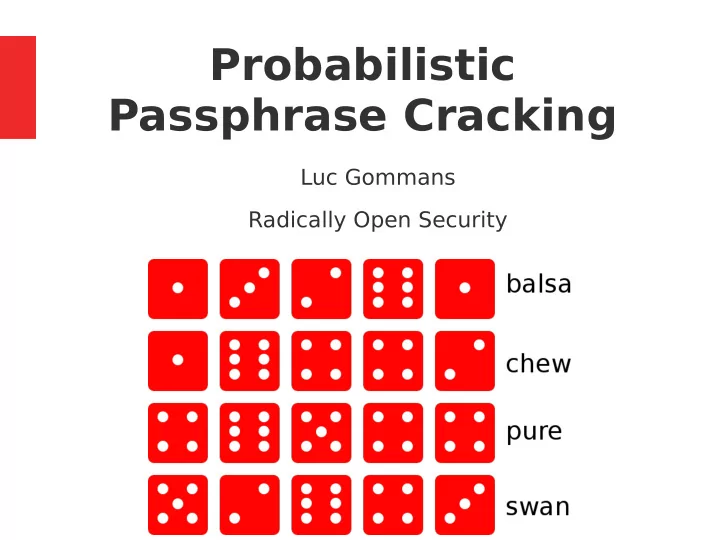
Probabilistic Passphrase Cracking Luc Gommans Radically Open Security Contents 1. Introduction 2. Prior Work 3. Research Question 4. Methods 5. Results 6. Conclusions 7. Future work 2 What are passphrases? balsa chew pure swan I


slide-1
SLIDE 1

Probabilistic Passphrase Cracking

Luc Gommans Radically Open Security

slide-2
SLIDE 2

2

Contents

  • 1. Introduction
  • 2. Prior Work
  • 3. Research Question
  • 4. Methods
  • 5. Results
  • 6. Conclusions
  • 7. Future work
slide-3
SLIDE 3

3

What are passphrases?

  • balsa chew pure swan
  • I have got a nice bike
slide-4
SLIDE 4

4

Prior Work

  • 2012 Labrande

Hybrid dictionary attack

  • 2016 Sparell and Simovits

Markov chains

  • 2017 Gaastra, Gijtenbeek and Gommans

Using lyrics and famous quotes

slide-5
SLIDE 5

5

Research Question

How can software efciently generate likely passphrases, to be used in passphrase cracking?

  • Efcient:

– Computational power – RAM – Storage

  • Likely:

– Results

slide-6
SLIDE 6

6

Contribution

  • Implement a new

method

  • Compare diferent methods

– Make previous work

directly comparable

slide-7
SLIDE 7

7

Hybrid dictionary attack

  • Reproduced Labrande‘s work

– Training dataset – Efectiveness comparison

  • Dictionary of phrases + sets of rules

– Lowercase all, remove spaces, etc.

slide-8
SLIDE 8

8

Probabilistic Method Selection

  • Markov chains

done by Sparell and Simovits

  • Probabilistic Context-Free Grammar

applied to passwords successfully

  • N-grams

popular in text prediction

slide-9
SLIDE 9

9

Context-Free Grammar

S → NP VP NP → Det N | W VP → V NP W → I | he | she | Joe Det → a | the | my | his N → elephant | cat | jeans | suit V → kicked | followed | shot

  • I followed Joe
  • a cat shot my elephant
slide-10
SLIDE 10

10

Probabilistic Context-Free Grammar

  • NP → 0.7(Det N) | 0.3(W)
  • Generate probabilities and rules based on texts

– Word classifcation database

slide-11
SLIDE 11

11

N-grams

  • „have we lost or have we won“ n=2

– 2 have we – 1 we lost – 1 lost or – 1 or have – 1 we won

→ have we won

slide-12
SLIDE 12

12

N-grams

  • Generated weighted statistics from:

– Wikipedia articles – Previously cracked passphrases

  • Cracking by taking the most frequently occurring

n-gram and fnding continuations

slide-13
SLIDE 13

13

Results Efectiveness

  • Hybrid dictionary (Labrande)

– 4.2M phrases of Korelogic (200k of ≥16 characters)

  • Hybrid dictionary (ours)

– 2.3M phrases of Korelogic (147k of ≥16 characters) – 1.3M phrases of LinkedIn (13k of ≥16 characters)

  • Markov chains

– 25k phrases of LinkedIn (384 of ≥16 characters)

  • N-grams

– 835k phrases of Korelogic (33k of ≥16 characters) – 482k phrases of LinkedIn (4k of ≥16 characters)

slide-14
SLIDE 14

14

Results Efciency

  • Hybrid dictionary

– Speed: >10 000 000 pps (phrases per second) – Storage: medium (690MiB)

  • Markov chains

– Speed: 2 500–22 500 pps – Storage: unknown

  • N-grams

– Speed: 3 300 000 pps – Storage: low-medium (47-464MiB)

slide-15
SLIDE 15

15

Conclusions

  • Hybrid dictionary is efcient and efective
  • N-grams most efective when length of phrase ≤n
slide-16
SLIDE 16

16

Future work

  • Better language modeling using n-grams
  • Probabilistic Context-Free Grammar
  • Neural Networks
slide-17
SLIDE 17

17

Thank you

  • Thanks to Radically Open Security
  • See our git repository for GPLv3 licensed:

– N-gram phrase generator & models (n=2 and n=3) – Phrase dictionary & rules – Slides and preview of the paper

github.com/radicallyopensecurity/passphrase-cracking

  • Questions?