
SLIDE 1
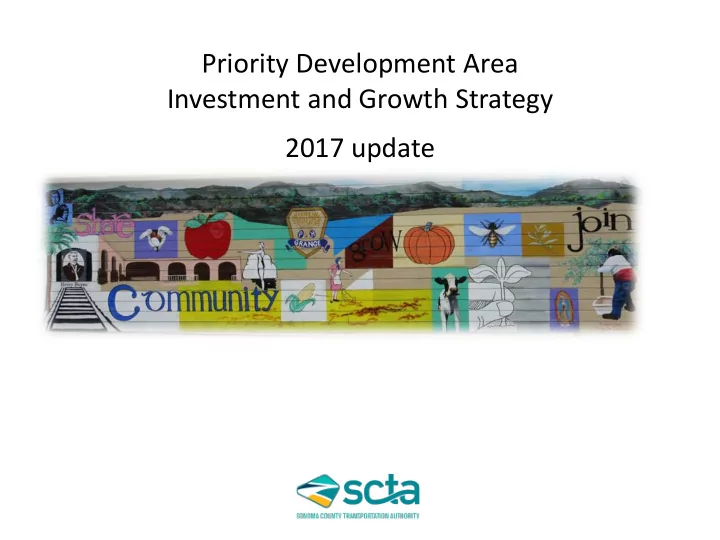
Priority Development Area Investment and Growth Strategy 2017 - - PowerPoint PPT Presentation
Priority Development Area Investment and Growth Strategy 2017 update What is the PDA IGS? A requirement by MTC/ABAG as part of the One Bay Area Grant (OBAG) program. Opportunity to review status of PDAs Update on Station Area and PDA
Santa Rosa’s four PDAs are located along corridors linked to the SMART stations. MTC/ABAG expect Santa Rosa PDAs to add 13,000 housing units and 4,700 jobs by 2040. Windsor’s Town Green PDA, adjacent to the SMART Station, is a hub for economic and community activities; helping to make the downtown a more walkable, mixed-use environment.
Windsor Town Green
Santa Rosa’s Railroad Square
Before and after streetscape improvements in Cloverdale
PDAs in the County’s smaller cities—Cloverdale, Cotati and Windsor near SMART stations, and the Rural Community Investment Area in the Springs —are anticipated to accommodate most new housing and jobs helping protect their character while supporting higher transit ridership and greater housing choices. Infrastructure improvements enhance safety and quality of life in the existing transportation corridors, making them more appealing for future residents.
in every city since the early 1990’s
Agricultural Preservation and Open Space District – ¼ cent sales tax since 1990
Climate Protection Authority in 2009
Specifically, to qualify to be a PDA an area must meet the definition as described in the “Plan Bay Area Application and Guidelines: Priority Development Area Designation”
the recommended area size is 100 acres, which is approximately a ¼ mile radius.
urban growth boundary or limit line if one is established, and has existing or planned infrastructure to support development that will provide or connect to a range of services and amenities that meet the daily needs of residents making non-motorized modes of transportation an option.
density of the selected place type from the Station Area Planning Manual, including affordable units, which can also be a part of a mixed use development that provides other daily services, maximizes alternative modes of travel, and makes appropriate land use connections.
mile around the station), (2) the area served by a bus or bus rapid transit corridor with minimum headways of 20 minutes during peak weekday commute periods, or (3) the area defined as a planned transit station by MTC’s Resolution 3434.
The Springs Rural Community Investment Area (near Sonoma) has a vibrant community and existing density and proximity to services. Current plans for the Springs could accommodate an additional 250 - 700 housing units by 2040.
Bus stop in Sonoma Valley
Unincorporated Sonoma County has designated 6 Rural Community Investment Areas and one Employment Investment Area. These areas are not expected to ever have the densities found in more urban areas, but have existing centralized population centers and services.