Previously: Cauchys Integral Formula and Consequences Theorem - - PowerPoint PPT Presentation

previously cauchy s integral formula and consequences
SMART_READER_LITE
LIVE PREVIEW

Previously: Cauchys Integral Formula and Consequences Theorem - - PowerPoint PPT Presentation

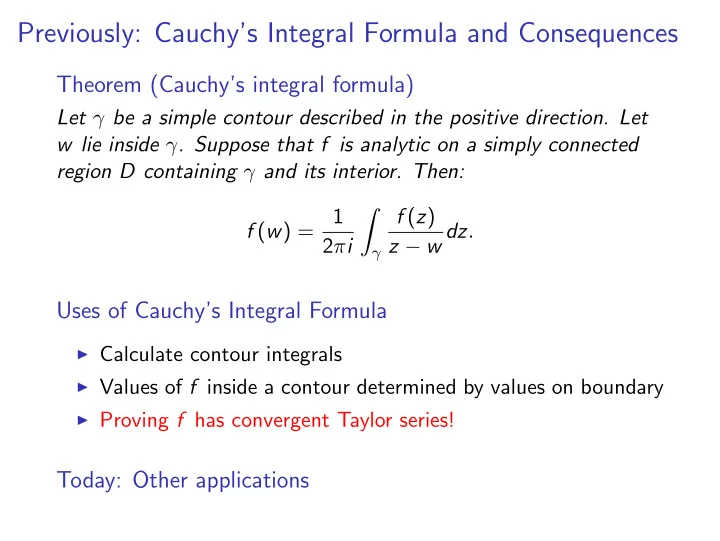
Previously: Cauchys Integral Formula and Consequences Theorem (Cauchys integral formula) Let be a simple contour described in the positive direction. Let w lie inside . Suppose that f is analytic on a simply connected region D


slide-1
SLIDE 1

Previously: Cauchy’s Integral Formula and Consequences

Theorem (Cauchy’s integral formula)

Let γ be a simple contour described in the positive direction. Let w lie inside γ. Suppose that f is analytic on a simply connected region D containing γ and its interior. Then: f (w) = 1 2πi

  • γ

f (z) z − w dz.

Uses of Cauchy’s Integral Formula

◮ Calculate contour integrals ◮ Values of f inside a contour determined by values on boundary ◮ Proving f has convergent Taylor series!

Today: Other applications

slide-2
SLIDE 2

Analytic functions have all derivatives!

Theorem (Cauchy’s Integral formula for the derivatives)

Let γ be a simple contour described in the positive direction. let w be any point inside γ. Suppose f analytic on a simply-connected region D containing γ. Then f (n)(w) = n! 2πi

  • γ

f (z) (z − w)n+1 dz

Proof.

Take

d dw of both sides of CIF. Differentiate inside the integral.

Example

Let γ be the square with vertices 1, i, −1, −i. Evaluate

  • γ

ez zn dz

slide-3
SLIDE 3

Another application of CIF: Liouville’s Theorem

Theorem (Liouville’s Theorem)

A function which is analytic and bounded in the complex plane is a constant.

Proof.

Let a, b ∈ C.

  • 1. Rewrite f (a) − f (b) as an integral around |z| = R using CIF.
  • 2. Use ML to bound |f (a) − f (b)|
  • 3. As R → ∞, the bound goes to 0.

Toy applications of Liouville’s Theorem frequently on exam, and in problem sheets. More excitingly, Liouville’s Theorem can prove the fundamental theorem of algebra.

slide-4
SLIDE 4

Hope you’re excited as I am

slide-5
SLIDE 5

A theorem you’ve long used...

Theorem (Fundamental Theorem of algebra)

Let p(z) be a non-constant polynomial with complex coefficients. Then there is a point w ∈ C such that p(w) = 0.

Proof.

Suppose not, and p(z) has no roots. Then show 1/p(z) is bounded and analytic on C, and apply Liouville’s Theorem. Using induction, it follows that a polynomial of degree n has n roots, counted with multiplicity.

Note

The trick of dividing by a nonzero function appears frequently in applications.