
SLIDE 1 1
Prevention for All
Tracey J. Woodruff, PhD, MPH Program on Reproductive Health and the Environment, UCSF March 12, 2014 EPA/NIEHS Children’s Centers 2014 Webinar Series
(Photo source: http://weekspregnanttips.com)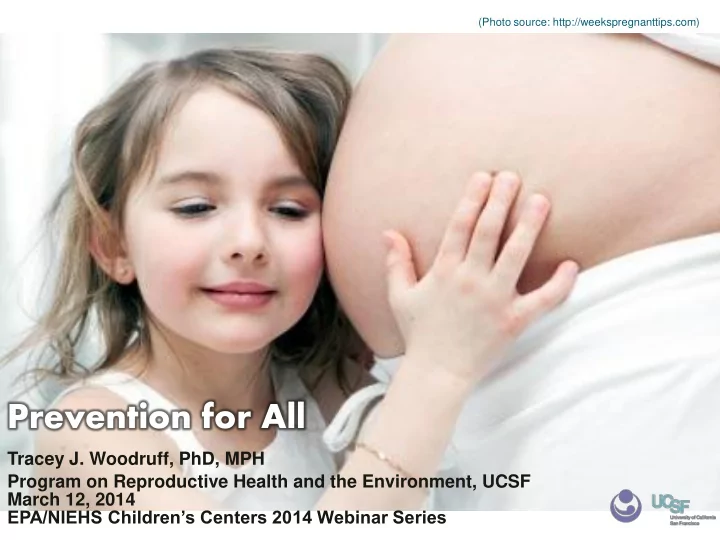
Prevention for All Tracey J. Woodruff, PhD, MPH Program on - - PowerPoint PPT Presentation
(Photo source: http://weekspregnanttips.com) Prevention for All Tracey J. Woodruff, PhD, MPH Program on Reproductive Health and the Environment, UCSF March 12, 2014 EPA/NIEHS Childrens Centers 2014 Webinar Series 1 PRHE Mission: To create a
Prevention for All
Tracey J. Woodruff, PhD, MPH Program on Reproductive Health and the Environment, UCSF March 12, 2014 EPA/NIEHS Children’s Centers 2014 Webinar Series
(Photo source: http://weekspregnanttips.com) Mission: To create a healthier
environment for human reproduction and development by advancing scientific inquiry, clinical care, and health policies that prevent exposures to harmful chemicals in
Our Challenge
Prevalence of chronic conditions among children and youth increased from 1988 to 2006
41988 to 1994 1994 to 2000 2000 to 2006 51.5% 27.8%
↑15
fold
5 Today
80,000 chemical substances registered for use in U.S. commerce 3,000 chemicals manufactured or imported in excess of 1 million pounds 700 new industrial chemicals introduced into commerce each year
6 Everywhere, Everyday, and Everyone
Outdoor environment Workplace Home/Indoor Food supply Personal care products
Toxic Chemicals
in Pregnant Woman in the US
Woodruff TJ, Zota AR, Schwartz JM. Environmental chemicals in pregnant women in the United States: NHANES 2003-2004. Environ Health Perspect. 2011 Jun;119(6):878-85. Epub 2011 Jan 10.
Environmental chemicals can cross the placenta
10ACOG/ASRM Committee Opinion
Woodruff, Zota, Schwartz EHP 2011
98 - 100%
Phthalates
Woodruff, Zota, Schwartz EHP 2011
PFCs
Woodruff, Zota, Schwartz EHP 2011
Pesticides
PBDEs________
human brain cells development
memory, and attention
decrements in IQ – similar to that of lead
(Schreiber et al., 2010, Driscoll et al., 2008, Viberg et al. 2006)
The evidence that links exposure to toxic environmental agents and adverse reproductive and developmental health outcomes is sufficiently robust, and the American College of Obstetricians and Gynecologists and the American Society for Reproductive Medicine join leading scientists and
exposure to toxic environmental agents while addressing the consequences of such exposure.
ACOG/ASRM Committee Opinion
“Environmental exposures can have a profound and lasting impact on the health of our patients and future generations”
ACOG/ASRM Committee Opinion
All exposures are not created equal
Underserved and minority populations disproportionately impacted
More likely to be exposed to higher levels of outdoor and indoor pollutants
ACOG/ASRM Committee Opinion
All exposures are not created equal
Women of reproductive age with occupational exposure to toxic chemicals are highly vulnerable to adverse reproductive health outcomes
Actions Matters – Clinical
http://prhe.ucsf.edu/prhe/toxicmatters.html
ACOG/ASRM Committee Opinion Individual Action Alone is Not Enough
from Washington, Oregon, and California, during the second trimester had detectable:
– Bisphenol A – Mercury – At least four phthalates – At least two and up to 4 perfluorinated chemicals
January 10, 2014
4-methylcyclohexanemethanol (MCHM)
25 Used to decide “safe” level
JANUARY 13 Monday Residents told water is safe to drink
JANUARY 13 Monday 14 Tuesday Residents told water is safe to drink ?
JANUARY 13 Monday 14 Tuesday 15 Wednesday Residents told water is safe to drink ? “CDC recommends - out of an abundance of caution that pregnant women drink bottle water until there are no longer detectable levels
methanol, or MCHM, in the water distribution system. "
January 16 – Company makes other toxicology studies public - based on adult male/female rats
6 Days after the spill
Tip of an Iceberg
~200 chemicals tested for health effects ~3000 chemicals manufactured/imported > 1 million pounds ~700 new chemicals added each year ~62,000 chemicals “grandfathered in” TSCA, not tested
(87,000 chemicals registered for use in the U.S. commerce as of 2006) 33 – Pharmaceuticals must have data to show efficacy and safety prior to use – Do manufactured chemicals have to have data on safety before use?
NO
“… we must shift the burden of proof from the individual health care provider and the consumer to the manufacturers before any chemicals are even released into the environment.” Dr. Jeanne Conry, President ACOG
Linda C. Giudice, MD, PhD, President American Society for Reproductive Medicine and Jeanne C. Conry, MD, PhD, President, American Congress of Obstetricians and Gynecologists – October 2013, Washington, DC 36 Actions Matter – Policy
Zota A.R., et al. 2013 ES&T.10 20 30 40 50 60 70 80 90 100 2006 2008-2009 2011-2012 PBDEs concentration ng/g lipid YEAR
PBDEs in Pregnant Women
June 2006, California State bans PBDEs
Summary
38among pregnant women are ubiquitous
lifespan and generations
toxicants requires improved public policy
Thanks for listening! Questions?