Presenters Rebecca Perkins Board member, Friends of the Jacobus - - PowerPoint PPT Presentation

presenters
SMART_READER_LITE
LIVE PREVIEW

Presenters Rebecca Perkins Board member, Friends of the Jacobus - - PowerPoint PPT Presentation

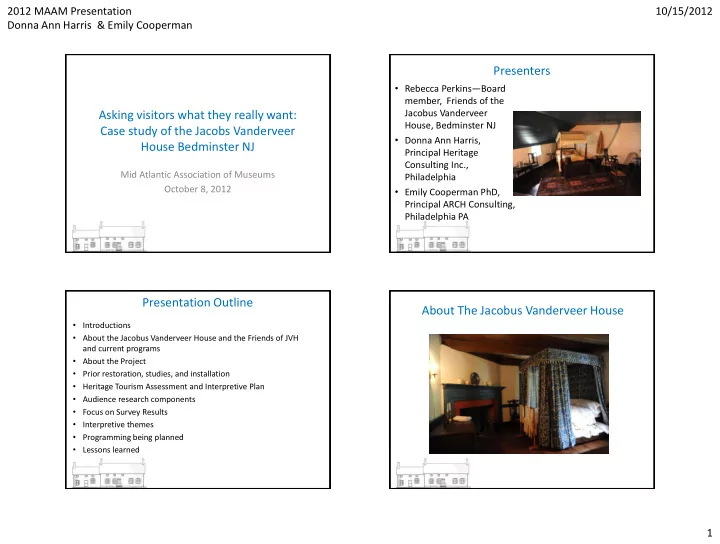
2012 MAAM Presentation 10/15/2012 Donna Ann Harris & Emily Cooperman Presenters Rebecca Perkins Board member, Friends of the Jacobus Vanderveer Asking visitors what they really want: House, Bedminster NJ Case study of the


slide-1
SLIDE 1

2012 MAAM Presentation Donna Ann Harris & Emily Cooperman 10/15/2012 1

Asking visitors what they really want: Case study of the Jacobs Vanderveer House Bedminster NJ

Mid Atlantic Association of Museums October 8, 2012

Presenters

  • Rebecca Perkins—Board

member, Friends of the Jacobus Vanderveer House, Bedminster NJ

  • Donna Ann Harris,

Principal Heritage Consulting Inc., Philadelphia

  • Emily Cooperman PhD,

Principal ARCH Consulting, Philadelphia PA

Presentation Outline

  • Introductions
  • About the Jacobus Vanderveer House and the Friends of JVH

and current programs

  • About the Project
  • Prior restoration, studies, and installation
  • Heritage Tourism Assessment and Interpretive Plan
  • Audience research components
  • Focus on Survey Results
  • Interpretive themes
  • Programming being planned
  • Lessons learned

About The Jacobus Vanderveer House

slide-2
SLIDE 2

2012 MAAM Presentation Donna Ann Harris & Emily Cooperman 10/15/2012 2

Principal Façade as Restored Current Programs

6

Grant Objective

  • A comprehensive heritage tourism assessment,

leading to: – Better understanding of the JVH audience – an interpretive plan and – interpretive products and strategies that will enable us to use the Vanderveer House, our research archive and historic collections to provide higher levels of visitor education and enjoyment

Jacobus Vanderveer House

8

North elevation

slide-3
SLIDE 3

2012 MAAM Presentation Donna Ann Harris & Emily Cooperman 10/15/2012 3

Jacobus Vanderveer House

9

Interior before restoration

Click any image to enlarge the floor plan view.

11

Click any image to enlarge the floor plan view.

slide-4
SLIDE 4

2012 MAAM Presentation Donna Ann Harris & Emily Cooperman 10/15/2012 4

13

Site givens – building restoration

Spaces set up for period room interpretation

14

Click any image to enlarge the floor plan view.

Site givens – building restoration

1813 Wing

15

Site givens – building restoration

Internal reveals

16

slide-5
SLIDE 5

2012 MAAM Presentation Donna Ann Harris & Emily Cooperman 10/15/2012 5

Site givens – building restoration

Accessible entrance

17

Site givens – analysis

  • f significance
  • Major track record
  • f documentation

reaching back to 1935

  • Pointing site

interpretation to 18th century history

  • f house as:
  • Example of building
  • f period (local

history

  • General Knox

18

New Jersey Historic Trust Grant to JVH

19

Project Design

  • 3 Phases:
  • 1. Research

a) Audience Research b) Review of existing research regarding interpretation

  • 2. Interpretive Plan, identify interpretive products
  • 3. Interpretive product implementation

20

slide-6
SLIDE 6

2012 MAAM Presentation Donna Ann Harris & Emily Cooperman 10/15/2012 6

Audience Research Components

  • 1. Historic House Museums

Today presentation

  • 2. Board member visits to

peer sites

  • 3. Current & former Board

member interviews

  • 4. On-line survey
  • 5. Local Partner interviews
  • Need a photo here

21

Audience Research Components

  • 6. Revolutionary War sites

school program site visits

  • 7. Residents focus groups
  • 8. Memo on informal

programming for kids

  • 9. Create matrix of audiences

and programs

  • 10. Create final audience

research report

22

Reach Museum Advisors Research

  • 60% want to visit “on our own” ”self curated

experiences”

  • 59% Talk with costumed interpreters-- historians,

docents” Staff does not direct their visit”

  • 48% want to view objects or object-based exhibits
  • 46% want to attend programs or events
  • Guided tours—only 45% like 55% don’t like guided

tours

Audience Research Findings

  • Audience
  • Board
  • Programming
  • Partnerships
  • Children’s programs
slide-7
SLIDE 7

2012 MAAM Presentation Donna Ann Harris & Emily Cooperman 10/15/2012 7

Findings - Audience

  • The JVH audience is made up of:

– 35-65 year olds, – half with children at home, – women

  • Who have an interest in:

– The history of the American Revolution – Everyday life in the 18th Century – Local history

  • This audience is typical of most house museums

nationwide

Findings – Programming (survey)

  • 1. A knowledgeable guide in specific rooms in the

house to answer questions

  • 2. Shopping events such as antiques markets,

designer showcases & local artists

  • 3. Printed brochures, maps, guides
  • 4. Educational lectures or programs on topics related

to the Vanderveer House

  • 5. Demonstration of crafts, historic cooking or similar

activities by costumed interpreters (not doing/classes)

26

Findings: Programming (survey)

  • 6. Guided tours
  • 7. Historical re-enactments of Revolutionary War life

by costumed interpreters

  • 8. Social events
  • 9. Lectures on antiques and historic objects care
  • 10. Smartphone app with interactive screen-based

features, or similar, handheld device

Findings - Programming

28

slide-8
SLIDE 8

2012 MAAM Presentation Donna Ann Harris & Emily Cooperman 10/15/2012 8

Matrix: Programming/Audience

JVH Audience ** program reserved in advance

Colonial Christmas Dinner** Colonial Christmas Open house Colonial Christmas School Programs** Colonial Christmas Receptions** Colonial BBQ event Antique, crafts, appraisal events Five Generals Tour** Journey to the Past Weekend** Individual tours ** Group tours ** Weekend Guided tours casual visitors Guide on demand Kids hands on tours ** Adult hands on tours ** Curator tours ** Specialized activities** Children's Summer camps** Self guided brochures Fly over video Cell phone tours adults Laminated cards in rooms Room books Room panels Podcasts/Videos Children in school classes Area Public School Fourth and Fifth Grade Classes Area Middle School History classes Area National History Day clubs Area High School History classes Individual undergraduate college students Individual graduate school students MA / PhD Area Parochial and Private School 4 and 5 grade classes Children in non-school settings Home school parents and children grade schools Boy Scout Troops earning merit badges Individual Boy Scout earning merit badges

Making decision on programming

  • Task force formed to identify programming for

coming year

  • 4 audience groups for programming

– Individual adults – Family groups – Children in non-school groups – Specialized groups

  • Voted on top 3 interpretive methods for that

audience

Top programming for 2013

  • Hands on activities for

kids

  • Night at the Museum
  • Summer History Camp
  • Parent/child activities
  • Colonial BBQ
  • Lectures
  • Special Exhibits/Loan

shows

  • Curator tours
  • Self-guided activities
  • Antique, craft and

appraisal events

  • Demonstrations
  • Junior docent program

Creating a year long calendar of events

  • Colonial Christmas

– 2 weekends after Thanksgiving – Gala dinner & Cocktail reception at house – House decorated by interior designers for Christmas – Children’s programming

  • Colonial BBQ summer

event

  • Lecture Series
  • Partner developed

events

– 5 Generals Tour – Fall Fest – Weekend Journey to the Past

slide-9
SLIDE 9

2012 MAAM Presentation Donna Ann Harris & Emily Cooperman 10/15/2012 9

Interpretation at the Jacobus Vanderveer House

33

First Steps: Analysis of Mountain

  • f Documentation
  • Take existing,

extensive documentation

  • Develop “building

block” documents

34

Interpretation – theme development

  • Narratives established by previous efforts:

1: Bedminster and the American Revolution, the Pluckemin Cantonment, Gen. Knox’s headquarters 2: Dutch in the Raritan Valley: the Vanderveer Family in Bedminster Community 3: Dutch, English and American traditions in architecture

35

First Steps: “Building Block” documents

  • Outline of existing theme bases and sub-categories

Sample:

The Vanderveers, Life in the Raritan Valley in the eighteenth and early nineteenth centuries Farming and settlement life in the area in the eighteenth century Character of rural settlement in the Raritan Valley Density and patterns Agriculture and crops Buildings (including JVH House) and architectural traditions How does the house work / how was it used How was it built and how did it change over time What other buildings were there on the property How does it relate to other houses of the period The Vanderveers over three generations in the JVH Dutch-American – the meaning of hybrid culture

slide-10
SLIDE 10

2012 MAAM Presentation Donna Ann Harris & Emily Cooperman 10/15/2012 10

First Steps: “Building Block” documents

  • Timeline

1770 Boston Massacre 1772 Jacob makes his will for his relatively large estate. It first gives money to the Dutch reformed church, but fairly small amounts. Leaves son Lourens (Lawrence) 430 acre "plantation where he now dwels [sic]

  • n," leaves son Elias a 435 acre

plantation "where on I now dwell" and to son Jacobus/James he leaves "the land over the river" - more than 500 undeveloped acres. The Jacobus Vanderveer house will be built on this property. Lucy Flucker sees Henry Knox on military parade 1772-73 House / property development Dendrochonological analysis of timbers and extensive purchases of hardware by Jacobus/James indicate that the Jacobus Vanderveer House was largely constructed 1773 Jacobus/James's buys pewter, cups and saucers, pepper and sugar boxes, needles and tape for his wife Winche (marriage date unknown) Lucy Flucker joins groups of "smart young people" who gather at Knox's bookstore in Cornhill Boston Tea Party 1774 Jacob signs a codicil to his will leaving Jacobus/James an additional 35 acres and "the negro girl called Jeno" instead of Wine. Henry Knox and Lucy Flucker are married in June. He is 24, she is

  • 18. Her parents are unhappy

about the marriage, but acquiesce to it.

First Steps: “Building Block” documents

  • “Cast of Characters” brief biographies

First Steps: “Building Block” documents

  • Interpretive Storyline

– “The Jacobus Vanderveer House tells the story of life in the Bedminster area in the eighteenth and early nineteenth century: the everyday life of Dutch-American settler families, their beliefs and lifeways, and the remarkable events of the Revolutionary War in the area”

  • Outline of Subject Topics. For example:

– The Knoxes and the Pluckemin Cantonment

  • a. Revolutionary War; b. American Military History
  • c. Domestic life; d. Life, sickness, and death for women and

children in the 18th century; e. Women’s education; f. Inherited wealth and elite status

Themes Development

  • Sample theme statements:

“The Vanderveers were people of strong Dutch traditions, belief and ties to community who prospered in the New World and over time became part of the American Melting Pot.” “The Pluckemin Cantonment was a crucial event in the American Revolution and American military history.” “Slavery was a well-entrenched institution in New Jersey in the eighteenth and early nineteenth centuries.”

slide-11
SLIDE 11

2012 MAAM Presentation Donna Ann Harris & Emily Cooperman 10/15/2012 11

Matrix: Connecting Themes to Site

41

Room floor restored for period installation / sense of authenticity "time capsule" space theme 1 (Vanderveers) degree of difficulty/ease of interpretation (1=difficult; 5=easy) Do objects and/or architecture support interpretation of theme 1? Theme 2 (Raritan Valley life) degree of ease Do objects/architecture support interpretation of theme 2? Theme 3 (Slavery) degree of ease Do objects/architecture support interpretation of theme 3? Theme 4 (Pluckemin Cantonment) degree of ease Do objects/architecture support interpretation of theme 4? Theme 5 (Family life) degree of ease Do objects/architecture support interpretation of theme 5? Theme 6 (Knoxes) degree of ease Do objects/architecture support interpretation of theme 6? total score for ease of tour interpretation Interpretive topics Landscape n/a partially no 3 partially 2 no 2 no 2 partially 1 no 1 no 11 JV estate, historic agriculture, Vanderveer holdings and wealth, early development patterns, location of Pluckemin Cantonment, events related to Rev. War in area, role of slavery in agriculture in area House exterior n/a yes no 4 yes 3 yes 1 no 2 partially 1 no 1 no 12 JV estate, Dutch cultural patterns/Dutch traditions in building, history of the property, restoration efforts, acculturation, orientation patterns in 18th century houses, relationship to surroundings Parlor 1 yes yes 5 yes 5 yes 3 slightly 5 yes 4 partially 4 partially 26 Eighteenth century patterns of living, acculturation of Dutch-Americans, lives of the Vanderveers, Knox headquarters and what headquartering was like in rented or borrowed quarters, patterns of life in those headquarters, curator's tour of collection objects Back room (Knox Bedroom) 1 yes yes 2 partially 4 yes 2 slightly 4 partially 5 yes 5 yes 22 Eighteenth century patterns of living, acculturation of Dutch-Americans, lives of the Vanderveers, Knox headquarters, curator's tour of collection objects, lives of Lucy and Henry Knox and their family Entry (South end of Hall) 1 mixed no 4 partially 4 yes 1 no 1 no 1 no 1 no 12 Dutch architecture, history of the house, the way the Vanderveers would have lived in the house, restoration of the house Room Behind Entry (N. end of Hall) 1 mixed no 1 no 1 no 1 no 2 no 1 no 1 no 7 history of the house, the way the Vanderveers would have lived in the house, the use of the house as Knox headquarters Kitchen 1 mixed no 2 no 3 yes 4 partially 3 no 2 partially 1 no 15 18th c. foodways, slavery in NJ, history of the restoration 1813 Parlor 1 mixed no 4 yes 4 yes 1 no 1 no 4 partially 1 no 15 History of the Vanderveer family, acculturation, Federal period style 1813 N. room 1 mixed no 4 yes 4 yes 1 no 1 no 4 partially 1 no 15 History Center 2nd floor hall 2 mixed no 2 partially 2 partially 1 no 1 no 1 no 1 no 8 History of the house 2nd floor E room 2 no no 2 partially 1 no 1 no 1 no 1 no 1 no 7 Event/lecture space; history of the house Ramp hallway 1 no no 1 no 1 no 1 no 4 yes 4 no 4 yes 15 Exhibition space New entry and stair 1 no no 1 no 1 partially 1 no 1 no 1 no 1 no 6 Transition/amenity space

Creating Interpretive Products

  • Create interpretive products that meet goals:
  • 1. Use themes
  • 2. Match organization capacity
  • 3. Work with site constraints and opportunities
  • 4. Address interests of audience

1. Orientation video 2. Room books 3. Self-guiding cards/brochures 4. Tour script that touches on themes and works with site

Lessons Learned

  • Formal school programs will have to wait
  • Volunteer recruitment critical to success
  • Restoration decisions made 10 years ago impact

interpretation today

  • Being open on weekends is difficult
  • Part time staff may be necessary

Thanks!

Donna Ann Harris Principal Heritage Consulting Inc. 422 South Camac Street Philadelphia, PA 19147 215 546 1988 www.heritageconsutlinginc.com donna@heritageconsultinginc.com Emily T. Cooperman, Ph.D., Principal Architectural Research and Cultural History 217 E. Evergreen Ave., Philadelphia, PA 19118 (215) 247-0604 etcooperman@comcast.net