Presenters Increased Access and Patient Erin Raftery RN, BSN, MPH - - - PDF document

presenters
SMART_READER_LITE
LIVE PREVIEW

Presenters Increased Access and Patient Erin Raftery RN, BSN, MPH - - - PDF document

Presenters Increased Access and Patient Erin Raftery RN, BSN, MPH - Erin is a nurse care manager and health coach with Eastern Iowa Health Center (EIHC), a FQHC in Cedar Success in a DPP Through Innovative Rapids, Iowa. She has been with EIHC


slide-1
SLIDE 1

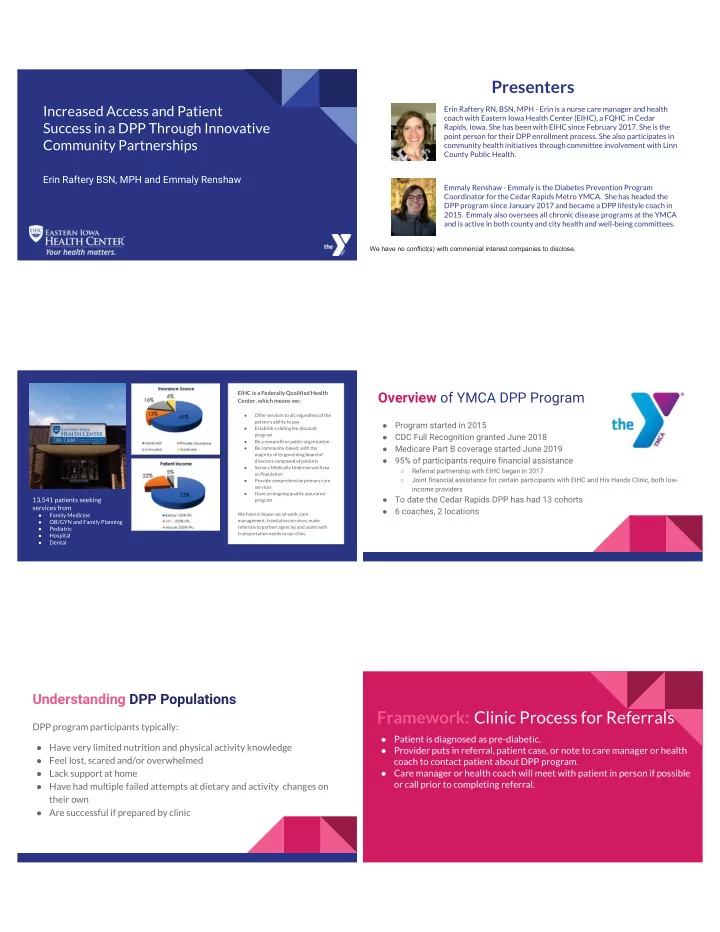
Increased Access and Patient Success in a DPP Through Innovative Community Partnerships

Erin Raftery BSN, MPH and Emmaly Renshaw

Presenters

Erin Raftery RN, BSN, MPH - Erin is a nurse care manager and health coach with Eastern Iowa Health Center (EIHC), a FQHC in Cedar Rapids, Iowa. She has been with EIHC since February 2017. She is the point person for their DPP enrollment process. She also participates in community health initiatives through committee involvement with Linn County Public Health. Emmaly Renshaw - Emmaly is the Diabetes Prevention Program Coordinator for the Cedar Rapids Metro YMCA. She has headed the DPP program since January 2017 and became a DPP lifestyle coach in

  • 2015. Emmaly also oversees all chronic disease programs at the YMCA

and is active in both county and city health and well-being committees.

We have no conflict(s) with commercial interest companies to disclose.

EIHC is a Federally Qualified Health Center, which means we:

  • Offer services to all, regardless of the

person's ability to pay

  • Establish a sliding fee discount

program

  • Be a nonprofit or public organization
  • Be community-based, with the

majority of its governing board of directors composed of patients

  • Serve a Medically Underserved Area
  • r Population
  • Provide comprehensive primary care

services

  • Have an ongoing quality assurance

program We have in house social work, care management, translation services, make referrals to partner agencies and assist with transportation needs to our clinic.

13,541 patients seeking services from

  • Family Medicine
  • OB/GYN and Family Planning
  • Pediatric
  • Hospital
  • Dental

Overview of YMCA DPP Program

  • Program started in 2015
  • CDC Full Recognition granted June 2018
  • Medicare Part B coverage started June 2019
  • 95% of participants require financial assistance

○ Referral partnership with EIHC began in 2017 ○ Joint financial assistance for certain participants with EIHC and His Hands Clinic, both low- income providers

  • To date the Cedar Rapids DPP has had 13 cohorts
  • 6 coaches, 2 locations

Understanding DPP Populations

DPP program participants typically:

  • Have very limited nutrition and physical activity knowledge
  • Feel lost, scared and/or overwhelmed
  • Lack support at home
  • Have had multiple failed attempts at dietary and activity changes on

their own

  • Are successful if prepared by clinic

Framework: Clinic Process for Referrals

  • Patient is diagnosed as pre-diabetic.
  • Provider puts in referral, patient case, or note to care manager or health

coach to contact patient about DPP program.

  • Care manager or health coach will meet with patient in person if possible
  • r call prior to completing referral.
slide-2
SLIDE 2

Framework: Clinic Process for Referrals .

  • If patient shows interest, readiness, or motivation for change we

discuss program fees, potential for scholarship funding if available and the referral process.

  • Patient and provider with assistance from health coach complete the

referral form and an authorization for our electronic referral system.

  • Patient name and date of referral is documented in excel to track and a

patient case (note in chart) is created to document the referral.

The Stages of Change Model

Understanding where your patients are at will help guide your discussion and inform you

  • f their likelihood of being

successful in a DPP program

Five Principles of Motivational Interviewing

  • Express empathy through reflective listening.
  • Develop discrepancy between clients' goals or

values and their current behavior.

  • Avoid argument and direct confrontation.
  • Adjust to client resistance rather than opposing it

directly.

  • Support self-efficacy and optimism.

O - Open-ended Questions A - Affirmations R - Reflective Listening S - Summaries

Identifying Scholarship Needs

  • Know program fee and ask patient if there are any financial concerns
  • If yes, and patient is identified by someone who is ready to commit a

scholarship is put into place. YMCA/EIHC Joint Scholarship Structure

  • 1. Joint scholarship between the YMCA and Clinic
  • 2. Reduced program fees charged to the Clinic
  • 3. Participant is responsible for $10.00

Patient Handoff and Program Enrollment

Erin identifies potential financial scholarship patients by:

  • Need for the program through blood test
  • Assesses readiness to begin program through motivational interviewing
  • Identifies long-term commitment to the program

When a patient is identified as a good candidate with the intent to commit

  • Office referral is sent over via fax or TavConnect
  • Participant is contacted right away and placed in a class or waitlist
  • Communication back to clinic on patient program status (enrolled, declined,

waitlist)

slide-3
SLIDE 3

SignifyCommunity, formally TAVConnect a SIM C3 opportunity to better track our patients in Linn County.

Success and Commitment in the first weeks of the Program Cedar Rapids YMCA has decreased the drop rate of low- income participants by over 60% and increased program

  • utcomes by:
  • Motivational interviewing by clinic staff
  • Introduction of food logs in the clinic and before the first class
  • Meeting one on with for an individual intake in a small group.
  • Identifying a quality of life goal along with weight and food journal goals
  • Identifying barriers like transportation and childcare

Questions?

Translating to Your Community

Identifying your unique (or not so unique) barriers and resources. Diabetes and Pre-diabetes resources already available? Other weight loss or nutrition education programs? What are your resources for addressing SDOH in your community? Do you assess your patients for these?

ACTIVITY!