SLIDE 1
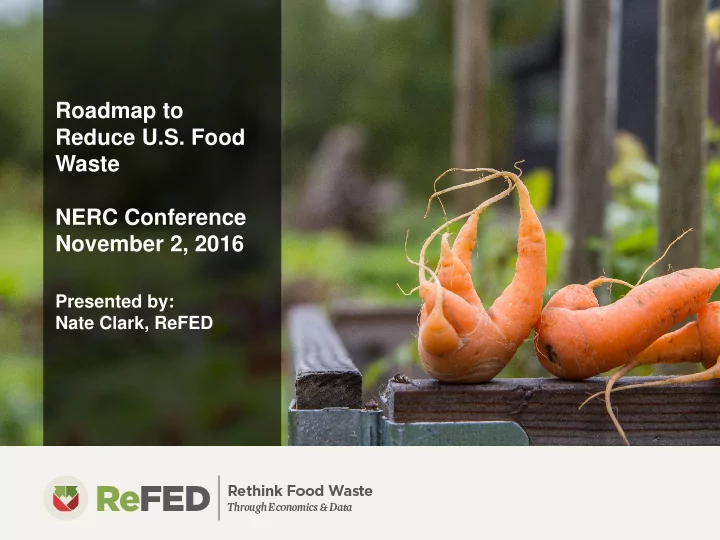
Roadmap to Reduce U.S. Food Waste NERC Conference November 2, 2016
Presented by: Nate Clark, ReFED
SLIDE 2
What is the ReFED Roadmap?
ReFED is a nonprofit collaboration formed in 2015 of over 30 business, nonprofit, foundation, and government leaders committed to reducing food waste in the United States. On March 9th, ReFED launched A Roadmap to Reduce U.S. Food Waste by 20 Percent, the first ever national economic study and action plan driven by a multi- stakeholder group committed to tackling food waste at scale.
SLIDE 3 ReFED Steering Committee, Advisory Council, and Roadmap Team
Atticus Trust Ahearn Family Foundation New York City
SLIDE 4
THE PROBLEM OF FOOD WASTE
SLIDE 5 9
Every year, American consumers, businesses, and farms spend $218 billion (roughly 1.3% of GDP) on food that is never eaten. This waste represents 18% of Cropland, 19% of Fertilizer, 21% of Freshwater, and 5% of GHG emissions.
Image courtesy of National Geographic/Brian Finke
SLIDE 6
ReFED Food Waste Baseline: Nearly 63M tons of w aste per year
$2B $15B $57B $144B
($218 billion)
SLIDE 7
THE SOLUTIONS AND ECONOMIC ANALYSIS
SLIDE 8 Solution Analysis
Screening Criteria:
- Supporting Data
- Cost-Effectiveness
- Scaling Potential
- Feasibility
8
SLIDE 9 Prevention
Solutions tend to be capital-light Involve changing behavior through packaging changes, software, and marketing Largest net environmental benefit by avoiding wasted resources in agriculture – twice the GHG impact per ton reduced of recycling Major focus for innovation – 44% of food waste innovators in ReFED’s database prevention-focused Major Barriers:
- Lack of social license
- Information gaps and organizational silos
- Misalignment of cost and benefits
Standardized Date Labeling Waste Tracking & Analytics Consumer Education Campaigns
SLIDE 10 Recovery
Three pillars to scale:
1. Enabling policy that financially incentivizes donations from businesses with standardized regulations (e.g. PATH Act in Dec. ’15) 2. Education for businesses on donor liability protections and safe food handling practices 3. Logistics and infrastructure to transport, process, and distribute excess food Half of new recovery potential comes from surplus produce on farms + at packinghouses
- Engage this community to donate through strategies like
Donation Matching Software and gleaning
- Spoiler Alert (MA) and Healthy Acadia (ME)
Opportunity to partner with public health officials to fight food insecurity + divert wasted food
- Waste Not Orange County, CA
Donation Matching Software
SLIDE 11 Recycling
Nearly three-quarters of total Roadmap diversion potential
- 73% of recycling opportunity expected to come
from Centralized Composting and Centralized Anaerobic Digestion (AD) facilities
Northeast, Northwest, and Midwest show the highest economic value per ton from recycling due to high disposal fees and high compost & energy prices
- Generate 53% (2.7M TPY) of composted material
at net societal benefit of $30/ton
Top levers to scale recycling:
- Increase in landfill disposal costs
- Efficiencies in hauling and collection through
siting near urban centers
Centralized Composting Centralized Anaerobic Digestion Water Resource Recovery Facility with AD
SLIDE 12 Barriers to Recycling Organics
12 Barriers Levers to Drive Action Cost of Disposal
- Landfill taxes, surcharges
High Transportation and Logistics Cost (i.e. Hauling)
- Reduce route redundancy
- Site facility closer to urban center than landfill disposal
alternative
Material Supply Assurance (Quantity)
- Enforcement of organics bans (letters or audits)
- Long-term contracts between generators and processors
Packaging and Contamination (Quality)
- Innovation on compostable packaging and depackaging
equipment
- Communication between generators, haulers, processors
Access to Financing
- If federal and state programs or impact investors could
supply 10% of all project capital in form of grants, potential of 2M additional tons of diversion
End-Market Development
- Municipal incentives for compost use in RFPs
- Innovation competitions for compost products
Permitting and Siting
- Factor environmental and social impacts of waste
diversion (i.e. cost of siting/building new landfills; benefits of local job creation) into cost-benefit analysis of food waste recycling
SLIDE 13
Marginal Food Waste Abatement Cost Curve
SLIDE 14
SLIDE 15
THE PATH AHEAD TO TAKE ACTION
SLIDE 16
Levers to Drive Action Across all Stakeholders
Four crosscutting actions needed to quickly cut 20% of waste and put the U.S. on track to achieve a broader 50% food waste reduction goal by 2030.
POLICY
Commonsense tweaks leading to standardized national policy
FINANCING
New catalytic capital and quantified non-financial impacts
EDUCATION
National Consumer and Employee campaigns
INNOVATION
5 focus areas and innovation incubator networks
SLIDE 17 Policy
Commonsense policy adjustments are needed to scale federal food donation tax incentives, standardize safe handling regulations, and boost recycling infrastructure by expanding state and local incentives and reducing permitting barriers.
- NERC states are no strangers to organics recycling/wasted food-related policy
– Enacted: CT, RI, MA, VT – Proposed: NJ – Counties/Municipalities: Montgomery County, MD; New York, NY
- May 2016: The first-ever Congressional Hearing on food waste by the House
Agricultural Committee
– Unique bipartisan issue
- STRATEGY: Develop multi-stakeholder Food Policy Councils
– Examples include: CT; RI; MA; NY; NJ
- HFLPC: “Keeping Food Out of Landfills: Policy Ideas for States and Municipalities”
SLIDE 18
Innovation
Big Opportunity: Innovation needed to scale solutions for depackaging, distributed recycling, and creating end-markets for compost
SLIDE 19
Financing
The Roadmap will require an $18 billion investment, less than a tenth of a penny of investment per pound of food waste reduced, which will yield an expected $100 billion in societal Economic Value over a decade.
SLIDE 20 Education
Consumer Education
- One of the most cost effective of the
27 solutions
- Spurs consumer demand for smarter
retail offerings, such as Standardized Date Labeling, Spoilage Prevention Packaging, Imperfect Produce, and Trayless Dining.
- Consumer attitudes currently drive
food waste at farm/retail level
- “Save the Food” National Campaign
Employee Education
- Food service employees play a
central role in food waste reduction (avoid unnecessary removal of products, ID donated, and properly source-separate scraps) Facility Operator Education
- NIMBY: Low threshold for error
- States/municipalities should invest
in “Compost Operator Training” courses
- Focus on generator/processor
relationships + community
- utreach
- Examples: ME, MD, VT,
USCC/NYS
SLIDE 21
How to get involved? Visit refed.com
Interactive Cost Curve ranks solutions by economic value, scalability, and environmental/social benefits Download and share the Roadmap full report (96pg), Key insights (5pg), and Technical Appendix Watch the ReFED video and sign-up for newsletter Future Research Priorities
For additional questions, contact us at info@refed.com