Presented by Andrew Kopka B.S. CNIM 1 2 Common EPs / recordings - - PowerPoint PPT Presentation

presented by andrew kopka b s cnim
SMART_READER_LITE
LIVE PREVIEW

Presented by Andrew Kopka B.S. CNIM 1 2 Common EPs / recordings - - PowerPoint PPT Presentation

Presented by Andrew Kopka B.S. CNIM 1 2 Common EPs / recordings used in the O.R. SSEP - Somatosensory evoked potentials TcMEP - Transcranial motor evoked potentials BAER - Brainstem auditory evoked responses EMG -


slide-1
SLIDE 1

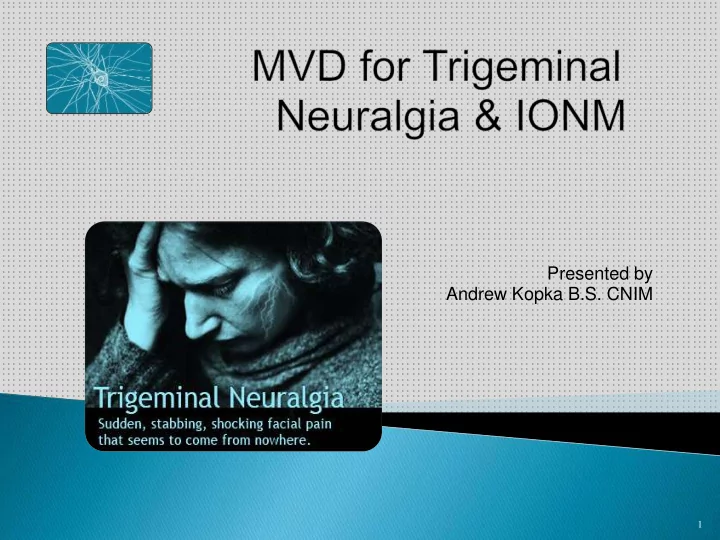
Presented by Andrew Kopka B.S. CNIM

1
slide-2
SLIDE 2

2

slide-3
SLIDE 3

 Common EP’s / recordings used in the O.R.

  • SSEP - Somatosensory evoked potentials
  • TcMEP - Transcranial motor evoked potentials
  • BAER - Brainstem auditory evoked responses
  • EMG - Free Run
  • EMG -Triggered
  • EEG - Electroencephalography

3

slide-4
SLIDE 4

Cranial Nerve V:

  • Mixed nerve
  • Largest cranial nerve
  • 2 roots from

venterolateral of the pons

  • Large sensory root

(Portio major) and small motor root (Portio minor)

4

slide-5
SLIDE 5
  • Cranial Nerve V:
  • Major sensory face
  • Motor for mastication

5

  • 3 divisions

Ophthalmic division V1 Maxillary division V2 Mandibular division V3

Temporalis Masseter

slide-6
SLIDE 6

V1 - Ophthalmic Division

6

slide-7
SLIDE 7

V2 - Maxillary Division

7

slide-8
SLIDE 8

V3 - Mandibular Division

8

slide-9
SLIDE 9
  • Trigeminal Neuralgia (TN) is neuropathic facial pain

arising from the trigeminal nerve.

  • The pain is intense, sharp, electric shock-like pain in

the face, lasting periods seconds, minutes, hours.

  • Incidence 4-5 cases : 100.000
  • TN or Tic Douloureux occur patients > 45 years.
  • Male : Female ratio 1 : 1.5
  • Unilateral (97%). Most affected V2 and V3.

9

slide-10
SLIDE 10
  • Light pressure at “trigger points” can trigger attacks.
  • Unpredictable symptom free intervals.
  • Patient biggest ambitions
  • Eating, shaving, applying makeup………

10

slide-11
SLIDE 11

11

7 TYPES

TYPICAL TN ATYPICAL TN MULTIPLE SCLEROSIS RELATED TN FAILED TN 2ndary TN POST- TRAUMIC TN PRE-TN

Classification Trigeminal Neuralgia

slide-12
SLIDE 12

12

  • 1. Most common form. Severe sudden

excruciating unilateral pain face.

  • 2. Intense, stabbing, electrical shock-like pain.
  • 3. Blood vessels compressing the trigeminal

nerve root at the REZ - trigeminal nerve enters brain stem

 Superior cerebellar artery (SCA)  Anterior inferior cerebellar artery (AICA)

  • 4. Repeated vascular pulsations causes

demyelination & injury to the trigeminal nerve - hyperactivity trigeminal nucleus - in TN pain

  • 5. Frequently pain free between attacks.
  • 6. Lasting only seconds - minutes - hours.
  • 7. Each attack spontaneous or be triggered by

specific stimulation.

  • 8. Common triggers include touch, talking, eating,

drinking, chewing, tooth brushing, hair combing

slide-13
SLIDE 13

(a) (c)

No compression CN V Vascular compression present

13

slide-14
SLIDE 14

14

Typical TN Progression

slide-15
SLIDE 15

15

  • Clinical history
  • Clinical examination
  • CT scan and MRI
  • MRA
slide-16
SLIDE 16

16

Medication: Anticonvulsants

  • Carbamazepine (Tegretol)
  • Drug of choice for TN, effective dose 600 -1200 mg/ day for 3-4 x/ day
  • Side effect: drowsiness, mental confusion, dizziness, ataxia
  • Oxycarbazepine (Trileptal)
  • Side effect: nausea, fatigue, tremor, anemia……..
  • Dose : 2 x 300mg, maximum dose : 2400-3000 mg/day
  • Phenytoin (Dilantin)
  • Dose: 300-500mg/day for 3x day
  • Side effects: Nystagmus, dysarthria, gingival hyperplasia, hypertrichosis,

allergic skin rash

  • Gabapentin (Neurontin)
  • Dose: 300-1200mg/day
  • Side effects: drowsiness, ataxia, fatigue
slide-17
SLIDE 17
  • “It’s the surgeons decision”……
  • General use EP’s and recordings for MVD’s:
  • *BAER’s
  • SSEP’s
  • *Triggered and Free run EMG

17

slide-18
SLIDE 18
  • BAER’s reflect the neurological responses of the 8th cranial nerve

(vestibulocochlear nerve), following activation at the cochlea via a click stimulus, to various generator sites along the 8th cranial nerve and the brainstem. The first five waves are resistant to anesthesia and therefore are well suited to IONM. The multiple generator sites allow relative localization of insults during surgeries involving the brainstem and the 8th cranial nerve pathways.

Goal! - early warning impending

neurological hearing deficits!

18

slide-19
SLIDE 19

19

  • BAER’s are elicited by delivering a click stimulus to the ear. To

avoid contributions from the contralateral ear, masking white noise is delivered to the contralateral ear at approx. 40dB nHL.

  • Many averaged trials are required to record reliable responses.

Recommended stimulation rates are between 5-15 Hz (that’s 5-15 stimuli/sec) with 11 Hz being a reasonable balance. Recommended stimulation and recording parameters are as follows:

Low Freq Filter r (Hz) High Freq Filter r (Hz) Am Am p (μV) Typical latencies es (ms) Stim. Intensity sity (dB) Stim Durati tion

  • n

(ms) Stim. Rate (Hz)

BAER

30-100 1500- 3000 0.3- 3 1.5-10 75-110 dB 0.1 5-15

slide-20
SLIDE 20
  • BAER pathways:

20

Wave I - Cochlea & extracranial cochlear nerve (CN VIII) Wave II - Intracranial portion acoustic nerve & cochlear nucleus (Medulla) Wave III - Superior olivary complex (Pons) Wave IV - Lateral lemniscus (Pons) Wave V- Inferior colliculus (Midbrain)

I II III IV V

slide-21
SLIDE 21
  • 2 -3 channels used to record

BAER’s following the International 10-20 System:

  • Channel 1: A1 - Cz
  • Channel 2: A2 - Cz
  • Channel 3: Cv2 (inion) - Cz
  • Important* Contralateral ear and

Cv2 - Cz generally have poorly defined Waves I-IV, but have a well defined Wave V.

  • Note* Ipsilateral ear to contralateral

ear may also be used (A1-A2)

  • Mastoid substitute: A1 and A2

21

slide-22
SLIDE 22
  • 1. I-V interpeak interval
  • 2. I-III interpeak interval
  • 3. III-V interval
  • 4. V/I amplitude ratio
  • 5. Presence of wave I-V

22

There are 5 principle features used to assess routine BAER’s

I II III IV V

slide-23
SLIDE 23

Point change significant?........institutional

  • baseline responses
  • a latency increase wave V of more than 1.0ms from baseline
  • a amplitude reduction of 50% from baseline

Changes I-III interpeak latency (IPL):

  • Suggests disturbance along the eighth nerve close to the cochlea and the

lower pons/cochlear nucleus. Often due to stretching/manipulation 8th nerve

Changes III-V IPL:

  • Suggest disturbance between the lower pons/superior olivary complex and

the midbrain/inferior colliculus. Often due to cerebellar compression due to retractor placement, or hypotension

Changes wave V latency:

  • Gradual latency/amp changes can begin w/ CPA exposure. Due to variety

factors: stretch 8th CN, retractor placement, or cold irrigation.

Abrupt loss wave I:

  • Loss of wave 1, w / wo loss waves II - V due to compression/stretching

auditory artery (labyrinthine artery) results – ischemia cochlea. Rapid: persists 15min = perm hearing loss

23

slide-24
SLIDE 24

Free run EMG:

  • Free run electromyography (EMG) records the patterns

electrical activity assoc. w/ skeletal muscles: continuous, live real-time. Since specific muscles are attached to specific nerves, nerve function can be implied from the type of activity seen in the EMG recording.

  • Recorded subdermal electrodes: corresponding muscles
  • assoc. neuro structures monitored.
  • Resting muscle/assoc. nerve are electrically silent. When the

nerve is irritated or injured, it will fire spontaneously, causing reciprocal firing in the muscle. This manifests as muscle responses “firing” occur in several patterns indicating degrees

  • f irritation or injury including:

24

slide-25
SLIDE 25

 spikes (individual discharges)  bursts (brief flurries of discharges)

25

slide-26
SLIDE 26

 train activity (more persistent regularly repeating discharge patterns)  neurotonic discharges (persistent prolonged bursting)

26

slide-27
SLIDE 27

Triggered EMG:

  • Neuro. structure/nerve

stimulated and a CMAP is recorded in corresponding muscles innervated by the neurological structure.

  • Used to:
  • ID nervous tissue
  • ID neurological structures

(cranial nerve, nerve root)

  • Integrity nerve (damage)

27

CN 7

CN 5

slide-28
SLIDE 28
  • Evaluate the health/state of muscles and motor neurons

controlling muscles

  • Recording parameters EMG:
  • MVD: Needle electrode placement
  • Masseter and Temporalis (CN V)
  • Obic. oculi and Obic. Oris (CN VII)……….reasons?
  • Trapezius (CN XI) control

28

Low Freq Filter (Hz) High Freq Filter (Hz) Gain/ sensiti sitivit vit y (μV) Typical latencie s s (ms) Stim. Intensit nsit y y (mA) Stim Durati tio n ( (ms) Stim. Rate (Hz) Time Base (ms)

Free ee EMG

30-100 1500- 3000 20-50/div n/a n/a n/a n/a 100/div

Trig EMG

30-100 1500- 3000 20-50/div 10-25 10-25 0.2 1-4 1-10/div

slide-29
SLIDE 29

29

Teflon pad

slide-30
SLIDE 30

30

http://www.youtube.com/watch?v=FDQa95DqHes

slide-31
SLIDE 31

31

  • Trigeminal nerve (CN V) separate into ophthalmic (V1), maxillary

(V2), and mandibular (V3) branches provided major sensory feedback for the face and motor innervation masseter and temporalis muscles.

  • Trigeminal Neuralgia (TN) is shock-like neuropathic facial pain

arising from compression trigeminal nerve via SCA (AICA).

  • Treatment for typical TN….. Medication: if pharmacologic treatment

fails….. surgical procedure.

  • MVD: craniotomy decompresses CN V by placing Teflon pads b/w

SCA (or AICA) and CN V.

  • BAER’s and Trig / Free run EMG provide intraoperative feedback as

to the state of CN V, CN VII, and CN VIII helping to protect these neuro structures during surgical procedure and preserve hearing, sensation to the face, and motor control of the facial muscles.

slide-32
SLIDE 32

32

Thank You

1. Aatif M. Husain MD:A Practical Approach to Neurophysiologic Intraoperative Monitoring, Demos; 2008. 2. www.spokenadvantage.homestead.com/trigeminal-neuralgia 3. www.eneuro.med.pro/images 4. www.mayfieldclinic.com 5. www.brain-surgery.com/microsurgical-decompression-of- trigeminal-neuralgia 6. www.cduma.com/trigeminal-neuralgia 7. www.umanitoba.ca/cranial_nerves/trigeminal_neural 8. http://www.youtube.com/watch?v=FDQa95DqHes&feature=s hare&list=PL064AEF4C9053A3F3 9. www.bmc.med.utoronto.ca/cranialnerves/index.php?option=c

  • m_content&view=article&id=48&Itemid=57
  • 10. Cranial Nerves in Health and Disease, 2002 Sian D. Spacey,

Patricia A. Stewart, Eliza