PRESENTATIONS OF THE ROGER-YANG GENERALIZED SKEIN ALGEBRA FARHAN - - PDF document

presentations of the roger yang generalized skein algebra
SMART_READER_LITE
LIVE PREVIEW

PRESENTATIONS OF THE ROGER-YANG GENERALIZED SKEIN ALGEBRA FARHAN - - PDF document

PRESENTATIONS OF THE ROGER-YANG GENERALIZED SKEIN ALGEBRA FARHAN AZAD, ZIXI CHEN, MATT DREYER, RYAN HOROWITZ, AND HAN-BOM MOON A BSTRACT . We describe presentations of the Roger-Yang generalized skein algebras for punctured spheres with an


slide-1
SLIDE 1

PRESENTATIONS OF THE ROGER-YANG GENERALIZED SKEIN ALGEBRA

FARHAN AZAD, ZIXI CHEN, MATT DREYER, RYAN HOROWITZ, AND HAN-BOM MOON

  • ABSTRACT. We describe presentations of the Roger-Yang generalized skein algebras for

punctured spheres with an arbitrary number of punctures. This skein algebra is a quantiza- tion of the decorated Teichm¨ uller space and generalizes the construction of the Kauffman bracket skein algebra. In this paper, we also obtain a new interpretation of the homoge- neous coordinate ring of the Grassmannian of planes in terms of skein theory.

  • 1. INTRODUCTION

Since the Kauffman bracket skein algebra Sq(Σ) of a closed surface Σ was introduced by Przytycki ([Prz91]) and Turaev ([Tur88]), based on Kauffman’s skein theoretic description

  • f Jones polynomial ([Kau87]), it has been one of the central objects in low-dimensional

quantum topology. It has interesting connections with many branches of mathematics, including character varieties ([Bul97, BFKB99, PS00]), Teichm¨ uller spaces and hyperbolic geometry ([BW11]), and cluster algebras ([FST08, Mul16]). Roger and Yang extended skein algebras to orientable surfaces with punctures and de- fined the algebra Aq(Σ) ([RY14]) by including arc classes. The algebra Aq(Σ) is indeed a quantization of the decorated Teichm¨ uller space ([Pen87, RY14]) and is also compati- ble with the cluster algebra from surfaces ([MW20]). Thus, it can be regarded as a good extension of Sq(Σ) and strengthens the connections of the aforementioned subjects. For both Sq(Σ) and Aq(Σ), many algebraic properties have been shown. For exam- ple, they are finitely generated algebras ([Bul99, BKPW16a]) without zero divisors ([PS00, BW11, MW19, MW20]) with a few exceptions. However, very few examples of Sq(Σ) and Aq(Σ) with explicit presentations are known. If we denote by Σg,n (resp. Σk

g) the orientable

surface with n punctures (resp. k boundary components), then a presentation of Sq(Σk

g) is

known only for g = 0, k ≤ 4 and g = 1, k ≤ 2 cases ([BP00]). The presentation of Aq(Σg,n) is known for g = 0, n ≤ 3 and g = 1, n ≤ 1 ([BKPW16b]). The main result of this paper is a calculation of a presentation of Aq(Σ0,n) for arbitrary

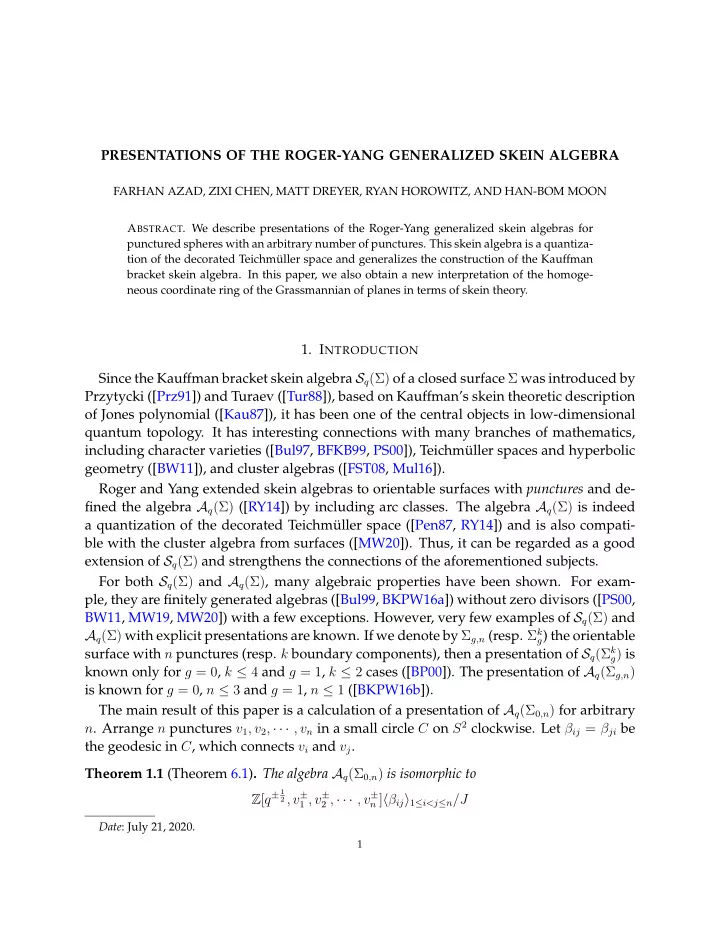
  • n. Arrange n punctures v1, v2, · · · , vn in a small circle C on S2 clockwise. Let βij = βji be

the geodesic in C, which connects vi and vj. Theorem 1.1 (Theorem 6.1). The algebra Aq(Σ0,n) is isomorphic to Z[q± 1

2, v±

1 , v± 2 , · · · , v± n ]βij1≤i<j≤n/J

Date: July 21, 2020.

1

slide-2
SLIDE 2

2 FARHAN AZAD, ZIXI CHEN, MATT DREYER, RYAN HOROWITZ, AND HAN-BOM MOON

where J is the ideal generated by (1) (Ptolemy relations) For any 4-subset I = {i, j, k, ℓ} ⊂ [n] in cyclic order, βikβjℓ = q

1 2βiℓβjk + q− 1 2βijβkℓ;

(2) (Quantum commutation relations) For any 4-subset I = {i, j, k, ℓ} ⊂ [n] in cyclic order, βijβkℓ = βkℓβij. For any 3-subset I = {i, j, k} ⊂ [n] in cyclic order, βjkβij = qβijβjk + (q− 1

2 − q 3 2)v−1

j βik;

(3) (γ-relations) For any i, j ∈ [n], γ+

ij = γ− ij;

(4) (Big circle relation) δ = −q2 − q−2. The definition of γ±

ij and δ, as well as their formulas in terms of the βij’s, are given in

Section 4. We want to emphasize that each generator of J has a very simple and explicit topological interpretation. See Section 4 for the details. A key step of the proof is the computation of a presentation of Aq(R2

n) (Section 5), where

R2

n is the plane with n punctures. By finding a generating set and many relations (Sections

3 and 4), it is straightforward to construct a surjective homomorphism of the form ¯ f : Z[q± 1

2, v±

1 , v± 2 , · · · , v± n ]βij/K → Aq(R2 n).

Similar to many other problems of finding presentations, a difficult non-trivial step is to show the injectivity of ¯

  • f. To do so, we employ a technique from algebraic geometry, in

particular the dimension theory. When q = 1, ¯ f is a surjective homomorphism of com- mutative algebras. The affine variety associated to C ⊗Z Aq(R2

n) is a closed subvariety of

the affine variety associated to C ⊗Z Z[q± 1

2, v±

1 , v± 2 , · · · , v± n ]βij/K. They have the same

dimension and the latter is irreducible. Therefore, they are isomorphic and ¯ f is an iso- morphism. Remark 1.2. During the proof, we show that the presentation of Aq(R2

n) with q = 1 is a

ring extension of the homogeneous coordinate ring of the Grassmannian of planes. The ring has occurred in many different territories of mathematics including classical invari- ant theory, cluster algebras, and even computational biology (Remarks 5.2, 5.6). Our re- sult provides a skein theoretic interpretation of the same object. Remark 1.3. The method of the proof relies on the fact that Aq(Σ0,n+1) is a domain, which was shown in [MW19] for n ≥ 3. Thus, the proof is valid for n ≥ 3. However, even for n ≤ 2, our presentation still coincides with the calculation in [BKPW16b]. See Remark 6.3.

  • Acknowledgements. The last author thanks Helen Wong for helpful discussions and

many valuable suggestions.

  • 2. THE ROGER-YANG GENERALIZED SKEIN ALGEBRA

In this section, we present the definition and basic properties of the Roger-Yang gener- alized skein algebra Aq(Σ).

slide-3
SLIDE 3

PRESENTATIONS OF THE ROGER-YANG GENERALIZED SKEIN ALGEBRA 3

Let Σ be an orientable surface without boundary, not necessarily compact nor con-

  • nected. Let V ⊂ Σ be a finite subset of points and let Σ := Σ \ V . A point v ∈ V is called

a puncture and Σ is called a punctured surface. We allow the case that V = ∅. In this paper, there are two relevant examples of a punctured surface. Let Σg,n be the n-punctured genus g surface. Let R2

n be the n-punctured plane. If V is any n-subset of R2, then R2 n = R2 \ V .

Definition 2.1. Fix a punctured surface Σ = Σ \ V . A loop is the image of an injective continuous map f : S1 → Σ × (0, 1). An arc is the image of an injective continuous map f : [0, 1] → Σ × (0, 1) such that f(0), f(1) ∈ V × (0, 1) and f((0, 1)) ∩ (V × (0, 1)) = ∅. A curve is either a loop or an arc. A multicurve is a disjoint union of finitely many curves. To visualize a curve, we draw its diagram. The second coordinate t ∈ (0, 1) is the vertical coordinate oriented toward the reader. It encodes which strand is over/under another strand, as in Figure 2.1. FIGURE 2.1. Examples of local planar diagram for curves We will always think about the regular isotopy classes of multicurves. Roughly, two mul- ticurves are regular isotopic if (1) they are homotopic, (2) each step in the deformation is a multicurve in the above sense, and (3) the deformation does not involve a Reidemeister move of type I. For the precise definition, consult [RY14, Section 2]. We may assume that for any multicurve, the only multiple points on Σ in the planar diagram above are double

  • points. However, note that it is possible that there are more than two strands meeting at

a puncture. There is a natural stacking operation of multicurves. Let α, β be two multicurves. By rescaling the vertical coordinate, we may assume that α ⊂ Σ × (0, 1

2) and β ⊂ Σ × ( 1 2, 1).

Then α ∗ β is defined as ‘stacking’ β over α: α ∗ β := α ∪ β. Definition 2.2. Let Σ = Σ \ V be a punctured surface. Suppose that V = {v1, v2, · · · , vn}. Let Rq,n := Z[q± 1

2, v±

1 , v± 2 , · · · , v± n ], which is the commutative Laurent polynomial ring

with respect to q

1 2, v1, · · · , vn with integer coefficients. The generalized skein algebra Aq(Σ) is

an Rq,n-algebra generated by regular isotopy classes of multicurves in Σ. The addition and scalar multiplication are formal, but the multiplication is given by the stacking operation αβ := α ∗ β. The algebra Aq(Σ) has four types of relations.

slide-4
SLIDE 4

4 FARHAN AZAD, ZIXI CHEN, MATT DREYER, RYAN HOROWITZ, AND HAN-BOM MOON

1) Skein relation = q + q−1 2) Puncture-Skein relation = v−1 q

1 2

+ q− 1

2

) 3) Framing relation = −q2 − q−2 4) Puncture-Framing relation = q + q−1 Example 2.3. For each vertex vi ∈ V , the waterdrop ωi at vi is the small arc class starting at vi, turning around counterclockwise, and ending at vi. We assume that the ending point is higher than the starting point. By using the Puncture-Skein relation, Framing relation, and Puncture-Framing relation, one may check that ωi = = v−1

i

  • q

1 2

+ q− 1

2

  • =
  • q

1 2(−q2 − q−2) + q− 1 2(q + q−1)

  • v−1

i

= (q

1 2 − q 5 2)v−1

i .

Example 2.4. For any curve class α ∈ Aq(Σ), the conjugate α of α is the new curve obtained by reversing all of the crossing data. A calculation shows that ωi = (q− 1

2 − q− 5 2)v−1

i

= qωi + (q− 1

2 − q 3 2)(−q2 − q−2)v−1

i .

Remark 2.5. The original definition in [RY14] is a ring-theoretic completion of Aq(Σ) in Definition 2.2. The original paper [RY14] did not address non-compact Σ cases, but the construction can be done in the same way. However, its connection to hyperbolic geome- try ([RY14, Section 3]) cannot be directly extended. In [RY14], the authors defined the curve algebra C(Σ) which is the classical limit of Aq(Σ), which can be described by using immersed curves on Σ. For the detail of the construction, see [RY14, Section 2.2]. Algebraically, the curve algebra C(Σ) can be obtained by setting q

1 2 = 1, i.e., C(Σ) = A1(Σ) = Aq(Σ)/(q 1 2 − 1). Thus, it is an Rn := Rq,n/(q 1 2 − 1) ∼

= Z[v±

1 , v± 2 , · · · , v± n ]-algebra. The algebra C(Σ) is a commutative algebra and has a Poisson

algebra structure. Moreover, Aq(Σ) is a deformation quantization of C(Σ) ([RY14, Theo- rem 2.13]). We leave a few known structural results on Aq(Σ). Theorem 2.6 ([Bul99, Theorem 1], [BKPW16a, Theorem 2.2]). The algebra Aq(Σg,n) (and hence C(Σg,n)) is finitely generated. Theorem 2.7 ([MW19, Theorems 5.1 and 10.5, Section 4]). There is a function f(g) such that for n ≥ f(g), Aq(Σg,n) and C(Σg,n) are domains (there is no zero divisor). When g = 0, Aq(Σ0,n) and C(Σ0,n) are domains for n ≥ 4. Remark 2.8. When n = 0, Aq(Σg,0) is the classical Kauffman skein algebra Sq(Σg,0). Przy- tycki and Sikora showed that Aq(Σg,0) is a domain ([PS00]).

slide-5
SLIDE 5

PRESENTATIONS OF THE ROGER-YANG GENERALIZED SKEIN ALGEBRA 5

For any finitely generated commutative algebra A over C we may define the (Krull) dimension of A ([Har77, Section I.1]). This is equal to the dimension of its associated affine algebraic variety Spec A ([Har77, Proposition I.1.7.]). When A is an integral domain, this is equal to the transcendental degree of the field of fractions Q(A) of A ([Har77, Exercise II.3.20.]). Proposition 2.9. For the same range of n in Theorem 2.7, the field of fractions Q(C ⊗Z C(Σg,n)) is transcendentally generated by edges in a triangulation T of Σg,n. Thus, the dimension of the C-algebra C ⊗Z C(Σg,n) is the number of edges for a triangulation T, which is 6g − 6 + 3n. In particular, for n ≥ 4, dim C ⊗Z C(Σ0,n) = 3n − 6.

  • Proof. By [MW19, Lemma 3.4], after a certain localization, C ⊗Z C(Σg,n) is isomorphic to

C[λ±

i ], where λi is a variable for each edge xi in T. The localization does not affect the

field of fractions, so Q(C ⊗Z C(Σg,n)) ∼ = Q(C[λ±

i ]) ∼

= C(λi). The remaining statements are immediate from an Euler characteristic calculation.

  • Finally, we state the following module theoretic result.

Definition 2.10. A reduced curve is a curve class without any self-crossing (both on the interior and at a puncture) on the planar diagram that is not a trivial loop or punctured

  • loop. A multicurve is reduced if it is a finite union of reduced curves without any crossings.

For a notational convention, we will regard the empty set as a reduced multicurve. Proposition 2.11. Fix a surface Σ = Σ \ V with |V | = n. The algebra Aq(Σ) (resp. C(Σ)) is a free Rq,n-module (resp. Rn-module) with a basis consisting of reduced multicurves, with one exception when Σ = Σ0,1 (see Remark 6.3). The classical case is obtained in the proof of [RY14, Theorem 2.4], and the quantum case is obtained by a coordinate ring extension.

  • 3. GENERATORS

In this section, we describe a collection of curves in R2

n and Σ0,n and show that they

generate Aq(R2

n) and Aq(Σ0,n) as Rq,n-algebras.

Let Σ be R2 or S2. We may arrange n punctures arbitrarily. Take a small circle C on Σ. From now on, we assume that the n punctures v1, v2, · · · , vn lie on C in clockwise order. Let P be the convex polygon inscribed in C, whose vertices are v1, v2, · · · , vn (Figure 3.1). Definition 3.1. For any pair i < j in [n] := {1, 2, · · · , n}, let βij be the regular isotopy class of the geodesic in C, which connects vi and vj. For notational convenience, we set βji = βij. Thus, βij classes can be represented by the diagonals and sides of P. Proposition 3.2. As an Rq,n-algebra, Aq(Σ0,n) and Aq(R2

n) are generated by {βij}1≤i<j≤n.

slide-6
SLIDE 6

6 FARHAN AZAD, ZIXI CHEN, MATT DREYER, RYAN HOROWITZ, AND HAN-BOM MOON

FIGURE 3.1. βij classes and configuration of P, D, and R.

  • Proof. Any multicurve α is generated by reduced multicurves by Proposition 2.11. Each

multicurve is a product of reduced curves. Thus, Aq(Σ0,n) and Aq(R2

n) are generated by

reduced curves. By [BKPW16b, Proposition 2.2], any reduced loop class is generated by reduced arc

  • classes. For the reader’s convenience, we describe an example of the recursive relation in

Figure 3.2. Indeed, in [BKPW16b, Proposition 2.2], the authors proved the statement for Σ0,n only. However, their proof only relies on the fact that every loop in Σ0,n divides the surface into two components. Thus, the same proof works for R2

n. vi vj

= vivj − q − q−1 − FIGURE 3.2. Generating a loop class by arc classes Now, we show that every reduced arc class is generated by {βij}1≤i<j≤n. Take a circle D, which properly contains C (Figure 3.1). Any multicurve in R2

n or Σ0,n is regular isotopic

to a multicurve in D. To show this statement, we will apply skein relations in D. Thus, the proof will be identical in the case of R2

n and Σ0,n. So from now on, we will focus on

the R2

n case.

Let R := P ∪ n

i=1 Ri, where Ri is a ray emanating from each vertex vi toward the outer

direction so that these rays are disjoint (Figure 3.1). For each reduced arc α, we define i(α, R) as the number of intersection points of the planar diagram of α and R, excluding intersections at vertices v1, v2, · · · , vn. Now, the intersection number i(α, R) is defined as i(α, R) := min {i(α′, R) | α′ is regular isotopic to α}.

slide-7
SLIDE 7

PRESENTATIONS OF THE ROGER-YANG GENERALIZED SKEIN ALGEBRA 7

We show the statement by induction on i(α, R). If i(α, R) = 0, then α is regular isotopic to a reduced arc in P. Thus, α is regular isotopic to one of the βij’s. Suppose that i(α, R) > 0. In this case, α intersects one of Ri’s. Otherwise, α lies in a simply connected region R2 \ n

i=1 Ri and the entire curve α can be contracted to the

interior of P. Thus, i(α, R) must be zero. We may assume that α intersects Ri. Take the closest strand of α to vi, and apply the Puncture-Skein relation at vi. Then α = q

1 2viγ1γ2−qδ

as in Figure 3.3. Now i(γ1, R), i(γ2, R), i(δ, R) are all strictly smaller than i(α, R). By our induction hypothesis, we obtain the desired result.

  • q− 1

2

α

Ri Ri+1

= vi

Ri Ri+1 γ2 γ1

− q

1 2

Ri Ri+1

δ

FIGURE 3.3. Intersection number reduction

  • 4. RELATIONS

In this section, we present several geometric relations among curve classes on R2

n and

Σ0,n. The first two types of relations are valid for Aq(Σ0,n) and Aq(R2

n). The remaining

relations are valid only for Aq(Σ0,n). Definition 4.1 (Ptolemy relations). Take a 4-subset I = {i, j, k, ℓ} ⊂ [n] and assume that the four elements are listed in clockwise cyclic order. The Ptolemy relation for I is (4.1) βikβjℓ = q

1 2βiℓβjk + q− 1 2βijβkℓ.

Note that this is a special case of the Skein relation in Definition 2.2. Definition 4.2 (Quantum commutation relations). For any 4-subset I = {i, j, k, ℓ} ⊂ [n] that is listed in clockwise cyclic order, the first Quantum commutation relation for I is (4.2) βijβkℓ = βkℓβij. For any 3-subset I = {i, j, k} ⊂ [n] in clockwise cyclic order, the second Quantum commu- tation relation for I is (4.3) βjkβij = qβijβjk + (q− 1

2 − q 3 2)v−1

j βik.

The second Quantum commutation relation follows from the comparison of the βijβjk and βjkβij after applying the Puncture-Skein relation at vj. The below relations are valid only for Aq(Σ0,n).

slide-8
SLIDE 8

8 FARHAN AZAD, ZIXI CHEN, MATT DREYER, RYAN HOROWITZ, AND HAN-BOM MOON

Definition 4.3 (γ-relations). Fix i, j ∈ [n]. Let γ+

ij (resp. γ− ij) be the reduced arc class outside

P in Figure 3.1, starting from vi, moving clockwise (resp. counterclockwise) and ending at vj (Figure 4.1). It is clear that if i = j, γ+

ij = γ−

  • ji. When i = j, γ+

ii is the arc moving around

P while γ−

ii = ωi in Example 2.3. The γ-relation is

(4.4) γ+

ij = γ− ij.

One can see that on Σ0,n, γ+

ij and γ− ij are regular isotopic. Note that γ− ii = ωi = (q

1 2 −

q

5 2)v−1

i

∈ Rq,n. If j = i + 1, then γ+

i,i+1 = βi,i+1.

v1 v3

γ13

+

=

v1 v3

γ31

+ v1

γ11

+

=

v1

ω1

FIGURE 4.1. The γ-relations Definition 4.4 (Big circle relation). Let δ be the reduced loop class of the circle D in Figure 3.1. The Big circle relation is (4.5) δ = −q2 − q−2. The Big circle relation is a special case of the Framing relation in Definition 2.2. By using skein relations, one may find explicit expressions for the relations above in terms of βij classes. We introduce some new notations. Let Cn be the cyclic graph with n vertices 1, 2, · · · , n arranged clockwise. For any two elements i, j ∈ [n], let (i, j) be the set of vertices in the path starting from i+1, moving clockwise, and ending at j−1. Note that (i, i) = [n]\{i} = ∅. We may give a total order on (i, j) as i+1 is the smallest and j −1 is the largest element. Then for any I ⊂ (i, j), we have an induced order. Lemma 4.5. For any I ⊂ (i, j), let ik be the k-th element of I. Set i0 = i and i|I|+1 = j. Then in Aq(Σ0,n) or Aq(R2

n),

(4.6) γ+

ij = γ− ji =

  • I⊂(i,j)

(−1)|(i,j)\I|q|(i,j)|− |I|

2

 

|I|

  • k=1

vik    

|I|

  • k=0

βikik+1   . For γ+

ii , we set βii = ωi (Example 2.4).

The right hand side has a clear combinatorial meaning if we set q = 1 and ignore all vertex classes. It is an alternating sum of all clockwise paths from vi to vj.

  • Proof. For any k ∈ (i, j), let ηikj be the reduced arc class starting at vi, moving to the inside
  • f P, going outside of P between vk−1 and vk, moving clockwise, and arriving at vj (see

Figure 4.2). Note that ηi,i+1,j = γ+

  • ij. We set ηijj = βij, and ηiii = βii = ωi.
slide-9
SLIDE 9

PRESENTATIONS OF THE ROGER-YANG GENERALIZED SKEIN ALGEBRA 9

v3

v1 v3 v6 β13 γ36

+= η346 = q− 1 2

v1 v3 v6

η136

+ q

1 2

v1 v3 v6

η146

FIGURE 4.2. Recursive formula for γ-classes and η-classes The Puncture-Skein relation at vk provides a recursive formula ηikj = q

1 2vkβikηk,k+1,j − qηi,k+1,j

(Figure 4.2). By applying the formula to γ+

ij = ηi,i+1,j and using ηijj = βij, we obtain the

desired result.

  • Lemma 4.6. For any I ⊂ [n], we denote the k-th element of I by ik and set i|I|+1 = i1. Then in

Aq(Σ0,n) or Aq(R2

n),

(4.7) δ = (−1)n−1(qn−2 + (q−1)n−2) +

  • I⊂[n]

|I|≥2

(−1)n−|I|qn−2i1+1− |I|

2

  • i∈I

vi  

|I|

  • k=1

βikik+1   . Note that the product µI := |I|

k=1 βikik+1 is the ordered product of all edges of the convex

polygon with the vertex set I. The non-constant part of the right hand side is, after setting q = 1 and ignoring vertices, the alternating sum of all convex polygons in P, including bigons.

  • Proof. Here we leave an outline of the proof. For any I ⊂ [n], let νI be the product of
  • i∈I vi and the configuration of curves {βikik+1}1≤k≤|I| that is like ‘infinite stairs’ in Figure

4.3. Note that νI = µI because in νI, there is no lowest component. We set µ{i} = viωi, ν{i} = viωi, and µ∅ = ν∅ = −q2 − q−2.

1 2 3 4 5 6

μI

1 2 3 4 5 6

vI

FIGURE 4.3. Example of µI and νI for I = {1, 3, 4, 5}. For any k ≥ 1, let I≥k := {ik, ik+1, · · · , i|I|} ⊂ I. Applying the Puncture-Skein relation, we get a recursive formula νI = q−1µI + (q

1 2 − q− 3 2)µI≥2. Solving the recursive equation,

we have (4.8) νI = (q

1 2 − q− 3 2)|I|−1ωi|I| +

|I|−1

  • j=1

q−1(q

1 2 − q− 3 2)j−1µI≥j.

slide-10
SLIDE 10

10 FARHAN AZAD, ZIXI CHEN, MATT DREYER, RYAN HOROWITZ, AND HAN-BOM MOON

On the other hand, let δI be the loop class properly containing the convex hull generated by {vi}i∈I. So, δ = δ[n]. Applying the Puncture-Skein relation at all vertices, we obtain νI =

J⊂I q

|I| 2 −|J|δJ. Using the M¨

  • bius inversion formula ([Sta12, Section 3.7]), we get

(4.9) δI =

  • J⊂I

(−1)|I|−|J|q

|J| 2 −|I|νJ.

Combining (4.8) and (4.9), we may describe δ = δ[n] as a linear combination of µJ’s and ωi’s. By calculating each coefficient, we obtain the formula.

  • Remark 4.7. A careful reader may wonder if we require an extra relation γ+

ii = γ− ii . But by

combining the γ-relations, the Big circle relation, and the Puncture-Skein relation, we can derive it since γ+

ii = qγ+ ii + (q− 1

2 − q 3 2)v−1

i δ = qωi + (q− 1

2 − q 3 2)v−1

i (−q2 − q−2) = ωi = γ− ii .

  • 5. PRESENTATION OF Aq(R2

n)

From now on, we assume that n ≥ 3. In this section, we find a presentation of Aq(R2

n).

This computation is not only interesting but is also a crucial step for the calculation of Aq(Σ0,n) because of the existence of functorial morphisms. Since R2 ∼ = S2 \ {p}, there is a natural inclusion map ι : R2

n → Σ0,n which maps the i-th

vertex to the i-th vertex. It induces an Rq,n-algebra homomorphism (5.1) ι# : Aq(R2

n) → Aq(Σ0,n),

which is specialized to ι# : C(R2

n) → C(Σ0,n). To avoid any unnecessary complication of

notations, we will use the same symbol ι# for the classical case and for the map after the coefficient extension. We may also regard p ∈ S2 as the (n + 1)-st puncture on S2. There is another morphism j : R2

n → Σ0,n+1 that maps the i-th vertex to the i-th vertex for 1 ≤ i ≤ n. Then we obtain

an Rq,n-algebra homomorphism (5.2) j# : Aq(R2

n) → Aq(Σ0,n+1).

Definition 5.1. Let Sq be the non-commutative Z[q± 1

2]-algebra generated by βij classes

modulo the ideal generated by relations in Definitions 4.1 and 4.2. Let S be its classical limit, that is, S := Sq/(q

1 2 − 1).

Remark 5.2. Note that S is a commutative algebra with the presentation S := Z[βij]/(βikβjℓ − βijβkℓ − βiℓβjk) where {i, j, k, ℓ} ⊂ [n] is cyclic. The commutative ring S has been appeared in many different contexts. (1) The algebra C ⊗Z S is the homogeneous coordinate ring of the Grassmannian Gr(2, n) ([GH94, Chapter I.5]).

slide-11
SLIDE 11

PRESENTATIONS OF THE ROGER-YANG GENERALIZED SKEIN ALGEBRA 11

(2) In classical invariant theory, S is the SL2(Z)-invariant subring of the algebra of the polynomial ring with 2n variables. It is also called the graphical algebra [MS19, Section 2]). (3) The algebra S is also a cluster algebra of type An−3 ([FZ03, Section 12]). (4) The tropicalization of C ⊗Z S is the space of phylogenetic trees in computational biology ([MS15, Sec 4.3]). In particular, it is well-known that C⊗ZS is an integral domain of dimension dim Gr(2, n)+ 1 = 2n − 3. Thus, dim C ⊗Z Rn ⊗Z S = 3n − 3. Remark 5.3. We say that a monomial β

mij ij

is non-crossing if no two βij and βkℓ with mij, mkℓ > 0 intersect except at one of the endpoints. The ring S is a free Z-module with a basis consisting of non-crossing monomials with respect to the βij’s (Straightening law, [Stu08, Corollary 3.1.9]). Since the freeness is preserved by the base ring extension, Rn⊗ZS is a free Rn-module with the same basis. We may extend this freeness result to the quantum setup as well. Proposition 5.4. Fix any total order in the set {βij}. Let B be the set of non-crossing monomials with respect to βij in Sq, such that the product is taken in a non-decreasing order. Then Sq (resp. Rq,n ⊗Z[q± 1

2 ] Sq) is a free Z[q± 1 2]-module (resp. Rq,n-module) with a basis B.

  • Proof. We leave a sketch of the proof of the Sq case (the case of Rq,n ⊗Z[q± 1

2 ] Sq is obtained

from the base ring extension). By applying Ptolemy relations, we know that every ele- ment can be written as a Z[q± 1

2]-linear combination of non-crossing monomials. By the

Quantum commutation relations and induction on the total degree, every element can be written as a Z[q± 1

2]-linear combination of monomials in B. Suppose there is a nontrivial

relation cIβI = 0 where βI ∈ B. By dividing the relation by an appropriate power of q

1 2 − 1, we may assume that the coefficients do not have q 1 2 − 1 as a common factor. Then,

by setting q

1 2 = 1, we obtain a relation ¯

cIβI = 0 in S. Because one of the cI’s does not have q

1 2 − 1 as a factor, ¯

cI is nonzero, violating the freeness of S.

  • Theorem 5.5. There is an Rq,n-algebra isomorphism

(5.3) Aq(R2

n) ∼

= Rq,n ⊗Z[q± 1

2 ] Sq.

Remark 5.6. Note that when q

1 2 → 1, the isomorphism in (5.3) is specialized to C(R2

n) ∼

= Rn ⊗Z S. Thus, Theorem 5.5 provides a skein theoretic interpretation of S. Corollary 5.7. The algebra Aq(R2

n) is a domain.

  • Proof. Suppose that a, b = 0 ∈ Aq(R2

n). By dividing appropriate powers of q

1 2 −1 ∈ Z[q± 1 2],

we may assume that a, b = 0 ∈ C(R2

n). Then ab = 0 as C(R2 n) ∼

= Rn ⊗Z S is an integral

  • domain. Therefore, ab = 0 ∈ Aq(R2

n).

slide-12
SLIDE 12

12 FARHAN AZAD, ZIXI CHEN, MATT DREYER, RYAN HOROWITZ, AND HAN-BOM MOON

Proof of Theorem 5.5. Since the non-commutative polynomial algebra is a free object in the category of algebras, there is a unique homomorphism f : Rq,n ⊗Z[q± 1

2 ] Z[q± 1 2]βij ∼

= Rq,nβij → Aq(R2

n)

which maps each βij to βij ∈ Aq(R2

n). Note that Ptolemy relations and Quantum commu-

tation relations are special cases of Skein relations and Puncture-Skein relations, respec-

  • tively. Thus, there is a well-defined quotient homomorphism

(5.4) ¯ f : Rq,n ⊗Z[q± 1

2 ] Sq → Aq(R2

n).

By Proposition 3.2, ¯ f is surjective. To prove the injectivity of ¯ f, we need the fact that dim C ⊗Z C(R2

n) = 3n − 3. This will

be shown in Proposition 5.8 below. By assuming it here, we will prove the injectivity. We show the classical case first. Suppose that ¯ f is not injective. Then, there is an iso- morphism Rn ⊗Z S/ ker ¯ f ∼ = C(R2

n). But since S is an integral domain, Rn ⊗Z S is also an

integral domain, so every element in ker ¯ f is not a zero divisor. Thus 3n − 3 = dim C ⊗Z Rn ⊗Z S > dim C ⊗Z Rn ⊗Z S/ ker ¯ f = dim C ⊗Z C(R2

n) = 3n − 3,

which is a contradiction. Now consider the general case. Pick g ∈ ker ¯ f for ¯ f : Rq,n ⊗Z[q± 1

2 ] Sq → Aq(R2

n). Since

Rq,n ⊗Z[q± 1

2 ] Sq is a free Rq,n-module (Proposition 5.4), we may express g = cIβI as an

Rq,n-linear combination of monomials in B uniquely. As in the proof of Proposition 5.4, after dividing g by an appropriate power of q

1 2 − 1, we may assume that ¯

g is nonzero in Rn ⊗Z S. But from ¯ f(¯ g) = 0 and the injectivity in the classical case, we obtain a contradic- tion.

  • Thus, the only remaining step is the dimension computation.

Proposition 5.8. The dimension of C ⊗Z C(R2

n) is 3n − 3.

  • Proof. Since there is a surjective homomorphism f : C⊗Z Rn ⊗Z S → C⊗Z C(R2

n), dim C⊗Z

C(R2

n) ≤ dim C ⊗Z Rn ⊗Z S = 3n − 3 by Remark 5.2.

Consider the map j# : C⊗Z C(R2

n) → C⊗Z C(Σ0,n+1) which comes from j# in (5.2) by the

coefficient extension. Let M be the image of j#. The homomorphism j# is not injective. Indeed, the loop class δ enclosing the polygon P (the isotopy class of the circle D in Figure 3.1) is also isotopic to the punctured circle at vn+1 on Σ0,n+1. In other words, δ −2 ∈ ker j#. Thus, there are well-defined surjective homomorphisms C ⊗Z C(R2

n) → C ⊗Z C(R2 n)/(δ − 2) → M.

Therefore, dim C ⊗Z C(R2

n) ≥ dim C ⊗Z C(R2 n)/(δ − 2) ≥ dim M. The first inequality is an

equality only if δ − 2 is a zero divisor in C ⊗Z C(R2

n).

slide-13
SLIDE 13

PRESENTATIONS OF THE ROGER-YANG GENERALIZED SKEIN ALGEBRA 13

Suppose that (δ − 2)h = 0 for some nonzero h ∈ C ⊗Z C(R2

n). By Proposition 2.11, we

may represent h uniquely as a linear combination of reduced multicurves. Furthermore, we may find representatives of those reduced multicurves that are contained in D. So all of them are disjoint from δ. Thus, 0 = (δ − 2)h is a nontrivial linear combination of reduced multicurves, which violates the freeness of C(R2

n) (Proposition 2.11). Therefore,

δ − 2 is not a zero divisor in C ⊗Z C(R2

n). Thus, dim C ⊗Z C(R2 n) > dim M.

Since C ⊗Z C(Σ0,n+1) is an integral domain by Theorem 2.7, M is also an integral do-

  • main. So dim M is equal to the transcendental degree of the field of fractions Q(M).

Let Q(M)(vn+1) be an extension field of Q(M) by the vertex class vn+1. We claim that Q(C⊗ZC(Σ0,n+1)) is a finite extension of Q(M)(vn+1). By Proposition 2.9, Q(C⊗ZC(Σ0,n+1)) is generated by the curve classes for edges in a triangulation of Σ0,n+1. Fix a triangulation T ′ of P. By adding n rays ei that each connect vi and vn+1, we can make a triangulation T of S2 with n + 1 vertices. We use it to construct a transcendental basis of Q(C ⊗Z C(Σ0,n+1)). Note that all edges from T ′ are already in Q(M). For each vi, consider an arc class αi that starts from vi, moves around vn+1 clockwise, and comes back to vi as in Figure 5.1. Then, αi ∈ im j# = M. By applying the Puncture- Skein relation at vn+1 and utilizing the fact that ωi = 0 when q

1 2 = 1 (Example 2.3), we

  • btain αi = vn+1e2

i . Thus, e2 i ∈ Q(M)(vn+1) and ei is in the finite extension of Q(M)(vn+1).

Therefore, Q(C ⊗Z C(Σ0,n+1)) is a finite extension of Q(M)(vn+1).

vi-1 vn+1

P

vi+1 vi

FIGURE 5.1. The curve class αi Since a finite extension does not change the transcendental degree, dim C ⊗Z C(Σ0,n+1) = tr.deg Q(C ⊗Z C(Σ0,n+1)) = tr.deg Q(M)(vn+1) ≤ tr.deg Q(M) + 1 = dim M + 1. Thus, 3n−4 ≤ dim M < dim C⊗Z C(R2

n) ≤ 3n−3. Therefore, dim C⊗Z C(R2 n) = 3n−3.

  • 6. PRESENTATION OF Aq(Σ0,n)

Now we restate our main theorem and give the proof. Theorem 6.1. Let J be the ideal generated by the Ptolemy relations, the Quantum commutation relations, the γ-relations, and the Big circle relation in Section 4. Then Aq(Σ0,n) ∼ = Rq,nβij/J.

slide-14
SLIDE 14

14 FARHAN AZAD, ZIXI CHEN, MATT DREYER, RYAN HOROWITZ, AND HAN-BOM MOON

  • Proof. By Theorem 5.5, it is sufficient to show that Aq(R2

n)/K ∼

= Aq(Σ0,n), where K is the ideal generated by the γ-relations and the Big circle relation in Definitions 4.3 and 4.4. Recall that there is a functorial morphism ι# : Aq(R2

n) → Aq(Σ0,n). This map is sur-

jective because any regular isotopy class of a multicurve in Σ0,n can be represented by a multicurve in R2

n by avoiding the point p ∈ S2 \ R2. Thus, it is sufficient to show that

ker ι# = K. It is clear that K ⊂ ker ι#. Observe that two non-isotopic curves α1 and α2 in R2

n can be isotopic in Σ0,n (i.e.,

ι#(α1) = ι#(α2)) because in Σ0,n, some strands of α1 can freely cross p ∈ S2 \ R2. In- deed, this is the only reason for the difference of the regular isotopy classes in these two

  • surfaces. In other words, ker ι# is generated by the relations in Figure 6.1. Note that

except the difference near p, the remaining part of the multicurves are the same.

P

P

FIGURE 6.1. Generators of ker ι# Therefore, to complete the proof, it is sufficient to show that each relation in Figure 6.1 is in K. This is proved in Proposition 6.2.

  • Proposition 6.2. Every element in Figure 6.1 is in K.
  • Proof. In this proof, we mainly use multicurves instead of their regular isotopy classes.

Whenever we want to describe their regular isotopy classes, we will explicitly mention it. Suppose that there is a multicurve α with a strand sufficiently close to p. Let αc be a new multicurve that is obtained by crossing p. In other words, α − αc is the relation in Figure 6.1. Step 1. Reduction to curves without crossings. The Skein relations, the Puncture-Skein relations, and the ‘crossing p’ relations are com- pletely local. For any multicurve α, by applying Puncture-Skein relations and Skein re- lations repeatedly, we may obtain an Rq,n-linear combination α = cIαI of multicurves without any crossings (but the multicurves may have some trivial loops and punctured loops – so this may not be a linear combination of reduced multicurves). For each αI, there is a unique connected component that contains the strand crossing p, and αc

I is ob-

tained by applying this crossing operation for the connected component. Thus, if we know that α = αc ∈ Aq(R2

n)/K for any curves without crossings, then cIαI = cIαc I

in Aq(R2

n)/K. After that, we may apply all of the Skein relations and Puncture-Skein

relations backward to get αc. Thus, α − αc ∈ K. Step 2. Reduction to reduced arcs. Now, suppose that α is a curve without intersection. If α is a curve isotopic to the trivial loop, then α − αc = −(δ + q2 + q−2) ∈ K follows from the Big circle relation. If α is a curve

slide-15
SLIDE 15

PRESENTATIONS OF THE ROGER-YANG GENERALIZED SKEIN ALGEBRA 15

isotopic to a waterdrop ωi (Example 2.3), then α − αc = −(γ+

ii − ωi) ∈ K. The case of ωi is

also obtained by Remark 4.7. Next, consider a loop α without intersections. Then, by using the Puncture-Skein rela- tions only (see Figure 3.2 or [BKPW16b, Proposition 2.2]), we may describe α as a poly- nomial with respect to (1) reduced arcs, (2) regular isotopy classes of waterdrops ωi and ωi, and (3) the regular isotopy class of the trivial loop. Therefore, by a similar argument to that in Step 1, it is now sufficient to prove the statement for reduced arcs. Step 3. Complexity measure for reduced arcs. Let α be a reduced arc connecting two vertices vi and vj. From the reducedness, i = j. We define w(α) as the number of connected components of α∩int P. And each connected component σ of α ∩ int P divides P into two components. Let e(σ) be the smaller number

  • f vertices in one of the components, not counting the end vertices of σ. We define e(α) =

min {e(σ)}. If there is no component in P, we set e(α) = 0. Finally, for each reduced arc α, we define its complexity as c(α) = (w(α), e(α)) ∈ N2 (see Figure 6.2 for an example). Give the lexicographical order on N2.

P

α

FIGURE 6.2. A curve α with c(α) = (4, 2) Step 4. Proof for the reduced arcs. We use transfinite induction on the complexity of α. If w(α) = 0, then α is an arc on the

  • utside of P, and is regularly isotopic to one of γ+

ij or γ−

  • ij. Thus, α − αc = ±(γ+

ij − γ− ij) ∈ K.

Note, that in this case, c(α) = (0, 0) as there is no component inside P. Suppose that the statement is true for all reduced arcs with complexity less than (r, s) and let α be a reduced arc with c(α) = (w(α), e(α)) = (r, s). Then, r ≥ 1. And there must be a component σ of α ∩ int P such that e(σ) = e(α). If e(α) = e(σ) = 0, then α has a turn-back near σ (Figure 6.3). By moving σ to the outside of P, we obtain a new reduced arc α′, which is isotopic to α but c(α′) < c(α), as w(α′) = w(α) − 1. Then, by our induction hypothesis, in Aq(R2

n)/K, α = α′ = α′c = αc.

⇒ ⇒ FIGURE 6.3. Two types of turn-backs and their removing Suppose now that e(α) > 0. Pick a component σ of α ∩ int P such that e(σ) = e(α). We deform σ toward the region which contains |e(σ)| vertices until one end of σ hits a vertex

slide-16
SLIDE 16

16 FARHAN AZAD, ZIXI CHEN, MATT DREYER, RYAN HOROWITZ, AND HAN-BOM MOON

(say vi). By the Puncture-Skein relation, we obtain α = q− 1

2viδ1δ2 −q−1ǫ (Figure 6.4). Then,

c(δ1), c(δ2), and c(ǫ) are strictly less than c(α). Without loss of generality, we may assume that δ2 is the curve containing the part that crosses p. By our induction hypothesis, in Aq(Σ0,n)/K, α = q− 1

2viδ1δ2 − q−1ǫ = q− 1 2viδ1δc

2 − q−1ǫc = αc.

Therefore, α − αc ∈ K.

  • α

σ

vi = q− 1

2vi

δ2 δ1 − q−1 ε FIGURE 6.4. A complexity deduction α = q− 1

2viδ1δ2 − q−1ǫ

Remark 6.3. It is straightforward to verify the coincidence of our presentation in Theorem 6.1 with the one in [BKPW16b] for n ≤ 3. By a direct computation, we have Aq(Σ0,2) ∼ = Z[q± 1

2, v±

1 , v± 2 , β12]/(v1v2β2 12 − 2 + q2 + q−2),

Aq(Σ0,1) ∼ = Z[q± 1

2, v±

1 ]/((q + q−1) + (q2 + q−2)) ∼

= Z[q± 1

2, v±

1 ]/((q + q−1 − 1)(q + q−1 + 2)),

Aq(Σ0,0) ∼ = Z[q± 1

2].

These presentations show the pathological behavior of Aq(Σ0,n) for small n. For n ≤ 2, Aq(Σ0,2) is commutative. C(Σ0,2) ∼ = Z[v±

1 , v± 2 , β12]/(β2 12) and Aq(Σ0,1) are not integral

domains, and Aq(Σ0,1) is not a free Z[q± 1

2, v1]-module anymore.

REFERENCES

[BKPW16a] M. Bobb, S. Kennedy, H. Wong, and D. Peifer. Roger and Yang’s Kauffman bracket arc algebra is finitely generated. J. Knot Theory Ramifications 25 (2016), no. 6, 1650034, 14 pp. 1, 4 [BKPW16b] M. Bobb, D. Peifer, S. Kennedy, and H. Wong. Presentations of Roger and Yang’s Kauffman bracket arc algebra. Involve 9 (2016), no. 4, 689–698. 1, 2, 6, 15, 16 [BW11]

  • F. Bonahon and H. Wong. Quantum traces for representations of surface groups in SL2(C).
  • Geom. Topol. 15 (2011), no. 3, 1569–1615. 1

[Bul97]

  • D. Bullock. Rings of SL2(C)-characters and the Kauffman bracket skein module. Commentarii

Mathematici Helvetici 72 (1997), no. 4, 521–542. 1 [Bul99]

  • D. Bullock. A finite set of generators for the Kauffman bracket skein algebra. Math. Z. 231

(1999), no. 1, 91–101. 1, 4 [BFKB99]

  • D. Bullock, C. Frohman, and J. Kania-Bartoszy´
  • nska. Understanding the Kauffman bracket

skein module. J. Knot Theory Ramifications 8 (1999), no. 3, 265–277. 1 [BP00]

  • D. Bullock and J. H. Przytycki. Multiplicative structure of Kauffman bracket skein module
  • quantizations. Proc. Amer. Math. Soc. 128 (2000), no. 3, 923–931. 1

[FST08]

  • S. Fomin, M. Shapiro, and D. Thurston. Cluster algebras and triangulated surfaces. I. Cluster
  • complexes. Acta Math. 201 (2008), no. 1, 83–146. 1
slide-17
SLIDE 17

PRESENTATIONS OF THE ROGER-YANG GENERALIZED SKEIN ALGEBRA 17

[FZ03]

  • S. Fomin and A. Zelevinsky. Cluster algebras II: finite type classification. Invent. Math. 154

(2003) 63–121. 11 [GH94]

  • P. Griffiths and J. Harris. Principles of algebraic geometry. Reprint of the 1978 original. Wiley

Classics Library. John Wiley & Sons, Inc., New York, 1994. xiv+813 pp. 10 [Har77]

  • R. Hartshorne. Algebraic geometry. Graduate Texts in Mathematics, No. 52. Springer-Verlag,

New York-Heidelberg, 1977. xvi+496 pp. 5 [Kau87]

  • L. H. Kauffman. State models and the Jones polynomial. Topology 26 (1987), 395–407. 1

[MS15]

  • D. Maclagan and B. Sturmfels. Introduction to tropical geometry. Graduate Studies in Mathemat-

ics, 161. American Mathematical Society, Providence, RI, 2015. xii+363 pp. 11 [MS19] H.-B. Moon and D. Swinarski. On the Sn-invariant F-conjecture. J. Algebra 517 (2019), 439–456. 11 [MW19] H.-B. Moon and H. Wong. The Roger-Yang skein algebra and the decorated Teichm¨ uller space. To appear in Quantum Topol. arXiv:1909.03085. 1, 2, 4, 5 [MW20] H.-B. Moon and H. Wong. The Roger-Yang skein algebra and cluster algebra. In preperation. 1 [Mul16]

  • G. Muller. Skein and cluster algebras of marked surfaces. Quantum Topol. 7 (2016), no. 3, 435–
  • 503. 1

[Pen87]

  • R. C. Penner. The decorated Teichm¨

uller space of punctured surfaces. Comm. Math. Phys. 113 (1987), 299–339. 1 [Prz91]

  • J. H. Przytycki. Skein modules of 3-manifolds. Bull. Polish Acad. Sci 39 (1991) 91–100. 1

[PS00]

  • J. H. Przytycki and A. Sikora. On skein algebras and SL2(C)-character varieties. Topology 39

(2000), no. 1, 115–148. 1, 4 [RY14]

  • J. Roger and T. Yang. The skein algebra of arcs and links and the decorated Teichm¨

uller space.

  • J. Differential Geom. 96 (2014), no. 1, 95–140. 1, 3, 4, 5

[Sta12]

  • R. Stanley. Enumerative combinatorics. Volume 1. Second edition. Cambridge Studies in Ad-

vanced Mathematics, 49. Cambridge University Press, Cambridge, 2012. xiv+626 pp. 10 [Stu08]

  • B. Sturmfels. Algorithms in invariant theory. Second edition. Texts and Monographs in Symbolic
  • Computation. Springer, Wien-NewYork-Vienna, 2008. vi+197 pp. 11

[Tur88]

  • V. G. Turaev. The Conway and Kauffman modules of a solid torus. Zap. Nauchn. Sem. Leningrad.
  • Otdel. Mat. Inst. Steklov. (LOMI) 167 (1988), Issled. Topol. 6, 79–89, 190. 1

DEPARTMENT OF MATHEMATICS, FORDHAM UNIVERSITY, NEW YORK, NY 10023 Email address: fazad2@fordham.edu DEPARTMENT OF MATHEMATICS, FORDHAM UNIVERSITY, NEW YORK, NY 10023 Email address: zchen218@fordham.edu DEPARTMENT OF MATHEMATICS, CORNELL UNIVERSITY, NEW YORK, NY 14853 Email address: mjd367@cornell.edu DEPARTMENT OF MATHEMATICS, NEW YORK UNIVERSITY, NEW YORK, NY 10012 Email address: reh420@nyu.edu DEPARTMENT OF MATHEMATICS, FORDHAM UNIVERSITY, NEW YORK, NY 10023 Email address: hmoon8@fordham.edu