Presentation to the General Chapters In June of this year, - - PDF document

presentation to the general chapters in june of this year
SMART_READER_LITE
LIVE PREVIEW

Presentation to the General Chapters In June of this year, - - PDF document

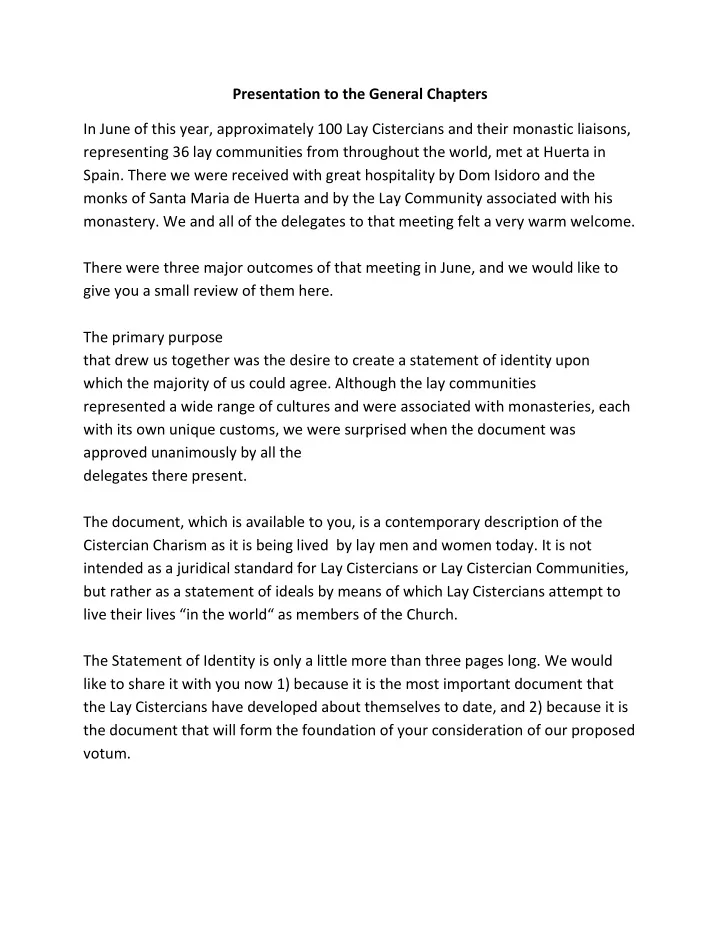
Presentation to the General Chapters In June of this year, approximately 100 Lay Cistercians and their monastic liaisons, representing 36 lay communities from throughout the world, met at Huerta in Spain. There we were received with great


slide-1
SLIDE 1

Presentation to the General Chapters In June of this year, approximately 100 Lay Cistercians and their monastic liaisons, representing 36 lay communities from throughout the world, met at Huerta in

  • Spain. There we were received with great hospitality by Dom Isidoro and the

monks of Santa Maria de Huerta and by the Lay Community associated with his

  • monastery. We and all of the delegates to that meeting felt a very warm welcome.

There were three major outcomes of that meeting in June, and we would like to give you a small review of them here. The primary purpose that drew us together was the desire to create a statement of identity upon which the majority of us could agree. Although the lay communities represented a wide range of cultures and were associated with monasteries, each with its own unique customs, we were surprised when the document was approved unanimously by all the delegates there present. The document, which is available to you, is a contemporary description of the Cistercian Charism as it is being lived by lay men and women today. It is not intended as a juridical standard for Lay Cistercians or Lay Cistercian Communities, but rather as a statement of ideals by means of which Lay Cistercians attempt to live their lives “in the world“ as members of the Church. The Statement of Identity is only a little more than three pages long. We would like to share it with you now 1) because it is the most important document that the Lay Cistercians have developed about themselves to date, and 2) because it is the document that will form the foundation of your consideration of our proposed votum.

slide-2
SLIDE 2

________________________________________________________________ LAY CISTERCIAN IDENTITY This is the final synthesis extracted from three previous syntheses from Lay Cistercian communities (English, French, Spanish) and finalized at S.M. Huerta, Spain, on June 6, 2008.

  • 1. Lay Cistercian Vocation

As individuals, we recognize a personal call that is experienced in community as a gift from God. We define it as a call to be an active witness

  • f Christ and his Church in the midst of the world, providing a prayerful and

contemplative testimony in a life defined by the values of the Cistercian

  • charism. This life is guided by the Rule of Saint Benedict as a concrete way to

interpret the Gospel, and by our Cistercian Fathers and Mothers. This personal call is a means of continuous conversion, one that leads to a rediscovery and deepening of the grace of our baptism and the development of an adult faith.

  • 2. Lay Cistercian Life

2.1 We are convinced that it is possible to adapt Cistercian spirituality to the lifestyle of a lay person though it is very clear that there are two different ways to live it, monastic and lay, and both are complementary. This shows us the vitality of the monastic life. Lay people have found in Cistercian spirituality a way to live in the world with greater commitment and spiritual depth. We are unanimous in our belief that the Cistercian charism can be lived outside the monastery. 2.2 There are many ways to live the Cistercian Lay life – but although the forms may be different all have only one aim : " to seek God".

slide-3
SLIDE 3

2.3 All the Cistercian values and practices, which are a means of liberation and internal conversion, can be incorporated in the life of laypersons: Prayer and praise Confidence and abandonment to God Humility Obedience Poverty Chastity Austerity Simplicity of life A balanced life Silence and solitude Work Hospitality and service Stability Simplicity Joy 2.4 This interior unification, this way of conversion, this desire for incarnation, is born and is realized in the choice of "preferring nothing to Christ" (RB 72), living in the world without being of the world (cf. John 17, 9-16). 2.5 We experience an inner and outer transformation (conversatio morum) which can be observed in the frequent reception of the sacraments, having the Eucharist as the center of our lives; the prayerful study of Scripture through Lectio Divina; fidelity to the Divine Office; filial devotion to the Virgin Mary; hospitality with our brothers and sisters; a change of priorities; a new way

  • f ordering the day; a new way of loving others through the Love of God; the

desire for formation and the necessity of spiritual guidance, and the experience of work as collaboration in the building of the Kingdom of God without our personal enrichment as our goal.

slide-4
SLIDE 4

2.6 The coenobitic dimension of our Lay Cistercian life finds expression in our life in the spiritual union we experience with all the members of our lay community as well as with the monastic community. A more ascetic life allows us to be united in personal and liturgical prayer, as well as in work, despite being physically apart. 2.7 Our Mission as Lay Cistercians is realized through a life of witness, independent of whether we participate in pastoral and/or social activities. The fundamental element of our life is in finding balance between times of prayer and action.

  • 3. Lay Cistercian Community

3.1. The experience of community is described as the birth of a new family which gives us aid and strength to live a commitment to Christian life without fear and with hope. We believe that praying together creates communion which unites us over distance and fortifies us as well. We believe that the greater bond is to be united by the Holy Spirit in a common search: the search for God. Consequently the community provides a personal enrichment through the transmission of values among all its members. Our discovery of community helps us experience

  • urselves as the Body of Christ. To experience the needs of others encourages

charity and teaches humility. The community is a God-given means to our sanctification. 3.2. For a majority of communities, it is fundamental to formalize our chosen lifestyle with some type of personal commitment, made in front of both communities, lay and monastic, that gives voice to the desire and personal decision to respond to the call of God to this specific Lay Cistercian vocation. 3.3. There is great diversity in the way that communities organize

  • themselves. In some communities we can say that there is a reluctance to create

structures.

  • 4. Bond with the Monastery and the Cistercian family

4.1. The monastic community is the heir of the Cistercian charism in its present form. Lay Cistercian communities, through their communion with a monastic community, receive light and formation from the monks and nuns.

slide-5
SLIDE 5

However, there are differences concerning the concrete bonds of union and the ways to describe these bonds. 4.2. We experience the two communities, monastic and lay, as a single family with different expressions of life. However, all are clearly aware of the difference between being lay and being monastic. 4.3. For all the groups, it is the monastic community, represented by the Abbot (Abbess), that recognizes in them the charism and confers on them their membership in the Cistercian family, according to the nature of the bonds that unite them. 4.4. It is common to all our communities and members to experience the monastery as our home and a place where the Lord unites, in a very special way, both communities, lay and monastic, and the members of both to each other. The hospitality of the monks and nuns makes the love of God present. 4.5 Being Lay Cistercians does not confer on us privileges in our relationship with the monastic community, but makes us aware of our duties and responsibilities. 4.6. Our Lay communities have, with different frequencies, meetings in the monastery in which we receive formation and learn to love one another in a new form of relationship centered on Christ, to which all the members have been chosen and called by God. 4.7. Monastics and laypersons learn fraternal life from one another, persevering together on the path to holiness. 4.8 Many members of lay communities go to the monastery individually. But all agree that in order to be Lay Cistercian it is not enough to simply feel attracted to a monastery, but that it is necessary to belong to a lay community.

  • 5. Epilogue

5.1 We believe that Lay Cistercian communities are a work of the Holy Spirit, and, with little communication among ourselves, we have striven to live and experience the Cistercian charism in total communion. We believe that in the lives

slide-6
SLIDE 6
  • f Lay Cistercians, by the grace of God, the Cistercian charism that has been

exclusively monastic for nine hundred years has found a new expression. 5.2 There exists in all Lay Cistercian communities the desire to respect and maintain diversity in all things that do not break the communion: to live the same charism with all the diversity of expressions while being strongly united in what is essential. The second outcome of the meeting at Huerta was the establishment of an Association (ad experimentum until it can be approved at our next meeting in 2011) of Lay Cistercian Communities. Although this Association is comprised predominantly of OCSO Lay Communities, it also contains members from other branches of the Cistercian Family—namely, the Congregation of San Bernardo, the Bernadines of Esquermes, and the Common Observance. The third outcome of the meeting at Huerta was a proposed votum for consideration at these General Chapters that asks that you recognize that Lay Cistercian Communities belong to the Cistercian Family. We hope that any such recognition will constitute an authentication of the Lay Cistercian vocation as an expression of the Cistercian Charism. It is important to emphasize that all the documents produced at Huerta state the fundamental character of the link that unites the monasteries and the Lay Communities that are associated with them, and through that, with all the branches of the Cistercian Family. As I mentioned previously, the next meeting of the Lay Cistercian Communities will be in 2011, a few months before the next meeting of your General Chapters. It will be held at New Melleray and Mississippi Abbeys in Iowa in the United States. The focus of that meeting will be the formation of new and on-going members of Lay Cistercian Communities. We recognize that the key to the conversion of lay people to Lay Cistercians is the transformation we receive in the Charism by living

slide-7
SLIDE 7

in community and in the world. In conclusion, we would like to thank you once again for inviting us to be here. It is a great pleasure for us to represent so many lay men and women around the world who have felt the call of the Holy Spirit to live this Charism in their daily

  • lives. Although there is a long history of the involvement of the laity in the life of

the Cistercian Order, today the emphasis seems to be on our spiritual brotherhood and

  • sisterhood. Perhaps Lay Cistercians are

a new and complimentary way of being Cistercian in the twenty-first century. Tina Parayre Dennis Day Marie-Christine Rossignol